Skip to content

Student Debt

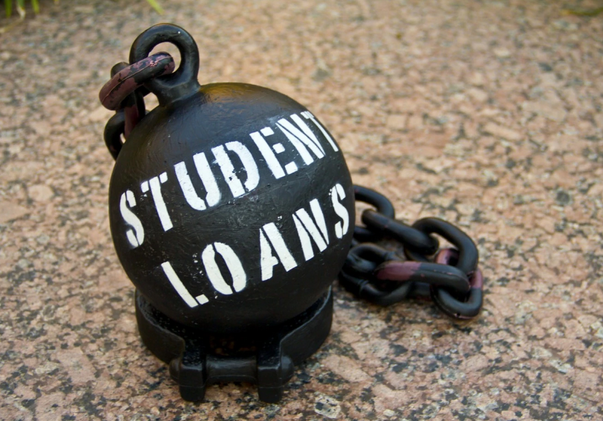
Revolt Against Student Loans Growing

Remember those 15 people who refused to repay their federal student loans? Their “debt strike” has picked up 85 more disgruntled borrowers willing to jeopardize their financial future to pressure the government into forgiving their student loans. And the government is starting to listen. The Consumer Financial Protection Bureau has invited the group to Washington on Tuesday to discuss their demand for debt cancellation. Although the CFPB doesn’t have the power to grant that request, the agency’s overture shows that the strike is being taken seriously. It’s been a month since 15 former students of the failing for-profit giant Corinthian Colleges said they would not pay a dime of their student loans because the school broke the law.
Liberate 41 Million Americans From Student Loan Debt

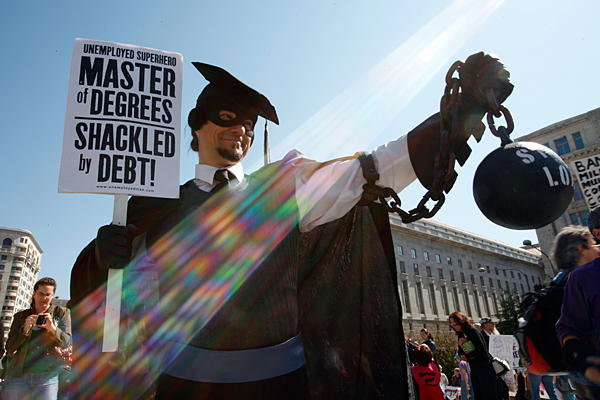
President Obama’s proposal for tuition-free community college education, and the broader discussion that it has inspired, confirms our belief that it is time for a comprehensive solution to a $1.3 trillion problem: student debt in the United States. We strongly support the concept of tuition-free public higher education, and are encouraged by renewed arguments in its favor. But we must also confront what has been done to the last several generations of students. They have been forced to take on debt that is crippling to them, to our economy and our society. A student debt “jubilee” would reflect both the values upon which this nation was founded and the economic principles that have sustained it through its greatest periods of growth and prosperity.

Students: You Are Not A Loan

The American higher education system is broken: between predatory student lenders, rapacious for-profit colleges, skyrocketing tuition rates and the number of people taking on a lifetime’s worth of debt before they can legally drink, the current system is not sustainable. Instead of providing a ladder to a better life, higher education too often reinforces class- and race-based disparities. And our government is not doing anything to provide relief to students even in the most egregious cases. What we really need is a revolution. Individually, debt can be overwhelming and isolating. Together, given the fact Americans collectively owe over $1.2tn in student loans, we may be able to overwhelm and transform the system. It’s time to believe in power in numbers: You are not a loan.

500 Students Occupy Building At UC Davis Over Tuition Increases

More than 500 students mobilized Tuesday and took over the UC Davis administration building for about an hour to protest a proposed tuition hike by the UC Board of Regents. The students chanted, marched and banged drums in Mrak Hall in what they said was a message to the UC Board of Regents. "Tell them shame,” said UC Davis junior Mariah Watson. "Tell them that if you won't represent us we'll get rid of you. Raise tuition and we'll raise hell." Students said they are frustrated over the proposed tuition hike that would raise their costs by more than $3,300 over the next five years. That increase would make it tough for students like Lorena Castillo, a UC Davis junior, to stay in school. "Taking out all of these loans my parents cannot help me one bit, so they already told me if it gets any more expensive you might not be able to take out anything else and you might not be able to go to school," Castillo said.

Rolling Jubilee: This Debt Fairy Has A Big Plan

Last month, CFPB sued Corinthian in an effort to force the school to forgive or refund $569 million to students for what the bureau says were predatory private loans. Rolling Jubilee forgave about $3.5 million in private Corinthian loan debt. Gokey acknowledges that's a drop in the bucket considering Americans collectively owe more than $1 trillion on student loans. But the group has a bigger end game. Strike Debt is wrapping up the Rolling Jubilee project. Gokey estimates it has enough money left to buy two or three more debt portfolios before it exhausts its funds. And then ..... the debt fairy morphs into a debt demon.

Unpacking The Myths Of Financial Aid

Why would the university award aid in this way? Couldn’t it just adjust the ratio of merit aid to need-based aid? Unfortunately, the “high tuition/high aid” model only “works” when it’s organized like this. That’s because, for many university administrators, financial aid is not so much a form of charity as it is an instrument for maximizing tuition revenue. If that seems hard to believe, consider a recent article published in Forbes magazine about a new trend in the field of higher education finances: “financial aid leveraging.”[6] While in the past university executives thought of financial aid strictly as an expense, as public universities search for new sources of revenue they have begun to see it as a way of boosting not only the university’s prestige but also its tuition revenue.

The Joys of Abolishing Debt

The Rolling Jubilee is premised on the argument that no one should be forced into debt for basic needs like healthcare and education — services that are freely and publicly provided in many developed countries. Thus, we would argue that all student loans are, in a sense, illegitimate. (The average class of 2014 graduate has to repay $33,000 in debt, and more than one in 10 are defaulting on their loans.) But we also believe any student debt owed to Everest College, a subsidiary of Corinthian Colleges Inc., is especially odious and should not be repaid.

Rolling Jubilee Abolishes $3.85 Million In Student Debt

Starting today, Rolling Jubilee is pivoting to the student loan crisis. On the third anniversary of Occupy Wall Street, Rolling Jubilee has announced its purchase of $3.85 million worth of student debt from Everest Colleges, a portfolio they bought for only $100,000. Everest is part of the troubled for-profit chain Corinthian Colleges, which effectively went out of business this summer after the Department of Education withheld federal loan funds for 21 days. The company has been the subject of numerous investigations from attorneys general across the country and the U.S. Consumer Financial Protection Bureau, which announced a $500 million lawsuit against Corinthian on Tuesday. This past week was a happy one for Goldman and the more than 2,700 students whose debt was erased by Rolling Jubilee. But for the group’s members, these tactics are less a solution to student debt, which reached $1.2 trillion this year, and more an opportunity to raise consciousness about the crisis and politicize student debtors to rally around a common cause. “This isn’t just a stunt or a spectacle,” said Astra Taylor, 34, a member of Rolling Jubilee who has $45,000 in student loans. “This isn’t a long-term plan, either. The point is to touch people where they are, and try to create a political awareness out of that.”

These 9 Charts Show America’s Coming Student Loan Apocalypse

Borrowers with federal student loans, long promoted as the safest way to borrow for college, appear to be buckling under the weight of their debt, new data show. More than half of Direct Loans, the most common type of federal student loan, aren't being repaid on time or as expected, according to figures from the U.S. Department of Education. Nearly half of the loans in repayment are in plans scheduled to take longer than 10 years. The number of loans in distress is rising. The increase in troubled loans comes as the average amount of student debt has significantly outpaced wage growth. After adjusting for inflation, the average recipient of federal student loan funds owed 28 percent more in 2013 than in 2007, according to Education Department data. But the typical holder of a bachelor's degree working full time experienced a 0.08 percent decrease in weekly earnings during that same period. For those with advanced degrees, median wages increased just 0.02 percent, according to figures from the U.S. Bureau of Labor Statistics. The Obama administration, mindful of borrowers' difficulty in repaying their federal student loans, has been promoting repayment plans that cap monthly payments relative to income. An unemployed borrower with no income, for example, could pay nothing every month, yet still be considered current on the debt.

Rolling Jubilee Student Debt Abolishment

This time, it’s different. Since the beginning of the Rolling Jubilee campaign, we’ve wanted to buy and abolish student debt. But most student loans are guaranteed by the federal government, and so they are not available for purchase. As part of our effort to buy private, unsecured student loans, we talked to Doug St. Peters, the Vice President of Portfolio Management at Sallie Mae, who packages that company’s debt into securities and sells your loans on the secondary market. He confirmed that Sallie Mae does sell its private loans to two large debt buying companies. He would not name names, and he refused to sell us any of these portfolios when he learned that we intended to abolish the debt. According to St. Peters, private Sallie Mae loans are sold for as little as 15 cents on the dollar. We repeat: a Vice President at Sallie Mae confirmed that they sell private loans for 15 cents on the dollar. One goal of the Rolling Jubilee campaign has been to educate ourselves and others about how little our debts are actually worth to the creditors who control our lives. If you have a private Sallie Mae loan, you should know that it may be sold at pennies on the dollar, even as the lender and debt collectors demand full payment, plus interest, from you.

Why Campus Administrators Make So Much Money?

The soaring incomes of campus administrators are paralleled by their soaring numbers. Between 1993 and 2009, their numbers reportedly increased by 60 percent, to 230,000―ten times the rate of growth of the faculty. According to a February 2014 report by the American Institutes for Research, between 1987 and 2012 the number of administrators at private universities doubled, while their numbers in central university system offices rose by a factor of 34. A look at one university system is instructive. Between 1975 and 2008, the total number of administrators at California State University rose 221 percent (from 3,800 to 12,183), compared to an increase in full-time faculty of less than 4 percent (from 11,614 to 12,019). CSU thereby achieved the distinction (since then, rapidly fading) of having more administrators than full-time faculty members.

Illinois To Sue Predatory Student Debt Settlement Corps

Student loan debt hovers at more than $1 trillion, a threefold surge from a decade ago, and a record number of college students who graduated as the financial system nearly imploded have an average debt load of more than $20,000. More than half of recent graduates are unemployed or have low-paying jobs that do not require that expensive college degree. Some Americans, including baby boomers whose savings were devastated by the financial crisis, are still struggling to pay off their student loans well into their 50s. For the debt settlement industry, all this means a tantalizing gold mine of new customers. “Your entire student loan can be forgiven,” Broadsword Student Advantage of Carrollton, Tex., boasts in radio ads. Debt settlement companies, which offer to help borrowers lower their monthly loan payments for a hefty upfront fee, have long been fraught with problems. But federal and state regulators are spotting new instances of abuse as the companies shift away from their traditional targets — credit card and mortgage debt — to zero in on student loans.

Bipartisan Deal Will Raise Student Interest Rates 20%

Interest rates go up Tuesday for students taking out new federal loans. This hike is relatively minimal but could foreshadow more increases to come. The change stems from a high-profile, bipartisan deal brokered last year by Congress and signed by President Barack Obama that ties the rates to the financial markets. Interest rates go from 3.86 to 4.66 percent on undergraduate Stafford loans. Graduate student loans go from 5.41 percent to 6.21 percent. Interest rates on Plus loans for parents go from 6.41 percent to 7.21 percent. For every $10,000 borrowed, the average borrower under the hike will pay back about $4 more every month when they begin paying back the money - about the price of a fancy latte. If the economy continues to improve, however, these kinds of rate hikes could continue. Congress stipulated that the rates for new loans be reset annually, but that borrowers keep the rate they were given for the life of the loan. The compromise in Congress was reached after rates doubled last July.

College Tuition: Destroying Lives And Ruining Economy

It’s easy to criticize the student debt crisis, and the small-ball solutions policymakers have offered up as band-aids. But if students want to organize around changing how we finance higher education in America to something more in their – and the country’s – interest, they should create two goals for themselves: a long-term vision for how things ought to look, and a realizable, tangible objective that can be achieved, even in today’s polarized political environment. I believe I have an answer on both counts. First of all, wrangling over student loans and interest rates and refinancing obscures the long-term vision – public colleges and universities should be free to attend. Or at least as close to free as possible. Though it may take time for the majority of the public to realize it, this idea is not far-fetched. The United States currently spends enough on grant aid, tax preferences and loan subsidies to cover the cost of tuition at every public college and university. Tuition is not the only expense, and more funding would be needed to make college free or near-free. But using existing resources – and moreover, returning them to pre-recession levels – gets us a lot of the way there.

Band-aids On The Gaping Wound Of Student Debt

In the 1960s, Ronald Reagan helped kill free higher education in the United States. Today, in the face of the student debt crisis, the best fight the Democrats are mustering is to try and lessen the pain of Reagan’s legacy. Everyone agrees we are in a student debt crisis, even the Federal Reserve. Over 38.8 million Americans have student debt (as of the end of 2012). 7 million of them are in default on their loans. Worse still, it is now accepted as fact that college, whether public or private, will be an undue financial burden that students may never get out of. The best one can hope is for a parent or relative to plan early for college. Put money away in a 529 plan (with Wall Street skimming money, as always, off the top). It wasn’t always this way. Once Upon A Time, America Had Free Higher Ed As Mike Konzcal and Aaron Bady wrote in “From Master Plan to No Plan: The Slow Death of Public Higher Education," there really used to be free higher education all across the state of California. And then, Governor Ronald Reagan took office, griped about the “orgies” happening on campuses, and proceeded to dismantle free higher education in the state:
assetto corsa mods

Urgent End Of Year Fundraising Campaign

Online donations are back! Keep independent media alive. 

Due to the attacks on our fiscal sponsor, we were unable to raise funds online for nearly two years.  As the bills pile up, your help is needed now to cover the monthly costs of operating Popular Resistance.

Urgent End Of Year Fundraising Campaign

Online donations are back! 

Keep independent media alive. 

Due to the attacks on our fiscal sponsor, we were unable to raise funds online for nearly two years.  As the bills pile up, your help is needed now to cover the monthly costs of operating Popular Resistance.

Sign Up To Our Daily Digest

Independent media outlets are being suppressed and dropped by corporations like Google, Facebook and Twitter. Sign up for our daily email digest before it’s too late so you don’t miss the latest movement news.