Skip to content

Missouri

Ferguson Case Poses Test For Corporate Media

The killing of Michael Brown, an African-American man, by a white police officer in Ferguson, Missouri, posed a test for corporate media. The story was hard to avoid once the local community came out in protest, still ongoing, and were met harshly by police. Probably more significant for the press corps, the online community–in this case largely black social media–erupted in pain and anger, with some of their criticism directed at the press itself. Some media have hewed to troubling practices that privilege police accounts and play up the specter of unruly mobs, as with the USA Today story (8/14/14) that rhetorically balanced "angry calls for reform and tear gas lobbed at protesters," in a piece that glossed the use of dogs, submachine guns and riot gear as police "seek[ing] order." And some will always choose to bland it out, like the L.A. Times' reference (8/13/14) to "an unsettled national conversation over race and policing." The surprise, then, has been the extent to which some media seem to be taking the outcry seriously, talking about the militarization of police–brought home by the rough treatment given to reporters covering the story–and the criminalization of black people.

How Should Police Respond To Protests?

The events these last few days in Ferguson, Missouri ought to be of grave concern to anyone who believes in the First Amendment, and specifically the rights to free speech, protest, and assembly. As you may have read, last night was particularly ugly, as police arrested a St. Louis alderman, Huffington Post reporter Ryan J. Reilly, and our own Washington Post reporter Wesley Lowery. Police also tear-gassed a news crew from Al-Jazeera. There are also reports, video, and images of police teargassing, arresting, and otherwise intimidating peaceful protests all over the town. While it’s true that there have been incidents of rioting, looting, and violence directed at police, the initial protests against Michael Brown’s killing were peaceful.* The only hint of violence at the first protest was described by an Associated Press reporter, who reported chants of “kill the police.” That report has since been disputed by people at the protest, who have suggested that the AP journalist or police misheard other chants. From what I can find, that report was also never confirmed by any other journalist. The problem lies in how local police responded to that initial protest. They brought out the full riot arsenal. Here we have a community that doesn’t see itself reflected in the police force. Ferguson is 67 percent black, while its police force is more than 90 percent white. It’s a community with long-simmering racial tension between police and the people they serve. It has now been well-reported that blacks are significantly over-represented when it comes to stop-and-frisks, traffic stops, and arrests in Ferguson, even though the town’s white residents are more likely to be caught with contraband like drugs or illegal weapons.

Civil Rights Commission Implores Eric Holder To Take Stronger Action On Ferguson

The U.S. Commission on Civil Rights is urging Attorney General Eric Holder to delve deeper into possible civil rights violations in the police response to protests in Ferguson, Missouri, and to press for more accountability by police in communicating information to the public. In a Friday letter to Holder, the commission expressed support for the Department of Justice's investigation of the fatal shooting of Michael Brown, an unarmed African American teenager killed by a Ferguson police officer on Aug. 9, but called for more extensive scrutiny of the excessive police response to the subsequent protests. In particular, the commission requested that the Department of Justice examine the racial discrepancies between Ferguson's residents and the city's police force, writing that they "may be related, directly or indirectly, to the tension between concerned citizens and local government." While over 60 percent of Ferguson's residents are black, only three out of its 53 police officers and only one of its six city council members are black. The police force also has a history of racial profiling: Blacks in Ferguson are twice as likely to be stopped by police as whites. Racial profiling contributed to the city of St. Louis' police chief's decision to remove his officers from assisting the Ferguson police.

McCulloch Blasts Nixon For Replacing St. Louis County Police

St. Louis County Prosecuting Attorney Robert McCulloch Thursday night blasted the decision by Gov. Jay Nixon to replace St. Louis County Police control of the Ferguson situation with the Missouri State Highway Patrol. “It's shameful what he did today, he had no legal authority to do that," McCulloch said. "To denigrate the men and women of the county police department is shameful." McCulloch noted that no one was seriously injured in the effort led by County Police Chief Jon Belmar until Nixon handed control of the Ferguson over to the state agency on Thursday. “For Nixon to never talk to the commanders in the field and come in here and take this action is disgraceful," McCulloch said. "I hope I'm wrong, but I think what Nixon did may put a lot of people in danger."

In Wake Of Clashes, Calls To Demilitarize Police

For four nights in a row, they streamed onto West Florissant Avenue wearing camouflage, black helmets and vests with “POLICE” stamped on the back. They carried objects that doubled as warnings: assault rifles and ammunition, slender black nightsticks and gas masks. They were not just one police force but many, hailing from communities throughout north St. Louis County and loosely coordinated by the county police. Their adversaries were a ragtag group of mostly unarmed neighborhood residents, hundreds of African-Americans whose pent-up fury at the police had sent them pouring onto streets and sidewalks in Ferguson, demanding justice for Michael Brown, the 18-year-old who was fatally shot by a police officer on Saturday. When the protesters refused to retreat from the streets, threw firebombs or walked too close to a police officer, the response was swift and unrelenting: tear gas and rubber bullets. To the rest of the world, the images of explosions, billowing tear gas and armored vehicles made this city look as if it belonged in a chaos-stricken corner of Eastern Europe, not the heart of the American Midwest. As a result, a broad call came from across the political spectrum for America’s police forces to be demilitarized, and Gov. Jay Nixon installed a new overall commander in Ferguson.

Anonymous Launches #OpFerguson After Cop Kills Unarmed Missouri Teen

Hacktivists have set their sights on the town of Ferguson, Missouri after police there on Saturday shot and killed an unarmed man, 18-year-old Michael Brown, elevating a wave of protests that have occurred in the days since to the digital realm. Demonstrations and vigils across the St. Louis, MO suburb have taken place ever since Saturday afternoon’s incident in which Brown was shot eight times by a Ferguson cop after an altercation allegedly occurred between the two, reportedly just days before the victim was expected to begin college. By Sunday, however, peaceful protests aimed at raising awareness of the shooting death began to turn violent in the city of barely 20,000, and local law enforcement responded to reports of riots and looting by deploying SWAT teams and heavily weaponized police. Members of the hacktivist group Anonymous — the internationally dispersed collective of hackers and activists that has previously waged campaigns targeting law enforcement organizations, government agencies and various corporations, among other entities, considered to be corrupt — responded to the shooting by issuing a statement on Sunday advocating for changes involving the use of force by law enforcement.

Ferguson: WP Reporter Wesley Lowery Recounts His Arrest

For the past week in Ferguson, reporters have been using the McDonald’s a few blocks from the scene of Michael Brown’s shooting as a staging area. Demonstrations have blown up each night nearby. But inside there’s WiFi and outlets, so it’s common for reporters to gather there. That was the case Wednesday. My phone was just about to die, so as I charged it, I used the time to respond to people on Twitter and do a little bit of a Q&A since I wasn’t out there covering the protests. As I sat there, many armed officers came in — some who were dressed as normal officers, others who were dressed with more gear. Initially, both Ryan Reilly of the Huffington Post and I were asked for identification. I was wearing my lanyard, but Ryan asked why he had to show his ID. They didn’t press the point, but one added that if we called 911, no one would answer. Then they walked away. Moments later, the police reemerged, telling us that we had to leave. I pulled my phone out and began recording video. An officer with a large weapon came up to me and said, “Stop recording.” I said, “Officer, do I not have the right to record you?”

This Is The Terrifying Result Of The Militarization Of Police

While serving as a U.S. Marine on patrol in Afghanistan, we wore desert camouflage to blend in with our surroundings, carried rifles to shoot back when under enemy attack, and drove around in armored vehicles to ward off roadside bombs. We looked intimidating, but all of our vehicles and equipment had a clear purpose for combat against enemy forces. So why is this same gear being used on our city streets? On Saturday, a police officer in Ferguson, Missouri, shot and killed 18-year-old Michael Brown, an unarmed black man. In the days that have followed, the town with a population of about 21,000 has seen massive protests in response to the shooting, as some witnesses said Brown had his hands up when he was killed. Putting aside what started the protests for a moment, it's worth discussing the police response to the outrage. In photos taken Monday, we are shown a heavily armed SWAT team. They have short-barreled 5.56-mm rifles based on the military M4 carbine, with scopes that can accurately hit a target out to 500 meters. On their side they carry pistols. On their front, over their body armor, they carry at least four to six extra magazines, loaded with 30 rounds each.

Town Erupts After Police Kill Unarmed Teenager

Anger and disbelief filled the St. Louis suburb of Ferguson, Missouri after 18-year-old Michael Brown was shot and killed following a confrontation with a police officer while he was walking down the street on Saturday afternoon. Piaget Crenshaw, a witness to the shooting, told Fox2 St. Louis that Brown and a friend, Dorin Johnson, were walking in the street when a police officer drove up and told them to get on the sidewalk. After a verbal confrontation, Crenshaw said the officer got out of his car and fired a shot and when the teens started running, fired another. “Crenshaw and Johnson say the teen [Brown] held up his hands to show he did not have a weapon, however the officer fired at him two more times and he collapsed and died in the street,” the news channel reported. Another witness told local news station KMOV that the officer “was in the car shooting this boy.” The woman said, “he threw his hands up and he shot him and the boy fell, then he shot him some more.” During a Sunday news conference, however, St. Louis County Police Chief Jon Belmar told reporters that the “genesis was a physical confrontation,” as the officer allegedly attempted to get out of his car and was pushed back in by Brown, after which a struggle over the officer’s weapon ensued. One shot was fired in the car and, as the officer exited his vehicle, several more. Belmar confirmed that Brown was unarmed and while he could not say how many times the teen was shot, it was “more than just a couple.”

Community Furious After Teen Shot Dead By Police

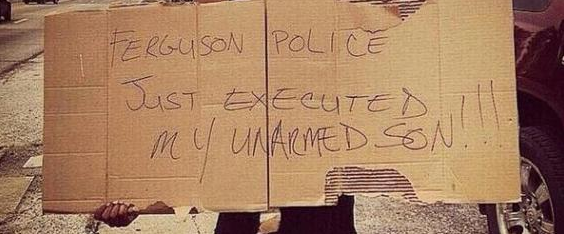
Following the shooting of 18-year-old man by a police officer in the city of Ferguson, Missouri, an outraged community gathered to demand answers. Michael Brown, a black teen and recent high school graduate, was shot dead in the city north of St. Louis on Saturday. The victim's grandmother said she found her grandson's body in the street, shortly after seeing him walking near her home, the Associated Press reports. A spokesman for the St. Louis County Police Department confirmed that a Ferguson police officer shot the man, but provided no further details on why the shooting occurred. Witnesses said that Brown was unarmed, KMOV reports. A crowd quickly gathered at the scene, as did 100 police cars from 15 departments, according to KSDK. The St. Louis Post-Dispatch reports that protesters came face-to-face with police at the site of the shooting, raising their arms and saying "Please don't shoot me." A dumpster was reportedly lit on fire. As tempers cooled, mourners participated in a prayer circle and vigil. A man identified as the victim's stepfather held a sign that said, "Ferguson police just executed my unarmed son!!!"

Corporate Victory Will ‘Screw’ Local Farmers As Amendment Passes In Missouri

Agribusiness giants scored a victory in Missouri on Tuesday when voters narrowly approved a corporate-backed state constitutional amendment that critics say will threaten animal rights, remove checks and balances around food safety, and make it more difficult to regulate industrial farming practices. The ballot question, which was supported by big-ag players like Monsanto and Cargill, asked: "Shall the Missouri Constitution be amended to ensure that the right of Missouri citizens to engage in agricultural and ranching practices shall not be infringed?" With all precincts reporting, the measure passed 498,751 to 496,223 — a margin of just 2,528 votes, or less than one percentage point. This makes Missouri the second state in the nation, after North Dakota, to adopt such a provision. The American Legislative Exchange Council (ALEC) has been promoting similar legislation in state capitols for almost two decades. While supporters of the so-called "Right to Farm" amendment described it as "a way for us to push back a little bit" against environmental groups and animal welfare organizations, opponents said it would open the door for foreign-owned factory farming in Missouri and "strip most local governments of their ability to stop foreign companies from polluting and contaminating our land."
assetto corsa mods

Urgent End Of Year Fundraising Campaign

Online donations are back! Keep independent media alive. 

Due to the attacks on our fiscal sponsor, we were unable to raise funds online for nearly two years.  As the bills pile up, your help is needed now to cover the monthly costs of operating Popular Resistance.

Urgent End Of Year Fundraising Campaign

Online donations are back! 

Keep independent media alive. 

Due to the attacks on our fiscal sponsor, we were unable to raise funds online for nearly two years.  As the bills pile up, your help is needed now to cover the monthly costs of operating Popular Resistance.

Sign Up To Our Daily Digest

Independent media outlets are being suppressed and dropped by corporations like Google, Facebook and Twitter. Sign up for our daily email digest before it’s too late so you don’t miss the latest movement news.