Skip to content

Monsanto

China Rejects 60,000 Tons Of US GMO Corn

China's quality watchdog said on Friday that China has recently rejected 60,000 tonnes of corn imports from the United States which contains unapproved transgenic content. Local authorities in the southern port city of Shenzhen found MIR162, a type of insect-resistant transgenic corn, among a batch of over 60,000 tonnes of corn imported from the United States, said Chen Xitong, spokesman for the General Administration of Quality Supervision, Inspection and Quarantine (AQSIQ). MIR162 is not authorized by China's agricultural department, and the Shenzhen bureau returned the batch of imports according to China's regulations for genetically modified agricultural products, Chen said. According to the spokesman, the AQSIQ has notified US authorities of the event, hoping they will order the US corn exporters concerned to strengthen inspection and quarantine of corn exports to China in conformity with Chinese law and regulations.

Hawaii’s Big Island Bans Biotech Companies, GMO Crops

The governing council for Hawaii (or Big) Island Tuesday banned biotech companies from operating on the island while barring growth of genetically modified organisms. The Hawaii County Council approved Bill 113 by a vote of 6-3, which would mandate a possible 30 days in jail and up to a $1,000 fine for any violator of the ban on growing genetically modified organisms (GMOs) on Big Island, officially known as Hawaii Island, the largest and southernmost of the Hawaiian state. The bill also keeps out biotech giants like Monsanto, Dow and BASF, which have operations on other Hawaiian islands. One of them, Kauai, recently advanced its own legislation that increases regulation of biotech companies there. The large papaya industry, with around 200 farms on Big Island, would be exempt from the bill, which was supported over a competing bill that that would have subjected papayas to the rules. Big Island Mayor Billy Kenoi has 10 days to decide whether to approve the council’s bill. The council could override a veto by Kenoi with a vote from six members.

Monsanto Threatens Protesters in Argentina

Monsanto is threatening protesters in Argentina who are blockading construction of a Monsanto factory. Protesters in Argentina continue to block construction of what is planned to be the biggest Monsanto plant in Latin America. Monsanto has resorted to intimidation tactics to try and remove them. They have been camped at the construction site in Malvinas, Argentina for 56 days. As of today they have established five blockades, one at each entrance to the construction site. Monsanto recently mailed letters of intimidation to the protesters threatening them to lift the blockades or face 3 years in prison. The blockades were recently flooded by heavy rains and protesters lost almost everything they had built including most of their tents. The community rallied to restock and rebuild the camps. Despite floods and threats of imprisonment, they are still showing no signs of going home.

Millions Against Monsanto: Five Lessons From The Battle Against GMOs

The rapidly growing anti-GMO Movement illustrates the powerful synergy that can develop from the combined use of social media, marketplace pressure and political action. Recent developments in this sector indicate that out-of-control corporations, media, politicians and the proverbial “one percent” can be outsmarted and outmaneuvered, and quite possibly defeated. In the wake of high-stakes multi-million dollar GMO labeling ballot initiatives in California in 2012, and Washington State in 2013, an army of organic food and natural health activists have put Corporate America and the political elite on the defensive. We’ve demonstrated that aggressive populist issue-framing; unconventional “inside-outside” coalition-building; marketplace pressure; and online list-building, mobilization and fundraising - strategically channeled into local and state-based political action - can begin to even up the odds between David and Goliath.

Monsanto’s Very Bad Week: Three Big Blows for GMO Food

It hasn't been a good week for Monsanto and the rest of the biotech industry. Just three days ago, Mexico banned genetically engineered corn. Citing the risk of imminent harm to the environment, a Mexican judge ruled that, effective immediately, no genetically engineered corn can be planted in the country. This means that companies like Monsanto will no longer be allowed to plant or sell their corn within the country's borders. At the same time, the County Council for the island of Kauai passed a law that mandates farms to disclose pesticide use and the presence of genetically modified crops. The bill also requires a 500-foot buffer zone near medical facilities, schools and homes -- among other locations.

VIDEO: 9.70 Documentary About Colombia Free Trade And Privatization Of Seeds

9.70 documentary, tells the story of a group of farmers from which the Colombian Government seized and destroyed 70 tons of rice. In a very short amount of time, the Colombian government approved a series of laws and resolutions in order to sign a Free Trade Agreement (FTA) with the United States as quickly as possible. One of the conditions set by the US was to create a legislation for the 'privatization' of seeds. The documentary examines the impact caused by these decisions, exemplifying them by using the case of Campoalegre, a southern Colombian town where the resolution was set in motion. In 2011, the Agency responsible for monitoring agricultural activities in Colombia (ICA) came to the town and seized 70 tons of rice, then returned with the police, and finally destroyed the seeds by burying them in a landfill for considering them illegal.

Scientists & Activists Oppose GMO Foods

Eighty-five scientists have joined forces to challenge the claims of biotech giants and the UK government that GM food is safe for humans. Environment Secretary Owen Paterson, who has responsibility for food and farming, and the industry have embarked on a huge public relations exercise to win over a sceptical public to genetically modified food. The campaign is built on an assurance that the food is safe to eat and could defeat a host of ills from malnutrition in the Third World to blindness in children. GM supporters also insist crops are safe for the environment and to be used as animal feed. However, these assurances have been questioned by the scientists, who warn there is a serious lack of independent research into the health effects of GM food. Studies involving feeding trials with animals suggest eating GM food could cause real harm, such as allergies, inflammation of internal organs and even breast cancer.

Monsanto Shills: Government and Corporate Media

Recently Truthout reposted an article by Belén Fernández that reported on "Monsanto, Rural Debt and the Suicide Epidemic in India" to focus on just one of the stories featured in Censored 2014. Truthout followed up with an interview with Fernández on Monsanto, the corporate mainstream media under-reporting stories such as the suicide epidemic in India and buffoonish commentary on GMOs by the likes of Thomas Friedman. BELÉN FERNÁNDEZ: I think alternative reporting definitely helps publicize certain issues, especially among certain sectors, and sometimes puts issues on the radar for the general public, but it's still often difficult to challenge the authority that the mainstream media commands. One can only hope that the media scene will continue to evolve as the process of reconciling reality with mainstream reporting becomes more and more impossible.

Blockade Against Monsanto In Malvinas, Argentina

Today is day 28th of the blockade against Monsanto in Malvinas, Argentina and around 50 protestors camping there have no intentions of going home any time soon. Citizens are making themselves at home near the main entrance of the new Monsanto plant currently under construction. They are camping out indefinitely to protest the new GMO seed processing plant which is scheduled to open for business in 2014. Revolution News spoke with activist Celina Molina from Asamblea Malvinas Lucha por Vida who said simply, “We do not want Monsanto to install the 2nd largest GMO seed processing plant of Latin America in our city.”

VIDEO: Millions WorldWide March Against Monsanto

Millions March Worldwide Against Monsanto: Resistance Report O10: Saturday October 12- People in over 400 cities and 57 countries march against Monsanto. The worldwide action comes days ahead of Monsanto receiving the Nobel Prize for Agriculture- the prestigious World Prize of Food for creating GMO’s. Also in this episode of the Resistance Report. Is the Department of Homeland Security Preparing for Another Wall Street Collapse? (5:37) The Plunder of Africa (9:22 ) Veterans Arrested at Their Own Memorial (16:51 ) It’s the Drones, Stupid(19:21 )

Photo Gallery: March Against Monsanto, October 12, 2013

March Against Monsanto events began in New Zealand and revolve around the world for the second March Against Monsanto. This cause has truly united the world! Over 400 cities in 57 countries will take place as we, the citizens of the world, say NO to poison! Three million people will stand up for the food supply, the environment, and our planet's sustainability. This will go down in history books and we would like to thank YOU for supporting a cause that is very much one of the most important of our lifetimes. We would like to express our deep gratitude for all at the national level. MAM has an awesome team that has spent countless hours working hard to make these events an international victory!! We would also like to give a very special thank you to all of our local organizers, whose hard work and selfless dedication has been instrumental in the global success of MAM.

Occupy Monsanto Protest Tossed Real Money Around Congress

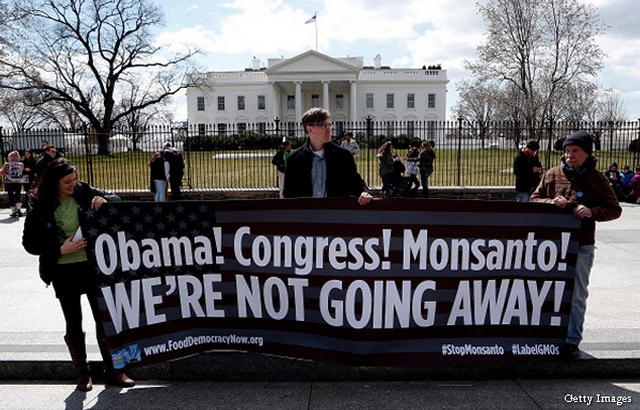
Some 2,000 dollar bills fluttered from the fifth-floor balcony of the Hart Senate Office Building on Thursday, falling upon activists who shouted "Monsanto Money!," while tossing piles of cash in the air and making snow angels in pools of the bills. "The government is shut down, but you still have Monsanto lobbyists engaging with congressmembers," said activist Ariel Vegosen of Occupy Monsanto, a group that regularly stages demonstrations against the controversial agriculture and biotech company. "We're here today to say that's not OK. Money shouldn't dictate how Congress makes decisions." Capitol police arrested three of the 10 activists, who wore business clothes and wigs to pose as lobbyists from the fictional "Biotechnology Industry Awards Committee." Adam Eidinger, one of those arrested, said that the tossed money would be collected by the others and used to pay bail if necessary.

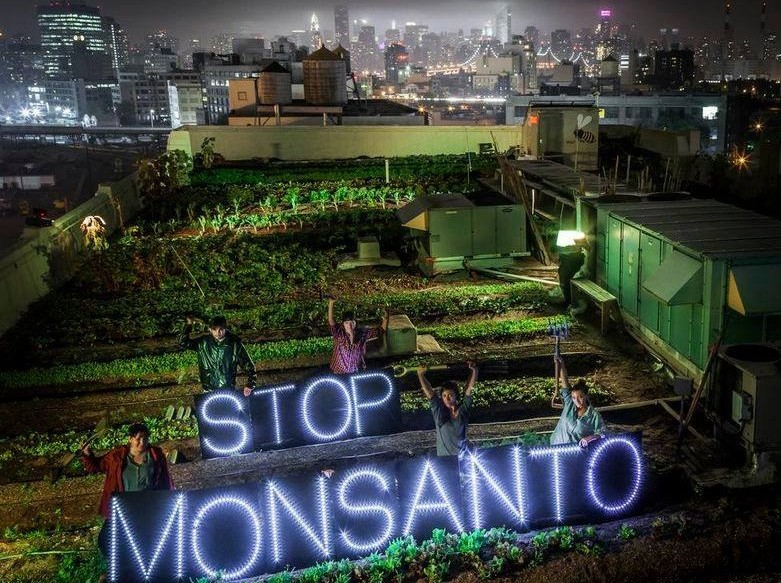
October 12: Worldwide March Against Monsanto

This time, as is the case with all sequels, things are expected to be bigger, better, and stronger. Forty-seven states will be represented, along with hundreds of cities and 52 countries spread out across six continents. (Guess which one will not be represented. Get your act together, Antarctica!) In fact, the global nature of this protest is really the eye-opener here. So often, we only worry about how U.S.-run businesses affect U.S.-residing citizens. But a corporation the size of Monsanto has some pretty gigantic effects overseas: In India, more than 250,000 farmers have committed suicide after Monsanto's Bt cotton seeds did not perform as promised. Farmers, left in desperate poverty, are opting to free their families of debt by drinking Monsanto pesticide, thereby ending their lives. Many farmers in other countries are also stripped of their livelihood as a result of false promises, seed patenting and meticulous legal action on the part of Monsanto and other big-ag interests. In many parts of Africa, farmers and their communities are left to choose between starving or eating GMOs.

Monsanto’s Winning The World Food Prize??

In an obscene development, a Monsanto executive is winning this year’s “Nobel Prize of agriculture” -- the prestigious World Food Prize -- for creating GMOs.Receiving it legitimizes the sort of rampant genetic modification Monsanto pioneered, and helps validate a ruthless business model that impoverishes farmers and monopolizes our food. If that wasn't baffling enough, the founder of Syngenta, the same biotech giant joining Bayer in suing Europe to keep selling bee-killing pesticides, will also win the prize -- and with it, a share of the $250,000 prize money. We cannot allow this prize to legitimize frankenfoods and bee killers. The ceremony is in less than two weeks, so we need to act now. Tell the World Food Prize Foundation not to reward Monsanto and bee-killer Syngenta’s outrageous practices.

Hungary Destroys Genetically Modified Corn Crops

Hungary has destroyed almost 1,000 acres of corn found to have been grown with genetically modified seeds, which are illegal in the country, International Business Times reports. The corn was plowed under so that pollen would not contaminate other crops. The action came in response to a new regulation introduced in March that stipulates that seeds are supposed to be checked for GMO before they can be sold to farmers. But some of the GMO seeds, manufactured by U.S. seed giants Monsanto and Pioneer, made it onto the market anyway. The Hungarian government said it will continue to test seeds despite the fact that seed sellers are obliged to make sure their products are GMO-free. Last week the Hungarian unit of Monsanto, the largest producer of GMO seeds, appealed to the Budapest Municipal Court to suspend the resolution by the Hungarian Agriculture Office to destroy the corn, but they were turned down, according to the Budapest Times.
assetto corsa mods

Urgent End Of Year Fundraising Campaign

Online donations are back! Keep independent media alive. 

Due to the attacks on our fiscal sponsor, we were unable to raise funds online for nearly two years.  As the bills pile up, your help is needed now to cover the monthly costs of operating Popular Resistance.

Urgent End Of Year Fundraising Campaign

Online donations are back! 

Keep independent media alive. 

Due to the attacks on our fiscal sponsor, we were unable to raise funds online for nearly two years.  As the bills pile up, your help is needed now to cover the monthly costs of operating Popular Resistance.

Sign Up To Our Daily Digest

Independent media outlets are being suppressed and dropped by corporations like Google, Facebook and Twitter. Sign up for our daily email digest before it’s too late so you don’t miss the latest movement news.