Skip to content

FCC

Open-Internet Activists To Protest At FCC Meeting

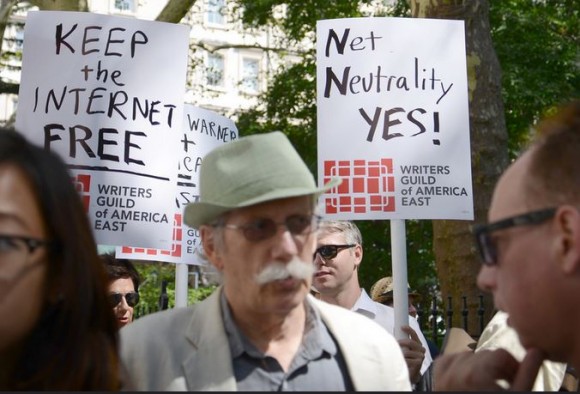
One of the best things about the Internet is that it is open. Like the mouse running round the pipes in your house, you can scurry wherever you’d like on the Web. Like a spider, you can spindle your own site, and like the public commons, no one owns the place–not you, me, not the government agency that ought to regulate it if only to preserve its openness, and not even Comcast, Verizon, or Time Warner, who are simply paid to provide the connection. But what if, as a federal appeals court ruled in February, those three companies had the ability to charge sites more if they wanted quick content delivery, leaving people clicking on other sites staring at the spinning circle or rainbow wheel waiting for them to load?
December 11: Next Step In the Campaign To Save the Internet

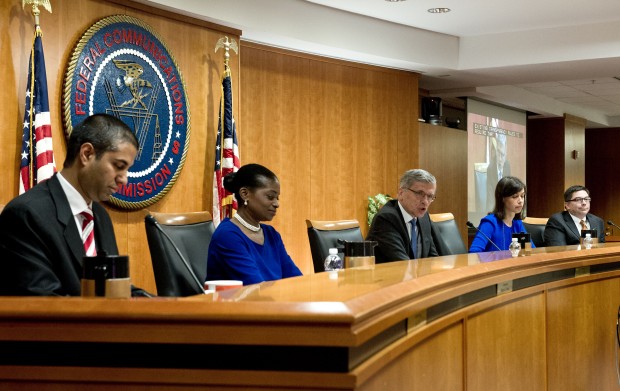
We have come an incredible distance in our campaign to save the Internet. Initially the solution of the net neutrality community was considered politically impossible, now it is politically inevitable. Or, at least some form of it is and we need to continue to keep the pressure on to make sure it is the right solution that does not allow a tiered Internet with wealthy corporations can pay for better service than start-ups, small businesses and citizen’s media. The solution is to reclassify the Internet as a common carrier so that there can be no discrimination and equal access for all. In order to put into effect Net Neutrality rules the Internet must be reclassified under Title II of the Federal Communication Act. The FCC had planned to put in effect their tiered Internet on December 11. We won an important victory when they were forced to not take that step. Now we need to push for reclassification and Net Neutrality rules. Please join us.

FCC Commissioner Clyburn Is Evasive On Reddit Chat

The article below describes an Ask Me Anything on Reddit with Commissioner Mignon Clyburn and describes the session as "not going well." It did not go well because Commissioner Clyburn refused to be clear about her views. Does she still support reclassification under Title II as she did in 2010? Does she support net neutrality? Does she still oppose paid prioritization? None of these questions were answered, instead Commissioner Clyburn used the phrase that the chair of the commission, Tom Wheeler, uses even when he is advocating for paid prioritization, "a free and open Internet." The Internet can be free and open and not be a common carrier with rules requiring net neutrality. We were also disappointed to see Commissioner Clyburn use the misleading talking point: "Title II on its own does not automatically ban paid prioritization." What Title II does do is gives the FCC the legal authority to stop paid prioritization and put in place net neutrality rules. The courts have made it clear that without Title II the FCC cannot put in place such regulations. There is no doubt Commissioner Clyburn knows this so why does she continue to use this misleading talking point?

Independent Movements Can Shape Obama’s Final Years

In the wake of the mid-term elections earlier this month, it might have seemed that there wasn’t much hope to hold onto for progressives, what with climate deniers and tea party fundamentalists rising to some of the highest offices in the land. What we’ve seen since, though, has been a string of executive decisions that might be cautiously described as hopeful. Responding to his new-found willingness to take on the GOP, pundits have commented that Obama is attempting to carve out a progressive legacy in the latter half of his second term. This may be true, but this week’s announcements are also evidence of the work grassroots organizers have been doing to put pressure on the White House since well before the 2008 election. In other words, like other presidents, any progressive legacy Obama manages to build between now and 2016 will be a product of the movements that challenged him most.

Civil Rights Groups’ False Split Over Net Neutrality

The heated debate in Washington over a critical policy measure that could shape the future of the Internet has created a peculiar split among traditional allies. A number of civil rights organizations and diversity groups overwhelmingly back a proposal that would lightly regulate telecom providers and broadband companies. But other groups representing minorities as well as consumer advocates and other public interest groups want to make sure that Internet service providers are regulated closely to be sure they don't slow down the traffic speeds of Web sites they don't like. The strange juxtaposition can be plainly observed in the letters sent by these groups to the Federal Communications Commission, which is responsible for establishing the new so-called "net neutrality" policy.

Saving The Internet: Impossible Shifted To Inevitable

The group Fight For the Future (FFTF) has been at the forefront of a broad coalition that has rallied to generate comments from 4 million people, 40,000 websites, and the President of the United States in support of net neutrality. Earlier this year, FCC Chair Tom Wheeler announced that he wanted a decision to come down on the concept of net neutrality (the concept that everyone’s data should move at the same speed and that huge corporations or governments should not get to buy into a fast lane and/or interfere with what you do online) by the end of 2014. Now that that decision is being pushed to early 2015, Evan Greer – a campaign organizer for FFTF, is calling out Wheeler for not listening to the overwhelming consensus of people, telling Acronym TV in the video above: “Now that there is a growing public consensus for title II reclassification, which is the only way to protect the internet, all of the sudden he wants to delay. From our perspective, it is pretty easy to see what is going on here...

Next FCC Hearing: ‘No Delay On Net Neutrality!’

We did it! It's official that the FCC will not vote on a phony 'hybrid' proposal at the next hearing on December 11. This is good news... and bad news. It's good that the our pressure forced the FCC to drop their weak rules, but it is bad that the delay gives the Giant Telecoms more time to push for loopholes and back doors and to spread their false information. We must make a strong push for full reclassification of the Internet under Title II as quickly as possible. No delay! We need hundreds of people to show up at the next hearing on December 11 at the FCC in Washington, DC with the message "Reclassify Now!" Will you be there? Sign the action pledge below and we'll send you the details as soon as we have them.

Net Neutrality and What You Can Do

This is a critical time for the future of the Internet as we know it. When the Internet was created, it was classified as a Common Carrier which meant that it was essentially a public utility like water or electricity. In 2002, Michael Powell, who was head of the Federal Communications Commission (FCC) and is now head of the industry lobbying group, changed it to an "information service" which meant that the government had less ability to regulate it. Since then, there has been increasing consolidation of Internet service providers by the Big 3: Comcast, Verizon and AT&T. They have sued the FCC in order to gain greater ability to monetize and control Internet service. The most recent case in January pushed the FCC to change its rules regarding the Internet.

Net Neutrality Supporters Raise Questions About Delay

The Federal Communications Commission (FCC) will not be voting on net neutrality in December, instead delaying the decision until sometime in 2015 when Republicans will have full control of Congress. The decision, which the agency confirmed Monday, is drawing criticism from net neutrality supporters, who say the delay is unnecessary and raises concerns about the possibility of FCC Chairman Tom Wheeler bowing to pressure from GOP lawmakers and telecom and cable companies. Last week, President Barack Obama threw his weight behind a “Title II” proposal to keep the Internet free and fair by treating Web access like a utility, not unlike water. Telecom and cable companies oppose this plan because they want a lighter regulatory touch, and they could benefit by being able to charge companies for faster download speeds, though they have said they will not do this.

FCC And Telecom Emails Illustrate Cosy Relationship

The Federal Communications Commission has long been accused of having a close relationship with the industry it regulates. The accusations are usually leveled because of the revolving door that has seen FCC officials leave the agency to work as lobbyists for telecom companies, and lobbyists for telecom companies leave to work for the FCC. Internal FCC documents obtained by VICE News in response to a Freedom of Information Act (FOIA) request we filed last April sheds a little more light on the revolving door and the cozy relationship between the regulators and the industry it oversees. The 600-pages of documents, which include emails and letters, are especially noteworthy because they pertain to discussions revolving around rules for net neutrality, which FCC Chairman Tom Wheeler — he's a former lobbyist for AT&T, Verizon, Sprint, and Nextel — is expected to unveil and enact in the coming weeks.

Movement Creates Nearly Inevitable Net Reclassification

On Monday morning, Federal Communications Commission Chairman Tom Wheeler walked out of his red brick house on a shady Georgetown street to find three protesters sitting in his driveway, blocking his Mini Cooper. Mr. Wheeler recognized and greeted a fourth protester, Kevin Zeese, then posed with group’s “Save the Internet” banner as they began to chant: “Don’t let the Internet die. Time to reclassify.” The protesters, from the group Popular Resistance, are among millions of Internet activists who have called for the FCC to reclassify broadband as a public utility, which would give the agency much more authority to regulate Internet providers and prevent them from cutting deals with content companies to deliver their Web pages to consumers more quickly. Reclassification has become the defining issue in the debate over “net neutrality,” or the idea that all Internet traffic should be treated the same.

Net Neutrality Protest At Industry Lobbying Headquarters

On Wednesday, November 12 at noon, net neutrality activists protested at the National Cable and Telecommunications Association located at 25 Massachusetts Ave., NW in Washington, DC. The picket, organized by Popular Resistance, highlighted the national consensus favoring reclassifying the Internet as a common carrier under Title II so that there can be no discrimination and equal access for all with real net neutrality rules. The largest opposition to reclassification and net neutrality comes from a handful of corporations that are members of NCTA. In order to push their agenda the NCTA is putting out false information, creating fake grassroots groups, threatening lawsuits and spending millions of dollars to "buy" Congress and non-profits such as the NAACP.

Obama Bundler Tom Wheeler Helps His Former Industry

When Tom Wheeler was appointed the 31st Commissioner of the FCC, some media policy watchdogs were skepticalthat the former telecommunications executive and Cellular Telecommunications and Internet Association lobbyist would be willing to "stand up to industry giants and protect the public interest," when faced with important rule making decisions on net neutrality, media mergers and broadband competition. Now, with news that the agency plans to allow Internet service providers to charge higher rates for Internet "fast lanes," it appears that at least some of those fears have been vindicated. Deemed the "Bo Jackson" of the communications world by President Obama, Wheeler had played nearly every position in the telecom industry by the time he was nominated to Chair the agency. In addition to presiding over the CTIA and, before that, the National Cable Television Association, Wheeler was a managing director at a venture capital firm and a co-founder of SmartBrief according to his agency bio.

Another Visit To FCC Chairman Wheeler’s House

We ended the day as we began it -- in the driveway outside of Tom Wheeler's house, but this visit was very different. A lot had happened since our first visit. President Obama spoke out in favor of everything we wanted: reclassification and net neutrality. He recognized the importance of equal access for all and the role of the Internet in encouraging creativity in the economy. After the president spoke out it was like a dam being opened. All sorts of key people, trade associations and corporations came out for reclassification and net neutrality. These new additions to the discussion showed a strong national consensus developing in favor of the proposals the net neutrality community has been urging. We decided to give Tom Wheeler and his wife a bottle of wine. In it we included the lyrics of the song "Which Side Are You On, Tom?" as well as a note saying "We are looking to support at Internet hero?" Wheeler came home, shook our hands and we had a friendly exchange, then we spoke about the national consensus that was developing and how the rulemaking proceeding had served an excellent role in helping to create that consensus.

Father Of Net Neutrality Supports Full Title II

Do I think the FCC will do what he says? The ball's in their court in a way it hasn't been before. I certainly think it stands a chance. He's the boss; he's the head of the Democratic Party and the President of the United States. His ideas hold a lot of weight. Obviously, [the FCC] is not going to just ignore this; they have more political cover to do it. I don't think it's the Chairman's preference, but knowing that he'll have the White House... They may find themselves very isolated. Sometimes, you have to pick a side or get run over. What's the point of being in the middle if you're the FCC at this point, unless you really think it's better in some way? If they stay in the middle, they're kind of naked right now — there's no one there with them. It's not like Congress is gonna help out. Congress is going to be against any version of the net neutrality rule, the tech companies are against any compromise. Sometimes, the middle can end up being a very dangerous place.
assetto corsa mods

Urgent End Of Year Fundraising Campaign

Online donations are back! Keep independent media alive. 

Due to the attacks on our fiscal sponsor, we were unable to raise funds online for nearly two years.  As the bills pile up, your help is needed now to cover the monthly costs of operating Popular Resistance.

Urgent End Of Year Fundraising Campaign

Online donations are back! 

Keep independent media alive. 

Due to the attacks on our fiscal sponsor, we were unable to raise funds online for nearly two years.  As the bills pile up, your help is needed now to cover the monthly costs of operating Popular Resistance.

Sign Up To Our Daily Digest

Independent media outlets are being suppressed and dropped by corporations like Google, Facebook and Twitter. Sign up for our daily email digest before it’s too late so you don’t miss the latest movement news.