Skip to content

GMOs

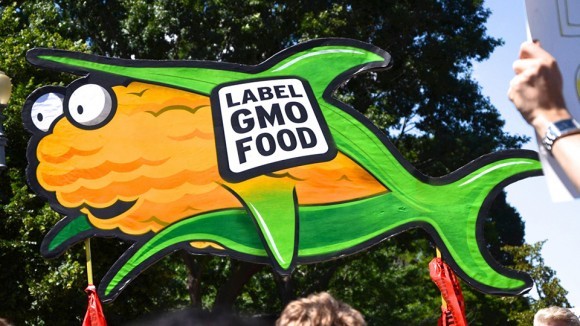
Dec. 10th: Rally For States’ Right To Require GMO Labeling

The battle for the right to know if your food contains genetically modified organisms (GMOs) could come to a screeching halt with the signing of one bill in Congress. We need to stop that bill in its tracks. H.R. 4432—the DARK (Deny Americans the Right to Know) ACT—was introduced by Rep. Mike Pompeo (R-Kan.) at the bidding of Monsanto, Big Food and the Koch Brothers. If passed, H.R. 4432 will strip your state of the right to pass a GMO labeling law. The DARK ACT will have its first hearing on Capitol Hill, on December 10. If we don’t turn out in numbers to protest this bill, our voice could be silenced.

GMO Labeling Campaign Claims Opponents Playing Dirty

The No on 92 Coalition attempted to place out-of-state election observers in at least four Oregon counties Tuesday, in violation of state law, proponents are complaining. Measure 92, which would require foods containing genetically modified ingredients to be labeled, failed by just 812 votes during the first, computerized tally last month. A hand recount began Tuesday in 19 counties and continues in the rest through Dec. 9. Under Oregon law, each campaign may authorize an observer to watch each counting table. Authorized observers must be registered Oregon voters. But out-of-state observers still registered and showed up in Marion, Multnomah, Linn and Benton Counties, said Dave Murphy of Food Democracy Now, which is helping coordinate volunteers for the Yes on 92 Campaign.

Study: GMO’s Contaminate Crops 2.8 Miles Away

The United States has absolutely no buffer zones to protect non-GMO crops from GMO crops, and this simply won’t work considering a newly published, 10-year risk assessment study that has found that GMO corn can contaminate non-GMO corn varieties up to 2.8 mile away. This is exactly what organic farmers, and non-GMO supporters warned us about decades ago. Biotech has tried to minimize the obvious laws of nature that govern pollen dispersal. However, the new study looked at 216 sites in Germany, Switzerland, and Belgium from 2001 to 2010 to analyze Bt pollen spread. Sampling methods were standardized but taken from within the same field and up to 4.45 km away.

United Nations Calls For An End To Industrialized Farming

In 2013, the United Nations announced that the world's agricultural needs can be met with localized organic farms. That's right, we do not need giant monocultures that pour, spray and coat our produce with massive amounts of poisons, only to create mutant pests and weeds while decimating pollinators and harming human health. Don't believe the hype: We do not need genetically modified foods "to feed the world." From my experience, many of these - how shall we say it - "worker bees" (i.e the GMO salesmen) who spread this propaganda, actually believe conventional tactics are necessary to ensure food security. They've drunk the Kool-Aid and cannot envision another possibility. The changes threaten their very existence.

Neil Young Announces Starbucks Boycott

I used to line up and get my latte everyday, but yesterday was my last one. Starbucks has teamed up with Monsanto to sue Vermont, and stop accurate food labeling. Tell Starbucks to withdraw support for the lawsuit -- we have a right to know what we put in our mouths. Starbucks doesn't think you have the right to know what's in your coffee. So it's teamed up with Monsanto to sue the small U.S. state of Vermont to stop you from finding out. Hiding behind the shadowy "Grocery Manufacturers Association," Starbucks is supporting a lawsuit that's aiming to block a landmark law that requires genetically-modified ingredients be labeled. Amazingly, it claims that the law is an assault on corporations' right to free speech.

Close To Home: Partnership Would Threaten Local Control

Though fast track has been used before, it raises constitutional issues and arouses suspicion about the proponents’ priorities and secret provisions of the pact. This process does not meet the minimal standards of transparency and accountability. Fair trade agreements do not have to be fast tracked. As with NAFTA and the World Trade Organization, the Trans-Pacific Partnership would favor the free flow of capital, remove restrictions on trade and investment, eliminate subsidies, protect intellectual property rights and promote privatization of public services. It is more about protecting investments than about trade.

Trade Deals Criminalise Farmers’ Seeds

Trade agreements have become a tool of choice for governments, working with corporate lobbies, to push new rules to restrict farmers' rights to work with seeds. Until some years ago, the most important of these was the World Trade Organization's (WTO) agreement on Trade-Related Aspects of Intellectual Property Rights (TRIPS). Adopted in 1994, TRIPS was, and still is, the first international treaty to establish global standards for “intellectual property” rights over seeds.1The goal is to ensure that companies like Monsanto or Syngenta, which spend money on plant breeding and genetic engineering, can control what happens to the seeds they produce by preventing farmers from re-using them – in much the same way as Hollywood or Microsoft try to stop people from copying and sharing films or software by putting legal and technological locks on them. But seeds are not software. The very notion of “patenting life” is hugely contested.

Dramatic Correlation Shown Between GMOs And 22 Diseases

The research highlighted below, "Genetically engineered crops, glyphosate and the deterioration of health in the United States of America," was published in The Journal of Organic Systems September and links GMO's to 22 diseases with very high correlation. We have reprinted many of the graphs from the study that show an incredible correlation between the rise of GMO crops that use the herbicide glyphosate and a wide range of disease. Glyphosate was introduced to the marketplace in 1974 but data on its use is only available since 1990. The study points out that research has shown that "glyphosate disrupts the ability of animals, including humans, to detoxify xenobiotics. This means that exposures to the numerous chemicals in food and the environment, such as endocrine disrupting chemicals and carcinogens, could be causing levels of damage that would not occur if the body were able to detoxify them." Correlation is not proof of causation. But the authors points out "we have data for 22 diseases, all with a high degree of correlation and very high significance. It seems highly unlikely that all of these can be random coincidence."

Living With GMOs: A Letter From America

We are writing as concerned American citizens to share with you our experience of genetically modified (GM) crops and the resulting damage to our agricultural system and adulteration of our food supply. In our country, GM crops account for about half of harvested cropland. Around 94% of the soy, 93% of corn (maize) and 96% of cotton grown is GM. The UK and the rest of the EU have yet to adopt GM crops in the way that we have, but you are currently under tremendous pressure from governments, biotech lobbyists, and large corporations to adopt what we now regard as a failing agricultural technology. Polls consistently show that 72% of Americans do not want to eat GM foods and over 90% of Americans believe GM foods should be labeled.

Maui Votes To Ban GMO Farming

A Maui County ballot initiative to temporarily ban genetically engineered crops narrowly passed Tuesday following one of the most heavily financed political campaigns in state history. The controversial measure pulled ahead late Tuesday, passing 50 percent to 48 percent — a difference of just 1,077 votes. It was a stunning turnaround after the measure was initially losing by 19 percent when the first results rolled in. The county’s first-ever ballot initiative targeting global agriculture companies Monsanto and Dow AgroSciences attracted nearly $8 million from opponents, making it the most expensive campaign in Hawaii’s history. Opponents outspent advocates more than 87 to 1, according to the latest campaign spending reports available Tuesday. That amounts to more than $300 for every “no” vote.

UC Berkeley Shuts Down Beehive Collective Art

Students at the University of California at Berkeley were forced to bring an art project on drought and California water policy to the main campus on October 21 after a dean prevented them displaying it at Gill Tract Community Farm, an “urban farm” in nearby Albany run by the university and community volunteers. The students say that Steven Lindow, executive associate dean of Berkeley’s College of Natural Resources, kicked the exhibit—a collaboration with the Beehive Collective, a political art group based in Maine—off the farm for clearly political reasons. They say that Lindow is tied to the genetically modified organism industry, and their event criticized Proposition 1, a state ballot initiative supported by the GMO industry.

Is OCA’s ‘Traitor’ Boycott Working?

It’s boycott time again. With less than two weeks to go before voters in Oregon and Colorado decide on ballot initiatives to require mandatory labeling of foods containing genetically modified organisms (GMOs), the Junk Food Giants are at it again. According to the latest numbers provided by the pro-labeling campaigns (as of October 22, 2014), the opposition in Oregon has raised $16.5 million to defeat Measure 92, while opponents of Colorado’s Proposition 105 have raised $14.3 million. Monsanto is the largest donor to both campaigns, with combined donations totaling approximately $8.8 million. While Dow has spent only $668,000 in both states, DuPont Pioneer just yesterday dumped a whopping $3 million into the Colorado NO on Prop 105 war chest.

3 Arrested Protesting World Food Prize

Three activists protesting the World Food Prize were arrested Thursday night in front of the Iowa Capitol building, just as attendees to the 2014 Laureate Award Ceremony gathered inside. The three protesters, part of the Occupy World Food Prize movement, were arrested after a march up the Capitols' west steps, during which a crowd of about 40 people chanted "No, no, GMO." The arrest came after an hourlong rally with speakers from Iowa and around the country, who criticized the World Food Prize's recognition of genetically modified organisms as the solution to feed a growing world population. The prize, they say, honors corporate and large-scale industrial agriculture, rather than farmers who grow their own food. "Even though a lot of people in that building over there are very powerful and rich, we represent a lot of people who can't get here — the majority of the human race," said Frank Cordaro, founder of the Iowa Catholic Worker and one of the protesters who was arrested, in his opening remarks.

Debunking Popular Myths About GE Crops

The recent article, “Seeds of Doubt,” in the August 25, 2014 issue of The New Yorker by Michael Specter echoes common myths about genetically engineered (GE) crops and omits legitimate scientific critiques of the technology. The resulting article fails to deliver the high level of integrity and journalism that is expected of The New Yorker. Biotechnology corporations spend hundreds of millions of dollars in advertising and marketing each year. Monsanto, one of the leading biotech companies, spends from $87 million to $120 million annually on advertising, much of it focused on GE crop technology. The industry spends millions more on lobbying, opposing ballot initiatives to label GE foods, and further promotional activities. Such massive spending has effectively framed a favorable narrative about GE crops and foods in several major media outlets, including The New Yorker.

USDA’s Greenlighting Of ‘Agent Orange’ Crops Sparks Condemnation

The U.S. Department of Agriculture’s decision this week to approve two new genetically engineered crops is being denounced by watchdog groups as a false solution to herbicide-resistant weeds and a move that threatens human and environment safety alike. The crops are Dow AgroSciences’ Enlist corn and soybeans, engineered to be resistant to its Duo herbicide, which contains 2,4-D, a component of the notorious Agent Orange. 2,4-D has been linked to Parkinson’s, birth defects, reproductive problems, and endocrine disruption. Dow states that the new system will address the problem of weeds that have become resistant to glyphosate, the active ingredient in Monsanto’s widely-used Roundup. Food and environmental safety groups, however, say that it speaks to the failure of the genetically engineered crops strategy that fosters herbicide expansion—profitable for the chemical companies—and ignores the paradigm shifted needed in the industrial agriculture system.
assetto corsa mods

Urgent End Of Year Fundraising Campaign

Online donations are back! Keep independent media alive. 

Due to the attacks on our fiscal sponsor, we were unable to raise funds online for nearly two years.  As the bills pile up, your help is needed now to cover the monthly costs of operating Popular Resistance.

Urgent End Of Year Fundraising Campaign

Online donations are back! 

Keep independent media alive. 

Due to the attacks on our fiscal sponsor, we were unable to raise funds online for nearly two years.  As the bills pile up, your help is needed now to cover the monthly costs of operating Popular Resistance.

Sign Up To Our Daily Digest

Independent media outlets are being suppressed and dropped by corporations like Google, Facebook and Twitter. Sign up for our daily email digest before it’s too late so you don’t miss the latest movement news.