Skip to content

Occupy

Our Invisible Revolution

When these ideas are shattered, the institutions that buttress the ruling class deflate and collapse. The battle of ideas is percolating below the surface. It is a battle the corporate state is steadily losing. An increasing number of Americans are getting it. They know that we have been stripped of political power. They recognize that we have been shorn of our most basic and cherished civil liberties, and live under the gaze of the most intrusive security and surveillance apparatus in human history. Half the country lives in poverty. Many of the rest of us, if the corporate state is not overthrown, will join them. These truths are no longer hidden. It appears that political ferment is dormant in the United States. This is incorrect. The ideas that sustain the corporate state are swiftly losing their efficacy across the political spectrum. The ideas that are rising to take their place, however, are inchoate.
Resistance Movement Electoral Candidates

In times as dire as ours, with the human prospect on this planet possibly measured in mere decades, even the frailest reeds of hope—the mushrooming of Occupy, a socialist winning or almost winning a major city council election, a thousand anonymous scattered souls standing up to housing cops or an oil pipeline—might serve as tinder for the next great firestorms of resistance. We must hoard all these slivers of possibility, lest we mindlessly discard the one that might make all the difference.

An Occupy Activist’s New Cause: Drug Raids And Police Abuse

Two men with different approaches to both politics and activism are leading Utah's police reform movement. Connor Boyack is the libertarian pragmatist, the negotiator and the policy wonk. Jesse Fruhwirth is the far-left idealist, the sign-toting activist and the revolutionary. It was Fruhwirth who organized a rally against police brutality at the Utah state capitol in March, and another in support of Matthew David Stewart in Ogden in April. Stewart, an Army veteran, was awaiting trial on murder charges, after a botched raid on his house to serve a drug warrant ended in the death of a police officer.

One Year Out, Sandy Survivors Human ‘Wave of Change’ to City Hall

A year after Superstorm Sandy flooded the streets of New York, carried away whole stretches of the Jersey Shore and caused untold devastation to half a million homes and countless homeowners along the northeastern seaboard, many survivors are still left adrift. On Sunday afternoon, survivors of the storm and other community leaders are convening at New York City Hall to "Turn the Tide" and demand a more equitable and sustainable rebuild. Protesters plan to carry handmade "waves" symbolizing the "wave of change" they hope to spark. Though millions of aid dollars were set aside following the storm, many communities—particularly minority and lower class—are still displaced. In addition to exposing the economic vulnerability of so many Americans, the storm forced many politicians and other members of New York's elite class to face the hard facts about our collective future in the face of global warming with its drastic weather patterns and swelling sea levels.

VIDEO: Russell’s Brand New Revolution & Chris Hedges On Class War

Resistance Report: While watching Russell Brand’s BBC interview, it is not hard to imagine two families in Middle America, neighbors, watching separately in the comfort of their own homes as Russell Brand does his bit and each nod in lonely agreement. “Yes!”, they are likely to say- “this Russell Brand fellow is right.” But family A has to work hard at a job they are made to feel they are lucky to have buying something, selling something, or processing something when, like their inner Lloyd Dobbler, they don’t want to buy anything sold or processed, or process anything sold, bought, or processed, or repair anything sold, bought, or processed. You know, as a career, they don't want to do that. And Family B is doing the same thing. Both are trying to keep up with the Joneses, as they the expression goes. Family B is competing to send their kids to better schools and than Family A; and Family A is competing just as hard to beat out family B. They are each other’s Jones.

Photo Essay: October 29, One Year Anniversary Of Occupy Sandy

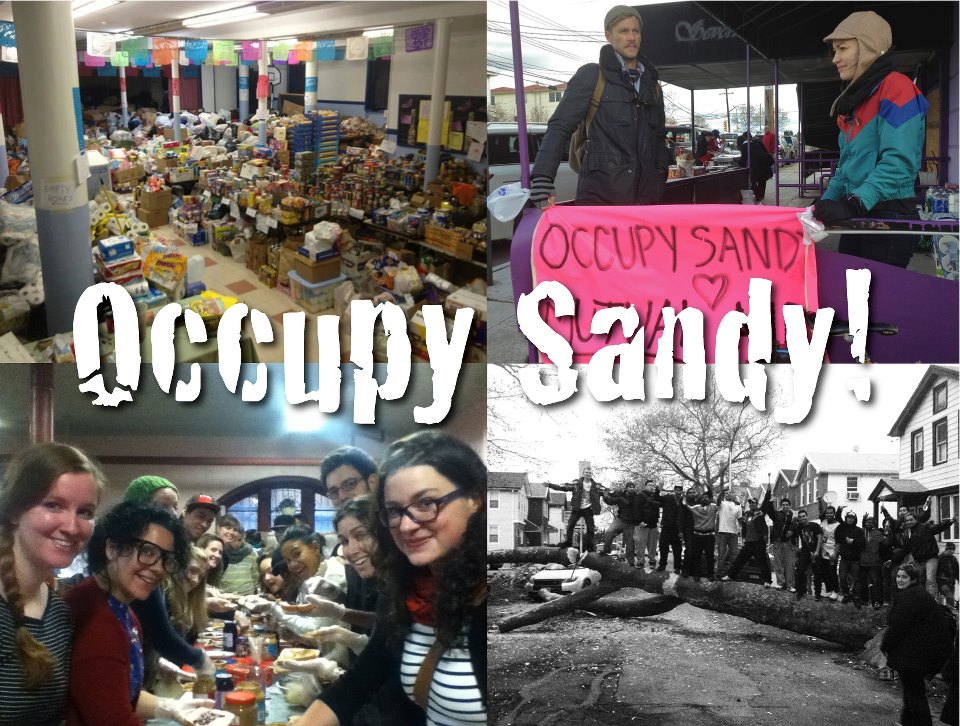
On October 29, 2012, Superstorm Sandy brought climate change to our shores, homes and hearts beyond any shadow of a doubt. Shortly after the storm subsided, Occupy Sandy began as a spontaneous effort by a group of people who felt compelled to act in response to disaster. Together, a network was created of more than 50,000 volunteers who were able to provide over 300,000 meals, rebuild or remediate over 1000 homes, and provide in excess of a million dollars worth of supplies through in-kind donations. Nearly 1 year after the storm, serious rebuilding is still just getting underway. Most of the money to rebuild New York hasn’t gotten to the people or infrastructure where it’s needed most. Fortunately, Sandy’s 1-year anniversary is an opportunity to honor the storm’s victims and—in a world increasingly vulnerable to natural disasters—to organize for action.

From Gandhi To Occupy: The Story Of Peaceful Protest

From battles to end racial segregation to local struggles to protect rare habitats, the captive crew of the Greenpeace ship Arctic Sunrise is following in a rich tradition of peaceful protest. But according to one of Britain’s foremost experts in civil disobedience, the nature of protest is changing. David Mead of the University of East Anglia’s Law School said that over the past 30 years there has been a radical shift towards protest and campaigns aimed at rogue corporations, not governments. “The mass protest march isn’t quite dead, but it’s very much secondary,” said the author of The New Law of Peaceful Protest. “Instead, protesters are more likely to engage with particular groups or organisations they dislike, whether they are polluting firms, oil companies or arms manufacturers.” Brian Fitzgerald, the head of mobilisation at Greenpeace International, agreed. “Corporations can be more responsive to pressure than many governments. Brent Spar and the campaign against Shell in the 1990s was a great early example of this. It was Shell that buckled over sinking the Brent Spar oil rig in the North Sea, not the UK government.

Oakland Protests “Urban Shield” Convention; 2nd Anniversary Of Eviction

The second anniversary of the eviction of Occupy Oakland was remembered on the same day as protesters marched through Oakland opposing the urban policing convention 'Urban Shield.' About 100 protesters gathered Friday evening at Frank Ogawa Plaza in downtown Oakland to commemorate the second anniversary of the eviction of the Occupy Oakland encampment from the plaza and the police crackdown on the subsequent protest. Those gathered spoke out against police violence, whacked a pig-shaped piñata and dined on roasted pig. Many people marched to the rally from the downtown Oakland Marriott, where they had protested all day outside the Urban Shield 2013 conference, where vendors were pitching weapons and equipment to law enforcement agencies gathered for a three-day training exercise.

Students Protest Closing CUNY Student Union, Arrests & Pepper Spray

A sit-in and protest at the the City College of New York turned confrontational Thursday afternoon, when a protester was pepper-sprayed and arrested for endangering the welfare of a minor, disorderly conduct, and resisting arrest. Another was detained and cited for disorderly conduct. The protest took place outside City College's recently closed Morales-Shakur Center, which CCNY abruptly converted into a "career center" on Sunday. The arrests happened when a crowd of protesters tried to force their way inside the North Academic Center (NAC), where the Morales-Shakur center used to be. The arrested, pepper-sprayed person was CCNY alumnus and activist David Suker.

On Revolution: “We No Longer Have The Luxury Of Tradition”

The overthrow of the current political system is the only way I can be enthused about politics. I don’t vote because to me it seems like a tacit act of compliance; I know, I know my grandparents fought in two world wars (and one World Cup) so that I’d have the right to vote. Well, they were conned. As far as I’m concerned there is nothing to vote for. I feel it is a far more potent political act to completely renounce the current paradigm than to participate in even the most trivial and tokenistic manner, by obediently X-ing a little box. Total revolution of consciousness and our entire social, political and economic system is what interests me, but that’s not on the ballot. Is utopian revolution possible? The freethinking social architect Buckminster Fuller said humanity now faces a choice: oblivion or utopia.

‘Thank You Anarchy’ Author and Wall Street Occupier Nathan Schneider on the Movement’s True Power

It can't be understated that Occupy was the subject of a national crackdown - from the Homeland Security trucks I saw patrolling the financial district the night before it started to the near-simultaneous wave of evictions coordinated by mayors. Second, however, I think it's fair to say that the movement hit the big time without having the organizational framework to involve people at all levels of society. Same with the sit-ins at Tahrir - that's why it was only because the Egyptian labor unions mounted a nationwide general strike that Mubarak came down.

How The Resistance Movement Is Changing Politics

There are early signs of some populist stirrings among a minority in the Democratic Party. It is still a party dominated by corporatism, Wall Street, Clintonism and Obamism but social movements may be creating a zeitgeist in the culture for a new kind of politics. I have my doubts this will end up showing itself inside the two parties, the Democratic Party has a long history of destroying social movements, and I am convinced that if it is going to manifest itself the movement needs to remain independent of the two parties and be like Rev. Dr. Martin Luther King said of the two parties of his era " look objectively at both parties and be the conscience of both—not the servant or master of either." At the same time third party pressure must build so that those within the two parties see the results of elections will be impacted by a third party that clearly puts forth an agenda of people and planet before profits.

Building Upon Occupy: Living The Journey To Social Transformation

In order to facilitate self and social transformation, we must realize our untapped powers to shape our worlds. Nurturing more empowered, expressive, collaborative citizens, less afraid of authority and more confident of our own experimentation and creativity, requires spaces to help citizens effectively shape and live out their identities and community roles without authoritative maps and demands, and processes for self-reflectivity and democratic engagement and decision making. The goal is to help people encounter the hurdles of internalized self-deformation, find personal and group direction, and ultimately commit to new forms of action and institution building. This new spirit, in evidence everywhere, is symbolized by the decision of the Madrid Indignados, after occupying the central square for many weeks with a tent city, to relinquish this occupation initiative and move beyond to collective consideration of sustainable transformation.

Register To Learn How To Stop Evictions And Foreclosures

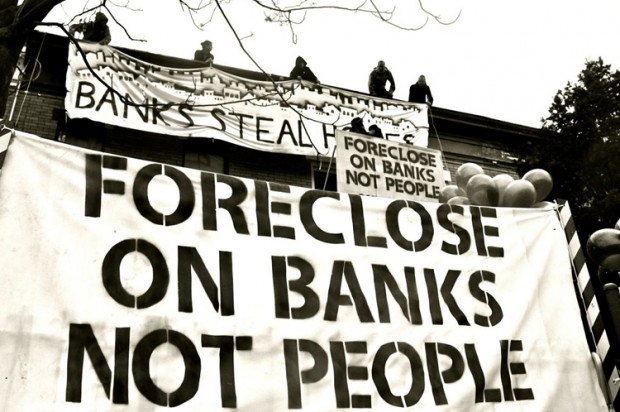
Over the last two years, Occupy Our Homes groups around the country have helped hundreds of families fight to stay in their homes, winning houses, farms, and even churches back from the bank. We've liberated vacant bank-owned homes in order to provide stable housing for those in need. We've worked with communities to set up Eviction Free Zones, where neighbors have pledged to defend each other from wrongful foreclosures and evictions. We've learned that the only way to hold Wall Street accountable is to come together and organize-- to create a world where people, not banks, have control over their communities.

Last Scheduled Brooklyn Bridge Case, Like Most Others, Is Dismissed

There were two incidents that helped to spark the early days of the Occupy Movement. One was the pepper spraying to two women who were already under arrest without cause, the other was the arrest of more than 700 people on the Brooklyn Bridge. From the videos it looked like the police were leading the protesters onto the bridge, then they trapped them with police on both sides and made 700 arrests. Now, two years later of the 732 arrests that day, 690 have been dismissed. There is a civil suit pending against the NY police for these mass arrests. Two years after more than 700 people were arrested on the Brooklyn Bridge roadway for participating in an Occupy Wall Street march, the last scheduled criminal case found its way to a courtroom in Manhattan this month. Of the 732 arrests made on the Brooklyn Bridge, 680 cases were dismissed, 195 at the request of prosecutors, 40 by the court and 445 contingent on defendants’ not being arrested again within six months.
assetto corsa mods

Urgent End Of Year Fundraising Campaign

Online donations are back! Keep independent media alive. 

Due to the attacks on our fiscal sponsor, we were unable to raise funds online for nearly two years.  As the bills pile up, your help is needed now to cover the monthly costs of operating Popular Resistance.

Urgent End Of Year Fundraising Campaign

Online donations are back! 

Keep independent media alive. 

Due to the attacks on our fiscal sponsor, we were unable to raise funds online for nearly two years.  As the bills pile up, your help is needed now to cover the monthly costs of operating Popular Resistance.

Sign Up To Our Daily Digest

Independent media outlets are being suppressed and dropped by corporations like Google, Facebook and Twitter. Sign up for our daily email digest before it’s too late so you don’t miss the latest movement news.