Skip to content

Oil

Russia Releases Ship Used In Gas Protest

Russia’s investigative committee (IC) this morning informed Greenpeace International that it has annulled the arrest of the ship Arctic Sunrise, which has remained in custody in Murmansk since a high profile protest against Arctic oil drilling last September. Greenpeace reacted positively to the news but reaffirmed its belief that the arrest of the ship was illegal under international law. Reacting to the news, Greenpeace International Executive Director Kumi Naidoo said: “Millions of people spoke out against the illegal imprisonment of the Arctic 30, and today the final member of the group is free to come home. Our ship was arrested during an entirely peaceful protest against Arctic drilling in international waters. There was absolutely no justification either for boarding the ship or keeping her for eight months. “This whole affair was a brazen attempt to intimidate those who believe that drilling for oil in the melting Arctic is reckless and unsafe. After months without proper maintenance our ship will need careful repairs, but like our campaign to protect the Arctic she will emerge better, fitter and stronger from this.” The investigative committee recently extended its investigation into the protest at the Prirazlomnaya platform by two months, until July 24th. However, lawyers acting for Greenpeace International were informed of the ship’s release unexpectedly during a meeting in the port city of Murmansk this morning. The ship should now be able to leave Russia in the coming days.

Frack Waste Trucks Blocked From Injection Well Site

An Athens County resident has barricaded the gates of a frack-waste transfer station near the rest area off of HWY 50. No trucks can enter or leave the site, and K&H injection well operations are effectively stopped for the business day. Crissa Cummings, age 42 of Millfield has locked herself to the gate, charging that the recently drilled K&H 2 injection well is operating unsafely. Cummings noted that ODNR reports show that more than 12 tons of contaminated soil and water have been removed from the site since January, and that 410 feet of cement casing has been lost down the injection well shaft, signifying a potentially dangerous situation. “In light of the recent studies that have linked fracking chemicals to birth defects, I feel sick when I think about all the babies and the pregnant friends that were protesting at this site in February, a couple of weeks after the brine spill,” says Cummings. A banner has been placed over the gates that reads “12 TONS OF SOIL AND WATER CONTAMINATED. K&H2 NOT SAFE”. Supporters wearing white hazmat style suits and ventilator masks are gathering, holding signs and chanting. Cummings herself is wearing a ventilator, noting that at least 4 workers have died since 2010 from exposure to frack waste, which contains high rates of benzene and other chemicals that can sicken people and be fatal when inhaled. Cummings says, “When a community says it does not want injection wells because we don’t believe they are safe, and our public servants ignore the desires of the public and our locally elected officials, the only recourse left to us is to use our bodies to stop the toxic frack waste from being injected into these dangerous wells.”

Will Harper Kill Northern Gateway Pipeline?

Is Prime Minister Stephen Harper about to toss Enbridge under the bus? With a federal cabinet decision on the Northern Gateway pipeline project due any day, many British Columbians believe federal approval is inevitable. Yet signs now point to the Tories turning away from Enbridge’s troubled oil export proposal, in the hope it dies quietly before the next federal election. The Enbridge saga has been a long, costly lesson for the energy industry and the Conservative party. Sacrificing Northern Gateway would certainly annoy the state-owned Chinese oil companies that have bankrolled the proposal. However, the consequences of forcing it through could be worse, for the Canadian oilpatch, and for Conservative MPs seeking re-election in B.C. If Alberta is built on oilsands, British Columbia is more like political quicksand: not impossible to traverse if you stay calm and swim carefully but thrash around and it will suck you down.

Artists Copyright Land To Keep Big Oil Away

By copyrighting his property as an artwork, he has prevented oil companies from drilling on it. Peter Von Tiesenhausen has developed artworks all over his property in northern Alberta. There’s a boat woven from sticks that is gradually being reclaimed by the land; there is a fence that he adds to each year of his life, and there are many “watching” trees, with eyes scored into their bark. Oil interests pester him continually about drilling on his land. His repeated rebuffing of their advances lead them to move toward arbitration. They made it very clear that he only owned the top 6 inches of soil, and they had rights to anything underneath. He then, off the top of his head, threatened them that he would sue damages if they disturbed his 6 inches, for the entire property is an artwork. Any disturbance would compromise the work, and he would sue.

Opposition To Drilling Elevated To An Art Form

This article is from our associated project, CreativeResistance.org Artist Peter von Tiesenhausen puts his imagination to work overtime when oil companies try to enter his northwestern Alberta sanctuary. He suspects he made himself as well known to industry as art markets with novel but effective methods of peaceful resistance. Von Tiesenhausen has kept wells, compressors and pipelines off his three square kilometres of fields and trees — a notable feat for his location that has attracted quiet visits from pillars of corporate Alberta. Guests have included ConocoPhillips Canada president Henry Sykes, an art collector, lawyer and son of former Calgary mayor and provincial Social Credit leader Rod Sykes. The spread von Tiesenhausen inherited from his parents, a former family farm 80 kilometres west of Grande Prairie, sits atop a natural gas hot spot known as the “deep basin.” Industry has been in aggressive growth mode in the area since Calgarian Jim Gray’s Canadian Hunter Exploration (now part of Burlington Resources, soon to merge with ConocoPhillips) discovered rich geological formations in the early 1970s.

Greenpeace Activists Occupy Oil Rig In Norwegian Arctic

A group of fifteen Greenpeace activists from eight different countries boarded and climbed an oil rig in the Norwegian arctic Monday morning, protesting a Norwegian company's plans to drill there. The activists, who were in the area on the Greenpeace ship the MV Esperanza in the Barents Sea approximately 190 miles north of Norway, made the decision to board the drilling rig Transocean Spitsbergen, which was en route to the Hoop area in the Barents Sea, after learning that the Norwegian government had reversed an earlier decision blocking drilling in the region. See also: Another Day, Another Tech Protest — But Not for the Reason You Think Greenpeace says the drilling site, the most northernmost well in the Norwegian Arctic, is too close to the Bear Island nature reserve — and an oil spill would devastate the island's unique and unspoiled habitat. Greenpeace's message: Pull out.

Under The Pavement Is Oil, And Above Ground Brews Resistance

In 2007, a construction crew hired by the city of Burnaby, British Columbia, broke through a half-century-old pipe carrying petroleum products from Edmonton to the Burrard Inlet. It sent a black geyser into the air that spilled 250,000 liters of oil, covered homes and vehicles, and caused the evacuation of over 250 residents. The neighborhood of Westridge, home to some of the most expensive real estate in the city, instantly became a toxic waste site. Remarkably, few of the residents in the area knew that the ruptured pipeline had been there since 1953, or that it was an essential part of a larger network of energy and resource extraction connecting Burnaby to the Athabasca Tar Sands. Originally set in the ground by the Trans Mountain Oil Pipeline Co., a division of Bechtel Corporation, the 700-mile-long Trans Mountain Pipeline joins other pipelines that converge like a web underneath the city. Many of them reach their terminus at a series of refineries, tank farms and terminals from which jet fuel, natural gas, crude oil and diluted bitumen are distributed elsewhere – most of it placed on to tankers to be taken to the U.S. and overseas. On the western coast, Burnaby marks the end of the line before the Tar Sands leaves Canada.

MI Action Camp Holds Anti-Fossil Fuel Flash Mob

On Monday, May 19, participants in the Backbone Campaign’s first Midwest action camp spread out a river of tie-dyed blue sheets stained with sticky black fingers of oil on the capitol lawn. They donned masks depicting Enbridge executives and state representatives who have invited all sorts of unconventional oil and gas development into the state, as others led a “Pet Coke” mascot around on a leash and singers sang a song they called “Restore Pure Michigan,” replacing lyrics to the tune of Lorde’s “Royals” with a more pertinent chorus: “No more dirty oil!” The lawn action and the flash mob in the Lansing capitol rotunda demonstrated what the Backbone Campaign has come to be known for: artful activism. The goal, as Backbone’s executive director Bill Moyer explained, was to expose the absurdity of the Michigan legislature welcoming all manner of unconventional fossil fuel extraction methods while the state’s tourism office carries out its “Pure Michigan” campaign. The juxtaposition of bold sunsets and pristine beaches with sand mines in the dunes, frack wells in the state forests, petroleum (pet) coke piles in Detroit, and the 2010 Kalamazoo River tar sands oil spill that still hasn’t been cleaned up, presented a smorgasbord of absurdity that was originally tossed about camp as “Pure Michigan my ass!” The week long action camp brought 75 participants to the grounds of Circle Pines Center, a 75-year-old cooperative based on peace, environmental education and social justice that is surrounded by state land where mineral rights, ironically, were auctioned off for oil and gas development in 2012 by the state’s Department of Natural Resources.

PA Gov. Corbett Issues Park Drilling Order

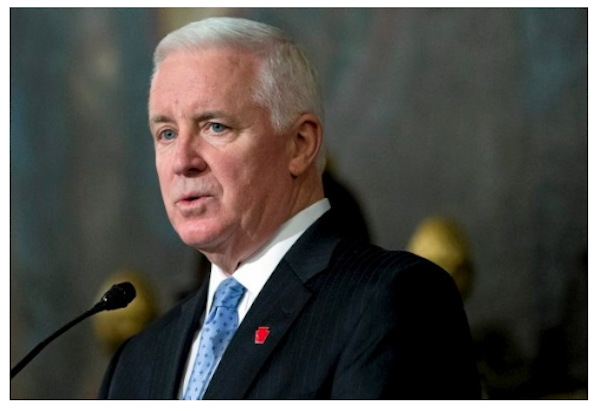
Gov. Tom Corbett issued an executive order Friday aimed at supporting his controversial proposal for new drilling for Marcellus Shale natural gas in state forests and in state parks to help balance the next state budget. Oil and gas development that results in no additional surface disturbance to state park and forest land is consistent with the Environmental Rights Amendment in the state Constitution, the order said. Corbett had said he would issue this executive order as part of the proposal to generate $75 million from lease payments through additional drilling. The order replaces a moratorium issued in 2010, by former Gov. Ed Rendell on additional gas drilling in state forest lands. “I am directing that the Commonwealth maintain a moratorium on any additional gas leasing of DCNR lands that involves long-term surface disturbance, such as placing well pads, roads or pipelines in the newly-leased areas,” Corbett said. Administration officials have said they want to allow gas firms operating on nearby parcels of privately owned land to drill underground to reach Commonwealth-owned gas deposits in the state parks and forests so long as it doesn’t disturb the land surface. But the Sierra Club of Pennsylvania and other environmental groups have said this drilling will create noise and air pollution and affect groundwater sources.

Movements Need To Realize: Transformation Is Complicated

The movement for social, economic and environmental justice is undertaking complex transformations. Moving an economy dominated by oil, coal, gas and nuclear energy to a carbon-free, nuclear-free energy economy is incredibly complex; moving from a big finance dominated capitalist system to economic democracy, an economy where people control their own economic destiny, communities unite to determine their future and people all have input into the national direction of the economy is equally complex. One of the simpler transformations would be to expanding and improving Medicare to apply to everyone in the United States away from the for-profit, insurance dominated system of today -- but even that is complicated as it is a transformation of 18% of the nation's GDP. These are just a few examples of many transformations we need to make (add to that poverty, loss of jobs due to robotics, ending war, ecological collapse among others) as the nation and world are facing many crisis situations that demand change. While we work for these complicated changes reality is also asserting itself and forcing change upon us. We are facing "complexity," lots of issues, lots of moving parts, systemic change of a modern, complicated society. There are people who have studied "complexity theory," one of those who have translated the research in this area into language that most of us can understand is Dave Pollard. The essay below is an introductory discussion of complexity in relation to social movement change written on October 10, 2010.

TransCanada Considers Rail As Pipeline Progress Slows

TransCanada Corp is in talks with customers about shipping Canadian crude to the United States by rail as an alternative route as its Keystone XL pipeline project that has been mired in political delays, Chief Executive Russ Girling said on Wednesday. "We are absolutely considering a rail option," Girling told Reuters on the sidelines of a conference in New York. "Our customers have needed to wait for several years, so we're in discussions now with them over the rail option." The comments are the first to confirm growing speculation that TransCanada might use more costly railway shipments as a stopgap alternative to the proposed Keystone XL pipeline, whose approval has been delayed by the U.S. government. Girling said the firm was exploring shipping crude by rail from Hardisty in Canada, the main storage and pipeline hub, to Steele City, Nebraska, where it would flow into an existing pipeline to the Gulf refining hub. The Keystone XL pipeline would deliver crude from the oil sands of northern Alberta to the U.S. Gulf Coast. The Obama administration signaled last month that there would be further delays to the regulatory process, which requires approval from the State Department.

US Oil Spills Increased by 17% in 2013

The rate of oil drilling in the U.S. leveled off in 2013, but the same can’t be said for the amount of spills that took place. According to a report from E&E Publishing, there were at least 7,662 spills, blowouts, leaks and similar incidents last year in 15 of the top states for onshore oil and gas activity. In states where the publication could compare results for both years, the publication determined there were about 20 more spills per day than in 2012. While most of the spills were small, they amounted to more than 26 million gallons of oil, fracking wastewater and more. That’s equivalent to the amount of oil BP gushed into the Gulf of Mexico in 2010.

“BP Out Of Opera” Calls On Cultural Institutions To Reject Oil Money

On May 20, 2014, BP Out of Opera performed a ‘flash dance’ just before the screening of a BP-sponsored performance of the Royal Opera House’s La Traviata. The group objects to BP sponsorship of the arts, joining a growing chorus of artists, actors and dancers who are acting out to bring attention to the oil money that is seeping into the art world as BP and other big oil companies attempt to greenwash their image by funding cultural events. A troupe of dancers took center stage at an outdoor screening before the opera began. In a video of the dancers performance,the opera’s boldly lettered “BP Big Screens” banner provides the backdrop behind the dancers. The three minute piece uses movement to communicate a power struggle between citizens and two characters representing BP who are adorned in BP logo-shawls. This flashy logo, with its rings of green and yellow diamonds, has provided much opportunity to costumers in this movement. Nice of BP to create such a pretty design for artists to riff on. In the case of this latest performance the logo-decorated costume piece ended up at the center of a tug-of-war between artists and security guards. At the end of the routine the dancers do finally succeed in pulling the BP shawls off the villains then throw the costumes on the ground and begin to stomp. At this point an opera security guard seems to mistake the company logo for a sacred symbol and he snatches the piece of costume off the ground. The dancers succeed in liberating their personal property and end the show to audience applause.

East Bay Oil Refinery Protest Draws About 100 Demonstrators

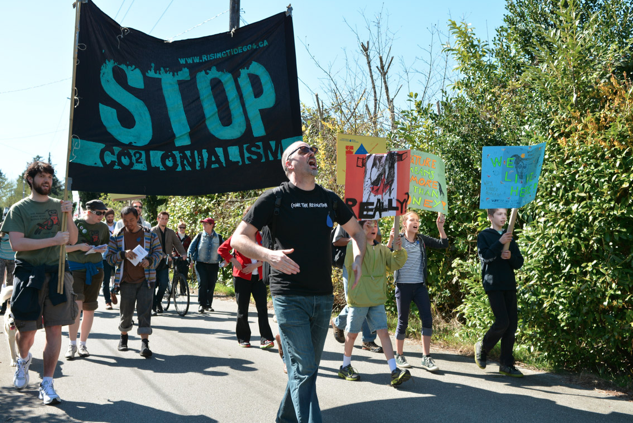
Accompanied by a four-kayak flotilla and a fifth-generation Martinez resident on horseback, about one hundred environmental activists marched seven miles from Martinez to Benicia on Saturday to protest the local toxic pollution and global climate impact of Bay Area oil refineries. The march was spearheaded by a Bay Area group affiliated with Idle No More, an organization of Canadian First Nations people fighting development of the tar sands oil fields in Alberta and other environmentally destructive projects on their traditional lands. Specific targets of the protest were proposed expansion projects at the Chevron (Richmond), Valero (Benicia), and Phillips 66 (Rodeo) refineries, a crude oil transportation terminal in Pittsburg planned by energy infrastructure company WesPac, and the major investment of Shell (Martinez) in the Canadian tar sands mines. The Saturday march was the second of four planned Refinery Corridor Healing Walks — the first, from Pittsburg to Martinez, was held in April, and future walks are planned for June and July, ending up at Chevron in Richmond. The series of walks aims to “connect the dots” to “bring awareness to the refinery communities, invite community members to get to know one another, and to show support for a just transition beyond fossil fuels,” according to the group’s website. At a gathering at the Martinez Regional Shoreline before the march, a winner of this year’s Goldman environmental prize, South African Desmond D’Sa, described the high rates of leukemia, cancer, and asthma in his home town of Durban and the community’s struggles against Shell Oil there, urging the crowd to “fight them (refineries) wherever they are.” Penny Opal Plant, of the East Bay Idle No More group, said she only recently began to conceive of the refinery corridor as a total area suffering from the “immense devastation” caused by oil refineries.

Protest At Museum To End Oil Company Funding

2011, Artists from art activist group Liberate Tate staged a performance in the Tate Britain on the anniversary of the Deepwater Horizon explosion that killed 11 workers and spilled 4.9 million barrels of oil into the Gulf of Mexico over 87 days. A naked member of the group had an oil-like substance poured over him by silent figures dressed in black and wearing veils, and lay in a fetal position on the floor in the middle of the exhibition Single Form. Dedicated to the human body, Single Form is one of a series of ‘BP British Art Displays’ staged throughout the galleries of Tate Britain. Liberate Tate is a network dedicated to taking creative disobedience against Tate until it drops its oil company funding. The network was founded during a workshop in January 2010 on art and activism, commissioned by Tate. When Tate curators tried to censor the workshop from making interventions against Tate sponsors, even though none had been planned, the incensed participants decided to continue their work together beyond the workshop and set up Liberate Tate.
assetto corsa mods

Urgent End Of Year Fundraising Campaign

Online donations are back! Keep independent media alive. 

Due to the attacks on our fiscal sponsor, we were unable to raise funds online for nearly two years.  As the bills pile up, your help is needed now to cover the monthly costs of operating Popular Resistance.

Urgent End Of Year Fundraising Campaign

Online donations are back! 

Keep independent media alive. 

Due to the attacks on our fiscal sponsor, we were unable to raise funds online for nearly two years.  As the bills pile up, your help is needed now to cover the monthly costs of operating Popular Resistance.

Sign Up To Our Daily Digest

Independent media outlets are being suppressed and dropped by corporations like Google, Facebook and Twitter. Sign up for our daily email digest before it’s too late so you don’t miss the latest movement news.