Skip to content

Privacy

The NSA Spies On Us—But On Whom Specifically? And Why?

We know the NSA has been vacuuming up personal digital data like an obsessive-compulsive house cleaner. What we don’t know is whom the feds have been targeting, and why. Seth Rosenfeld is the author of “Subversives: The FBI’s War on Student Radicals, and Reagan’s Rise to Power,” which won the 2013 Pen Center USA Award in the “research nonfiction” category. In the op-ed, Rosenfeld details a dark history of government surveillance of American citizens, and notes that it took the Church Committee in the days of post-Watergate cynicism toward government to determine the assaults on civil liberties that occurred under the guise of national security. Rosenfeld calls for a new version of the Church Committee to start shining a light into the government’s darkest corners to get answers to some specific questions.
Judge Upholds NSA’s Phone Data Sweeps

Ruling that the government’s global telephone data-gathering system is needed to thwart potential terrorist attacks, and that it can only work if everyone’s calls are swept in, a federal judge in New York City ruled Friday that Congress legally set up the program and that it does not violate anyone’s constitutional rights. The decision conflicts in many key respects with a ruling earlier this month by a federal judge in Washington, D.C., who concluded that, after a full trial in court, the program almost certainly will be found to be unconstitutional. Appeals are expected in both cases, and one or more cases like these ultimately will reach the Supreme Court. Given the fact that the issues surrounding the National Security Agency’s global “metadata” program are novel and not easily resolved, it is no surprise that judges are ruling differently. That very difference, though, is likely to enhance the prospects that the Supreme Court sooner or later will agree to resolve the dispute.

Video: Snowden’s Christmas Message

Edward Snowden delivered an ‘Alternative Christmas Message’ on British TV on Wednesday. In his pre-recorded address, the whistleblower calls for an end to mass spying by governments, stating that a child born today will have "no conception of privacy." Snowden, who is behind the biggest leak in the US National Security Agency (NSA)’s history, will speak to Brits on December 25 in Channel 4’s annual message. The address is an alternative to the Queen’s Christmas speech, which is shown by the nation’s other leading broadcasters each year. The video was filmed in Russia, where Snowden has lived since being granted temporary asylum in August. The address will be his first television appearance since arriving in Moscow. In excerpts from the address published by Channel 4, Snowden says that British author George Orwell's warnings of data collection in his classic dystopian novel ‘1984’ are “nothing compared to what we have available today.” “The types of collection in the book – microphones and video cameras, TVs that watch us – are nothing compared to what we have available today. We have sensors in our pockets that track us everywhere we go. Think about what this means for the privacy of the average person.”

Snowden Ally Says Berlin Apartment Subject To Raids

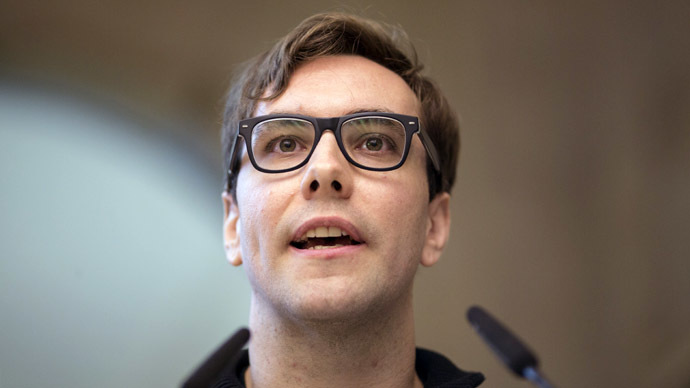
Applebaum described strange scenarios which have been haunting him. “When I flew away for an appointment, I installed four alarm systems in my apartment,” Appelbaum said. “When I returned, three of them had been turned off. The fourth, however, had registered that somebody was in my flat - although I'm the only one with a key. Some of my effects - the positions of which I carefully note - were indeed askew. My computers had been turned on and off,” he added. “The monitoring pressure has ultimately destroyed my relationship with my girlfriend,” he mourned. The internet activist, journalist and cybersecurity specialist is a core member of the Tor encrypted network and has well-documented ties to WikiLeaks. Appelbaum believes that the intention behind the incidents is to make him feel uncomfortable - so that he knows they “care” about him “while leaving no possible evidence.” He reiterated his commitment to internet freedoms and the right to privacy. “It's about protecting our core values against a totalitarian surveillance state - whether in analogue or in the digital world,” he said.

Video: Drones in Yemen, Hunger Games In America & Corporate Espionage

On this episode of The Resistance Report: 1. Dennis Trainor, Jr. talks about the 15 innocent people in Yemen who were killed Thursday by a U.S. Drone attack. The 15 homicide victims will be called collateral damage, and yet we are not at war with Yemen. 2. We hear the haunting yet absurd steps taken by the NSA to monitor citizens. Unfortunately for activists, revolutionaries, and other agents of social change, that’s only the “state” prong of surveillance. The corporate arm is much more damning. 3. Donald Sutherland, who stars in the Hunger Games Franchise, wants to see a revolution that brings about the end of the American Empire, and he wants the Hunger Games movies to be a spark for that flame. 4. A group called We the People Maine went to the State House on Wednesday to deliver a formal request for the Legislature to apply for a Constitutional Convention of States to overturn Citizens United and establish that “corporations are not people and money is not speech.”

A New TSA Harassment Coming: Searches To Leave The Airport

A few weeks ago I caught wind of another nifty whiz-bang airport innovation guaranteed to make your journey even more onerous than it already is. And of course, it’s brought to you by our trusty friends at the TSA. At Syracuse International Airport, you can’t leave — after you’ve gotten off the plane, collected your baggage, and are ready to hit the road — unless you pass through electronically controlled, wholly contained, glass portals. If you’ve ever been to a European bank, you know what these are. They hold only one person at a time. You step in, a cylindrical glass door locks around you, then when someone in the bank decides you’re not a bank robber, they release the lock and allow you to proceed. Same for the next person. Thus, only one person at a time can enter, not a slew of people all at once. This brilliant idea came to Syracuse with a $60 million price tag, part of an airport renovation. ‘We need to be vigilant and maintain high security protocol at all times. These portals were designed and approved by TSA which is important,’ said Syracuse Airport Commissioner Christina Callahan.

Activist Videos Border Patrol In Over 300 Searches

“This is not increasing our security, in fact, it’s making us less secure. It’s just feeding an empire building, it’s feeding agency budgets, and job security for various law enforcement agencies,” says the University of Arizona’s Terry Bressi of in-country immigration checkpoints. Bressi sat down with ReasonTV’s Tracy Oppenheimer to discuss these checkpoints and their implications for civil liberties. Bressi estimates that he has been stopped by border patrol between 300-350 times. After his first encounter, he started carrying cameras and audio recording equipment, and has since been videotaping his checkpoint interactions. He says this holds officers accountable for their actions, and he hopes that by posting these videos online, citizens will become more aware of their rights. “A federal agent who is standing in the middle of a public highway, wearing a public uniform, collecting a public paycheck while seizing the public absent reasonable suspicion has no expectation of privacy,” says Bressi in regards to filming border patrol agents.

Rising Corporate Espionage: Why We Need Jeremy Hammond

Corporations are increasingly spying on nonprofit and activist groups, according to a new report from corporate watchdog and Ralph Nader brainchild Essential Information. The report, released this week, found that “Many different types of nonprofits have been targeted with espionage, including environmental, anti-war, public interest, consumer, food safety, pesticide reform, nursing-home reform, gun control, social justice, animal rights and arms control groups,” with major corporations employing former CIA, NSA and FBI agents to carry out the private surveillance work. Essential Information claims that a number of corporate espionage operations are both “unethical” and “illegal.” E.I. reported: "Many of the world’s largest corporations and their trade associations — including the U.S. Chamber of Commerce, Walmart, Monsanto, Bank of America, Dow Chemical, Kraft, Coca-Cola, Chevron, Burger King, McDonald’s, Shell, BP, BAE, Sasol, Brown & Williamson and E.ON – have been linked to espionage or planned espionage against nonprofit organizations, activists and whistleblowers."

People Who Have Fought Successfully Against Surveillance

Fighting Surveillance Tactics and Winning Through increasingly sophisticated surveillance technologies, corporations and the government track our everyday activities, often in the name of protecting Americans from terrorist attacks. Heidi Boghosian, a civil rights lawyer, told Bill Moyers this week that these two powerful forces are “hand-in-hand working to gather information about Americans as well as people across the globe.” But Boghosian says some people are refusing these intrusions into their privacy and coming out on top. Here are some of their stories. They include: Andrea Hernandez: Don’t track me, Nicholas Merrill: Gagged for six years but silent no more, Mike Webb: Keep your scanners away from my child, Time’s Up: Guilty by association?

Hedges: Jeremy Hammond Exposed State’s Criminalization Of Dissent

Without figures like Jeremy Hammond, Edward Snowden, Chelsea Manning, Julian Assange, Barrett Brown, there is no free press. Jeremy Hammond broke into the private security firm known as Stratfor, which does work for a variety of intelligence agencies--for the Marine Corps and the Defense Department, the Pentagon, but also for corporations, including Raytheon, Dow Chemical, and others. And he turned over 3 million emails, email exchanges within the company to Rolling Stone, WikiLeaks, and other publications. Now, this was quite a significant dump, because it illustrated two or three very chilling things about the security and surveillance state, first of all that there was no division between corporate spying and government spying. It was seamless, including the same people going back and forth. It was from that dump that we realized the extent to which the Occupy movement was being spied upon and infiltrated and monitored and followed. And we also found from those email exchanges that there was a concerted attempt on the part of security officials, both inside the government and within the private security contracting agency, to link, falsely, nonviolent dissident groups with terrorist groups so that they could apply terrorism laws against these groups.

Why We Are Allowed To Hate Silicon Valley

“Is it O.K. to be a Luddite?” ran the title of a fabulous 1984 essay by Thomas Pynchon – a question that he answered, by and large, in the affirmative. This question feels outdated today. “Is it okay not to be a Luddite but still hate Silicon Valley?” is a much better question, for the real enemy is not technology but the present political and economic regime – a wild combination of the military-industrial complex and the out-of-control banking and advertising – that deploys latest technologies to achieve its ugly (even if lucrative and occasionally pleasant) ends. Silicon Valley represents the most visible, the most discussed, and the most naive part of this assemblage. In short, it’s okay to hate Silicon Valley – we just need to do it for the right reasons. Below are three of them – but this is hardly an exhaustive list.

Videos & Photos: “Hey, National Security Agency: Stop Watching Us!”

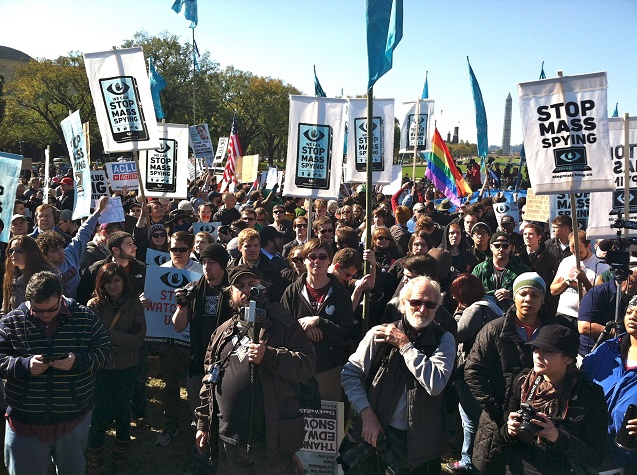
A huge rally was held on Saturday morning, Oct. 26th, at Columbus Circle, directly in front of the historic Union Station in Washington, D.C. Stopping the National Security Agency’s (NSA) massive spying/surveillance on its own citizens was the focus of the spirited protest action. Politicos, celebrity authors, NSA whistleblowers and Civil Liberty champions all made an appearance. What the spooks from the NSA have been up to is beyond Orwellian. Of course, musical ambience was provided for the event. After the rally at Union Station, the crowd continued protesting by parading over to the U.S. Capitol with their anti-NSA/surveillance banners blowing in the wind.

People Are Developing A Tech Solution To Stop NSA Spying

Two American companies with a track record of offering encrypted private communications are set to join forces in an unprecedented bid to counter dragnet Internet spying. Some of the world’s top cryptographers are behind the secure communications provider Silent Circle, and they’ve teamed up with the founder of Lavabit, the email provider used by Edward Snowden, which recentlyshut down in a bid to resist surveillance. They’re calling it the “Dark Mail Alliance.” For months, the team has been quietly working on rebuilding email as we know it—and they claim to have had a breakthrough. The newly developed technology has been designed to look just like ordinary email, with an interface that includes all the usual folders—inbox, sent mail, and drafts. But where it differs is that it will automatically deploy peer-to-peer encryption, so that users of the Dark Mail technology will be able to communicate securely.

Video, Photo Essay & Samples Of News Coverage #StopWatchingUs

Thousands gathered by the Capitol reflection pool in Washington on Saturday to march, chant, and listen to speakers and performers as part of Stop Watching Us, a gathering to protest "mass surveillance" underNSA programs first disclosed by the whistleblower Edward Snowden. Billed by organizers as "the largest rally yet to protest mass surveillance", Stop Watching Us was sponsored by an unusually broad coalition of left- and right-wing groups, including everything from the American Civil Liberties Union, the Green Party, Color of Change and Daily Kos to the Libertarian Party, FreedomWorks and Young Americans for Liberty. The events began outside Union Station, a few blocks away from the Capitol and ended in front of the US Capitol Building.

Who Buys the Spies?

As the storm over surveillance broke, we were completing a statistical analysis of campaign contributions in 2012, using an entirely new dataset that we constructed from the raw material provided by the Federal Election Commission and the Internal Revenues Service (which compiles contributions from so-called “527”s). In light of what has transpired, our quantitative analysis of presidential election funding invites closer scrutiny, particularly of the finding that we had already settled upon as perhaps most important: In sharp contrast to endlessly repeated claims that big business was deeply suspicious of the President, our statistical results show that a large and powerful bloc of “industries of the future” – telecommunications, high tech, computers, and software – showed essentially equal or higher percentages of support for the President in 2012 than they did for Romney. Though documenting the claim would take us far beyond this post, we believe that the emergence of these new industries is a key factor in transforming the old National Security State into its new, even more sinister twenty-first century model.
assetto corsa mods

Urgent End Of Year Fundraising Campaign

Online donations are back! Keep independent media alive. 

Due to the attacks on our fiscal sponsor, we were unable to raise funds online for nearly two years.  As the bills pile up, your help is needed now to cover the monthly costs of operating Popular Resistance.

Urgent End Of Year Fundraising Campaign

Online donations are back! 

Keep independent media alive. 

Due to the attacks on our fiscal sponsor, we were unable to raise funds online for nearly two years.  As the bills pile up, your help is needed now to cover the monthly costs of operating Popular Resistance.

Sign Up To Our Daily Digest

Independent media outlets are being suppressed and dropped by corporations like Google, Facebook and Twitter. Sign up for our daily email digest before it’s too late so you don’t miss the latest movement news.