Skip to content

Protest

Rally to Raise Minimum Wage, Cut Corporate Tax Breaks

As Congress returned from a two-week recess, more than 1,500 people gathered at the Capitol to protest the growing chasm between rich and poor Americans, calling on Congress to stand with everyday people instead of corporate special interest groups. Immediate demands included a raise in the minimum wage and cuts to corporate tax breaks, both key causes of rising economic inequality and the result of Congressional lawmakers who cater to out of control corporate interests. “Today we came together and marched 1,500 strong to take back the capitol by saying NO to poverty wages and NO to corporate giveaways. Congress must put workers and their families before profits. We're showing that our labor and our voices matter, and together we're fighting for a new economy that will work for us all,” said Gilda Blanco, a member of the National Domestic Workers Alliance (NDWA). Together, members from a range of worker and economic justice groups — including National People’s Action (NPA), Restaurant Opportunities Centers (ROC) United, the National Domestic Workers Alliance, and OurDC — came together as part of a broad and growing movement to underscore the wide-spread damage big corporations do to everyday, working people.

UT Students Arrested During Sit-In Protest Against Staff Cut-Backs

Eighteen UT students stepped out of Travis County Jail yesterday morning, where they spent 14 hours after being charged with criminal trespassing during a sit-in demonstration at UT President Bill Powers’ office. The student activists, who staged the sit-in to protest the university’s "Shared Services" plan to eliminate staff jobs and consolidate responsibilities, were arrested around 5 p.m. Wednesday. Among the students were representatives from campus organizations University Democrats, University Leadership Initiative, and United Students Against Sweatshops. According to activist leader Bianca Hinz-Foley, student groups have attempted to meet with Powers for the past 14 months, and went to UT’s tower to “sit and wait there until President Powers actually responded to all of the people who have spoken out against this plan.” Hinz-Foley said Powers did not make an appearance during the demonstration. A rally against the "Shared Services" program kicked off the sit-in demonstration, during which several staff members spoke, along with faculty members and Councilman Mike Martinez.

Madrid People’s Creative Response to Imposed Austerity

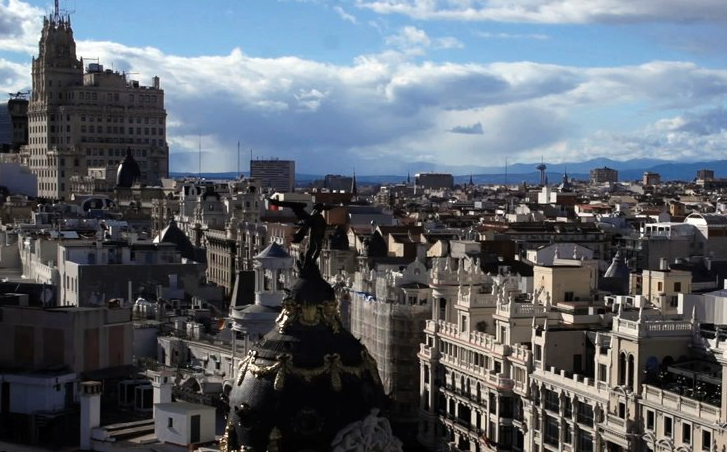
This short documentary explores ongoing resistance and self-organization in the midst of the economic and social crisis in Madrid, Spain. As social conditions continue to deteriorate across the country, people have been turning to the streets and to each other to find for solutions to the crisis. This film tells a story of the massive mobilization that saw millions of people converge on Madrid on March 22nd 2014, the story of the proliferation of social centers, community gardens, self-organized food banks, and the story of large-scale housing occupations by and for families that have been evicted. The film pieces together many of the creative ways that people have been coping with crisis and asks what the future may hold for Spain. Filmed and edited in March/April 2014, it is part of the Global Uprisings documentary series. View more at globaluprisings.org.

The Modern History of Venezuela, The Protests and Democracy

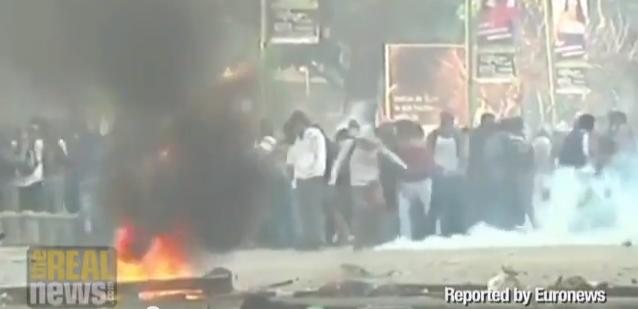
LANDER: Who won an election as president. And there were municipal elections a few months ago, and the government won by a difference of 10 percent. Ten percent. So it's obvious that the government has majority backing in the country. These mobilizations and these barricades, which are mostly barricades, more than anything else, are anything but pacific mobilizations. And nobody can pretend that there's a constitutional right to blockade streets, to put barbed wire across the streets so that at least two motorcyclists have been killed, decapitated by the barbed wire. Nobody can claim to have a constitutional right to burn public buildings. Nobody can claim to have a constitutional right to have snipers killing policemen. And that's what happened. JAY: And if you compare that to the mass arrests in the United States at the Republican convention, the Democratic Party convention, or in Toronto, Canada, after the G20 meetings, where 1,000 people were arrested when clearly it was a handful of people that were involved in any violence, it's the height of hypocrisy the way the Western media covers all this.

Rana Plaza Factory Disaster Anniversary Marked By Protests

Thousands of people, some wearing funeral shrouds, staged demonstrations at the site of the Rana Plaza factory complex on Thursday on the one-year anniversary of the Bangladesh disaster that claimed 1,138 lives. The demonstrators – who included injured survivors and the families of the deceased – marched to the ruins of the nine-storey building carrying flowers and chanting slogans including "We want compensation!" and "Death to Sohel Rana!", the owner of the building. Relatives of the 140 workers still unaccounted for also joined in, calling on the government to help find their bodies. They included toddlers holding photos of their missing mothers. "I want my daughter's dead body. At least it would give us some consolation," said Minu Begum, clutching the photo of her missing daughter, Sumi Begum, who worked at one of Rana Plaza's five factories.

Ceremony of Gifts, Prayers Unites Indians and Ranchers of “Reject and Protect”

The Cowboy Indian Alliance marked the first day of the “Reject and Protect” encampment on the National Mall today with prayer ceremonies and offerings to each other, the Earth and its people. With prayer, songs and burning sage, Native Americans dressed in full tribal regalia along with ranchers and farmers who had traveled to Washington from the U.S. “Heartland” officially kicked off the six-day protest against the Keystone XL pipeline. Their message to President Obama and their state legislatures: reject the Keystone XL pipeline project. “The Keystone pipeline is the main focus,” said Jeff Horinek of the Ponca Nation. “We depend on water, and a lot of the country’s produce comes from the heartland of the country.” Horinek said the Keystone XL pipeline would run directly across from his home. He plans to leave if it is approved.

Asia-Pacific Voices Protest TPP and US Corporate Colonialism

As President Barack Obama prepares to embark on his fifth visit to the Asia-Pacific region, grassroots protests against U.S. efforts to ram through the Trans-Pacific trade deal and the U.S. military pivot to Asia are mounting on both sides of the Pacific. "People are saying we don't want more U.S. militarization in our countries," said Rhonda Ramiro, Vice Chair of BAYAN-USA—an alliance of Filipino organizations in the U.S.—in an interview with Common Dreams. "This is about U.S. military power and economic domination." In the coming days, protests against the TPP and U.S. military pivot will sweep U.S. embassies in Japan, South Korea, and the Philippines, with more actions slated for the "weeks and months to come," said Ramiro. Channel News Asia reports that in Tokyo, where Obama will land Wednesday, protests against the TPP by workers, farmers, and community groups are already heating up.

Revolution 101: Steve D’Arcy On Militant Protest

First, let me say what I don't mean by "militancy." I'm not using this word as a euphemism for violence. The whole theme of violence and nonviolence gets too much attention and distracts us from more basic and pressing questions. Instead, I define militancy as grievance-motivated collective action that is both adversarial and confrontational. Militancy is adversarial in the sense that, instead of seeking to find common ground with its targets, it identifies them as adversaries to be defeated or to be forced into retreat. For example, the companies that profit from the tar sands, and the politicians that serve these business interests, are not potential partners for a meeting of the minds. If they are to be stopped, it will have to be through determined struggle; relentless, escalating, and with a broadening base of participation. We have to identify these targets as adversaries, and work to build an alliance of people and organizations willing to fight them and defeat them. Militancy is confrontational in the sense that it actively encourages conflict, rather than seeking to resolve or limit the animosity and disorder that conflict generates. In Martin Luther King's words, militancy seeks "to create a crisis" and "to foster tension." Defeating a determined and hostile adversary -- someone like Prime Minister Stephen Harper, for example -- requires a willingness to defy the authority of that adversary, and to disrupt the functioning of the systems of power from which that adversary draws strength.

Livermore Lab Arrests 40 At Good Friday Anti-Nuke Protest

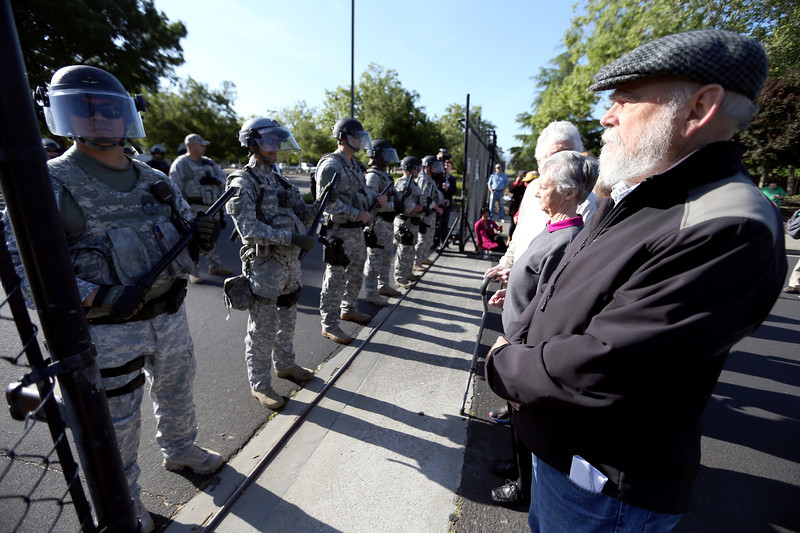
The Alameda County Sheriff's Department, California Highway Patrol and Livermore Police Department assisted in the arrests. According to lab officials, the west gate was closed for two hours. The annual Good Friday protest is organized by the Ecumenical Peace Institute of Berkeley and the Livermore Conversion Project in Oakland. It has been held for about the past 30 years. "The message of today's event is that we've got to stop devoting our valuable resources, our energy, our money, and our intelligence in the service of killing people, and turn it toward creating things that give life," said Ecumenical Peace Institute program coordinator Carolyn Scarr, who was among those arrested. At the gathering, keynote speaker Kathy Kelly, co-coordinator of Voices for Creative Nonviolence, talked about the impacts of military intervention in Iraq and Afghanistan.

Cowboy Indian Alliance Camp Comes To Life On National Mall

Set-up of the campsite by the Cowboy Indian Alliance for a week-long protest against the Keystone XL pipeline began on the National Mall in Washington, DC today. “Reject and Protect” officially begins tomorrow with an opening ceremony at the Capitol Reflecting Pool at 11am. So far seven tipis standing 20 feet tall have been assembled with one in progress and more to go up tomorrow. Several will be painted with ceremonial tribal designs as the week progresses. Ranchers, farmers and members of native communities along the pipeline route formed the Cowboy Indian Alliance to stand against energy company TransCanada’s efforts to acquire land under eminent domain. Cyril Scott, President and Tribal Leader of the Rosebud Sioux Tribe, watched over the camp while other tribal leaders and elders met nearby. “We are here to stop the Keystone XL and protect our people and water,” he said.

Environmentalist Kicked Out Of Chevron-Sponsored Event

After organizers of a Chevron-sponsored economic development summit learned of a paying attendee’s association with an environmental watchdog, he was forcibly ejected from the event. On Wednesday, Paul Paz y Miño was standing at the back of the ballroom of the Marriott Convention Center during the Economic Development Summit for Energy and Sustainability in Oakland, Calif., when he was approached by a woman. The woman asked Paz y Miño, the online and operations director for the environmental watchdog organization Amazon Watch, about a stack of papers he had. When it was revealed that he was holding about 40 flyers regarding Chevron’s controversial environmental actions and its Richmond, Calif., community news website, Richmond Standard, three security guards arrived to physically remove Paz y Miño from the summit. Getting kicked out of the event may have surprised Paz y Miño if oil and energy giant Chevron had not been the event’s presenting sponsor.

Cowboy Indian Alliance Stands The Line In DC Against Keystone XL

On Earth Day, April 22, ranchers and members of native communities along the proposed route of the Keystone XL Pipeline will arrive in Washington, DC to reject the pipeline and protect their land. The coalition, called the Cowboy Indian Alliance, will set up an encampment on the National Mall through April 27 to oppose the pipeline that would transport dilbit from the tar sands of Canada to the refineries of the Gulf Coast. “Reject and Protect,” as it is called, promises to be yet another major anti-Keystone XL protest. The builder of the Keystone XL, TransCanada Corp., has applied to the State Department for a cross-border permit. Final approval rests with President Obama. “We want to tell the President that this is much bigger than protecting unions or environmentalists. It’s about protecting land, water, and homes,” says Jane Kleeb of Bold Nebraska, one of the sponsoring organizations. Over a dozen tribes—including Sioux, Rosebud, Crow, and Yankton—will pitch fifteen tipis in front of the Smithsonian Museum of Natural History. A covered wagon will represent ranchers.

Global Climate Convergence Activists Protest BP Lake Michigan Spill

Monday afternoon, an estimated 500 gallons of oil from the tar sands in Alberta, Canada, leaked into Lake Michigan, poisoning the source of drinking water for 7 million people in and around Chicago. The BP Refinery on the lake’s shore has admitted responsibility, but has yet to take sufficient action to ensure the safety of our drinking water and ecosystem. This serves as further evidence that the reliance on fossil fuels in all its forms has serious and long term effects on the health of the planet and the people who inhabit. This is doubly true in the case of the processing or tar sands that goes on at BP’s Whiting facility. This most current spill comes after years of legal challenges to the Whiting plant that is one of the largest sources of industrial pollution in the nation.

Living The Most Revolutionary Times In History

If Karl Marx raised his head, he would be absolutely baffled: Revolts are shaking the world, bursting in the most unexpected places, but they rarely take power. The conditions for rebellion are as sharp today as in the nineteenth century, but few protests lead to the literal meaning of revolution, that "violent change in political, economic or social institutions of a nation." In addition, working people, whom Marx called the proletariat, seem not to have found control of the worldwide riots they are sparking – nor is class struggle the leitmotif of the wave of social unrest that has been repeating since the Arab Spring. Instead, a new political subject – more diffuse, more heterogeneous, more unclassifiable – is blurring the boundaries and formal definitions of revolution. Measuring the period between 2006 and 2013, we live in the most agitated era in modern history – more intense than 1848, 1917 or 1968 – according to the World Protests report released last fall by the Initiative for Policy Dialogue and the Friedrich Ebert Stiftung in New York.

Taiwanese Protesters Plot Next Steps After Parliament Occupation

At 6:07 a.m. on April 10, the students inside the Taiwanese parliament voluntarily left the assembly hall while 20,000 people outside showed their support and witnessed the end of the occupation. The students passed sunflowers one by one from the parliament to the crowd to symbolize planting the seeds of democracy in Taiwanese society. This action was followed by a series of lectures and the crowd sang, once again, the Sunflower Movement protest song “Island’s Sunrise” together. Since April 7, when the students announced the end of their protest, the students gradually began to clean up the parliament. They took down the banners on the facade of the parliament, placed the room chair in correct order and cleaned most of the rooms. It was a calm ending to an occupation that had extended for almost a month — a standoff between the Sunflower Movement student protesters and President Ma Ying Jeou’s government.
assetto corsa mods

Urgent End Of Year Fundraising Campaign

Online donations are back! Keep independent media alive. 

Due to the attacks on our fiscal sponsor, we were unable to raise funds online for nearly two years.  As the bills pile up, your help is needed now to cover the monthly costs of operating Popular Resistance.

Urgent End Of Year Fundraising Campaign

Online donations are back! 

Keep independent media alive. 

Due to the attacks on our fiscal sponsor, we were unable to raise funds online for nearly two years.  As the bills pile up, your help is needed now to cover the monthly costs of operating Popular Resistance.

Sign Up To Our Daily Digest

Independent media outlets are being suppressed and dropped by corporations like Google, Facebook and Twitter. Sign up for our daily email digest before it’s too late so you don’t miss the latest movement news.