Skip to content

Public Workers

Sanitation And City Services Workers Strike In Philly Labor Battle

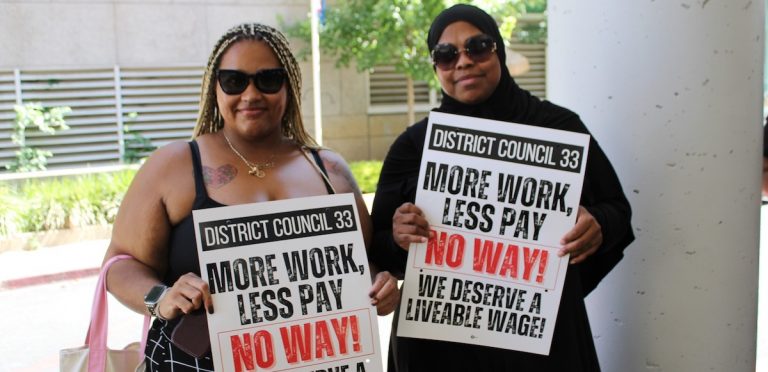
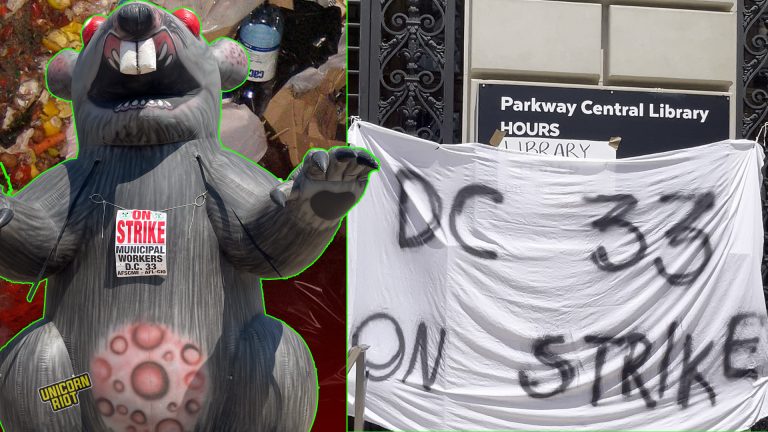
Philadelphia, PA —  A working class uprising continued through Fourth of July celebration week in the “poorest big city” in the United States. Jammed locks at health centers, opened fire hydrants, slashed tires, blocked trucks, and blocked access to work sites were just a few allegations brought by City Solicitor Renee Garcia in a recent press conference. Two injunctions have been filed that require a limited number of essential workers to return to work and a third aims to stop “unlawful activity” by union members who are striking for better pay and benefits. Despite court orders, the city had received numerous reports of noncompliance, according to Garcia, “and they have not stopped.”
‘Holding The Line’: Municipal Workers’ Strike Enters Second Week

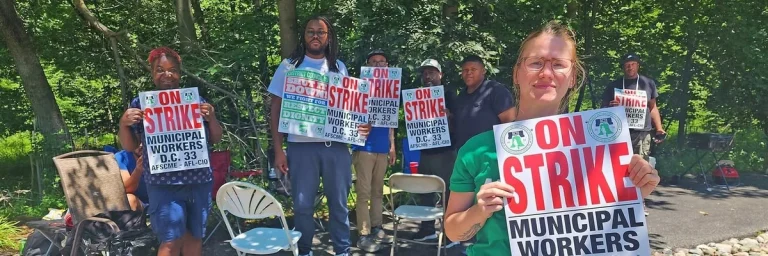
Philadelphia's largest municipal workers' strike in over 40 years is entering its second week after negotiations with the city broke down this weekend. Over 9,000 sanitation workers, 911 dispatchers, water services workers, crossing guards, and other city employees walked off the job last week, demanding that the city increase their salary enough to meet the rising cost of living. But even with trash piling up on the streets and other city services understaffed, Mayor Cherelle Parker (D) would not agree to the demands made by AFSCME District Council 33, Philadelphia's largest blue-collar union. Parker has offered a pay increase of 8.75% over the next three years, which she described as historic.

Philadelphia Municipal Workers Strike Before July 4 Celebrations

Nine thousand blue-collar workers who make Philadelphia run went on strike July 1. After sacrificing through the pandemic and years of bruising inflation, they say they’re on strike so they can afford to live in the city they serve. Already, uncollected garbage is piling up as the workers, members of AFSCME District Council 33, defend their strike lines. The COVID-19 pandemic brought the term “essential worker” into widespread use, but many experienced a gap between how they were talked about and how they were treated. They were called essential, but regarded as disposable. In June 2020, at the height of the pandemic, hundreds of Philadelphia sanitation workers and other DC 33 members rallied to demand hazard pay and personal protective equipment.

The Movement Supporting Public Employees Is Rising

Thousands of workers hit the streets February 19, all around the country — at federal offices like the Department of Health and Human Services, at Tesla dealerships and public spaces — to declare their opposition to the slashing and burning of public services currently happening under the guise of ​“efficiency.” Workers focused on billionaire Elon Musk’s power within President Donald Trump’s new administration, through the so-called Department of Government Efficiency (DOGE). National Park Service workers, standing in the snow, brandished signs reading, ​“Immigrants didn’t steal my job. The president did.”

Québec Workers Conduct Largest Strike Ever

One of the largest strikes in North American history happened this winter and the struggle is ongoing. In Québec, 420,000 public sector workers in health care and education, united in a “Common Front” (Front Commun) of four major union federations, spent seven days on strike December 8-14. This followed half-day and three-day work stoppages in November. In addition to the Common Front, 66,500 workers in one of the teachers unions—la Féderation Autonome d’Enseignement (FAE)—were on strike for more than a month and more than 80,000 workers with a nurses union, la Fédération Interprofessionelle de la Santé du Québec (FIQ), struck December 11-14.

Québec Public Sector Workers Are Ready For A General Strike

Fed up with the deterioration of public services under the Coalition Avenir Québec (CAQ) government, thousands took to the streets to demand fair pay, improved benefits, and better working conditions while unions negotiated new collective agreements with the province. The coalition of unions—including the Confédération des syndicats nationaux (CSN), the Centrale des syndicats du Québec (CSQ), the FTQ, and the Alliance du personnel professionnel et technique de la santé et services sociaux (APTS)—is known as the “common front,” or front commun, and represents over 420,000 workers in Québec’s public schools, health care and social services sectors.

The Tories Are Causing A Potential ‘Exodus’ Of Public Sector Workers

Nearly two million public sector workers are thinking about quitting their jobs, with nearly half saying it’s because of pay. These are the results of new research from the Trades Union Congress (TUC), which says the Tories are causing a “mass exodus” of workers from the public sector. And it’s the NHS which will be the biggest casualty of over a decade of Tory-led pay cuts. However, public sector workers aren’t taking the Tories’ pay assault lying down. As we’ve seen in recent months, strike action in the private sector has taken off. Now, in the public sector, the Royal Colleges of Nurses and Midwives, the National Education Union (NEU) and Unison have been balloting members on strike action.

The Insidiousness Of Iowa’s Chapter 20 Anti-Union Labor Law

Iowa City, Iowa - On a chilly Friday morning In Iowa City, a handful of graduate students and members of UE Local 896 enter their union office and prepare to call as many fellow workers as they can. Most calls go to voice mail, but those who answer will hear something like this: “Hi there, this is Caleb from our labor union. We’re just checking in with folks to see if you’ve had a chance to vote in our recertification election?” We briefly explain the importance of the election to those who don’t know. We need a majority of all 1,932 TAs and RAs, not just members, to vote yes to keep the union legally recognized. If you don’t vote, you are counted as a no against the union. And this is all because of a 2017 law change here in Iowa. Currently, we are in the second week of the recertification election process, and we’re not alone.

Virginia Public Sector Workers Organize To Make Their New Bargaining Rights A Reality

When Virginia changed its law last year to allow local government workers to bargain collectively, it was a leap forward in a time when the trend is generally in the opposite direction. As always, the devil is in the details—and there’s a lot of devilry here. But the change presents a substantial opening for unions. Now teachers, firefighters, and sewer workers are getting organized and pushing local governments to bargain over such issues as pay and staffing. Bargaining is still banned for state employees. But the new law, which takes effect May 1, allows cities, counties, and towns to bargain with their employees, an activity that had been expressly forbidden since a 1977 state Supreme Court ruling, codified by a 1993 law.
assetto corsa mods

Urgent End Of Year Fundraising Campaign

Online donations are back! Keep independent media alive. 

Due to the attacks on our fiscal sponsor, we were unable to raise funds online for nearly two years.  As the bills pile up, your help is needed now to cover the monthly costs of operating Popular Resistance.

Urgent End Of Year Fundraising Campaign

Online donations are back! 

Keep independent media alive. 

Due to the attacks on our fiscal sponsor, we were unable to raise funds online for nearly two years.  As the bills pile up, your help is needed now to cover the monthly costs of operating Popular Resistance.

Sign Up To Our Daily Digest

Independent media outlets are being suppressed and dropped by corporations like Google, Facebook and Twitter. Sign up for our daily email digest before it’s too late so you don’t miss the latest movement news.