Skip to content

Ferguson

Officer Darren Wilson Testified Before Grand Jury

CLAYTON • Ferguson police Officer Darren Wilson testified here for almost four hours Tuesday in front of the St. Louis County grand jury investigating his shooting Aug. 9 of Michael Brown, a source with knowledge of the investigation said Wednesday. Wilson was not obligated to appear, and also has spoken with St. Louis County investigators twice and federal investigators once, the source said. The source said Wilson was “cooperative.” A spokesman for Prosecuting Attorney Robert McCulloch’s office, Ed Magee, refused to comment Wednesday on who had testified. The shooting of Brown, 18, who was black and unarmed, by Wilson, who is white, gave rise to racially charged protests and looting. Some activists have threatened more of the same if the grand jury does not indict Wilson.

Fury Of Ferguson Descends On St. Louis County

The fury of Ferguson descended on the seat of St. Louis County with a vengeance Tuesday night with demonstrators unleashing a torrent of chants, invective and threats at a County Council that listened for two hours in stunned silence. Protesters demanded the arrest of Darren Wilson, the police officer who shot 18-year-old Michael Brown to death on a Ferguson street five weeks ago, the removal of County Prosecutor Robert McCulloch from the Brown case, the resignations of County Police Chief Jon Belmar and Ferguson Police Chief Thomas Jackson and accountability from the elected county legislative arm. But the bulk of the ire was directed at Steve Stenger, the 6th District Democratic councilman facing Republican state Rep. Rick Stream in the November general election in the race for county executive. Several speakers demanded that Stenger call on his “BFF (Best Friend Forever)” St. Louis County Prosecuting Attorney Robert McCulloch to resign by noon today. McCulloch was the councilman’s chief political ally in Stenger’s primary defeat of incumbent County Executive Charlie Dooley four days before Brown was shot to death.

Hands Up Mass Mobilization In Ferguson

olice brutality and excessive use of force against young people of color, militarized policing, poverty, economic inequality, and the absence of real participatory democracy deeply harm our communities from Dayton, OH to Los Angeles, CA. The uprisings in Ferguson and mobilizations around the country represent a desire by community members to claim their right to self-determination, energy to strengthen a movement for racial justice, and end violence against black and brown communities. We are calling for a convergence in Ferguson, MO from October 10th – 13th to continue the fight for justice for Mike Brown and to spark the broader movement for racial justice and sow transformative seeds for others to carry back home. There is an urgency in this moment to strengthen the mobilizing, organizing, and resistance happening across the country to build a movement.

What Your City Could Have Bought Instead Of Military Equipment

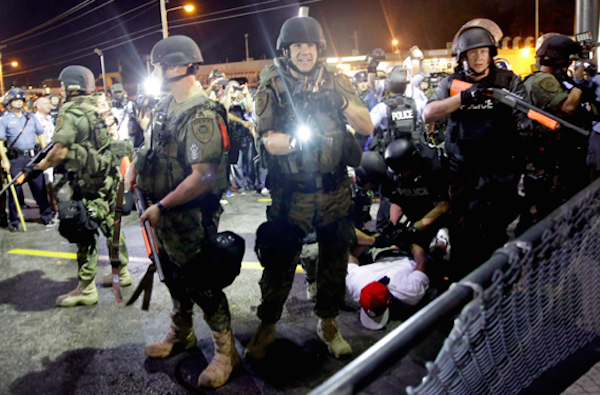
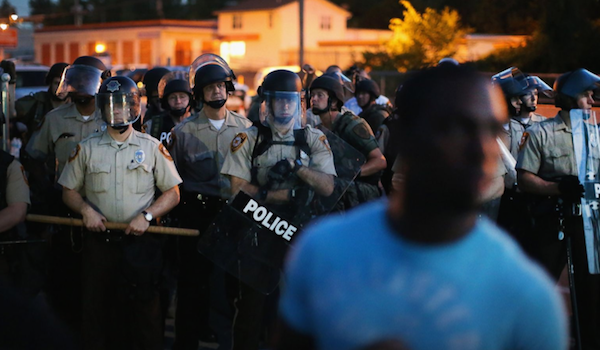
It’s been a month since the shooting of Michael Brown, who was unarmed, black and 18 years old. Scenes of Ferguson in the days following his death drew constant comparisons to a war zone: officers decked out in camouflaged combat gear, some of them arriving by humvee, snipers planted on rooftops, tear-gas-filled streets, protesters treated with milk for their burns. Finally, the conversation reached Capitol Hill Tuesday in the first congressional hearing on the militarization of police. The long-awaited hearing comes as a congressman from suburban Atlanta, Rep. Hank Johnson (D-Ga.) prepares to introduce the Stop Militarizing Law Enforcement Act to restrict the flow of surplus military supplies from the Pentagon to local police departments. So this is a good time to think about how the taxpayer dollars now being spent on assault rifles and lumbering street warfare vehicles could otherwise be spent.

Woman Shot At Protest: Police Have Not Spoken To Her

FERGUSON, Mo. (KMOV.com) - A woman who was shot during the protests in Ferguson said police have still not contacted her. Mya Aaten-White said she was walking down West Florissant August 12 when she was shot in the head. Aaten-White said she was walking back to her car when the shooting occurred. Aaten-White said police have yet to speak to her about the incident. Her alma mater, Howard University, stepped in and appointed a lawyer, but the two were unable to schedule a meeting with police. "I have a strong distrust from them and they have not done what were supposed to do in my case," Aaten-White said.

False Perception Of Black Crime At Root Of Injustice

This report examines how racial perceptions of crime are a key cause of the severity of punishment in the United States. Race and Punishment: Racial Perceptions of Crime and Support for Punitive Policies, authored by Nazgol Ghandnoosh, Ph.D., research analyst at The Sentencing Project, synthesizes two decades of research revealing that white Americans’ strong associations of crime with blacks and Latinos are related to their support for punitive policies that disproportionately impact people of color. Coming on the heels of the tragic events in Ferguson, Missouri, the report demonstrates that the consequences of white Americans’ strong associations of crime with blacks and Latinos extend far beyond policing.

The Michael Brown Murder Cover-Up

On Aug. 15, the world saw Ferguson Police Chief Thomas Jackson belatedly release Darren Wilson’s name—and no other information at all about the killing of Michael Brown—while at the same time releasing a report (followed by a video) on an unrelated robbery that Brown was apparently involved in. On Aug. 20 and 21, first St. Louis County, then Ferguson released incident reports on the shootings—reports virtually devoid of any information. These highly questionable revelations stirred a fair amount of public outrage, but few people seemed to realize how truly sinister they were, or how they connected to much broader patterns of official lawlessness that have long bedeviled St. Louis County, and Missouri more generally, as well as many other jurisdictions across the land. On Sept. 5, TheBlot magazine reported that Chief Jackson had lied on Aug. 15, when he claimed that he released the robbery report and video because of numerous media requests. Public records released to TheBlot showed that no one had specifically asked for either of them, while many people had asked for information about the killing of Michael Brown, which Jackson refused to release at that time.

Ferguson Protesters Deal With Fallout After Arrests

WASHINGTON -- On Thursday night, about 30 people gathered in the SEIU office on Pershing Avenue in St. Louis. What they had in common is they were all somehow involved in the protests over the shooting of Michael Brown, and they were all eventually caught up by the police and arrested. While the arrests of journalists -- who are much less likely to face punishment or have their future career prospects damaged by an arrest record -- attracted a significant amount of attention, many less high-profile citizens have had to quietly figure out how to deal with the fallout from their own arrests. The people who gathered Thursday were brought together by the advocacy group Missourians Organizing for Reform and Empowerment, which took it upon itself to provide jail support for individuals who had been taken in. Organizers set up a 24-hour phone line that people could call for help, created a fundraising website to help pay for legal support and provided rides and supplies to people when they were released from jail. The group is also putting people in touch with ArchCity Defenders and other legal groups for possible pro-bono representation. Molly Gott, a community organizer with MORE, said the group's job now is to make sure that nobody forgets that there are individuals who were swept up by the police -- who were heavily criticized for being heavy-handed and arresting people without justification -- and now face municipal charges like "refusal to disperse." "People spent a lot of time sharing their stories about when they were arrested, which was pretty powerful," said Gott. "[They] are definitely organizing to pressure Ferguson to drop their charges."

Between Peacekeepers And Protesters In Ferguson

From the very beginning, the movement in Ferguson, Missouri, has been youth-led and locally initiated. It was spurred after neighbors saw a young man dead in the streets for four hours after he had been gunned down by police officer Darren Wilson. After the first three or four nights, people deeming themselves "peacekeepers" began appearing at the protests. "I feel like they're trying to heal a broken arm with a band aid." The "peacekeepers" are of an older generation. Just about all of them are middle-aged. Some wear black shirts that say "peacekeeper" across the chest; others wear orange shirts that say "clergy;" some are politicians; some are clergy members; others have labeled themselves "community leaders." Many protesters - especially people who have been out in Ferguson since Day One - have questioned their motives and are often at odds with their goals. Spook, a 24-year-old writer who attended the protests since they began on August 9 told Truthout, "there's a rift there," describing the relationship between peacekeepers and protesters. "People didn't see eye to eye." King D Seals, a 27-year-old resident of Ferguson, told Truthout, that while he respects them, he sees them as "disingenuous." Another St Louis resident and organizer, who was out during the protests, described the peacekeepers' tactics to Truthout: "I feel like they're trying to heal a broken arm with a band aid."

Ferguson Changes Policies On Racially Unfair Tickets And Fines

FERGUSON, Mo. — In the first major sign of change in this small city since last month’s police killing of an unarmed black teenager, the Ferguson City Council said Monday that it would establish a citizen review board to provide guidance for the Police Department. It also announced sweeping changes to its court system, which had been criticized as unfairly targeting low-income blacks, who had become trapped in a cycle of unpaid tickets and arrest warrants. Municipal court fines are the city’s second-highest source of revenue, leading many critics to argue that the authorities had a financial incentive to issue tickets and then impose more fees on those who did not pay. Young black men in Ferguson and surrounding cities routinely find themselves passed from jail to jail as they are picked up on warrants for unpaid fines, one of the many simmering issues here that helped set off almost two weeks of civil unrest after the teenager, Michael Brown, 18, was killed by a white Ferguson officer on Aug. 9. On the eve of what was expected to be a tense City Council meeting on Tuesday, the first meeting since the shooting, the city instead pre-emptively announced many changes activists have long sought. Among other things, the Council was scheduled to vote on capping how much of the city’s revenue can come from fines. The city also announced a one-month window to quash pending warrants, a major victory for the activists and lawyers who had pressed for change and were expected to force the issue at Tuesday’s meeting.

The Effects of Marching For Michael Brown

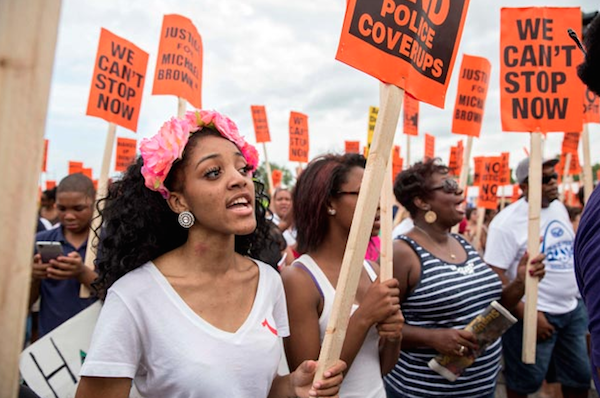
At 7 p.m. on Saturday night, “‘Hands up, don’t shoot!’ buttons, one dollar!” were the chants you heard outside of the 10th Street exit of the U Street/African-American Civil War Memorial/Cardozo. There, college students, random citizens, members of the National Black United Front (NBUF), the Party for Socialism and Liberation and the D.C. Statehood Green Party were gathering, ready to follow the lead of one man: Eugene Puryear. It was the third time they’d done this since 18-year-old Michael Brown was shot and killed in Ferguson, Missouri. Their goal? To march the commercial corridors of the District and make the point that police brutality would not be accepted nationally or locally. The first two times, they went to H Street and then Chinatown. Now, it was Black Broadway. At first, I was skeptical. There were probably 250 people there at its largest point. In a town like this, Small-scale marches usually don’t get you very far. But Puryear changed my mind. Puryear is a D.C. based-activist who went to Howard University. The first time I ever saw him, he was at a candidate debate at the Sixth and I Street synagogue. Now, at 28, he’s running for an At-Large City Council seat. I came away thinking he was the smartest guy I heard speak all day.

St. Louis Police Shot 16 Before Michael Brown In 2014

By the time of Michael Brown's murder, St. Louis area police had already shot at least 16 people in 2014, the vast majority of whom were black. Truthout obtained this figure by examining news reports from January 1 to August 6 of 2014. On August 10, protests opposing the police killing of unarmed black teenager Michael Brown began. You can view the data Truthout compiled here. In the vast majority of incidents where the race of an individual shot by police was known, the individuals were black. Truthout was not able to determine how many (if any) of these police shootings were "justified" because data concerning police shootings is so limited. Police shootings, along with other uses of force by the St. Louis area police, are not a new development. In Ferguson, seven active or former officers have now been named in civil lawsuits for excessive use of force; and in March 2014, two officers with the St. Louis Police Department severely beat a man with disabilities. In another recent civil case, an amount of over $800,000 was awarded to a victim of excessive force by the St. Louis Metropolitan Police Force. In 2012, US District Judge Carol Jackson stated that the St. Louis Board of Police Commissioners may be "deliberately indifferent" or even tacitly approving of a "widespread persistent pattern of unconstitutional conduct." In a separate 2010 federal civil lawsuit, which accused the St. Louis police of excessive force, the victim's lawyer cited statistics showing that the St. Louis internal affairs investigators sustained only one of 322 citizens' physical abuse complaints against police from 1997 to 2002.

Occupy & Ferguson Livestreamer To Work For ABC/Univision

Fusion, the joint online and television venture between Univision and the Disney-ABC Television Group, is expected to announce on Monday that it has hired Tim Pool, a digital journalist known for his use of cutting-edge reporting technologies and his marathon live-stream reporting during the recent controversy in Ferguson, Mo., and the Occupy Wall Street protests. Mr. Pool, 28, most recently worked for Vice Media, a rival youth-focused news and entertainment venture. He is scheduled to start on Monday as Fusion’s senior correspondent and director of media innovation. The move comes as Fusion continues to build out its next-generation news network targeted at the diverse and elusive millennial audience. Fusion, which started last year, recently hired Jane Spencer, formerly of The Daily Beast and The Wall Street Journal; Felix Salmon, formerly of Reuters; and Anna Holmes, founder of the website Jezebel. “We have this blank slate,” Mr. Pool said, adding that in his new role he would explore approaches for using mobile, robotic, drone and other technologies for reporting. Mr. Pool, a Chicago native, said “it wasn’t really on purpose” that he became a journalist. He said he grew up on the Internet and so naturally started posting updates and photos to Facebook, Twitter and other outlets as those new technologies emerged. He traveled to New York during the Occupy Wall Street demonstration in 2011 and quickly gained recognition for his live stream of the protests — captured on his mobile phone.

Ferguson Protesters Shut Down Adams-Morgan

Saturday night, the 6th of September was the third Saturday night in a row that Ferguson/Michael Brown protesters marched into and shut down one or more gentrified parts of the city. Two weeks earlier it was Chinatown, last week it was H st where all the new money is flowing into NE, this time around it was U Street and later Adams-Morgan and Columbia heights. A huge thunderstorm seemed to strike DC a glancing blow, appearing to be almost instantly arriving as the march set out, yet the skies did not open until the march was finishing up at the first target, the intersection of 14th and U streets. By the time 16th and U was reached the rain was drenching but marchers kept going. One speaker remarked ""Police shoot and kill in the rain too so we're marching in the rain too." From 16th st marchers returned to 14th and U, then 14th and U as the rain ended. Everyone then decided to march on Adams-Morgan. The final intersections shut down for extended periods were 18th and Columbia, and 14th and Irving.

Lessons From Ferguson

One week ago, we traveled to Ferguson, Missouri, a place that has drawn the attention of the nation. Ferguson has dominated the news cycle, elicited a response from the United Nations, and mobilized thousands not simply because of what happened there but because of how residents of Ferguson responded. The murder of 18-year old Michael (a.k.a Mike) Brown by Ferguson police officer Darren Wilson is only one moment that reveals the ways Black lives are ignored, dismissed, devalued, erased, violated, and systematically destroyed. Instead, the story of Mike Brown’s life and death is not unique. Stories of violence enacted by police, directed at and experienced by Black folks abound. Here is one story. And another. And yet another. Here and here are some more. Yet violence against Black life is irreducible to “blue on Black” crime or racial profiling in Ferguson. Black folk are disproportionately vulnerable to deteriorating social risks linked to race, sex and class. Ferguson serves as a microcosm of the greater social body, which thwarts Black survival then criminalizes Black reflexive survival tactics. Ferguson is one of 90 municipalities subdividing St. Louis County, a system put in place to control the funneling of resources, services, and tax revenue with the added effect of exacerbating poverty. Additionally, St. Louis has a history of excluding Blacks through covenants, deeds and discriminatory penal policies.
assetto corsa mods

Urgent End Of Year Fundraising Campaign

Online donations are back! Keep independent media alive. 

Due to the attacks on our fiscal sponsor, we were unable to raise funds online for nearly two years.  As the bills pile up, your help is needed now to cover the monthly costs of operating Popular Resistance.

Urgent End Of Year Fundraising Campaign

Online donations are back! 

Keep independent media alive. 

Due to the attacks on our fiscal sponsor, we were unable to raise funds online for nearly two years.  As the bills pile up, your help is needed now to cover the monthly costs of operating Popular Resistance.

Sign Up To Our Daily Digest

Independent media outlets are being suppressed and dropped by corporations like Google, Facebook and Twitter. Sign up for our daily email digest before it’s too late so you don’t miss the latest movement news.