Skip to content

Food and Agriculture

Campaign Against Glyphosate Steps Up In Latin America

After the World Health Organisation (WHO) declared glyphosate a probable carcinogen, the campaign has intensified in Latin America to ban the herbicide, which is employed on a massive scale on transgenic crops. In a Mar. 20 publication, the WHO’s International Agency for Research on Cancer (IARC) reported that the world’s most widely used herbicide is probably carcinogenic to humans, a conclusion that was based on numerous studies. Social organisations and scientific researchers in Latin America argue that thanks to the report by the WHO’s cancer research arm, governments no longer have an excuse not to intervene, after years of research on the damage caused by glyphosate to health and the environment at a regional and global level.

Corporate Power, Grassroots Resistance, & Battle For Food System

For most of history, farmers have had control over their seeds: saving, sharing, and replanting them with freedom. Developments in the course of the 20th century, however, have greatly eroded this autonomy. Legal changes, ranging from the Plant Variety Protection Act (1970) in the United States to the World Trade Organization’s Agreement on Trade-Related Aspects of Intellectual Property Rights (TRIPS), have systematically eroded farmers’ rights to save seeds for future use. By the end of 2012, Monsanto had sued 410 farmers and 56 small farm businesses in the United States for patent infringement, winning over $23 million in settlements.

Coalition Challenges Expanded Use Of Hazardous Herbicide

A coalition of conservation, food safety, and public health groups filed a motion today challenging the U.S. Environmental Protection Agency (EPA)’s decision to expand the use of “Enlist Duo” on genetically engineered (GE) corn and soy crops to nine additional states: Arkansas, Kansas, Louisiana, Minnesota, Missouri, Mississippi, Nebraska, Oklahoma, and North Dakota. Earthjustice and Center for Food Safety filed the motion in the United States Ninth Circuit Court of Appeals on behalf of Beyond Pesticides, Center for Biological Diversity, Center for Food Safety, Environmental Working Group, the National Family Farm Coalition, and Pesticide Action Network North America.

Marijuana: The Gateway Plant To Urban Farming

Released this week in honor of 4/20 and Earth Day (two holidays important in their own right), “The Gateway Plant” provides a unique glimpse into MG’s theory of resilience-based organizing. We know that when people work together to directly meet their needs through shared work, democratic self-governance, and confronting unjust policies, they build a critical foundation for ecological restoration and self-determination. “Our farm is about community resilience and black liberation,” said Karissa Lewis, one of the Full Harvest co-founders. “Whether we’re dealing with gentrification or food deserts or racist policing, in America it always comes down to land and power. So we’re taking the land back. And that way, we can start to take our power back as a community.”

Farmers Turn To GMO-Free Crops To Boost Income

When Justin Dammann enters his southwestern Iowa cornfield this month, the 35-year-old farmer will sow something these 2,400 acres have not seen in more than a decade — plants grown without genetically modified seeds. The corn, which will head to a processor 20 miles down the road this fall, will likely make its way into tortilla shells, corn chips and other consumable products made by companies taking advantage of growing consumer demand for food without biotech ingredients. For Dammann and other Midwest farmers, the burgeoning interest in non-GMO foods has increased how much they get paid to grow crops in fields once populated exclusively with genetically modified corns and soybeans. The revenue hike is a welcome benefit at a time when lower commodity prices are pushing farm income down to what's expected to be the lowest level in six years.

USDA Announces Record Number Of Organic Producers In U.S.

The U.S. Department of Agriculture (USDA) announced today that the organic industry continues to show remarkable growth domestically and globally, with 19,474 certified organic operations in the United States and a total of 27,814 certified organic operations around the world. According to data released by the Agricultural Marketing Service's (AMS) National Organic Program (NOP), the number of domestic certified organic operations increased by more than 5 percent over the last year. Since the count began in 2002, the number of domestic organic operations has increased by over 250 percent. "As demand for organic products continues to soar, more and more producers are entering the organic market," said Agriculture Secretary Tom Vilsack.

Vegetarians, Ranchers And Conscious Omnivores Need to Unite

For the first time since the advent of industrial agriculture, the federal government is considering advising Americans to eat “less red and processed meat.” That advice is the outcome of studies conducted by an independent panel of “experts” which was asked by the U.S. Department of Agriculture (USDA) and the Department of Health and Human Services (HHS) for recommended changes to the U.S. Dietary Guidelines. The February 19 “eat less red and processed meat” pronouncement by the Dietary Guidelines Advisory Committee (DGAC) was reported widely in mainstream media. It set off a heated debate about whether or not consumers should eat meat, a debate that included the standard name-calling by factory farm front groups, including the Farm Bureau, denouncing consumers and environmentalists (and their alleged pawns on the DGAC) for being “anti-meat” and “anti-farmer.”

Fast Track A Bad Deal For Farmers & Our Food System, 110+ Groups Say

Over 110 farm, food and consumer groups urged members of Congress in aletter today to oppose trade promotion authority or “fast track” legislation that would pave the way for trade agreements detrimental to farmers, ranchers and food systems, such as the Trans-Pacific Partnership (TPP). A fast track bill, expected to be introduced this week, would allow the President to negotiate two mega trade deals in secret, and present a final version to Congress for a simple up or down vote—depriving Congress of its right to amend the finalized agreement. The groups expressed concern that pending trade deals would primarily benefit agribusiness corporations and not address the key challenges facing farmers and rural communities.

Civil Society Asks World Bank Three Questions

Oakland, CA - As the World Bank prepares for its annual Spring Meetings, members of Our Land Our Business, a campaign of over 260 NGOs, farmer groups and trade unions from around the world, are publically posing three questions about the Bank’s role in land grabbing, climate destruction and the corporatization of agriculture. These questions penetrate to the heart of the World Bank’s development model and throw its loudly and expensively self-promoted claim to serve the interests of the world’s poor into stark relief. Why have you not spoken to farmers before promoting massive agriculture-reform programs? Your flagship agricultural reform initiative – “Enabling the Business of Agriculture” (EBA), formerly known as “Benchmarking the Business of Agriculture” (BBA) – is due to be rolled out across 40 countries this year. At no point in your decision to create the EBA have you consulted farmers or farmer groups.

Water Or Wine? CA’s Drought & Water Competition

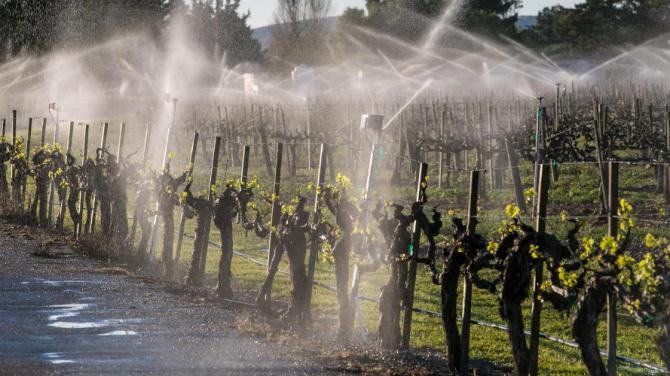
(Sonoma County, Northern California) “California Puts Mandatory Curbs on Water Use” reports the April 2 New York Times long article at the top of the front-page. “Steps to Confront Record-Setting Drought,” the sub-headline reads. The article describes Gov. Jerry Brown’s executive order—California’s first time restricting water use. A 25% reduction of water use over the next year is required of residents, golf courses, cemeteries, and many businesses. But wait. “Owners of large farms…will not fall under the 25% guideline.” Agricultural enterprises can continue to dig deep wells into our common water table and extract as much of our limited water supply as they want, for free. This includes vineyards. It takes around 30 gallons of water to make one glass of wine. That results in extensive water use by an industry that has an agricultural component but is mainly an industrial, commercial bottling operation, often in a rural area zoned for other things. This sounds like a double standard.

Global Justice Movements Converge On Revolutionary Ground

Collective adrenaline ran high as the World Social Forum opened on March 24 in Tunis. It had not yet been five years since a peaceful revolution brought a dictatorship long backed by Western political superpowers to its knees and ignited the fire of the Arab Spring that burns to this day. And it had not yet been a week since shooters stormed the Bardo Museum, killing 22, and retesting the resolve of a delicately budding democracy. Tens of thousands of delegates from across the globe converged in Tunis not only to show support for Tunisian sovereignty, but also to share their own local struggles and solutions while advocating change in the face of interlinked systemic injustices.

Farmworkers Call For Boycott Of Driscoll’s Berries

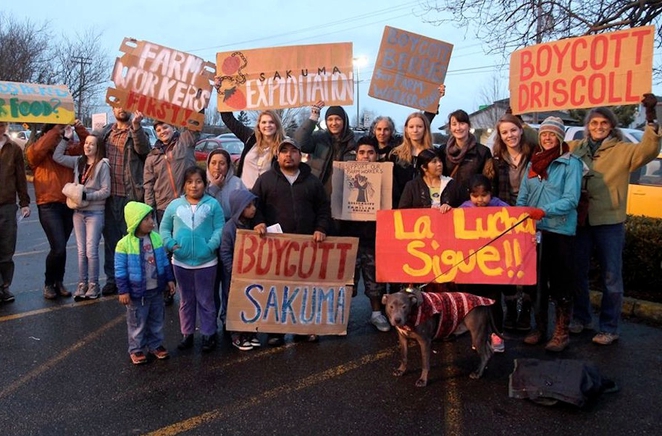
Farm workers in Washington state are fighting for fairer pay and better treatment, and they need support from consumers. These workers, who pick strawberries for the notorious Sakuma Brothers Berry Farm, have been subjected to a wide range of abuses for years, such as inadequate piece rates, systematic wage theft, racist and sexist abuse from supervisors, substandard housing, and continuous retaliation for their efforts to improve conditions. The Sakuma Brothers berry farm, located in Burlington, WA, supplies strawberries to Driscoll’s, a familiar label to many consumers. Even here in faraway, still-wintry Ontario, Driscoll’s is the only brand of fresh strawberries available year-round at my local grocery store. Sakuma also sells berries to Häagen-Dazs and Yoplait.

A Seed To Save The World

Kansas City, MO - In the shadows of Kansas City, shop carts rattle past an urban farm as ragged figures scurry away from the burnt shell of an apartment building. “You get a strut on this block,” said Jake, an intern on the farm who spent almost a year living homeless under a bridge. We watched the motley crowd with their carts full of metal. “You see? Head down and shoulders up.” The farm sprouted in a neighborhood forgotten by the twinkling skyline to the west, where old buildings are often burnt to expose the copper wiring within the walls. The wiring is then stripped by “scrappers” and sold to the local scrapyard for five cents per pound. With all of the nearby high schools discredited as educational institutions, scrapping metal is often the most viable means of income.

Second Week Of Global Protests To Stop GE Trees

In Brussels, Belgium, dozens of people representing organizations from around the world traveled from the European Parliament to the Brazilian Embassy where they rallied againstGE trees and delivered letters of protest. In Melbourne, Australia, protesters dressed as koalas, owls and other forest creatures rallied against GE eucalyptus trees at the Brazilian consulate. Other demonstrations took place in Europe and North America. This week's actions follow a wave of protests against GE trees at Brazilian embassies and consulates on 3 March 2015. These protests were directed at a 5 March 2015 meeting of the Brazilian Technical Commission on Biosafety (CTNBio), which was to decide whether or not to approve a request by FuturaGene to commercially release GE eucalyptus trees in Brazil.

Important Strike In Mexico: Farm Workers Paralyze Baja Farms

Thousands of farmworkers in the San Quintín Valley of Baja California, just 185 miles south of the U.S. border, struck some 230 farms, including the twelve largest that dominate production in the region, on March 17 interrupting the picking, packing, and shipping of zucchini, tomatoes, berries and other products to stores and restaurants in the United States. The strikers, acting at the peak of the harvest, were demanding higher wages and other benefits to which they are legally entitled such as membership in the Mexican Institute of Social Security (IMSS), the public health system. While there have over the last two decades been several large scale protests by workers in San Quintín, usually riots over the employers failure to pay their employees on time, this is the first attempt by workers to carry out a such strategic strike.
assetto corsa mods

Urgent End Of Year Fundraising Campaign

Online donations are back! Keep independent media alive. 

Due to the attacks on our fiscal sponsor, we were unable to raise funds online for nearly two years.  As the bills pile up, your help is needed now to cover the monthly costs of operating Popular Resistance.

Urgent End Of Year Fundraising Campaign

Online donations are back! 

Keep independent media alive. 

Due to the attacks on our fiscal sponsor, we were unable to raise funds online for nearly two years.  As the bills pile up, your help is needed now to cover the monthly costs of operating Popular Resistance.

Sign Up To Our Daily Digest

Independent media outlets are being suppressed and dropped by corporations like Google, Facebook and Twitter. Sign up for our daily email digest before it’s too late so you don’t miss the latest movement news.