Skip to content

Supreme Court

The Supreme Court And Political Corruption

The Supreme Court of the United States is enshrined in the Constitution as one of three branches of government, the other two being the Executive branch, the presidency, and the Legislative branch, the Senate and House of Representatives. In other words the Court is a lawmaking body. The 1954 Brown v. Board of Education decision was a landmark, a case that most Black people commit to memory. The Court declared that public accommodations could not be considered equal if they were separate, and thus began the long road to ending segregation in the law.

Here’s What ‘Moore V. Harper’ Means For Voting Rights Going Forward

Chief Justice John Roberts has historically not decided cases in a way that protects voting rights. In 2013, he authored Shelby v. Holder, which drove a stake through the heart of the Voting Rights Act. And in 2021, he voted to further weaken the Act in Brnovich v. DNC. But this past month, Roberts surprisingly authored two new Supreme Court opinions that support the right to vote. On June 8, the high court struck down a racist congressional district map in Allen v. Milligan, and on June 27, the court preserved judicial review of state legislative enactments in Moore v. Harper.

US Supreme Court Strikes Down Student Debt Relief

On June 30, the US Supreme Court struck down President Joe Biden’s student debt relief program, which had been held up in the courts for several months due to right-wing legal challenges. The six ultra-conservative justices which make up the majority of the court ruled against the program, while the three centrist justices voted to uphold it. The Court ruled that Biden had overstepped his authority when he announced a sweeping student debt relief program on August 24, 2022. The program would have zeroed out the debts of 20 million people. Biden issued an executive action in August to forgive the debts of student loan borrowers by up to USD 20,000.

SCOTUS’s Latest Attack On Affirmative Action

The Supreme Court of the United States confirmed once again what an utterly reactionary, rightwing institution it is by striking down the right to use affirmative action in college admissions. The 6-3 ruling, issued June 29, stems from two cases – Students for Fair Admissions v. Harvard University and Students for Fair Admissions v. University of North Carolina – which claim that whites and Asians are victims of “reverse discrimination.” What this vote means is that “race-conscious admissions policies,” can no longer be used to assure that working class students of color, especially if they are Black and Brown, will have access to colleges and universities, whose exorbitant tuition fees have put millions into a lifetime of debt.

Indigenous Activists Respond To Gutting Of Affirmative Action

Boston, MA - Indigenous activists in Boston reaffirm their commitment to overcome historic barriers to higher education for students in light of today’s ruling delivered by the Supreme Court of the United States (SCOTUS) that guts Affirmative Action in college admissions at institutions of higher education across the country. The Indigenous activists demand the passage of two bills in the state legislature specifically addressing Native issues in public education. Today’s SCOTUS ruling overturns a longstanding precedent that had previously benefited Black, Indigenous, and Latine students in higher education due to a demonstrable historic lack of opportunities for those students.

Supreme Court Keeps Navajo Nation Waiting For Water

More than 150 years after the Navajo Nation signed treaties with the United States establishing its reservation and recognizing its sovereignty, the country’s largest tribe still struggles to secure the water guaranteed by those agreements. Decades of negotiations with the state of Arizona have proven fruitless. The state has been uniquely aggressive in using the scarce resource as a bargaining chip to extract concessions from the Navajo Nation and other tribes, dragging out the talks while Indigenous communities await desperately needed water and infrastructure, a recent ProPublica and High Country News investigation found.

ICWA Stands! Supreme Court Affirms Indian Child Welfare Act

The court’s opinion in the case Haaland v. Brackeen upheld the federal Indian Child Welfare Act (ICWA), a 1978 law that gives tribal governments exclusive jurisdiction over Native children who live on reservations. Considered to be the “gold standard” of child welfare policy, ICWA has protected the continued existence of Indian tribes and their most vital resource — Indian children — for 45 years. By a 7-2 margin, the court today reinforced ICWA by affirming an appellate court en banc ruling that challenged some aspects of the law’s constitutionality. The nation's highest court found that ICWA does not discriminate on the basis of race and does not impose an undue burden on states.

Supreme Court Weakened Legal Protections For Striking

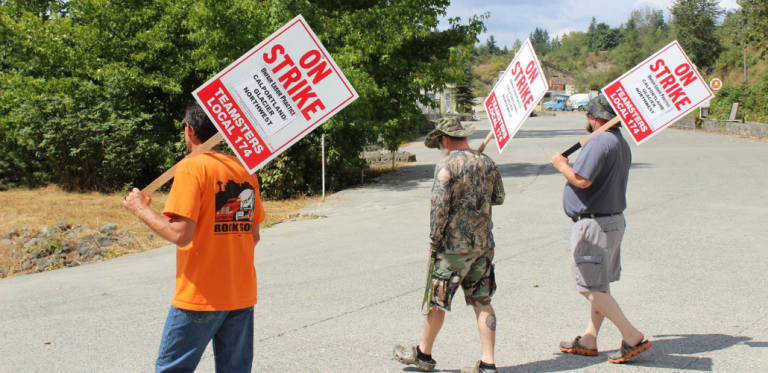
In a shameful decision last week, eight members of the U.S. Supreme Court weakened the right to strike. Only Justice Ketanji Brown Jackson stood up for the workers. In her 27-page dissent in Glacier Northwest, Inc. v. International Brotherhood of Teamsters, Jackson wrote, “The right to strike is fundamental to American labor law.” Indeed, it is the threat of a strike that gives workers leverage during contract negotiations with an employer. Jackson continued: Workers are not indentured servants, bound to continue laboring until any planned work stoppage would be as painless as possible for their masters. They are employees whose collective and peaceful decision to withhold their labor is protected by the [National Labor Relations Act] even if economic injury results.

Unions Can Still Strike; Don’t Let The Supreme Court Tell You Otherwise

The U.S. Supreme Court’s decision in Glacier Northwest v. Teamsters Local 174 is outrageous—valuing property over workers’ rights. But it could have been much worse. Unions still have the right to strike. Employers still can’t generally sue unions in state court for losses caused by strikes. But the decision does open the door to whittling away those rights more in the future. The practical impact of the Court’s decision is that employers will be suing unions more often for alleged property damage caused by strikes—and that therefore unions (and their attorneys) are likely to be more cautious. But the Court did not do what many had feared it would do in this case.

The US Supreme Court Seems Ready To Gut Affirmative Action

This summer, the U.S. Supreme Court’s Republican-appointed majority is anticipated to end affirmative action, which for decades has sought to remedy a bruising legacy of discrimination against marginalized groups, including Black Americans. Nearly 10 years ago, Students for Fair Admissions, an organization headed by Edward Blum, a stockbroker turned conservative legal strategist, filed lawsuits against Harvard University and the University of North Carolina, claiming that their undergraduate admissions practices are racially discriminatory. The lower courts sided with the defendants, but the high court in the coming weeks is expected to say that schools are barred from considering race when reviewing applications.

SCOTUS Case May Slash Regulation Of Everything

In an ominous but unsurprising development, the Supreme Court has agreed to hear a case that may well imperil our health, safety, labor, clean air and water, food and environmental protections. On May 1, the court decided to reconsider its 40-year-old precedent in the current case of Loper Bright Enterprises v. Raimondo. This right-wing court, which demonstrated its disregard for legal precedent when it overruled Roe v. Wade, may now overturn the well-settled “Chevron deference.” Doing so would be consistent with the conservative fealty to deregulation in order to protect corporate profits.

Clarence Thomas Reversed Position After Gifts And Family Payments

Supreme Court Justice Clarence Thomas changed his position on one of America’s most significant regulatory doctrines after his wife reportedly accepted secret payments from a shadowy conservative network pushing for the change. Thomas’ shift also came while he was receiving lavish gifts from a billionaire linked to other groups criticizing the same doctrine — which is now headed back to the high court. The so-called “Chevron deference” doctrine stipulates that the executive branch — not the federal courts — has the power to interpret laws passed by Congress in certain circumstances. Conservatives for years have fought to overturn the doctrine, a move that would empower legal challenges to federal agency regulations on everything from climate policy to workplace safety to overtime pay.

Volunteers And Victims Of US Border Patrol Violence Demand Justice

Hundreds of people die every year at the hands of US Border Patrol agents, either from being beaten, shot, car chases or being left stranded in the desert,  simply for exercising their right to move. A US Supreme Court decision, Hernandez Vs Mesa, in February 2020 granted the US Border Patrol the ability to murder people on the Mexican side of the border without being held accountable. Clearing the FOG spoke with four women from the Border Patrol Victims Network - Ana Maria Vasquez and Tracye Peterson, who are volunteers, Marisol Garcia Alcantara, who was shot by border agents, and Yanelis Laurencia, whose 23-year-old son was murdered. They are working to raise awareness of the rampant violence on the border that targets migrants and local residents, and to demand justice.

Supreme Court Liberals Help Turn Judges Into Prosecutors

So the truth is out: the three so-called liberals on the supreme court are phonies. More precisely, they, like most of their conservative brethren, are corporate hacks. We learned this a couple of weeks ago, when the high court ruled against Steven Donziger, a climate-activist attorney, long persecuted and then literally prosecuted by Chevron. In a pro-corporate decision about as subtle as a heart attack, seven of the nine justices declined to hear Donziger’s appeal of a criminal contempt decision involving his representation of Indigenous Ecuadorians against Chevron. Two far-right justices dissented.

Student Loan Forgiveness Program Appears Headed For Defeat

A right-wing majority of the Supreme Court is on the verge of denying student debt relief to more than 40 million borrowers. On February 28, the high court heard oral arguments in a pair of cases challenging President Joe Biden’s student loan forgiveness program. Instituted to ameliorate the effects of the COVID pandemic, the program could provide up to $20,000 of debt relief to people with federally held loans. The first case heard by the court was Biden v. Nebraska, brought by Republican state attorneys general from Nebraska, Missouri, Arkansas, Iowa, Kansas and South Carolina against Biden, his Secretary of Education Miguel Cardona and the Department of Education.
assetto corsa mods

Urgent End Of Year Fundraising Campaign

Online donations are back! Keep independent media alive. 

Due to the attacks on our fiscal sponsor, we were unable to raise funds online for nearly two years.  As the bills pile up, your help is needed now to cover the monthly costs of operating Popular Resistance.

Urgent End Of Year Fundraising Campaign

Online donations are back! 

Keep independent media alive. 

Due to the attacks on our fiscal sponsor, we were unable to raise funds online for nearly two years.  As the bills pile up, your help is needed now to cover the monthly costs of operating Popular Resistance.

Sign Up To Our Daily Digest

Independent media outlets are being suppressed and dropped by corporations like Google, Facebook and Twitter. Sign up for our daily email digest before it’s too late so you don’t miss the latest movement news.