Skip to content

Energy

Rational Synergy Convergence

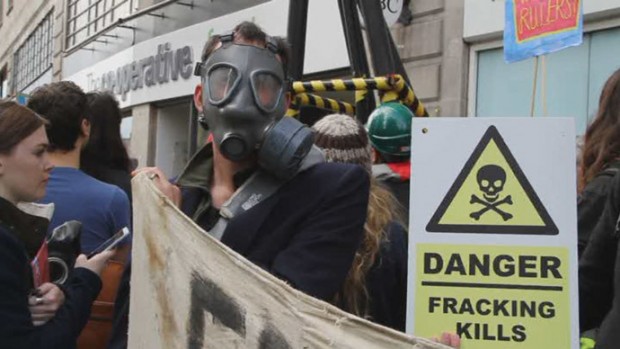
Join us for the Rational Synergy Convergence! The Rational Synergy Convergence is a public gathering of local leaders and thinkers committed to economic equity and environmental justice. Speakers discuss the bleak state of global capitalism and envision a more economically just and ecologically sustainable future. The convergence will focus on economic inequality in the midst of a “fracking boom” and the effects of imperialism on human lives & biological communities. The Rational Synergy Convergence will be meeting in protest of the International Energy Conference!

Duke Energy Fined Penny Per Ton For Massive Spill

Although the North Carolina Department of Natural Resources found Duke Energy in gross violation of the federal Clean Water Act, the state agency placed so little value on public health that they were willing to settle for a pittance—a penny per ton of toxic coal ash stored at Duke’s two illegally polluting plants. To rub ash into the wound, the agency didn’t even require Duke to stop the flow of arsenic, cadmium, chromium and other toxic metals from the millions of tons of coal ash at the plants, much less clean up the pollution. The state was willing to accept $99,000 in settlement with the utility giant. Duke Energy can spare this chump change. The utility just announced a 50 percent increase in corporate profits in 2013, amounting to $2.6 billion per year for a company already valued at $50 billion. Duke’s $99,000 penalty was nothing—it’s like one of us, earning $50,000 a year, getting fined $1.90. Barely amounting to a library fine, this is no deterrent for the likes of Duke.

Thousands Of Abandoned Uranium Mines Are Poisoning Us. Take Action.

The Environmental Protection Agency and US Geological Survey document over 10,000 abandoned uranium mines in the US, most in 15 western states on public, private, and tribal lands. Over 4,200 of these mines produced uranium that was sold to the US Atomic Energy Commission for use in nuclear weapons from the 1940s through the 1970s. Starting in the 1960s, much of the mining was done to provide fuel for nuclear power plants. There are several AUMs in and near the Grand Canyon, 169 of them within 40 miles of Mt. Rushmore, and eight right on the edge of Grand Teton / Yellowstone National Parks. One in seven (10 million) people in the western US lives within 50 miles of an AUM. The Mining Act of 1872 governs hard rock mining (including uranium mining) on federal lands.

EPA Head Challenged To Drink Water From Fracking Wells

If you’ve watched Josh Fox’s blockbuster frack-umentary Gasland, you’re familiar with Dimock, Pennsylvania, the town fracked within an inch of its life by Cabot Oil & Gas. In 2012, the Environmental Protection Agency shut down its investigation into water contamination in Dimock due to fracking, concluding that the water was safe to drink. Yet last year the LA Times and DeSmogBlog revealed that the EPA had covered up findings showing that fracking wells in Dimock caused “methane to migrate up to aquifers to unprecedented levels.” A whistleblower at the EPA subsequently alleged that the studies were dropped for political reasons.

Cowspiracy Exposes The Truth About Animal Agriculture

In 90 minutes, co-producers Kip Andersen and Keegan Kuhn argue that our institutional and individual attention to selected environmental issues will not make a collective difference unless we also confront the realities of animal agriculture. Animal agriculture’s environmental effects are so pervasive that apparent progress elsewhere cannot counter its destructive and growing impact. The film suggests why protection for expanded areas of the ocean will not protect oceans or ocean animals. Growing food organically, even on a commercial scale, will not protect the land. Keeping lumber operations out of the Amazon will not save the rainforest.

Pipeline’s Path Stirs Opposition In Va., W.Va.

RICHMOND, Va. — A proposed $5 billion pipeline that would deliver natural gas to the Southeast is finding pockets of opposition along its planned path in West Virginia and Virginia, where it would carve through two national forests. The 550-mile Atlantic Coast Pipeline is also seeing resistance in remote high-elevation sections of Virginia amid concerns it would traverse an environmentally sensitive landscape. Some landowners also object to plans for the pipeline to dissect their property. Some landowners, such as Andrew Gantt, are pushing back. He has refused to let surveyors onto hundreds of acres in Nelson County, midway between Charlottesville and Lynchburg, that are devoted to loblolly pines and hardwoods such as maple and oak. The ancestral land dates to the first European settlers.

New Oilsands Report Claims All Is Well

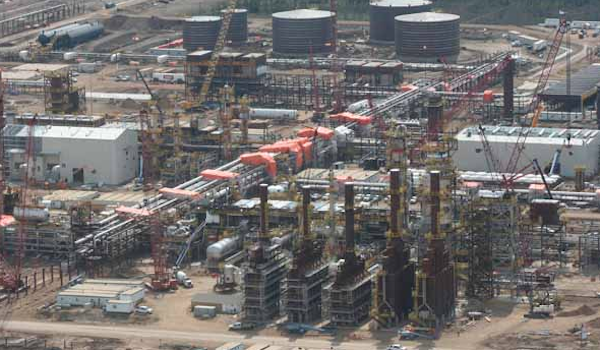
EDMONTON — Two days after the auditor general criticized a report on oilsands environmental monitoring as inaccurate and misleading, a followup report has been released claiming all is well. In his October audit, Merwan Saher slammed the initial oilsands report for being 15 months late and missing “key information.” He also found management of the monitoring program projects to be “weak,” lacking detailed work plans, timelines, progress reports and reviews. But the second annual report of the Canada-Alberta Joint Oilsands Monitoring program says the Alberta government “made notable progress in creating conditions for achieving commitments made under the joint implementation plan.”

Bicyclists Demonstrate How Bikes Reduce Traffic Jams

In Latvia, as part of International Car Free Day, some cyclists went to a lot of trouble to tangibly demonstrate one huge difference between bikes and cars: the amount of space they take up on the road. These photos, which the European cycling group Let's Bike It posted to the social network Vk.com, show a group of bikers in Riga that strapped rickety car-sized constructions to their bikes to show how much space they'd take up if they were actually driving one. The implication here is pretty obvious: if those cyclists actually were in cars, they'd dramatically increase traffic congestion. On the other hand, getting people out of cars and onto bikes is one way of cutting it. The photos also call to mind a particularly well-known demonstration of the road space people in cars take up, in comparison to both bikes and buses.

Solar Getting Less Expensive & Easier To Install

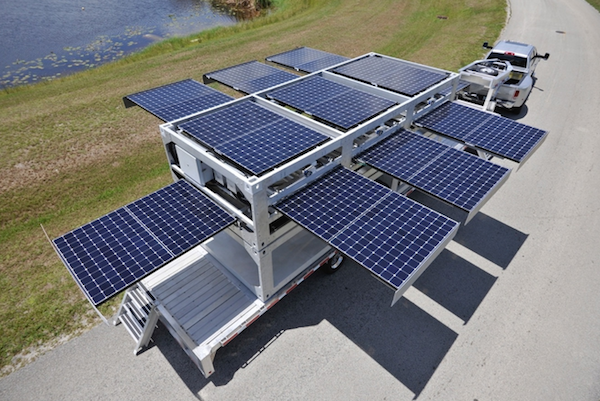
Seven years ago we first covered the Magic Box That Does Everything, the Ecos LifeLink. I titled the post It Generates. It Internets. It Cools and Refreshes. And now, apparently, It Exists. It doesn't appear to cool and refresh with the water purification anymore, but it does still generate and internet, with up to 15 Kilowatts of power. Director and intellectual property strategist Dean Becker gushes in a press release: This innovative patented solar technology has the potential to be one of the most important solar patented innovations of our generation. Did I mention it is patented? Indeed, it is covered by US patent US 8593102. I looked it up to try and figure out what was in fact patentable in covering a shipping container with solar panels and filling it with batteries and routers; it seems pretty obvious to me. And indeed, inventor Dennis McGuire notes in the application that "there exist a multitude of mobile and portable power stations that supply electricity to field hospitals, emergency aid units, and water filtration systems."

Thousands Join Hundreds Of #GlobalFrackDown Protests

The Global Frackdown involved thousands of people in hundreds of actions across the country urging an end to fracking for methane gas. Fracking has become a major problem in the United States under the mis-leadership of both political parties and the 'all of the above' energy strategy put forward by President Obama. Obama has reduced the use of coal by expanding the use of fracking. There is a major week of actions beginning on November 1 -- Beyond Extreme Energy -- that we urge you to participate in. Here is how RT, the only mass media outlet to cover the event, described the global day of actions: Marching across the world to inspire actions on the ecological crisis, thousands of anti-fracking activists in over a dozen countries united against what they call dirty energy technology, which contaminates groundwater and causes health problems. Over 250 events across all continents are taking place as part of the Global Frackdown day, organized to target fracking, a technique used to extract hydrocarbons by pumping pressurized chemicals underground. Organized by Food & Water Watch in coalition with hundreds of groups worldwide . . .

AER Approves Pipeline From Oilsands To Edmonton

EDMONTON – The Alberta Energy Regulator has approved the $3-billion Grand Rapids oil pipeline with 26 conditions.The pipeline is designed to ship up to 900,000 barrels of diluted bitumen per day from near Fort McMurray, Alta., to the Edmonton area. Several of the conditions deal with the pipeline’s route and others deal with enhanced environmental monitoring and mitigation to better protect wildlife and wetlands. The approval follows two weeks of hearings this summer. The hearings were boycotted by the Athabasca Chipewyan First Nation, an aboriginal group that lives in Alberta’s oilsands region. The First Nation criticized the process as too rushed and skewed in favour of the oil industry. Landowners along the proposed route raised similar concerns.

Why Is The World Bank Failing On Energy Poverty?

World Bank energy investments are categorically failing to end energy poverty. That's the stark finding of a new report released by Sierra Club and Oil Change International which measures how multilateral development banks (MDB) fare on their efforts to end energy poverty. The report benchmarked recent MDB investments in clean energy access against the breakdown of needed investment called for in the International Energy Agency's (IEA) "Energy for All" scenario. In that scenario, universal energy access is achieved by 2030. As it stands, if the "Energy for All" scenario is going to succeed, it will require 64 percent of all new investments be used to fund the fastest, cheapest, and most effective source of energy that will help energy poor populations get on to the energy ladder. That source of energy? Distributed off-grid and mini-grid clean energy systems for those living Beyond the Grid.

How Oil & Gas Waste Became Exempt From Federal Regulation

In the small town of Nordheim, Texas, residents are trying to stop a commercial oil and gas waste facility proposed for a large plot of land less than a mile away. They worry that the Texas wind will carry toxic air emissions into the town and across the campus of the local school. The residents' effort is hampered by the U.S. Environmental Protection Agency's decision in 1988 to classify most oil and gas waste as "non hazardous," even though it contains chemicals, including benzene, that are known to cause health problems. The industry lobbied hard for the non-hazardous classification, arguing that the cost of treating the waste as hazardous would be exorbitant. Here's a look at how the exemption came about, and a recent effort to repeal it.

Saskatchewan Train Derailment Investigators Rule Out Operator Error

Investigators trying to figure out the cause of a major derailment near Clair, Sask., have ruled out mistakes by the train's operators, Transportation Safety Board officials say. Investigators with the Transportation Safety Board of Canada check out debris from a derailment near Clair, Sask. 1 of 4 "With information from the event recorder and interviews with the crew, there were no issues with they way the train was controlled prior to the incident," Rox-Anne V'Aoust, manager of media relations for the TSB, told CBC News Wednesday. V'Aoust quickly added that there are many other elements, including human actions, that could have played a role in Tuesday's derailment. Twenty-six out of 100 freight cars derailed about one kilometre from Clair, home to about 50 people, around 10:30 a.m. CST Tuesday.

World Needs Decentralized, Democratized Energy

In order to build an adequate low-carbon 21st century energy system that scientists have said is necessary to stave off the worst impacts of climate change, a new report argues that the world must look beyond large-scale, centralized renewable projects—such as industrial solar and wind farms—and take up efforts to build more democratically-controlled and decentralized power grids. "A timely and equitable energy transition can occur only with greater energy democracy, which requires that workers, communities, and the public at large have a real voice in decision making, and that the anarchy of liberalized energy markets is replaced with a comprehensive and planned approach," writes Sweeney.
assetto corsa mods

Urgent End Of Year Fundraising Campaign

Online donations are back! Keep independent media alive. 

Due to the attacks on our fiscal sponsor, we were unable to raise funds online for nearly two years.  As the bills pile up, your help is needed now to cover the monthly costs of operating Popular Resistance.

Urgent End Of Year Fundraising Campaign

Online donations are back! 

Keep independent media alive. 

Due to the attacks on our fiscal sponsor, we were unable to raise funds online for nearly two years.  As the bills pile up, your help is needed now to cover the monthly costs of operating Popular Resistance.

Sign Up To Our Daily Digest

Independent media outlets are being suppressed and dropped by corporations like Google, Facebook and Twitter. Sign up for our daily email digest before it’s too late so you don’t miss the latest movement news.