Skip to content

Student Activism

398 Arrested In KXL Civil Disobedience Action at White House

This past weekend, over one thousand young people converged on Washington, D.C, to protest the proposed construction of the controversial Keystone KL pipeline. These are the people that climate change will most directly affect, and they wanted President Obama to hear their concerns. We hope he was listening, as the weekend’s events, dubbed “XL Dissent” proved to be quite powerful. After all, the students and activists brought their urgent message right to the front door of the White House. Sunday morning, students and other supporters showed up at campus of Georgetown University to rally before marching over two miles to the White House. On the way to the White House the march made a stop in front of Secretary of State John Kerry’s home, where an oil spill was laid in down on the street in front of his home. Kerry and Obama have the final say on whether or not the pipeline in approved. The arrests continued through the afternoon and well into the cold and rainy evening until 398 student activists were arrested. Most organizers were expecting a few hundred to show up, but none expected the large group that finally showed up in DC to express their opposition to the pipeline and were willing to risk arrest in doing so.

Breaking: Initial Photos Massive Youth Protest #NoKXL

Below are some initial photographs from the #XLDissent youth protest against the Keystone Pipeline being held today in Washington, DC. More than 1,000 youth activists marched through Washington, DC to the White House. They carried signs opposing the KXL pipeline and saying "We did not vote for KXL" and "Obama: Stop the Pipeline of The PEOPLE Will." At the White House they chanted "We are unstoppable, another world is possible." There was a die-in on an oil spill in front of the White House involving scores of youth, some of whom were arrested. At the same time hundreds of youth zip-tied themsevles to the White House fence. They refused to leave after several police warnings and they began to be arrested. As each was arrested they shouted support to each other "We love you" they exclaimed.

Student Protests Result In Withdrawal Of “Success Fee”

President of Sonoma State University RubenArmiñana explained two funding alternatives that could be used to increase class availabilities. Firstly, chancellor of the California State University (CSU) System, Timothy White, is introducing new funding in the form of graduation initiatives in next year’s budget. Secondly, next year’s budget will provide more funding for campuses toward enrollment growth. “We will use the money we get in the next budget for enrollment growth and whatever we get from the graduation initiative from the chancellor toward hopefully increasing classavailabilities,” Armiñana said. Armiñana said both the graduation initiative and extra funding for enrollment in next year’s budget would not prove to be as effective in supporting increased class availabilitiesas the proposed Academic Success fee, an annual student fee increase of $500. “Those two measures would not be as vigorous as what would have happened if the fee got approved,” Armiñana said. Community Service Advisor and sophomore Veronica Saxer described the administration’s decision to drop the Academic Success fee as “bittersweet.”

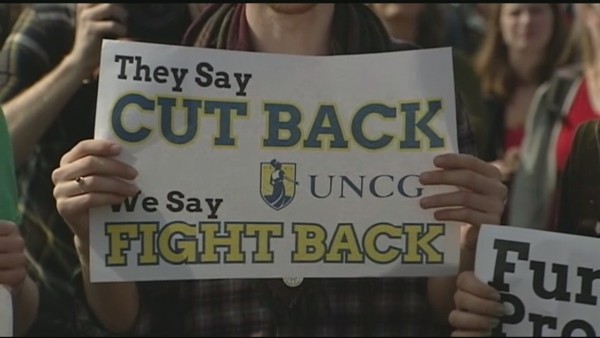
‘Outrage Week’ at UNC-Greensboro Over Budget Cuts

Hundreds of students attended, including some professors with their classes. This past week was dubbed “Outrage Week” by many of the students and faculty upset by the impending budget cuts set to affect the upcoming 2014-2015 Academic Year. On Wednesday students and faculty organized a protest they titled, “Enough is Enough: UNCG Walks Out.” This protest took place on the EUC lawn and was prefaced by an email sent out to all UNCG students inviting them to join. One of the student organizers of the event, Emma Troxler, said, “The purpose of this protest is to gather students and faculty together to create a bigger movement and to fight for a better university.”

5 Things To Know About College Student Debt

3.More college students are borrowing, no matter what type of degree they’re getting. For all types of undergraduate degrees — bachelor’s, associate, and certificates — the percentage of degree recipients borrowing has gone up over the last four and eight years. The biggest jump has been in associate degrees, from only 36.4% of graduates borrowing in 2004 to almost half in 2012. 4.Students who complete degrees at for-profit colleges are way more likely to graduate with more debt than their public school counterparts. “There is still significant variation depending on the type of school a graduate attended,” Miller writes. The biggest difference is between students going to public institutions and for-profit private ones: “42 percent of students earning an associate degree at a… public college borrow. This is less than half the rate of students seeking similar degrees at private for-profit colleges, where nearly nine in ten students graduate with debt.” While the average amount of debt is going up for borrowers regardless of what type of college they attend, the average debt for students who get a degree at private or for-profit institutions is growing faster.

The Only Way To Solve Student Debt Crisis: Strategic Resistance

There is only one way out of the student loan crisis — civil disobedience on a massive scale. Two reforms could bring a fair settlement to banks and borrowers alike. However, while fair, these reforms would cost the banks billions in receivables, which means they will use their considerable political influence to block them. That's why civil disobedience is the only way to succeed. This is an emergency. In addition to the deepening distress experienced by millions of former students, the Federal Reserve, the Treasury Department, and several other governmental agencies have all warned that the $1.1 trillion in unsecured educational debt, much of which will never be repaid, creates a significant danger to the entire economy similar to that generated by housing debt in 2008. This crisis is too big to sweep under the rug. Currently, close to ten million broke and under-employed former students are trapped in a debtors' prison without walls.

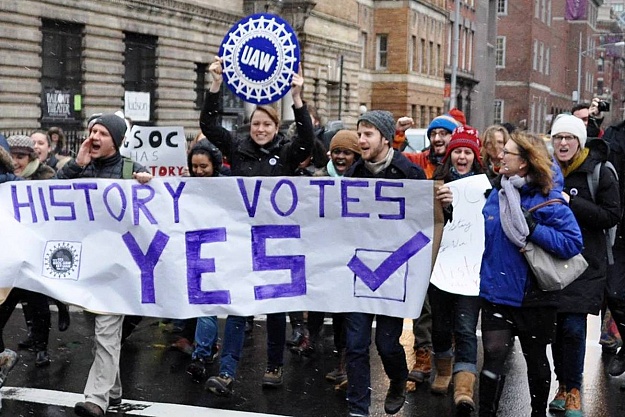
How Graduate Students At NYU Organized A Union

The news arrived the day before Thanksgiving—most students probably missed it, focused on getting home for the holiday. In an email to the NYU community, University President John Sexton made an announcement that many had been waiting eight years to receive: the administration had reached an agreement with the United Auto Workers to hold an election to determine if a majority of graduate employees wished to be represented by the Graduate Student Organizing Committee/UAW and Scientists and Engineers Together/UAW (GSOC/UAW andSET/UAW). The turnaround was rapid: the American Arbitration Association oversaw the election two weeks later, on December 10 and 11. The results arrived via email less than two hours after the polls closed: 620 votes for the union, 10 against it. This makes NYU the only private university in the country with a recognized graduate employee union.

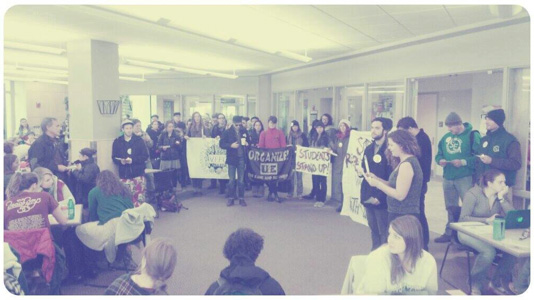
Vermont Students & Workers Oppose Poverty Wages

In Vermont, labor unrest in higher education is giving way to powerful new forms of adjunct, staff and student organization. At "progressive" Burlington College, once run by Bernie Sanders' wife, a controversial neoliberal "restructuring" has spurred restive students to dissolve their student government and form a "more democratic student union." At St. Michael's College, the mission statement of which is packed with social justice verbiage, the school has refused to give a contract to the first union in the Catholic College's 109-year history. In response, an "alt-labor" coalition of low-wage janitors, students and Vermont Workers' Center members has staged a series of rallies, dragging St. Mike's $434,000 per year President John J. Neuhauser back to the bargaining table. At the University of Vermont, shantytowns (to win divestment from apartheid) and occupations of the president's wing of the Waterman administration building (to win a more diverse faculty divest from war profiteering and protest tuition increases) are as much a prerequisite for a Catamount green-and-gold graduation as any seminar.

Teachers In Oregon Vote To Strike For Better Learning Conditions

In an ongoing battle for student and teachers' rights in Portland, Oregon's public school system, nearly 3,000 teachers voted Wednesday night with an overwhelming majority to authorize a strike starting February 20th if school officials don't meet their demands to improve education. Among those demands, the teachers are calling for Portland Public Schools to hire more teachers in order to allow smaller class sizes. The teachers are also calling for a curriculum that "does not force teachers to teach to the test" and an increase in teacher pay that "provides fair compensation after years of sacrifice," according to the Portland Association of Teachers. “No teacher ever wants to go on strike, we want to be in classrooms with our students,” explained PAT president Gwen Sullivan. “But Portland teachers are united and resolved to stand up for our students’ learning conditions. It’s time to move this to a conclusion so that we can have a contract that is fair for teachers and good for students.”

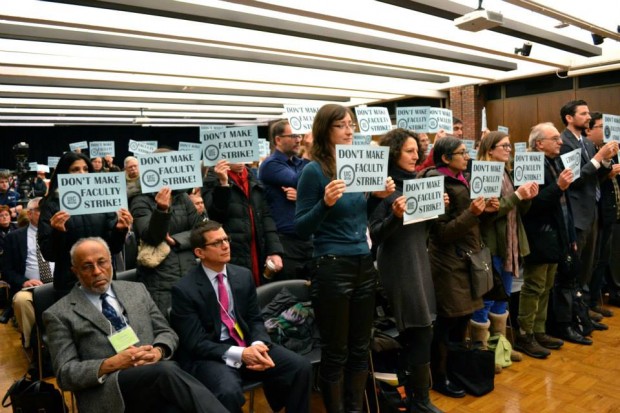
Strike: Students & Faculty Union Unite At Univ. Of Illinois At Chicago

The unions at UIC are standing up and sending a unified message--that workers and students alike are unhappy with conditions on campus. Students are paying more for a worse education--meanwhile, UIC employees are providing more wealth than ever for the university, but getting by with less. If the faculty get the contract they are asking for, not only will they have jobs worth staying in, but students stand to get a better education as well. The UF says that a strike will begin on February 18-19, with picket lines going up on those days--students are encouraged to come to campus on those days, but to join the picket lines instead of going to classes. Workers across Chicago are being asked to write solidarity statements from their unions and community organizations, and come out to show the administration that this fight is part of a broader struggle for all workers in the city.

Portland Students Take Over School Board Meeting

Below are two articles and a video showing the takeover of a Portland, Oregon School Board meeting by students, teachers and community members. The protest was organized by the Portland Student Union. Revolts against school closings and budget cuts have been occurring in many cities most notably Chicago and Philadelphia. The cutbacks in education are tied to the broader issues of austerity and corporatization of schools. This is a national phenomena that is leading to a national education revolt. Indeed, you can see the international nature of the issue as many students are wearing the red square from the student protests in Montreal last year. School Board walked out of its own session early on January 13 when students mic-checked the meeting out of frustration that the district has not listened to nor prioritized their concerns of students as they negotiate with the Portland Association of Teachers (PAT) in what has become an increasingly heated contract battle. The students made ten specific demands.

Government Already Spending What Is Needed For Free Tuition

Here’s a news flash you probably didn’t know: It would cost less for the government to make all public universities tuition-free than what the government already spends in higher education. Today, the government spends $69 billion a year on student aid for the neediest students. According to the New America Foundation, around $36 billion is spent on higher education grants (like the Pell Grant program), $32 billion of potential revenue is lost through tax credits, exemptions and deductions, and around $1 billion dollars is spent on federal work-study programs. The cost of all public universities? $62.6 billion. That is a $6.4 billion difference between what America spends to help its neediest students and the cost of all public colleges combined.

City College Of San Francisco Wins Round In Accreditation Battle

City College of San Francisco has regained accreditation, for now. With a Jan. 2 injunction Judge Curtis Karnow blocked last summer's action by the Accrediting Commission for Community and Junior Colleges (ACCJC) stripping the college's accreditation. Thedisaccreditation would have gone into final effect July 2014 and would have effectively shuttered the school, which has served thousands of students for decades. Karnow's injunction delays the move pending a court decision on a lawsuit brought by San Francisco City Attorney Dennis Herrera against the disaccreditation. After hearing two days of arguments, on Dec.. 26 and 30, Judge Karnow noted in his ruling that the "consequences would be catastrophic" if the ACCJC were allowed to finish the disaccreditation process. "Those of you who have challenged the faculty unions know the sacrifice and price of demonstrating the courage to say no when you must," Kinsella wrote. "That is the type of leadership you now have to demonstrate to retain your accrediting commission. "As an aside if you think this is an ACCJC issue you need to think beyond this because this is nothing more than a fight for total control, void of all but legal constraints that enrich faculty with more entitlements every year. Once they control accreditation they own you." In comments at a forum on ACCJC, held at the College of San Mateo in October, Rafael Mandelman, newest elected board trustee of CCSF, observed that this remark of Kinsella's "offers an amazing insight on how ACCJC sees the world ... that there's this Manichean battle between good and evil. Faculty unions are evil and administrators ... are good."

High School Students Walk Out In Support Of Teachers

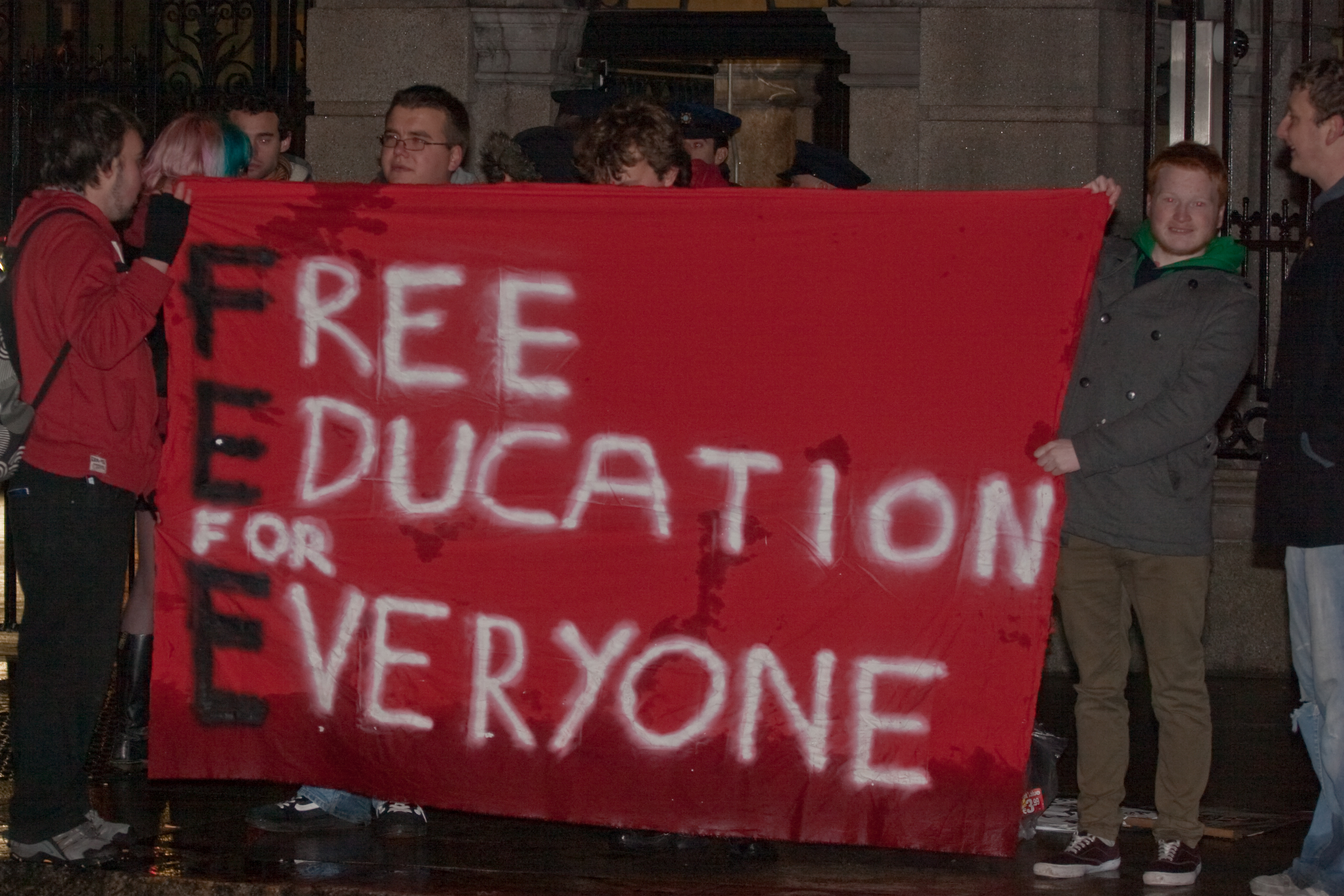
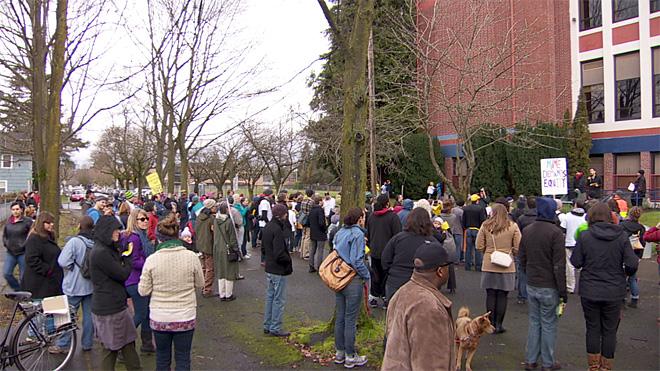
About 200 students at Jefferson High School in Portland, Ore., walked out of classes on Friday, January 10, in support of their teachers who are locked in an increasingly heated contract battle with the school district--and to reclaim respect for students and the school in general against media claims that Jefferson is a "failure" and a "gang" school. The protest came during a week of action to build support for the teachers, whose contract campaign has taken up issues of education justice, challenging swollen class sizes and the standardized testing mania. Called by the Portland Student Union and Portland Teachers Solidarity Campaign, the week of actions will culminate on Monday, January 13, with a rally and march on the Portland Public Schools (PPS) board meeting. On Friday, Jefferson students chanted, "We're the future of this nation, we deserve an education!" as they blocked both lanes of traffic for several blocks on North Killingsworth Street, a busy thoroughfare in North Portland.

Old Cooper Union Dead: Trustees Approve $20K Tuition

...at yesterday's vote, the Board rejected the Working Group's proposal, upholding a plan from April 2013 to charge half-price admission and adding need-based aid—a plan that sparked outrage and protest from alumni and students alike. "The Working Group plan puts forward a number of recommendations that are worth pursuing under any financial model," the statement read. "However, we believe that the contingencies and risks inherent in the proposals are too great to supplant the need for new revenue sources. Regrettably, tuitionremains the only realistic source of new revenue in the near future."
assetto corsa mods

Urgent End Of Year Fundraising Campaign

Online donations are back! Keep independent media alive. 

Due to the attacks on our fiscal sponsor, we were unable to raise funds online for nearly two years.  As the bills pile up, your help is needed now to cover the monthly costs of operating Popular Resistance.

Urgent End Of Year Fundraising Campaign

Online donations are back! 

Keep independent media alive. 

Due to the attacks on our fiscal sponsor, we were unable to raise funds online for nearly two years.  As the bills pile up, your help is needed now to cover the monthly costs of operating Popular Resistance.

Sign Up To Our Daily Digest

Independent media outlets are being suppressed and dropped by corporations like Google, Facebook and Twitter. Sign up for our daily email digest before it’s too late so you don’t miss the latest movement news.