Skip to content

The Commons

The Future Requires A Politics Of Relationality

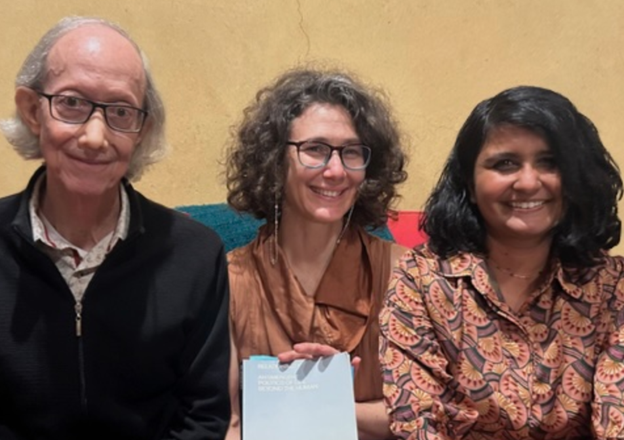
At a time when the superstructures of human civilization seem terminally messed up – unable to address climate collapse, authoritarian capitalism, among many other wicked problems – I was thrilled to encounter a book that dares to imagine a fresh and compelling way forward. The book, Relationality: An Emergent Politics of Life Beyond the Human, is a big-hearted and poetic yet rigorous scholarly book. On my latest episode of Frontiers of Commoning (Episode #68), I interviewed the three authors -- noted anthropologist Arturo Escobar and global studies professor Michal Osterweil, both at the University of North Carolina at Chapel Hill, and Kriti Sharma, a professor of critical race science and technology studies at UC Santa Cruz.

A Vision Of A Post-Capitalist Eco-Localism That Works

What might the world look like if climate change is not stopped? What if societies refuse to, or cannot rein in capitalism and its relentless growth and exploitation of nature? Chris Smaje, a writer and farmer in southwest England, offers some intelligent speculation in his recently published book, Finding Lights in a Dark Age: Sharing Land, Work and Craft.   Smaje is not a doomer or survivalist, nor given to lurid prophesy. His book is a serious analysis of current macro-political and social trends and how they might play out in everyday life. He extrapolates from existing trends -- the rising costs of fossil fuels, food, and transport, the proliferation of droughts, floods, and wildfires, etc. – to sketch a vision of a post-capitalist, climate-disrupted world that is already arriving.

From Capital To Commons: A Review

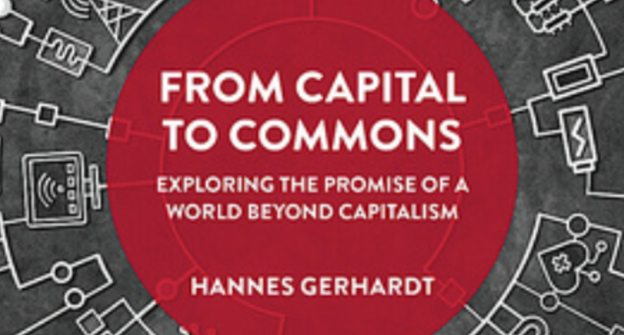
Environmental news, paradoxically, approaches banality as every day a new horror finds resonance in the media we consume and which consumes us. These daily reports enervate us and lead to resignation. Is our passivity the intention? If we refuse to be immobilized, how do we find a route out of our misery? We don’t suffer from a lack of proffered paths for our “engagement.” A multiplicity of them pursue our attention, many illusory, and often provided as a service for a “slight fee.” In frustration, and as a kind of therapy, the most committed rush to clean a beach, while mostly we sign online petitions, or make donations to allay the futility we feel. The complexity of our ecological predicament, when we are methodically informed, clarifies matters.

The Importance Of Network Protocols For Commoning And Open Markets

Most of us don’t give much thought to the arcane technical protocols that make the Internet and its various platforms work. Yet these invisible architectures of code profoundly affect how we can interact with others. They determine what sorts of information we can receive and even how our worldviews and identities are shaped. Sometimes tech protocols empower us to govern ourselves as commoners and freely collaborate with each other. Think open source software, wikis, and collaborative websites. More typically, network protocols are used to create closed, proprietary corporate platforms that turn us into dependent consumers and victims of data-surveillance.

Systems Are Breaking And That’s Our Opportunity

A few months ago, I reconnected with a friend whom I had worked with on an initiative on ‘the sharing economy’. At the time, we were both ‘Young Global Leaders’ (YGLs) with the World Economic Forum. It was 2013, and we had volunteered our time to bring attention to how new technologies could be used to help everyone have a good life with less ecological impact. Personally, we were imagining a future of peer-to-peer resource sharing, community-based production, and cooperative ownership. Meeting up after years, we laughed that our work had oddly contributed to the World Economic Forum publishing the line that became infamous as a globalist’s dystopian injunction: “You will own nothing and be happy.”

How The Commons Can Reach Working-Class Communities

All civilisations fall in the end. The Roman Empire is long gone, along with the ancient Greeks, Egyptians and Sumerians. Will the global civilisation of corporate capitalism buck the trend? Of course not, but how long does it have left? In such a complex system, it’s impossible to predict when there will be a sudden shift, but there’s good evidence that the process of breakdown has already begun. Damage to soils, water tables, forests, the oceans and climate is occurring alongside economic and political upheaval. No longer is this a theoretical matter about the distant future, but something we should be preparing for today. But how? I come at that question after decades working on ‘sustainable development’. During the 90s, I was doing that in Eastern Europe, but was dismayed that most saw corporate capitalism as the path to follow.

The Potential For Community Energy And Commons In North Wales

I’d like to find out more about what you’re doing, your ambitions, the barriers you face. You contacted us, so you know that we’re working to build commons in Stroud – to bring assets into community ownership without debt or giving away equity, but with a reasonable return for investors, strong asset locks, and the ability to federate with other projects around the country, and eventually the world. So after this initial interview, I’d like to bring you together with specialists to see where we might collaborate. So first, before we ask about what you’re doing – why are you doing it? What’s your motivation?

Sharing Seeds In A World Of Proprietary Agriculture

Seed sharing has been a venerable tradition since the dawn of agriculture. Sharing has been a way of honoring the renewal of life, developing new seedlines, and maintaining a farmer’s independence while helping other farmers.  Modern capitalism, armed with new technologies and legal powers, has savaged this tradition of seed-sharing, with disastrous results. For the past several decades, large biotech corporations have aggressively engineered seeds and the design of seed markets to make them proprietary monopolies. This has had profound consequences for farmers and global agriculture:  legal bans on seed-sharing, a loss of biodiversity, less innovation in seed breeding, and higher prices that threaten sustainable agriculture and the economic sovereignty of farm communities, especially in the Global South.

Money Commons: Review Of ‘Remaking Money For A Sustainable Future’

“For those interested in how money works, and in how it is made to work, these are lucky times”, writes Barinaga. While it’s up for debate whether these times are lucky in other respects, her statement is certainly true as far as our understanding of money is concerned. The financial crises of the last two decades have led to many good books and articles explaining how money is created and managed, not least a 2014 communication by the Bank of England. For anybody taking a closer look, it’s quickly obvious that our current money system isn’t working for most people, nor is it compatible with a sustainable future. This book does a very good job of explaining why that is so.

From Inner Change To Systemic Change

“Be the change you want to see in the world!” is the familiar counsel of great social movements. The advice echoes the lyric from the great African-American song, “This little light of mine, I’m gonna let it shine!” But how, exactly, might our inner epiphanies and transformations catalyze systemic change? We may individually develop new insights and values from wisdom traditions and contemplative practice, but how might they radiate out into something larger, collective, and consequential? At this particular moment in modern civilization, as societies grapple with climate change, savage inequalities, and authoritarian rule, the pathways for bringing about change seem terribly murky.

The Many Innovative Spheres Of Organized Sharing

Fifteen years ago, the American group Shareable filled a huge void in public consciousness when it began reporting about creative forms of sharing. Its web magazine introduced people to tool libraries, mutual aid networks, food-sharing systems, “sharing cities,” social co-operatives, tiny houses, and other neglected forms of collaboration. Based in the Bay Area, Shareable is a worker-directed “news and action hub” that, in its words, “promotes people-powered solutions for the common good.” Despite a fairly small staff, the nonprofit has been a catalytic force nationally in promoting commoning and progressive change.

Commoning Within Arts Collectives: Three International Stories

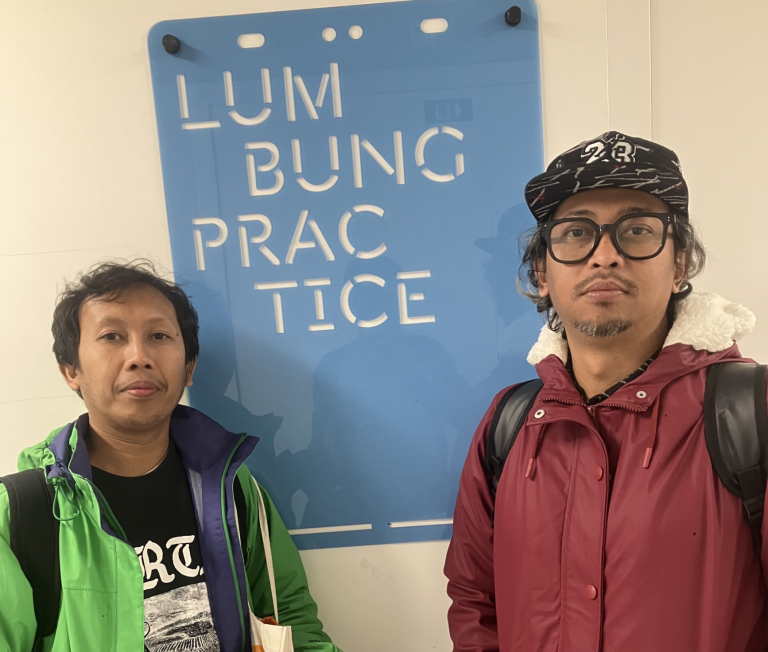
What are some of the distinctive ways that precarious arts collectives share resources, support each other, and make art? I recently learned a lot about this topic from a workshop of international artists convened in Amsterdam. Most of the artists are associated with the so-called Lumbung Practice collective, an interdisciplinary group experimenting with how to cultivate a commons-based art economy. The artists come from Indonesia, Iran, Morocco, transqueer-migrant disaporas, and other geographies and circumstances, so they have some very different experiences and talents.

Welcome To ‘Think Like A Commoner’

About a year ago, some folks in Bangkok reached out to me. Hans van Willenswaard and his wife Wallapa wanted to translate my book Think Like a Commoner into Thai and publish it. Hans is the founder of the Innovation Network International in Thailand, and his wife Wallapa is a social entrepreneur and founder of the Mindful Markets movement. Both have been quite involved in the commons for some time. I was thrilled by their request, but upon re-reading the original version of my book, published in 2014, I was dismayed to realize that parts of it felt outdated.

Future Natures: On Seeing Commons Through Popular Genres

In academic research about the commons, few scholars are as venturesome in their creative approaches than the scholars and researchers associated with the Centre for Future Natures, at the University of Sussex in England. Led by anthropologist and research fellow Amber Huff, Future Natures explores “ecologies of crisis, commons, and enclosures," but its chief output isn’t monographs and books. It’s an exuberant array of creative works in popular genres like comic books, zines, social media, videos, and podcasts. 

The Commons Economy Reloaded

The world seems to have one devastating event after another, and the urgency to strengthen relationships, support one another, and fulfill each other’s needs outside of institutions feels more and more relevant. Many of the solutions offered by elected officials are mired with bureaucracy and lack innovation. In addition, those solutions remove agency from citizens and place it into the hands of institutions that don’t value community needs. It feels poignant to remind us of important work that a few GEO members did during Trump’s last presidency. 
assetto corsa mods

Urgent End Of Year Fundraising Campaign

Online donations are back! Keep independent media alive. 

Due to the attacks on our fiscal sponsor, we were unable to raise funds online for nearly two years.  As the bills pile up, your help is needed now to cover the monthly costs of operating Popular Resistance.

Urgent End Of Year Fundraising Campaign

Online donations are back! 

Keep independent media alive. 

Due to the attacks on our fiscal sponsor, we were unable to raise funds online for nearly two years.  As the bills pile up, your help is needed now to cover the monthly costs of operating Popular Resistance.

Sign Up To Our Daily Digest

Independent media outlets are being suppressed and dropped by corporations like Google, Facebook and Twitter. Sign up for our daily email digest before it’s too late so you don’t miss the latest movement news.