Skip to content

Ukraine

The Ultimate End Of NATO

By militarizing the Ukraine crisis, Russia has exposed the absolute military impotence of NATO. First and foremost, after dangling the bait of NATO membership before Ukraine for the past fourteen years, NATO was compelled to confess that it would not be able to come to the defense of Ukraine in case of any Russian military invasion because Article 5 only allowed collective defense to be invoked for NATO members, which Ukraine is not. Moreover, the “massive” economic sanctions that NATO has promised to unleash in lieu of a military response have turned out to be as impotent as NATO’s military power. Despite what the political leadership of NATO and the United States may say to the contrary, there is no unity of purpose when it comes to imposing sanctions on Russia in the event of a military incursion into Ukraine.

What The Cuban Missile Crisis Can Teach Us About Today’s Ukraine Crisis

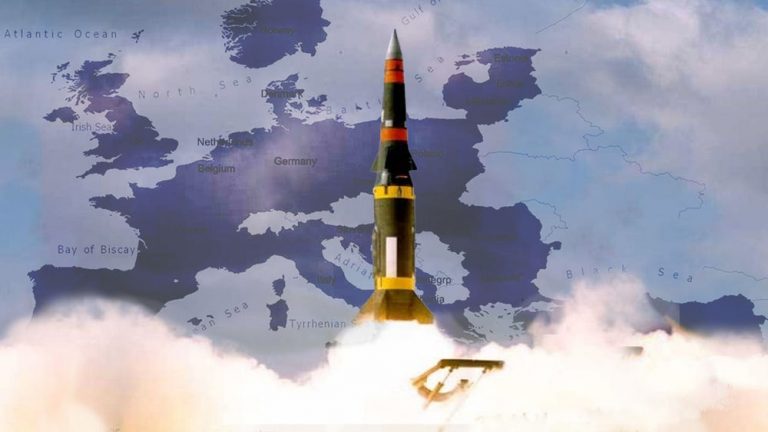
During the 1962 Cuban crisis, the situation was remarkably similar to that in today’s Eastern Europe, although the great power roles were reversed. In 1962, the Soviet Union had encroached on the U.S. government’s self-defined sphere of influence by installing medium-range nuclear missiles in Cuba, a nation only 90 miles from U.S. shores. The Cuban government had requested the missiles as a deterrent to a U.S. invasion, an invasion that seemed quite possible given the long history of U.S. intervention in Cuban affairs, as well as the 1961 U.S.-sponsored Bay of Pigs invasion. The Soviet government was amenable to the request because it wanted to reassure its new Cuban ally of its protection.

Neo-Nazis Active In Ukraine As White House Adds 3,000 Troops

The original roles in the drama seem to be reversed. Back in December, Ukrainian Foreign Minister Oleksii Reznikov was warning that “not provoking Russia—that strategy does not and will not work,” claiming that Russia invaded Georgia in 2008 because NATO hadn’t let it join. In fact, Georgia began that war by attacking South Ossetia, driving tens of thousands of Russian-speaking residents there to flee across the border into Russia, creating an unprecedented refugee crisis for that country. These details, however, rarely trouble Western politicians or journalists. In December, the US seemed much more reluctant to escalate matters. President Joe Biden said he would not deploy troops to Ukraine, and ruled out a military response to any Russian incursion.

Memo To Congress: Diplomacy For Ukraine Is Spelled M-i-n-s-k

A December 2021 poll found that a plurality of Americans in both political parties prefer to resolve differences over Ukraine through diplomacy. Another December poll found that a plurality of Americans (48 percent) would oppose going to war with Russia should it invade Ukraine, with only 27 percent favoring U.S. military involvement.  The conservative Koch Institute, which commissioned that poll, concluded that “the United States has no vital interests at stake in Ukraine and continuing to take actions that increase the risk of a confrontation with nuclear-armed Russia is therefore not necessary for our security. After more than two decades of endless war abroad, it is not surprising there is wariness among the American people for yet another war that wouldn’t make us safer or more prosperous.”

Russia, Ukraine And The US: The Background They’re Not Telling You

In the winter of 2022, the news is dominated by growing tensions  between Russia and Ukraine. Reports that Russia has amassed some  100,000 troops on its border with neighboring Ukraine have brought  charges from the United States and NATO that Russia is planning to  invade its neighbor, with whom it has had increasingly tense relations. Will Russia invade Ukraine? And if it does, how will the United  States and NATO react? Already, the U.S. and its allies are threatening new sanctions against Russia, sending massive amounts of military  equipment to Ukraine and beefing up their military presence in bordering countries. How close are we to war in the region? And how would the U.S. be  involved?

Antiwar Groups Rally To Stop Us From Being Lied Into War With Russia

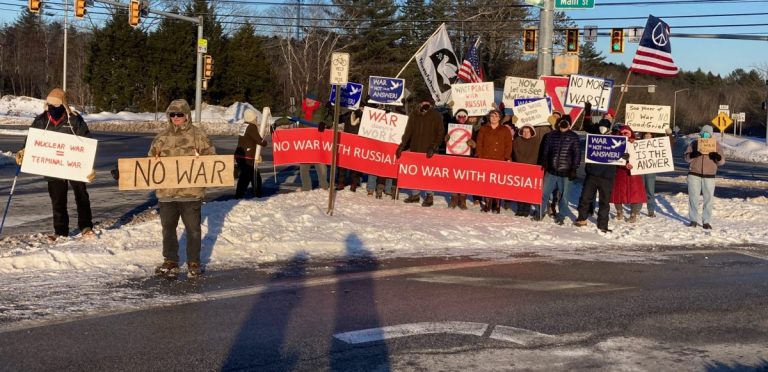
Clearing the FOG provides excerpts from the speakers at the National Online Rally to stop war with Russia over Ukraine that was held on Feb. 5 as part of the national actions that took place in about 70 cities in Hawaii and coast to coast. The rally and actions were organized based on a unified call to action issued by 12 national and international antiwar organizations, which was endorsed by more than 200 more organizations. The demands include stopping the war with Russia, stopping the supply of weapons to Nazis in Ukraine, ending NATO, de-escalating the threat of nuclear war and resolving the current conflict within the framework of international law. Speakers include Alice Loazia from Task Force on the Americas, David Swanson of World Beyond War, Sara Flounders of International Action Center, Ann Wright of CODEPINK, Rafiki Morris of Black Alliance for Peace, Leela Anand of ANSWER Coalition, Henry Lowendorf of the US Peace Council, Bruce Gagnon of the Global Network Against Weapons and Nuclear Power in Space, Susan Schnall of Veterans For Peace and Joe Lombardo of the United National Antiwar Coalition. You can view the entire rally here.

NY Times, Washington Post Driving US To War With Russia Over Ukraine

Washington - Amid tough talk from European and American leaders, a new MintPress study of our nation’s most influential media outlets reveals that it is the press that is driving the charge towards war with Russia over Ukraine. Ninety percent of recent opinion articles in The New York Times, The Washington Post and The Wall Street Journal have taken a hawkish view on conflict, with anti-war voices few and far between. Opinion columns have overwhelmingly expressed support for sending U.S. weapons and troops to the region. Russia has universally been presented as the aggressor in this dispute, with media glossing over NATO’s role in amping tensions while barely mentioning the U.S. collaboration with Neo-Nazi elements within the Ukrainian ruling coalition.

Peace Groups Say No To War Between US And Russia Over Ukraine

Washington DC - Groups opposed to war rallied outside the White House to condemn the Administration’s role in a military buildup in Europe and warned war between superpowers would come at great cost. Speakers questioned why the U.S. is involved in yet another conflict less than a year after the end of the Afghanistan War — its most recent and the longest war it ever fought — while many families can not afford adequate housing, food and healthcare, and communities buckle under crumbling infrastructure. Speakers from anti-war groups Answer Coalition, CODEPINK Women Against War, Caudia Jones School for Political Education, World Without War, and others hammered at the social and economic implications another war would bring.

Crisis or Confusion? A Brief Guide For Black Folk On The Situation In Ukraine

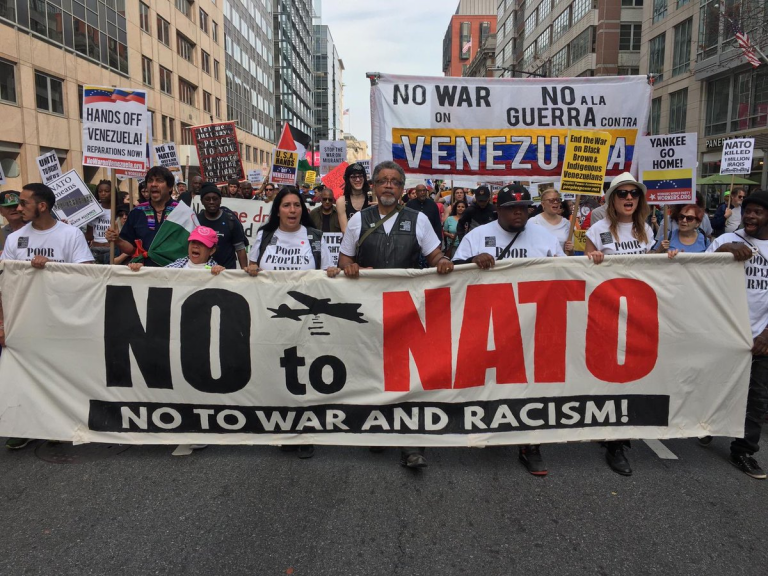
Within large sectors of the U.S. left, including many elements of the Black left, there is widespread confusion related to the Ukraine “crisis.” Years of anti-Russia propaganda from the US and its NATO allies, and the tendency to abstract the current Ukrainian situation from its historical and geo-strategic context, have created a climate of confusion. This climate has played into the hands of state propagandists and democratic party activists eager to use the Ukraine situation to deflect attention from Biden’s disastrous domestic agenda. The situation with Ukraine did not just fall out of the sky in 2021. It has a long history.

The Untold History Of NATO And Case For Its Abolition

NATO, the North Atlantic Treaty Organization, is moving ever closer to Russia’s border. Russia views this as an existential threat – and a historic betrayal of key guarantees it was given by the west as the Soviet Union disintegrated. As Biden sends thousands of additional troops to Eastern Europe, the threat of war is growing by the day.

The US Black Political Class And War

What should Black people think about the United States manufactured crisis in Ukraine? There are many details worth knowing. The most important being that Ukraine’s current troubles began with a U.S. regime change operation in 2014. The Barack Obama administration and NATO overthrew the elected president and sided with right wing neo-Nazi groups such as the Azov Battalion and the Right Sector. Of course destabilizing Russia was always the goal and should be immediately suspected whenever former Soviet republics experience any upheaval. As important as these facts are to understanding the current situation, there is more basic information which explains any and all international events that are designated as crises by this country.

The Illegality Of NATO

In recent years, participation in NATO has made European countries accomplices in US efforts to achieve global hegemony by means of military force, in violation of international law, and especially in violation of the UN Charter, the Nuremberg Principles. Former UN Assistant Secretary General Hans Christof von Sponeck used the following words to express his opinion that NATO now violates the UN Charter and international law: “In the 1949 North Atlantic Treaty, the Charter of the United Nations was declared to be NATO's legally binding framework. However, the United-Nations monopoly of the use of force, especially as specified in Article 51 of the Charter, was no longer accepted according to the 1999 NATO doctrine. NATO's territorial scope, until then limited to the Euro-Atlantic region, was expanded by its members to include the whole world”

Russia Accuses US And NATO Of Provoking War In Ukraine

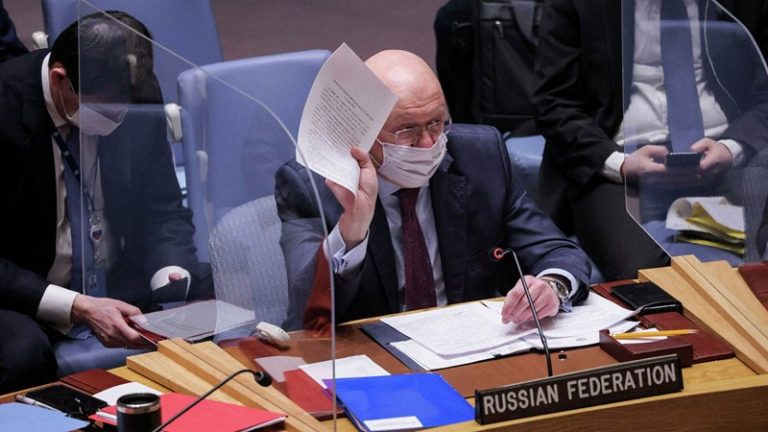
On Monday, January 31, at a UN Security Council (UNSC) meeting called to discuss the situation in Ukraine, the Russian envoy to the UN, Vasily Nebenzya, accused the US and the North Atlantic Treaty Organization (NATO) of whipping up war hysteria in eastern Europe. Nebenzya was responding to the US permanent representative at the UN, Linda Thomas Greenfield, who reiterated her country’s claims of an imminent threat of Russian invasion of Ukraine. She called on the UN to take urgent steps to prevent the war, saying that failure to do so will lead to “horrible consequences.” She claimed that deployment at the Russian border is the “largest in decades” and that “diplomacy will not succeed in an atmosphere of threat and military escalation.”

Blackwater Is In The Donbas With The Azov Battalion

The phone call between President Biden and Ukrainian President Zelensky “did not go well“, CNN headlines: while “Biden warned that the Russian invasion in February is practically certain when the frozen ground makes it possible for tanks to pass through”, Zelensky “ asked Biden to tone down, arguing that the Russian threat is still ambiguous”. While the Ukrainian president himself takes a more cautious stance, the Ukrainian armed forces are massing in Donbas close to the Donetsk and Lugansk area inhabited by Russian populations. According to reports from the OSCE Special Monitoring Mission in Ukraine, units of the Ukrainian Army and National Guard amounting to about 150,000 men are positioned there, the news is overshadowed by our mainstream which speaks only of the Russian deployment.

After Failed Talks, Russia Will Likely Target Persian Gulf

For some reason, in the aftermath of this month’s failed talks among the Russian, American and NATO representatives in Geneva, everybody is talking as though they believe Russia’s invasion of Ukraine is imminent. From the officials of the U.S. State Department, Pentagon and NATO to the intelligence agencies and the media, nearly everyone is talking as though they have not the slightest doubt that Russia intends to invade. However, in a Friday meeting with president Biden, Ukrainian President Volodymyr Zelensky urged Biden not to provoke panic, saying that he did not see a greater threat now then during a similar massing of troops last spring. Russian president Vladimir Putin is indeed both a cautious and calculating leader who has increased Russia’s strength and global position incrementally over the last twenty years.
assetto corsa mods

Urgent End Of Year Fundraising Campaign

Online donations are back! Keep independent media alive. 

Due to the attacks on our fiscal sponsor, we were unable to raise funds online for nearly two years.  As the bills pile up, your help is needed now to cover the monthly costs of operating Popular Resistance.

Urgent End Of Year Fundraising Campaign

Online donations are back! 

Keep independent media alive. 

Due to the attacks on our fiscal sponsor, we were unable to raise funds online for nearly two years.  As the bills pile up, your help is needed now to cover the monthly costs of operating Popular Resistance.

Sign Up To Our Daily Digest

Independent media outlets are being suppressed and dropped by corporations like Google, Facebook and Twitter. Sign up for our daily email digest before it’s too late so you don’t miss the latest movement news.