Skip to content

Brazil

Anarchist Tactics Grow in Brazil Protests As Demonstrators Battle Police

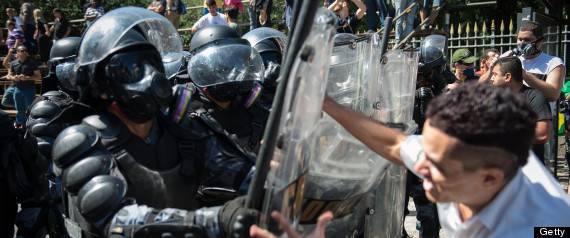
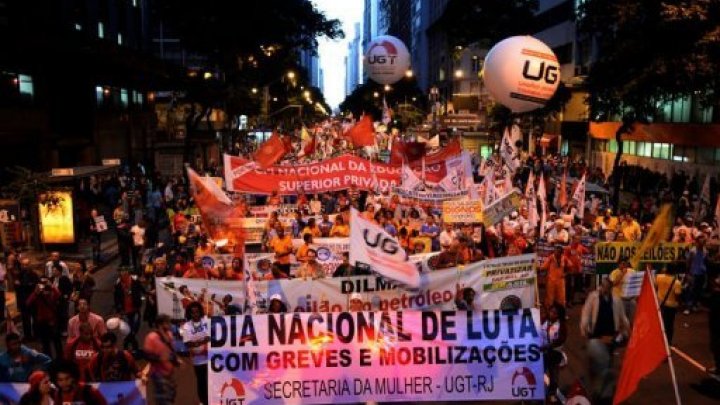
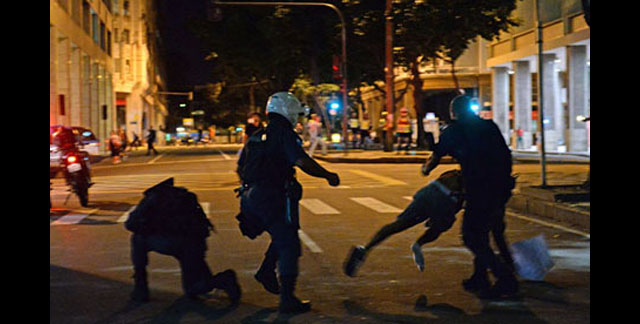
"It was the Black Bloc that protected me in that protest," Coelho, 47, said at the beginning of a march last week that again descended into fighting between anarchists and police. "The police came in firing tear gas, hitting us with clubs. A young Black Bloc stepped right in between me and the police. If it weren't for them, the police would have destroyed us." That sentiment has helped turn the anarchists in Brazil into a driving force behind protests in recent weeks. The demonstrations have lessened in size but not frequency since masses took to the streets in June, fed up with a litany of problems that mostly center on corruption, woeful public services, and big spending on the upcoming World Cup and 2016 Olympics. More protests erupted Monday as demonstrators railed against a government auction of a big offshore oil field, which petroleum unions think should remain completely in Brazilian hands, and the anarchists rallied in Rio's historic center to support the strike of the teachers and oil workers.
Brazil Is Going To Block The NSA

The NSA revelations are but another smear against brand USA in the global psyche, having done potentially as much damage as the Middle East wars started under President George W. Bush. Even US allies are implementing mechanisms by which to keep the US from eavesdropping. The Brazilian President Dilma Rousseff announced Sunday that the Brazilian government would be creating its own secure email system to shield official communications from spying by the US and other countries. "We need more security on our messages to prevent possible espionage," Rousseff wrote in Twitter posts on Sunday. She ordered the Federal Data Processing Service, SERPRO, to design a safe email system for use throughout the federal government.

At the UN, A Latin American Rebellion

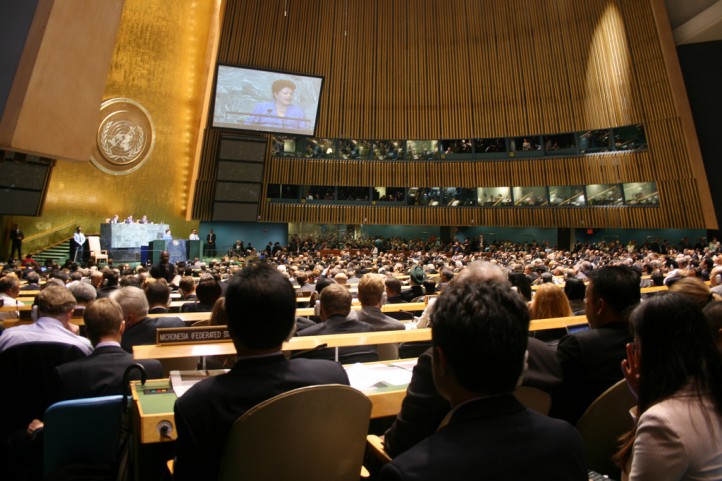
Without a doubt, the 68th UN General Assembly will be remembered as a watershed. Nations reached an agreement on control of chemical weapons that could avoid a global war in Syria. The volatile stalemate on the Iran nuclear program came a step closer to diplomacy. What failed to make the headlines, however, could have the longest-term significance of all: the Latin American rebellion. For Latin American leaders, this year’s UN general debate became a forum for widespread dissent and anger at U.S. policies that seek to control a hemisphere that has clear aspirations for greater independence. In a region long considered the United States’ primary zone of influence, Washington’s relations with many Latin American nations have gone from bad to worse under the Bush II and Obama administrations.

Thousands Join Teachers’ Protest In Rio De Janeiro

Several tens of thousands joined a demonstration in support of teachers, who are opposed to a salary and benefit package proposed by Rio's mayor, Eduardo Paes. The turnout, despite a torrential downpour, was among the biggest since a nationwide wave of protests in June that overshadowed preparations for next year's World Cup. Anarchist groups smashed banks and burnt a bus, while "Black Block" protesters threw firebombs at the police, who responded with teargas, rubber bullets and percussion grenades. The scenes outside the city hall will resurrect fears about social stability that had abated in recent months. After the million-strong protests three months ago, the president, Dilma Rousseff, tried to assuage public anger with a promise to divert more revenue to education and health.

Brazilian President: US Surveillance a ‘Breach of International Law’

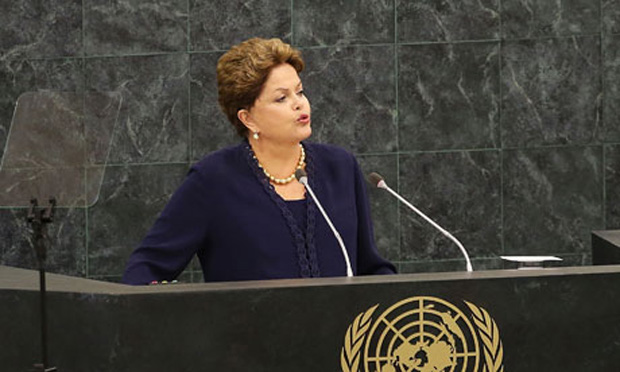
Brazil's president, Dilma Rousseff, has launched a blistering attack on US espionage at the UN general assembly, accusing the NSA of violating international law by its indiscriminate collection of personal information of Brazilian citizens and economic espionage targeted on the country's strategic industries. Rousseff's angry speech was a direct challenge to President Barack Obama, who was waiting in the wings to deliver his own address to the UN general assembly, and represented the most serious diplomatic fallout to date from the revelations by former NSA contractor Edward Snowden.

Mass Protests In Brazil On Independence Day

Police used tear gas and rubber bullets to scatter anti-government protesters who interrupted an independence day military parade in Rio de Janeiro on Saturday, and demonstrations in dozens of other cities led to some scuffles between marchers and police. Authorities said they arrested at least 10 people in Rio, and at least six marchers were injured. It was among more than 100 planned demonstrations across Brazil, with unions, student groups, anarchists and other groups calling for an end to political corruption and drastically improved public services in health, transportation, education and security. In the capital of Brasilia, about 1,000 protesters gathered in front of Congress. While it was peaceful for the most part, police and activists clashed at times.

NSA ‘Spied On Communications’ Of Brazil, Mexico Presidents

The National Security Agency spied on the communications of the presidents of Brazil and Mexico, a Brazilian news program reported, a revelation that could strain US relations with the two biggest countries in Latin America. The documents were part of an NSA case study showing how data could be "intelligently" filtered, Fantastico said. Justice minister Jose Eduardo Cardozo told the O Globo newspaper that the contents of the documents, if confirmed, "should be considered very serious and constitute a clear violation of Brazilian sovereignty." "This [spying] hits not only Brazil, but the sovereignty of several countries that could have been violated in a way totally contrary to what international law establishes," Cardozo said.

Brazil’s Vinegar Revolution: Left In Form, Right In Content

“It’s not just about 20 cents”. This was the status message of Mark Zuckerberg, head of Facebook last week, a message that was relayed through several of Brazil’s major cities. The message became one of the initial slogans of what many are now calling the “Vinegar Revolution” which was reportedly triggered by a 20 cent hike in bus fares in the city of Sao Paulo June 20th. The very mention of Zuckerberg in connection with mass protests should immediately sound alarm bells among those who have been following closely the Facebook, Twitter fomented ‘colour revolutions’ that have rocked several states targeted for covert regime change by US imperialism over the last decade. Colour revolutions are essentially fake revolutions orchestrated by NGOS funded by the US government which are organized in countries ruled by governments that threaten or present an obstacle to the furtherance of US interests.

Global Unrest Defines a Fearless Summer of Protest

The summer of 2013 has seen some of the largest, most vocal mass protests around the world since 2011. When sparks flew out of Turkey’s struggle to save Istanbul’s last standing green space in Gezi Park, other parts of the world took note: people exercised power through occupations, strikes and blockades from Frankfurt, Germany to Sanford, Florida and beyond. While the demonstrations have shaken many people out of complacency, institutional powers have also sat up. An escalated war on whistleblowers, Orwellian surveillance state tactics and diminishing civil liberties have stacked up. But after a fearless summer of mass mobilizations, the world’s protesters are resisting more now than ever before.

Workers Play A Big Role In These Global ‘Middle-Class’ Revolutions

South Africa's rebellion against police brutality is driven by a labour movement whose members were gunned down by police in the worst massacre since Sharpeville. In Egypt, no revolution was possible without the Mahalla strikes and the rise of organised labor. In Latin America, from Argentina to Brazil to Bolivia, democratic movements have been driven by the poor. Paul Mason has documented the surging growth of the working class south of the equator. These are workers whose only asset is their labour power, which they sell in order to survive. Profit, the final, directive purpose of global production, depends on their doing so. This gives workers potential power.

Understanding The Mass Protests In Brazil

TThe mass movements starting in June 2013 were the largest and most significant protests in Brazil in a generation, and they have shaken up the country's political system. Their explosive growth, size and extraordinary reach caught everyone – the left, the right, and the government – by surprise. This article examines these movements in light of the achievements and shortcomings of the democratic transition, in the mid-1980s, and the experience of the federal administrations led by the Workers’ Party since 2003. It is disappointing, but also sobering, to conclude that Brazil is not going through a revolutionary crisis, and that the current political mobilizations are unlikely to trigger one. Nevertheless, this is unquestionably the most important social movement in Brazil in the last thirty years. The point, now, is to continue to fight on the streets, workplaces and schools, continue to broaden and radicalize the movement, bring out the working-class with its specific demands, defeat the right and disorganize and attract part of the middle classes, and push for progressive constitutional and policy changes.

Brazil’s Unions Join Movement for First Time, 150 Cities Strike

Centra Unitaria do Trabajadores (CUT), the national worker's coalition, called workers to join the strikes and protests that took place in more than 150 cities in 18 states of the country. More than 80 kilometers of roads where blocked. The city of São Paulo alone registered more than 20 street demonstrations, all gathering in the economical hub of the city, the Avenida Paulista, by the end of the day. [incompr.] is one of the most organized cities in Brazil and attracts several investments because of its infrustructure. The largest demonstrations to date took place there, with 35,000 people protesting.

S. American States Recall Ambassadors Over Bolivian Plane Incident

“What the United States government is seeking is to obstruct Edward Snowden’s bid to seek asylum. Not to get asylum, but to seek asylum,” Tatchell said. “It has bullied and threatened and menaced other countries around the world to not grant him asylum and to not grant airspace so that a flight can take him to another country. That is a direct attack upon the United Nations’ refugee conventions, and it is shocking and appalling that a supposedly democratic government, in collusion with European governments - including the government in Britain - has been conspiring to not allow Mr. Snowden to make a valid asylum application.”

Thousands on the Streets in Brazil Protests

Violence broke out in central Rio de Janeiro at rush hour following a march by trade unionists estimated at up to 20,000 people. The protest was part of a union-organised national day of action in which demonstrations were held and roads blocked in all 27 Brazilian states. Police used teargas and stun bombs on demonstrators in central Rio. Protests were intended to be peaceful but one flashpoint erupted after the discovery of a cardboard box full of homemade molotov cocktails made of beer bottles as the march reached the central Floriano Square. As a demonstrator smashed the molotov cocktails underfoot police began firing teargas – and panic and violence rapidly ensued. A group of masked protesters threw rocks and fireworks at police while others wrapped scarves around their faces as gas filled the air. In the middle of running battles a soundtrack continued playing the national anthem while a speaker urged calm.

The Roots of Social Rebellion? Social Movements

Like Rome, the revolution is never built in a single day. In Bishara’s words, the Arab Spring was “fermented” by countless civil society activists, neighborhood organizers, human rights advocates, and nondescript political associations that chipped away at tyrannical regimes during “largely unreported years.” Workers who rose up at the Mahallah textile factory in 2006 in Egypt and the miners agitating against mistreatment in the mining belt of Qafsa in Tunisia in 2008 were some of the forefathers who seeded the ultimate downfall of despots in these countries. The common intellectual lesson from the streets of Brazil, Turkey, and the Arab world is to avoid underestimating half-baked social movements still in their infancy.
assetto corsa mods

Urgent End Of Year Fundraising Campaign

Online donations are back! Keep independent media alive. 

Due to the attacks on our fiscal sponsor, we were unable to raise funds online for nearly two years.  As the bills pile up, your help is needed now to cover the monthly costs of operating Popular Resistance.

Urgent End Of Year Fundraising Campaign

Online donations are back! 

Keep independent media alive. 

Due to the attacks on our fiscal sponsor, we were unable to raise funds online for nearly two years.  As the bills pile up, your help is needed now to cover the monthly costs of operating Popular Resistance.

Sign Up To Our Daily Digest

Independent media outlets are being suppressed and dropped by corporations like Google, Facebook and Twitter. Sign up for our daily email digest before it’s too late so you don’t miss the latest movement news.