Skip to content

Coal

Obama Administration Secretly Weakening EPA Rules

Hopes for environmental policy change were dashed before the end of Obama’s first year. He talked a big game on the campaign trail, but when it came to acting on those promises, that rhetoric proved to be just as hollow as his predecessor’s. Obama doubled down on coal, oil, and fracking, while allowing renewable energy investments to fall. But the most disturbing part of the story is that Obama and his officials have been working in secret to weaken environmental standards that his administration has been patting themselves on the back for in public. Recently, a federal judge expanded a Freedom of Information Act lawsuit that was filed against the Small Business Administration (SBA), which claims that officials within the White House Office of Management and Budget (OMB) has been working to weaken the Environmental Protection Agency’s (EPA) power plant pollution standards. The administration has been dragging its feet in providing the information requested, even after the court ruling, which has led environmental groups to file a complaint against the White House.

Stop Mountaintop Removal: Activists Blockade Headquarters

Three activists with Mountain Justice and Radical Action for Mountains and People’s Survival (RAMPS) are currently stopping business as usual at Alpha Natural Resources headquarters in Bristol, VA, in protest of Alpha’s devastating practices of mountaintop removal coal mining. Activists were protesting the opening of new mines on Coal River Mountain in southern West Virginia. Two protestors are locked in front of the front doors of the office, while a third is hanging from a flag pole displaying a banner that reads “Save Coal River Mountain” “That mountain is the mountain I learned to hunt on, it’s the mountain that’s sustained my family for generations. I’ll be a dead man before I see them take what’s left up there,” said Junior Walk, of West Virginia.

Federal Court Allows Coal Ash Litigation To Continue Against Duke Energy

Conservation groups represented by the Southern Environmental Law Center won a major victory Monday night when a federal court ruled that they may go forward with challenges to coal ash pollution contaminating an important public fishery near Wilmington, NC and drinking water supplies for a nearby community. The court rejected numerous arguments by Duke Energy seeking to dismiss the lawsuit brought by Cape Fear River Watch, Sierra Club and Waterkeeper Alliance. “This ruling is a major step towards protecting people who depend on nearby drinking wells for clean water and on fish from Sutton Lake for their next meal,” said Frank Holleman, the senior attorney at the Southern Environmental Law Center who represented the groups in court. “The court said Sutton Lake belongs to North Carolinians and rejected Duke Energy’s attempt to avoid its responsibility for polluting groundwater and drinking water supplies and convert Sutton Lake into its wastewater dump.” The state drew national press when it stepped in at the last minute to try to block the citizens groups’ Clean Water Act lawsuit by filing an enforcement action in state court.

I Let Go Of Being A Righteous Outside Organizer

I want to share a story. And I should warn you: it’s full of hubris. I moved to West Virginia in December of 2012, thinking I could lead a blitz campaign to end the reign of mountaintop removal in the state. I spent a few months volunteering for local groups, like Coal River Mountain Watch, RAMPS, and so on, listening and learning, and trying to be of service — while looking for openings and seeing the need for an audacious all-out effort that would finally safeguard these mountains and her people. By the Summer of 2013, I thought I was ready to make my move. I wrote up a 7-page manifesto, which I have yet to share publicly, and mailed it (yes, snail-mailed it) to what I saw as some of the best organizers in the state (though not all). The manifesto was coupled with an invitation to join together for a visionary summit at the Southern Appalachian Labor School on August 17th 2013 — to brainstorm and possibly even launch a new campaign.

Opposition To Coal Exports Continues In Pacific Northwest

Wyoming Gov. Matt Mead visited Longview, WA, yesterday to sell his dirty coal, but local community members did not roll out the red carpet. Instead, 60 Longview-area residents protested Gov. Mead’s visit, delivering a bucket of Powder River Basin coal that activists had gathered from the side of railroad tracks, spilled by coal trains. The Governor traveled west to promote a massive coal export terminal in Longview that, if approved, would receive nine full coal trains every day from Wyoming, and ship 44 million tons to Asia every year. Gov. Mead tried to convince folks that coal is good for them. The protestors weren’t buying it. Armed with megaphones and signs, protestors greeted the Governor when he toured the proposed coal terminal saying: Governor, keep your coal in the ground. We don’t want it here in Washington. “The benefits the Governor seeks for Wyoming are dwarfed by the damage mining and exporting coal would bring to his own people, the people of Longview and the rest of the world,” said Reverend Kathleen Patton of Longview. There is tremendous opposition to coal exports in Longview and across the Pacific Northwest. A record 200,000 citizens submitted comments on the Longview coal terminal and 2,000 showed up to testify in person.

Hidden Camera Catches Coal Ash Dumping

Two months have passed since hidden-camera images exposed Louisville Gas & Electric (LG&E) for dumping toxic coal ash into the Ohio River—a practice the company has engaged in for two decades. The utility has done nothing in response, so two environmental groups figure it’s time to pay up. The Sierra Club and Earthjustice filed a lawsuit asking a federal judge to order LG&E to stop the illegal dumping. The company could face up to $68 million in penalties to account for the last five years of its illegal dumping, plus $37,500 for each day moving forward, until the violations are eliminated. The groups notified the company that they intended to sue in March, but that seemed to have no impact on LG&E. Sierra Club and Earthjustice are armed with a year’s worth of footage from a camera that was strapped to a tree. They also have proof from Google Earth satellite images that date back to 1993.

‘Appalachia’s Agony’: The Human Effects Of Mountain Top Removal

The Appalachian Communities Health Emergency Act is the first law ever proposed that would end the human rights/ human health disaster that is Mountaintop Removal in Appalachia. The New York Times called Mountaintop Removal "Appalachia's Agony." It's no wonder: communities near Mountaintop Removal sites suffer shockingly disproportionate levels of cancer, heart disease, pulmonary disease, birth defects and other physical and mental illnesses. More than four thousand people die in West Virginia mining communities every year. Science calls these "excess deaths." We call them Husband, Wife, Grampa, Granma, Brother, Sister, Son, Daughter, Aunt, Uncle, Cousin. Mountaintop Removal's horrors MUST end, and you have a vital role to play in ending it. Get your member of Congress to sign on to the A.C.H.E. Act now.

Help Activists On Trial For Blockading 40,000 Tons Of Coal

The Lobster Boat Blockade has provided an incredible opportunity for the climate movement to pursue a new legal tactic in our effort to push for immediate and dramatic emissions reductions. Ken and Jay are preparing to mount a "necessity defense" - potentially the first ever in the US climate movement. This is a powerful opportunity to showcase the seriousness of the climate crisis in a court of law, and put climate change on trial. Ken and Jay choose to take this action because they see no alternative - in both practical political terms and as a moral obligation. Ken has worked on climate change since 1989, as both a professional environmentalists and climate activist, and Jay has been an active citizen organizer working on climate since 2008. Neither have been arrested or charged with any crime before, and are good candidates for a watershed trial. Making a necessity defense means they admit their action and argue that the threat of passing the climate change point of no return is evident and immediate, the contribution of coal burning is clear-cut, available legal avenues for averting the crisis have been tried and are inadequate, and therefore, they were justified in taking action to directly prevent further injury.

Bank Of America Protested Over Coal And Climate Finance

An international coalition of shareholders and community leaders from as far away as Bogota, Colombia, will testify to the grave impacts resulting from Bank of America’s financing of the coal industry at the bank’s Annual General Meeting today in Charlotte, North Carolina. Shareholders will also consider a resolution requesting the bank to report carbon emissions stemming from financing of carbon-intensive industries. Coal is the top contributor to greenhouse gas emissions (GHG) that cause climate change. The proposed resolution requests that Bank of America provide an assessment and report on its financing of GHG emissions. It was introduced by members of the Interfaith Center for Corporate Responsibility (ICCR) and endorsed by a coalition of institutional investors with nearly $35 billion in managed assets. “Coal is still a big problem for Bank of America, as it continues to finance billions of dollars each year to the dirtiest companies in the business,” said Ben Collins, Policy Campaigner for Rainforest Action Network. “Shareholders proposed a resolution that the bank come clean on its accounting-- and report the climate consequences of its financing decisions in the light of day.”

Southern Appalachian Mountain Stewards Campaign Against Coal Mess

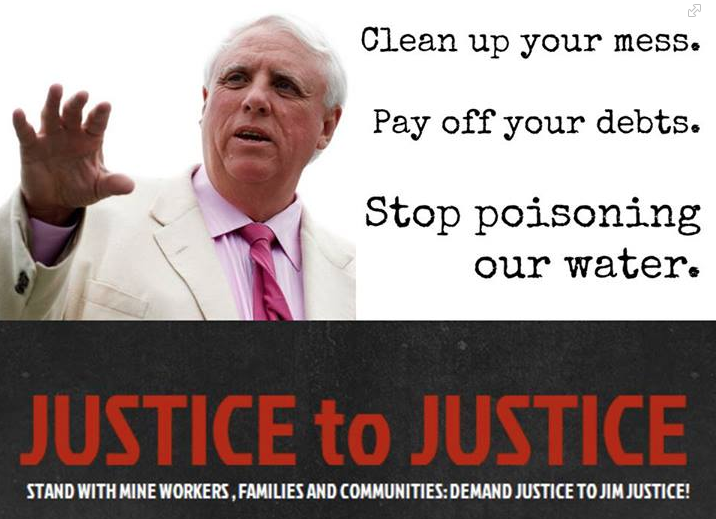
Southern Appalachian Mountain Stewards is launching a new effort to draw attention to the reckless practices of West Virginia Coal Baron Billionaire, Jim Justice. Justice owns Southern Coal, based in Roanoke, VA, and a multitude of subsidiaries across Central Appalachia. Justice has drawn heat in recent years for failing to settle debts with contractors, allegedly illegally laying off workers, and for hundreds of violations on his surface mines in the four-state region of Central Appalachia (SW VA, E KY, NE TN, S WV). Join SAMS as we call on Jim Justice to clean up his mess, pay his debts, and to stop poisoning our water. Learn more about our campaign: http://www.justicetojustice.com/ Southern Appalachian Mountain Stewards (SAMS) is an organization of concerned community members and their allies who are working to stop the destruction of our communities by surface coal mining, to improve the quality of life in our area, and to help rebuild sustainable communities. We support safe and responsible underground mining and work for the diversification of our coalfield economies.

Protesters Converge On Bank Of America Shareholder Meeting

Charlotte-Mecklenburg police are preparing for another large protest expected in uptown Wednesday morning. It comes less than a week after protesters crowded outside the Duke Energy building. Wednesday’s event is expected to bring hundreds outside Bank of America. Police have already brought over barricades they plan to line up outside Bank of America’s headquarters to make sure protesters don’t trespass. Rainforest Action Network said it's prepared as well. The environmental organization plans to protest Bank of America's multibillion-dollar investment in the coal industry. “Bank of America is on the hook for this. It's putting our communities and our shareholders at risk,” Todd Zimmer, with RAN, said. Zimmer said for the first time the group will take the protest off the streets and into the meeting itself. Five of its members plan to speak. “They are all shareholders, so they have every right to be in the meeting. They will be testifying as to the real impacts they experienced,” Zimmer said. One of the speakers is from Colombia. That's where the coal company Drummond limited has a mine. Bank of America works with Drummond. Santiago Piñeros is an attorney with Social Thought and Action. He has seen how people are now sick from the pollution and coal ash. “It’s a violation of human rights- of health, of life,” he said.

Following The Money On The WV Chemical Spill

West Virginia may be the indicator of where our nation is headed — the ‘canary in the coal mine’ if you will. West Virginia has had 5 major industrial accidents in the past 8 years. . . Joe Manchin, a governor who has publicly pressured the federal Environmental Protection Agency to curb enforcement, ran for the US Senate in 2010. At his back was the American Chemistry Council, a leading industry group for big coal. The council spent over $225,000 on advertisements promoting Manchin. That’s big money anywhere, but in a small state like West Virginia, that’s the kind of spending that wins an election.

Carbon Divestment Movement Hits Australia’s Four Big Banks

Hundreds of customers with Australia’s Big Four Banks will close their accounts in a statement against the banks’ investments in new coal and gas projects. These customers will be taking part in Australia’s first ‘National Days of Divestment Action’ organised by Market Forces and 350.org Australia. Since May last year, hundreds of customers have ‘put their bank on notice’ and pledged to move more than AUD $100 million out of the Big Four banks unless they commit to ruling out future loans to coal and gas projects. This is the first time that customers of Australia’s largest banks have been mobilised for a divestment action of this scale. Since 2008, Westpac, ANZ, NAB and the Commonwealth Bank have loaned a collective AUD $19 billion [1] to new coal and gas projects, including the controversial Abbot Point coal terminal and the Maules Creek coal mine. Julien Vincent, Lead Campaigner for Market Forces commented, “The rapid expansion of coal and gas in our country at the expense of communities, other industries and the environment is cause for concern for a great many Australians.”

Hundreds Protest During Duke Shareholder Meeting

Duke Energy’s chief executive on Thursday touted the company’s accomplishments over the past year, but some shareholders focused on a massive coal ash spill that coated 70-miles of a North Carolina River in toxic sludge. Outside Duke’s headquarters, where investors gathered for the annual shareholders meeting, about 200 protesters criticized the spill, and the way the $50 billion company has handled the coal ash issue. Duke has 14-coal fired plants with 33 ash pits spread across the state. The Rev. William Barber, president of the North Carolina chapter of the NAACP, told the protesters many of the pits are located in rural areas around minority communities. “Duke is trying to say they have made a mess and now the people have to clean it up. What we’re saying is they ought to clean it up,” Barber said. The shareholders meeting came nearly three months after the Feb. 2 spill that polluted the Dan River. Duke CEO Lynn Good told shareholders that the company had a profitable year, and was working hard to protect the environment. She said Duke had reduced emissions at its coal-fired plants.

Honoring Grassroots Environmental Heroes

The Goldman Prize continues today with its original mission to annually honor grassroots environmental heroes from the six inhabited continental regions: Africa, Asia, Europe, Islands and Island Nations, North America, and South and Central America. The Prize recognizes individuals for sustained and significant efforts to protect and enhance the natural environment, often at great personal risk. Each winner receives an award of $150,000, the largest award in the world for grassroots environmentalists. The Goldman Prize views “grassroots” leaders as those involved in local efforts, where positive change is created through community or citizen participation in the issues that affect them. Through recognizing these individual leaders, the Prize seeks to inspire other ordinary people to take extraordinary actions to protect the natural world. The Prize Recipients The work of Goldman Prize recipients often focuses on protecting endangered ecosystems and species, combating destructive development projects, promoting sustainability, influencing environmental policies and striving for environmental justice. Prize recipients are often women and men from isolated villages or inner cities who chose to take great personal risks to safeguard the environment.
assetto corsa mods

Urgent End Of Year Fundraising Campaign

Online donations are back! Keep independent media alive. 

Due to the attacks on our fiscal sponsor, we were unable to raise funds online for nearly two years.  As the bills pile up, your help is needed now to cover the monthly costs of operating Popular Resistance.

Urgent End Of Year Fundraising Campaign

Online donations are back! 

Keep independent media alive. 

Due to the attacks on our fiscal sponsor, we were unable to raise funds online for nearly two years.  As the bills pile up, your help is needed now to cover the monthly costs of operating Popular Resistance.

Sign Up To Our Daily Digest

Independent media outlets are being suppressed and dropped by corporations like Google, Facebook and Twitter. Sign up for our daily email digest before it’s too late so you don’t miss the latest movement news.