Skip to content

Labor

Climate Action Could Deliver 48 Million Jobs

LONDON: A new international campaign, Unions4Climate action, has been launched at the World Congress of the International Trade Union Confederation (ITUC) this week. The movement aims to draw attention to the potential of the low carbon economy, with a focus on green job creation. More than 50 trade unions across the globe are demanding that governments deliver an ambitious climate agreement at the UNFCCC 21st Conference of the Parties (COP21) in Paris next year. The international gathering is the deadline for determining the post 2020 climate framework and widely recognized as a crucial meeting for delivering meaningful climate action. Józef Niemiec, Deputy General Secretary of the European Trade Union Confederation (ETUC), commented: “The ETUC urges governments to agree to an ambitious and legally binding agreement in Paris next year. A global framework, built on common but differentiated responsibilities, is the cornerstone of the just transition we are calling for.” The leaders of the unions involved in the campaign are arguing that acting on climate change will lead to an industrial revolution which will create new jobs for the millions of workers they represent.

100 Arrested Near McD’s Headquarters Over Low Pay

McDonald’s closed part of its corporate headquarters on Wednesday in response to a mass protest by workers and activists that campaigners say ended in over 100 arrests. Over 2,000 people calling for a hike in the minimum wage and the right to form a union without retaliation descended on the fast food giant’s suburban Chicago headquarters in what is believed to be the largest demonstration McDonald’s has ever faced. Chanting, “Hey McDonald’s You Can’t Hide, We Can See Your Greedy Side,” and “No Big Macs, No Fries, Make our Wage Supersize,” protesters blocked the entrance to McDonald’s campus in Oakbrook, some 20 miles outside Chicago. A short walk from Hamburger University, McDonald’s training center, the protesters were confronted by a phalanx of police officers in riot gear. After they sat down the police issued two orders to disperse and arrests began. McDonald’s workers, church leaders and Service Employees International Union president Mary Kay Henry were among those arrested.

Pressure Mounts On Johns Hopkins To Pay A Living Wage

JAISAL NOOR, TRNN PRODUCER: At the world-renowned Johns Hopkins Hospital in Baltimore the starting wage is $10.71 an hour, and 1,400 employees--including some 15-year veterans--are paid less than $10.91. That qualifies a family of four for food stamps.That's why on Saturday, May 10, ahead of the expected resumption of contract negotiations, thousands rallied to demand the hospital pay more. HOPKINS WORKER: There is no reason for us at all to be getting food stamps, to not be able to have enough to take care of our children. There's no excuse for that. DANNY GLOVER, FILMMAKER: This is a call to action. This is a call to action. We are telling the administration at Johns Hopkins University/Hospital, to get into that tent with that negotiating room, to talk with these workers, to be there and support these workers. To these workers it's about building a community, a better community. NOOR: Two thousand healthcare workers represented by 1199 SEIU United Healthcare Workers East walked off the job for three days on April 9 to demand a $15 an hour base wage by 2015. Hopkins offered a five-year contract with a 2 percent raise. The Real News spoke to striking workers on the picket lines.

Fast-Food Worker Movement More Energized Than Ever

“Walk out! We got your back! Walk out! We got your back!” shouted hundreds of fast-food workers and their supporters in a crammed McDonalds store. All eyes were on Marta, as she paced around behind the McDonalds counter trying to figure out if she could join her fellow workers on the other side. In unison, the workers continued to shout, “Walk out! We got your back!” News cameras flashed on Marta’s face, and organizers advised her over the counter about her rights. Marta walked over to consult her managers, sparking hope in the crowd that she just might do it. By this point, Maria, another McDonalds worker on duty, had already gathered her things in the back and walked directly out from behind the counter into a thundering crowd and several hugs, leaving the counter door behind her swinging enticingly. Marta continued to pace and talk to her managers, who shrugged at whatever she said. Then Marta disappeared. When she returned, her black purse was hanging on her shoulder and her sweater was draped over her arm. The crowd erupted —“¡Si se puede! ¡Si se puede!” (Yes, we can!) — as Marta pushed through the door without looking back. She clapped and danced as the crowd engulfed her with the chanting.

A World To Win, A Planet To Save

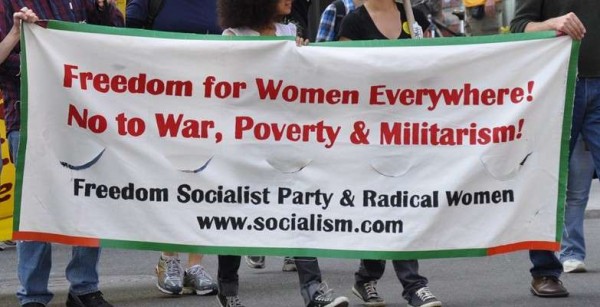
The dynamic "A World to Win, A Planet to Save" socialist feminist conference starts in Los Angeles in 5 days! Over the past few years, people all over the world have taken brave action against the inhumane profit system. But what comes next in order to create a just and healthy world? Come to the Freedom Socialist Party convention and let’s strategize. Highlights on Saturday, May 24 include a 10:30 a.m. presentation on "In the Midst of the Great Recession: Reaction, Rebellion and Opportunity" by Steve Hoffman. Hoffman is an AFSCME member and delegate to the Martin Luther King County Labor Council. He organized the first post-recession rally against cutbacks in Washington state. Afterwards, at 3:15 p.m., Yolanda Alaniz and Christina López will explore "Which Way Forward for Immigrant Rights?" Alaniz is co-author of Viva la Raza: A History of Chicano Identity and Resistance. She grew up working in the fields of Eastern Washington, joined the Brown Berets and MEChA at the University of Washington and helped found two groundbreaking Latina organizations.

Dongguan Factory Strike: A Turning Point For Chinese Labour?

Last month, tens of thousands of Chinese workers staged a massive strike at a shoe factory in Dongguan, lasting over two weeks and involving over 40,000 people. The strike was notable for both for its scale and substance – the workers not only demonstrated significant legal knowledge and political savvy, but also showed a wider sense of workers' consciousness. If China is the world’s factory, then one of its core production lines is playing up. Last month, mass protests kicked off in the southern manufacturing city of Dongguan. Some 40,000 workers went on strike, all from the same massive footwear factory operated by Yue Yuen Industrial, a supplier of shoes for global brands such as Adidas and Nike. It wasn’t just the sheer number of participants that made the Yue Yuen strikes so notable. These protests were a demonstration of Chinese workers' increasing sense of autonomy and their ability to connect with fellow workers and initiate large-scale collective action. Labour disputes in China occur more frequently than many people outside of the country realise. But thus far, strikes have mainly focused on wages. Winning a better salary was the goal and once workers had more money in their pocket they tended to be happy. Industrial actions didn’t usually to lead to longer-term campaigns organised by workers' committees with wider mandates. The leaders of many grassroots labour organisations in China had therefore been rather pessimistic about the prospects of increasing a wider sense of workers' consciousness.

Congratulations, Class Of 2014: You’re Totally Screwed

Welcome to the wide world, Class of 2014. You have by now noticed the tremendous consignment of debt that the authorities at your college have spent the last four years loading on your shoulders. It may interest you to know that the average student-loan borrower among you is now $33,000 in debt, the largest of any graduating class ever. According to a new study by the Pew Research Center, carrying that kind of debt will have certain predictable effects. It will impede your ability to accumulate wealth, for example. You will also borrow more for other things than people without debt, and naturally you will find your debt level growing, not shrinking, as the years pass. As you probably know, neither your parents nor your grandparents were required to take on this kind of burden in order to go to college. Neither are the people of your own generation in France and Germany and Argentina and Mexico. But in our country, as your commencement speaker will no doubt tell you, the universities are “excellent.” They are “world-class.” Indeed, they are all that stands between us and economic defeat by the savagely competitive peoples of Europe and Asia. So a word of thanks is in order, Class of 2014: By borrowing those colossal amounts and turning the proceeds over to the people who run our higher ed system, you have done your part to maintain American exceptionalism, to keep our competitive advantage alive.

Will The Next Labor Movement Come From The South?

Corporate America - especially in the American South - doesn't seem to know the proper way to treat a guest. Guest workers have long been one of the most easily exploited segments of the American workforce. Employers frequently take advantage of their legal vulnerabilities to ignore labor laws, pay subminimum wage and threaten them with physical abuse, all of which American citizens are better equipped to resist. Whole sectors of the American economy - especially agriculture - have long depended on this underground labor market and the ease with which employers can dominate it. But in recent years, guest workers have been bringing attention to their plight and winning some small victories. One of the leaders of that movement is Saket Soni, executive director of the National Guestworker Alliance and the New Orleans Workers' Center for Racial Justice. From his base in the Deep South, perhaps the United States' most worker-unfriendly region, he has helped organize workers across the Gulf Coast. In 2012, Soni worked with a group of guest workers at a crawfish processing plan named CJ's Seafood, where employees were locked in, forced to work nearly around the clock and threatened with violence when they protested.

Unions Need To Build Power

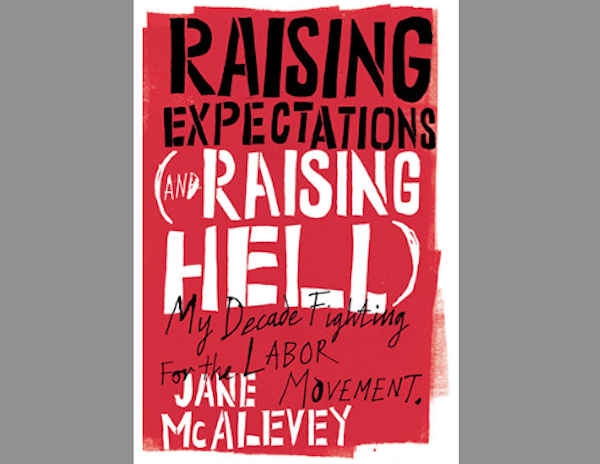
This week, Verso has published the first paperback edition of Jane McAlevey's Raising Expectations (And Raising Hell), a memoir of her decade-long work in the labor movement. Truthout published Laura Flanders' interview with McAlevey when the book first came out. The paperback now includes a new afterword that contains McAlevey's analysis of the current state of the labor movement and new developments since her book was first published. The new extract is below. From the Afterword: San Francisco, February 2014 In the past two years, SEIU has all but forsaken actual worker organizing in the health-care sector despite the fact that the union's gains in the years under discussion in this book were largest among health-care workers. The multistate assault by the right wing against the public sector has left SEIU fighting a primarily defensive action there. And in the third wing of the union, known most commonly as "Justice for Janitors" and officially as the Property Services sector, SEIU's new President, Mary Kay Henry, forced out longtime organizer Steven Lerner because of his insistence that the union needed to take on the financial and banking industries. Hmm.

Fighting The Big Apple’s Big Inequality Problem

New York City can sometimes feel like ground zero for the battle over inequality. Up until a few months ago, its mayor was one of the world's richest men; it is home to Wall Street and movie stars, and it seems as though every oligarch from every country in the world has an apartment here. Here, too, are the millions of working people who make the city run, and all too many of those working people are barely making enough to get by. In her introduction to the new book New Labor in New York, out now from Cornell University Press, sociologist Ruth Milkman points out that while New York has the nation's highest union density, the city also has one of the highest levels of income inequality among large cities. It is against this background that worker centers and other forms of non-union labor organizing have flourished, won victories, hit setbacks and managed to grow. And it is against that background that Milkman and her colleague Ed Ott, both professors at the City University of New York's Joseph S. Murphy Institute for Worker Education and Labor Studies, decided to teach a course that would ask students at the Murphy Institute and the CUNY Graduate Center to write an in-depth profile of one worker center or labor organization and its innovations. After two semesters of field research, study, and collaborative workshopping, these profiles were collected into the book. Taken together, they make up a valuable resource for evaluating today's labor organizing, its successes and failures.

Tennessee Labor Activists Bring ‘Moral Monday’ To May Day

In Tennessee, labor organizers tend to brace themselves for the worst when they see their state’s name in a national headline. And so far, the news this year has been particularly grim. The aftershocks from the United Auto Workers’ historic defeat in Chattanooga are still being covered by major media outlets; just last month, the Department of Labor Statistics revealed that Tennessee leads the nation in minimum-wage jobs. As long as the GOP is at the helm, with Republicans in the state legislature quashing a $1 raise to the minimum wage for companies that don't provide health insurance and blocking federal funding to expand Tennessee’s Medicaid program, progressives in the region will probably continue to feel disheartened. A number of pro-labor groups, however, are pooling their resources in order to make the voice of the Left louder in state politics. “It would be nice for people to have some sense that there are sane people in Tennessee,” says Thomas Walker, who organizes with the United Campus Workers (UCW), a higher-education union affiliated with the Communications Workers of America and headquartered in Knoxville.

Organized Labor, Public Banks: Keys To A Worker-Owned Economy

Worker-owned cooperatives build economic democracy, but how do we build more worker-owned cooperatives? Here are three valuable allies to help us get there. Before his death in February, Jackson Mississippi Mayor Chokwe Lumumba was helping his constituents chart an economic plan whose main component was worker-owned cooperatives. In her recent article about Lumumba and cooperatives, Laura Flanders cites Collective Courage author Jessica Gordon Nembhard’s point that African-American leaders from Marcus Garvey to W.E.B. DuBois were proponents of cooperatives. DuBois, Garvey and Lumumba understood that worker democracy was necessary for economic sovereignty and community solidarity. For Richard Wolff, whose most recent book is Democracy at Work: A Cure for Capitalism, this time-honored form is also the key to arenewed movement for economic democracy. For Wolff, a synergy of labor and the left around worker-owned cooperatives promises to be an “unapologetically anticapitalist” strategy, challenging “the essence of the capitalist organization of production—the employer-employee relationship” and reshaping it in an egalitarian fashion.

US Workers Were Once Massacred Fighting For The Protections Being Rolled Back Today

On April 20, 1914, the Colorado National Guard and a private militia employed by the Colorado Fuel & Iron Company (CF&I) opened fire on a tent camp of striking coal miners at Ludlow, Colo. At least 19 people died in the camp that day, mostly women and children. A century later, the bloody incident might seem a relic of the distant past, but the Ludlow Massacre retains a powerful, disturbing and growing relevance to the present. After a century of struggling against powerful interests to make American workplaces safer and corporations responsive to their employees, the US is rapidly returning to the conditions of rampant exploitation that contributed to Ludlow. That’s especially true in mining, where a coordinated union-busting campaign, the corporate capture of federal regulatory agencies, and widespread environmental degradation leave coal miners unsafe and mining communities struggling to deal with the massive environmental impact of modern mining practices. A century ago, miners led the fight for workers’ rights. The Gilded Age of the late 19th and early 20th centuries was a period of great upheaval for the American working class.

Vio.Me: Workers’ Control In The Greek Crisis

Just one among thousands of Greek companies that succumbed to the deep recession brought about by the austerity measures imposed by a series of governments, the construction materials manufacturer Vio.Me was abandoned by its owners in May 2011. Forty of its workers, organized horizontally in a militant primary workers’ union, occupied the factory, located in the outskirts of Thessaloniki, to prevent the employers from taking away the machinery before paying the workers the nearly €1.5 million owed in salaries and compensations. After one year of unfruitful contacts with the Ministry of Labor and the central trade union bureaucracies, the workers of Vio.Me, with the threat of poverty and chronic unemployment looming over their heads, announced in July 2012 their intention to self-manage production in the occupied factory, with their now famous slogan: “If you can’t do it, we can.” This declaration was met with the indifference or hostility of most political parties, right and left, and of the trade union bureaucracies.

An Interview With Staughton Lynd About The Labor Movement

For more than 50 years, Staughton Lynd has been a leading radical in the United States. He was an engaged supporter of the Black Liberation Movement in the Deep South in the early 1960’s, most notably as coordinator of the Freedom Schools during Mississippi Summer in 1964. He was an active opponent of US aggression in Indochina, including as chairperson of the first national demonstration against the war in Vietnam in April 1965.[1] In recent decades, Lynd has been an attorney representing prisoners, particularly at the Ohio State Penitentiary in Youngstown, and has written a book, a play and numerous articles about the 1993 uprising at the Southern Ohio Correctional Facility in Lucasville.[2] Since the late 1960’s, Lynd has also been deeply involved in the labor movement as an activist, attorney and prolific writer.[3] Inspired by Marty Glaberman, Stan Weir and Ed Mann,[4] Lynd has been a passionate and prolific proponent of decentralized, rank-and-file driven unionism.
assetto corsa mods

Urgent End Of Year Fundraising Campaign

Online donations are back! Keep independent media alive. 

Due to the attacks on our fiscal sponsor, we were unable to raise funds online for nearly two years.  As the bills pile up, your help is needed now to cover the monthly costs of operating Popular Resistance.

Urgent End Of Year Fundraising Campaign

Online donations are back! 

Keep independent media alive. 

Due to the attacks on our fiscal sponsor, we were unable to raise funds online for nearly two years.  As the bills pile up, your help is needed now to cover the monthly costs of operating Popular Resistance.

Sign Up To Our Daily Digest

Independent media outlets are being suppressed and dropped by corporations like Google, Facebook and Twitter. Sign up for our daily email digest before it’s too late so you don’t miss the latest movement news.