Skip to content

mental health

End All Youth Detention & Torture At Rikers Island Now

By Marian Wright Edelman in Huffington Post - Nobody of any age should be held in jail without a trial for three years. No child or adolescent should be held in an adult jail. No child or youth should be housed in facilities where those entrusted to care for them violently assault them. Yet, a 16-year-old accused of stealing a backpack was kept in one of the most violent adult jails in the United States, Rikers Island in New York City, for three years without a trial. This was morally scandalous and inhumane. Even worse, he spent more than two years of that time in solitary confinement, locked up alone except to go to the shower, the recreation area, the visit room or the medical clinic. This was torture. The suicide of 22-year-old Kalief Browder on June 6, barely two years after his release and return home, was the final horror in his tragic and brutal journey into the depths of the adult criminal justice system in New York City and state.

PTSD Among Ferguson Activists Long After Police Abuse

Johnetta Elzie rose to national prominence as a leading protester in Ferguson last summer. Her activism protesting the police shooting death of Michael Brown has been highlighted in national publications like the Los Angeles Times and the Washington Post, but the police aggression and the intensity of protesting nonstop took a serious toll on her mental health. During the height of the protests, she was tear-gassed at least nine times, faced off against menacing police dogs, regularly confronted by aggressive law enforcement officers, and spent many nights running away from cops. A rubber bullet struck her left collarbone during one protest. “It was just crazy for me to see the police responding to us like we were almost at war. Only we weren’t armed,” Elzie, a native of St. Louis, told AlterNet.

Kathy Kelly: A Note From Lexington Prison

Here in Lexington federal prison, Atwood Hall defies the normal Bureau of Prisons fixation on gleaming floors and spotless surfaces. Creaky, rusty, full of peeling paint, chipped tiles, and leaky plumbing, Atwood just won’t pass muster. But of the four federal prisons I’ve lived in, this particular “unit” may be the most conducive to mental health. Generally, the Bureau of Prisons system pushes guards to value buffed floors more than the people buffing the floors, walking the floors. Here, the atmosphere seems less uptight, albeit tinged with resigned acceptance that everyone is more or less “stuck” in what one prisoner described as “the armpit of the system.”

Six Ideas For A Police Free World

After months of escalating protests and grassroots organizing in response to the police killings of Michael Brown and Eric Garner, police reformers have issued many demands. The moderates in this debate typically qualify their rhetoric with "We all know we need police, but..." It's a familiar refrain to those of us who've spent years in the streets and the barrios organizing around police violence, only to be confronted by officers who snarl, "But who'll help you if you get robbed?" We can put a man on the moon, but we're still lacking creativity down here on Earth. But police are not a permanent fixture in society. While law enforcers have existed in one form or another for centuries, the modern police have their roots in the relatively recent rise of modern property relations 200 years ago, and the "disorderly conduct" of the urban poor.

Why 2,600 Kaiser Mental Health Workers Are On Strike

Kaiser Permanente’s 2,600 California mental health clinicians are on strike today, and we’re staying out all week. Mental health clinicians hate to strike. We got into this profession to help people. But every day we are forced to apologetically explain to Kaiser members why they cannot get the timely, appropriate care they pay for with their monthly premiums—care that Kaiser is required by law to provide. That’s because, despite its huge profits, Kaiser does not staff its psychiatry departments with enough psychologists, therapists, social workers, and psychiatric nurses to treat the ever-growing number of patients seeking mental health care.

Breaking The Spell Of The Corporate State

What does the illusory world of psychopaths look like from the inside? Within this state devoid of empathy, individuality comes to be defined as opposition to the underlying communal self. In this environment, the development of individuality often necessitates pitting one against another. It is a hostile and competitive, dog-eat-dog world. Governed by reptilian impulses like fight or flight, one is driven by interests of simple self-preservation and advancement. In this, relationship becomes a battleground, or in the words of the psychopath, a game—or just doing business. In the eyes of these ruthless and careless sections of humanity, the earth itself is no longer alive, but only a resource to be exploited. Their dry intellect tears apart the web of life, with its intricate threads of interdependence. The existing extreme form of capitalism has become the ultimate social expression of the psychopaths’ internal reality of survival of the fittest.

US Government Sanitizes Vietnam War History

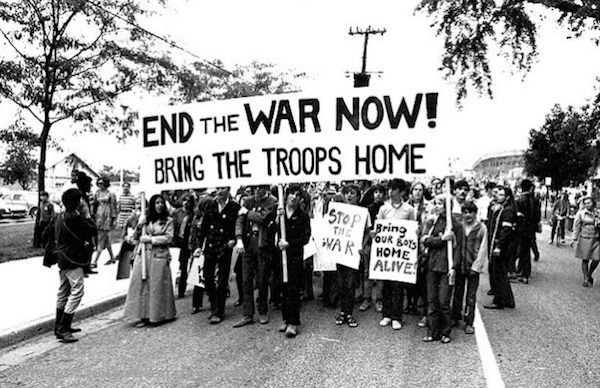
For many years after the Vietnam War, we enjoyed the "Vietnam syndrome," in which US presidents hesitated to launch substantial military attacks on other countries. They feared intense opposition akin to the powerful movement that helped bring an end to the war in Vietnam. But in 1991, at the end of the Gulf War, George H.W. Bush declared, "By God, we've kicked the Vietnam syndrome once and for all!" With George W. Bush's wars on Iraq and Afghanistan, and Barack Obama's drone wars in seven Muslim-majority countries and his escalating wars in Iraq and Syria, we have apparently moved beyond the Vietnam syndrome. By planting disinformation in the public realm, the government has built support for its recent wars, as it did with Vietnam.

For Families And Communities, Deportation Means Trauma

Maru Mora-Villalpando lives in fear of deportation. As a community organizer for #Not1More Deportation and an undocumented immigrant from Mexico, her fears are not unfounded. Her nephew was deported in 2008; her cousin was deported in 2010 and she has seen countless other families separated. "I expect that to happen to me as well," she said. Mora-Villalpando says her 17-year-old daughter constantly worries that she will be deported, particularly because of her activism, which forces her to travel frequently. "We have to be in constant touch. This is how I protect her and lessen her stress that her mother can be taken at any moment," she told Truthout. Research shows this kind of fear can be profoundly detrimental for children. The study "The Children Left Behind: The Impact of Parental Deportation on Mental Health" notes the crucial role of parent-child relationships in social skills, emotion regulation and self-concept development.

City Cut Funds For Mental Health Patients, Spied On Them Instead

Two years after Mayor Rahm Emanuel closed the mental health clinics, he's finally allowing his City Council allies to hold a hearing on them sometime this month. If it actually happens, I'm hoping someone asks about the curious tale of Mo and Gloves, because their story reveals a lot about the Emanuel administration's attitude toward mental health care in poor areas. The tale started in the fall of 2011, when the mayor decided to close six of the city's 12 clinics, most of them in low-income, high-crime neighborhoods. As I've written before, Emanuel never gave a reason for the closings. He never conducted a study or convened a task force or, most importantly, met with the patients—even though a number of them, backed by other activists, demanded that the mayor hear firsthand the consequences of closing clinics in low-income communities where residents are under stress from gunfire and unemployment. In fact, the mayor repeatedly went out of his way to avoid any face-to-face encounters.

Meeting The Needs Of The Power Structure

In the history of authoritarian governance, there have always been ruling power structures such as monarchies, dictatorships and corporatocracies (the combination of giant corporations, the wealthy and their political representatives). All these power structures have constructed a particular idea of “the professional” to act on their behalf. Power structures have used clergy to subdue populations (that’s why dissident clergy who cared about social justice and who were embarrassed by their profession created “liberation theology”). Power structures have used police and armies to try to break human rights and labour movements. And today, corporatocracies claim the profession of mental health as a powerful means to maintain the status quo.

How-To For Mental Health Activism

For our events, we make sure childcare is available, as well as designated people and safe spaces for anyone who freaks out. We begin with a “good faith agreement” to acknowledge that we may not be on the same political page but to think about the structural implications of what we’re saying (i.e. “is this sexist/white supremacist/queerphobic?”), and, when someone does make a mistake, address it immediately and respond respectfully. Because talking about psychological and emotional issues can be intensely affecting for most people, we also always ask that if there is a disagreement, that the response begin with a clarifying question to encourage conversation instead of argument and to ensure that miscommunication is not part of the conflict.
assetto corsa mods

Urgent End Of Year Fundraising Campaign

Online donations are back! Keep independent media alive. 

Due to the attacks on our fiscal sponsor, we were unable to raise funds online for nearly two years.  As the bills pile up, your help is needed now to cover the monthly costs of operating Popular Resistance.

Urgent End Of Year Fundraising Campaign

Online donations are back! 

Keep independent media alive. 

Due to the attacks on our fiscal sponsor, we were unable to raise funds online for nearly two years.  As the bills pile up, your help is needed now to cover the monthly costs of operating Popular Resistance.

Sign Up To Our Daily Digest

Independent media outlets are being suppressed and dropped by corporations like Google, Facebook and Twitter. Sign up for our daily email digest before it’s too late so you don’t miss the latest movement news.