Skip to content

Occupy

Museum Of Modern Art Acquires 31 Occupy Screen Prints

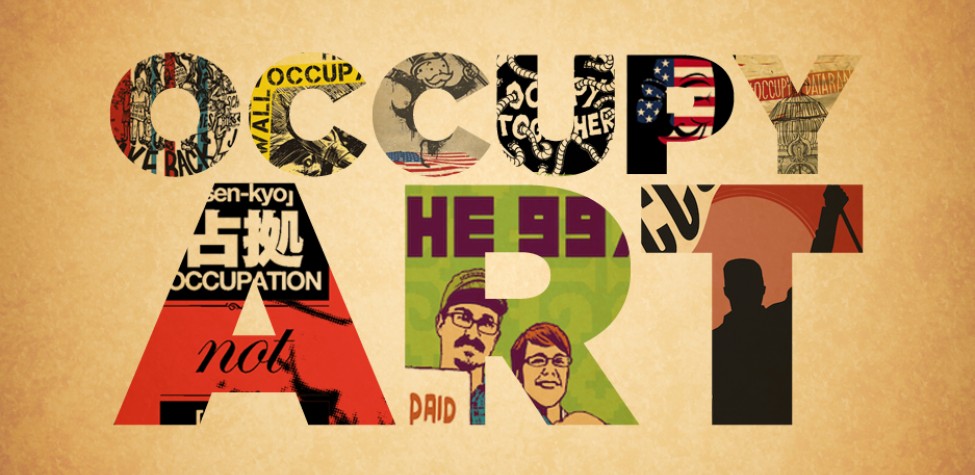
The Museum of Modern Art has gone and given the Occupy Wall Street movement its stamp of institutional approval, buying up the 2012 Occuprints portfolio of 31 screenprints that were curated by the Booklyn Artists Alliance. The set of prints, which includes protest posters from artists in New York, Montreal, Oakland, Detroit, Chicago, and other cities where the Occupy movement has had a major presence, will be on view in MoMA’s study center for the time being and may be included in an Occupy-themed show at the institution or at MoMA PS1 in “the next few months or years,” according to chief curator of prints and drawings Christophe Cherix. “We felt the portfolio was saying something very important in relation to New York, what’s happening now,” Cherix told the Guardian, “and at the same time we felt the portfolio had a very interesting relationship to other works in the collection from different periods but that are all trying to socially engage with the public.”

An Interview With Occupy Activist and Author Nathan Schneider

Maybe it's the same gene. Or maybe it's a mood or a moment. Many people who were talking the anarchist talk during Occupy are now more or less back to doing the same-old-same-old. The Occupy mood or moment was caused partly by a failure -- from the Democratic Party of Obama to radical left organizations -- to bring young folks into the fold. A few years after Obama's election, with no limits on Wall Street or the security state, there were no viable alternatives. So, there was a craving to do away with everything, take over a square and start from scratch.

Occupy Oakland Celebrates Its Two-Year Anniversary

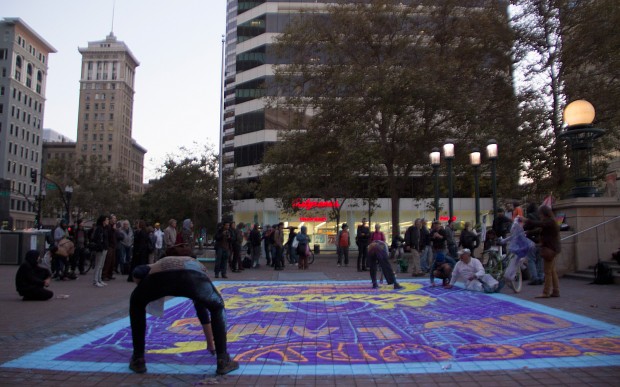
Occupy Oakland marked its two-year anniversary Thursday with a celebratory gathering at Frank Ogawa Plaza in downtown Oakland. The event started at 2 p.m. with volunteers serving freshly cooked food to supporters and the local community. By 5 p.m., dozens of people had gathered to commemorate Occupy Oakland’s anniversary, but also to support and highlight the California Prisoners’ Hunger Strike. Organizers also used the event to focus attention on the 60-day California Prisoners’ Hunger Strike, which ended last month. The hunger strike, which at its peak included 30,000 California prisoners, was the largest in United States history and called for an end to solitary confinement in California prisons.

Police Involved In Biker Assualt Infiltrated Occupy Wall Street

The undercover NYPD detective arrested in connection with the brutal assault of an SUV driver routinely spied on Occupy Wall Street members using the name "Albert." He was also arrested in his role as an OWS activist. DNAinfo reports at the height of the movement in 2011, Wojciech Braszczok infiltrated Zucotti Park and feigned sympathy for the protesters' cause to glean information that'd he'd then report to the NYPD’s Organized Crime Intelligence Division. He lived in the park, attended rallies, and even went to birthday celebrations of protestors.

Five Stages Of Movement’s For Revolutionary Change

We need to go beyond what has been done plenty of times in history -- to overthrow unjust governments through nonviolent struggle -- and create a strategy that builds at the same time as it destroys. We need a strategy that validates alternatives, supports the experience of freedom, and expands the skills of cooperation. We need a political strategy that is at the same time a community strategy, one that says "yes" to creative innovation in the here and now and links today's creativity to the new society that lies beyond a power shift. With the help and feedback of many activists from a number of countries I've created a strategic framework that aims to support today's activists, something like the way Otpur activists were supported by their strategy. I call it strategy for a living revolution. The strategy not only encourages creating new tactics and more boldness in using the best of the old, but it also helps activists sort out which tactics will be most effective.

A Revolution Comes In Stages — Occupy Or Otherwise

Bill Moyer’s Movement Action Plan, is an excellent guide for movements aiming at reform. I discovered on a training trip to Taiwan in the early 1990s that progressive community and labor organizers were already using MAP to guide their work. However, Occupy’s goals go well beyond reform. Occupy famously wanted to end the rule of the 1 percent, for one thing. To accomplish that goal, we need a model that shows how a movement goes beyond reform to facilitate a revolution. In the organization Movement for a New Society, Bill and I were very close comrades, doing model-building at the same time but addressing different situations. In my strategy workshops I taught Bill’s model for participants who were into carrying out reform, but I used a second model for the revolutionaries present. The second model was called Strategy for a Living Revolution. The good-news/bad-news from the Living Revolution perspective is that although Occupy did many things right, there was no reason to expect short-term success because the movement overwhelmed itself with a multiplicity of tasks that couldn’t all be done at the same time.

Occupy Portland Wins Right To Jury Trial In Orgeon Supreme Court

If prosecutors and police charge a criminal offense, they cannot reduce the charges to avoid constitutional rights to an attorney and trial by jury Fifty people arrested during Occupy Portland protests two years ago are entitled to jury trials even though prosecutors downgraded the misdemeanor charges to violations with no threat of a jail sentence, the Oregon Supreme Court ruled Thursday. The ruling in State v. Benoit is one of two decisions issued Thursday by the state’s highest court that found prosecutors can’t unilaterally change a criminal prosecution to a noncriminal one and use that to deprive defendants of such constitutional protections as a jury trial and the right to an attorney. “There is no textual, historical, or logical support for the proposition that … what began as a criminal proceeding with defendant's arrest, booking, and incarceration for a crime can, in the absence of her consent, be transformed without further constitutional consequence into a noncriminal proceeding,” Justice David Brewer wrote for the unanimous court.

Video Documenting Police Protest Tactics

In this ten minute video, Paul Henri-Sullivan documents NYPD tactics in crowd control.  He follows an OWS protest with his camera focused on the police. He sees how the police white shirts direct arrests as the protest gains momentum in order to weaken the protest.  The police consistently tell the crowd to keep moving and get out of the streets, but than at the direction of a white shirt, police go into the crowd and arrest people, often at the specific direction of the who to arrest.  They will often throw the person to the ground so that it becomes a spectacle arrest, one that other protesters can see in order to intimidate them, or to draw other protesters out to un-arrest the person so they can also be arrested.  Consistently targeted are men wearing dark clothes and a bandanna.  Sometimes it seems the police commanders have specific people in mind or, perhaps, know specific people due to police infiltration.  Sullivan continues to film until he finds himself under arrest as well.  As often happens, it is a minor charge that gets the protester off the street and then months later the charges are dropped.

Searching For Occupy

I can still recall my sense of ‘shock and awe’ when, at home on a break from four months of ‘occupying’ a tent, two General Assemblies (GAs) a day and multiple protests each week, I watched on live stream as the police charged through the Washington, D.C. encampment at Freedom Plaza. They tore down our tents, took apart the kitchen and issued threats to the Occupiers still standing their ground. From home, I did the only thing I could do and responded to tweets that the Occupiers were hungry and put out a call to send them pizza. When all was said and done, a few symbolic tents remained, but the Occupy movement was declared (according to mainstream media) ‘dead.’ I sat at home for months, depressed, deflated and yet unwilling to be defeated. In July, 2012, I was in Paonia, Colorado to scatter my parents' ashes, when a local guy named Sid and I decided to protest the younger Koch brother, Bill’s, WWII tank that was to lead the July 4th parade.

Occupy Banking: Yes, Please

A spinoff group from the Occupy movement is seeking to launch its own prepaid debit card, as a prelude to offering a more complete set of financial services. Ridiculous? Not at all. In fact, taking over some of Wall Street's business could be the most useful thing Occupy Wall Street could do. According to the New York Times, the prepaid debit card is but the first offering from the Occupy Money Cooperative, a spinoff group that wants to build at least a rudimentary set of alternative financial products, for the public. How is this different from the banks that Occupy was protesting? Well, EVIL BANKS are for-profit enterprises that seek to maximize their own profits by squeezing consumers for everything they're worth. For most people, that translates to high fees for every little service, which is, essentially, extortion by banks. It is middlemen taking as big a cut as possible of the money that flows through their coffers, with no associated benefit for the public. It is $32 billion in overdraft fees in 2012 alone. What Occupy wants to do, by contrast, is to create a not-for-profit financial institution that could fulfill common needs—debit cards, checking and savings accounts, loans—with no profit imperative, meaning that it could be totally focused on charging the lowest possible fees.

Three Lessons From The Street

If we want to create a world of democracy, transparency, and egalitarianism, we need to start to demonstrate what that looks like in our own work. How do we make decisions? Who does what jobs, and why? How do we treat each other? If we can't manifest our values in our own offices, it seems unlikely that we can do so in our communities, cities, or countries. Yet many social change organizations continue to churn out formulaic reiterations of the organizing systems constructed by Anglo-American industrialists a century and a half ago. At their core is the idea that a few great leaders will create hierarchies led by specialists and experts, and that the rest of us will be given a box (or cubicle) to fit within, to implement the visions of the infallible heroes at the top. My new book, Anarchists in the Boardroom, tells the stories of Argentine worker-run factories, Occupy encampments, and direct actions against tax-dodging corporations to highlight some of the emerging alternatives to our inherited systems of organizing. There is something deeply human about these non-hierarchical systems that seems to bring out the best in us. They allow us to find our own ways of supporting the causes we believe in, rather than slotting us into hierarchies and departments that prescribe how we are meant to do so.

What Do We Need To Build A Movement?

We must develop a revolutionary theory that is not reliant on the industrial or agrarian muscle of workers. Most manufacturing jobs have disappeared, and, of those that remain, few are unionized. Our family farms have been destroyed by agro-businesses. Monsanto and its Faustian counterparts on Wall Street rule. They are steadily poisoning our lives and rendering us powerless. The corporate leviathan, which is global, is freed from the constraints of a single nation-state or government. Corporations are beyond regulation or control. Politicians are too anemic, or more often too corrupt, to stand in the way of the accelerating corporate destruction. This makes our struggle different from revolutionary struggles in industrial societies in the past. Our revolt will look more like what erupted in the less industrialized Slavic republics, Russia, Spain and China and uprisings led by a disenfranchised rural and urban working class and peasantry in the liberation movements that swept through Africa and Latin America. The dispossessed working poor, along with unemployed college graduates and students, unemployed journalists, artists, lawyers and teachers, will form our movement. This is why the fight for a higher minimum wage is crucial to uniting service workers with the alienated college-educated sons and daughters of the old middle class. Bakunin, unlike Marx, considered déclassé intellectuals essential for successful revolt.

Status Of The Resistance Movement: Growing, Deepening, Succeeding

So much has been accomplished by Occupy and other social justice movements in the past two years that it is incredible the corporate media and their pundits do not report on what is happening around them. Despite the lack of corporate media coverage, the movement is deepening, creating democratic institutions, stopping some of the worst policies from being pushed by the corporate duopoly and building a broad-based diverse movement. This is not to say things are getting better for the 99%; in fact, quite the opposite is happening. Big business government continues to funnel money to the top while robbing most Americans of the little wealth they had. More Americans are being impacted by the unfair economy and realize that their struggle is not their fault but is the reality of living in a system with deep corruption and dysfunction. Economic injustice is the compost creating fertile ground for the movement to grow.

Obama Tells UN America Opposes Violence To Suppress Dissent

Nowhere was Pres. Obama's lying so blatant and obscene in his speech to the UN as when he vowed that “we will not stop asserting principles that are consistent with our ideals, whether that means opposing the use of violence as a means of suppressing dissent...” This, after all, was being said just one week after the second anniversary of the launching of the Occupy Movement, which we now know, thanks to documents obtained by the Partnership for Civil Justice under the Freedom of Information Act, was crushed nationwide by a campaign of violent police assault coordinated at the highest levels of the FBI, Homeland Security Department and other federal police and intelligence agencies

Occupy’s Impact Continues to Blossom

September 17th this week marked Occupy Wall Street’s second anniversary, and as we depicted in the Occupy Network S17 newsletter, it could not be a better time to take stock of where we are at and consider where we might go from here. Of particular note, over the past two years Occupy has evolved into a network of many loosely tied, sometimes rather autonomous, groups and projects. This includes offshoots like Occupy Our Homes, Occupy The SEC, Strike Debt, Occupy The Pipeline, Occupy Sandy, OWS Alternative Banking, the People’s Puppets of Occupy Wall Street, Occu-Evolve, and many more.
assetto corsa mods

Urgent End Of Year Fundraising Campaign

Online donations are back! Keep independent media alive. 

Due to the attacks on our fiscal sponsor, we were unable to raise funds online for nearly two years.  As the bills pile up, your help is needed now to cover the monthly costs of operating Popular Resistance.

Urgent End Of Year Fundraising Campaign

Online donations are back! 

Keep independent media alive. 

Due to the attacks on our fiscal sponsor, we were unable to raise funds online for nearly two years.  As the bills pile up, your help is needed now to cover the monthly costs of operating Popular Resistance.

Sign Up To Our Daily Digest

Independent media outlets are being suppressed and dropped by corporations like Google, Facebook and Twitter. Sign up for our daily email digest before it’s too late so you don’t miss the latest movement news.