Skip to content

South Korea

Koreas Negotiating Peace Treaty & End To Demilitarized Zone

The 1950 to 1953 war between North and South Korea ended their hostilities with a truce and the creation of a demilitarized zone. Now the North and South Korea governments are preparing to announce a permanent end to the Korean War, he  newspaper Munhwa Ilbo reported Tuesday, citing an unnamed South Korean official. CNBC reports: Ahead of a summit next week between North Korean premier Kim Jong Un and South Korean President Moon Jae-in, lawmakers from the neighboring states were thought to be negotiating the details of a joint statement that could outline an end to the confrontation. Kim and Moon could also discuss returning the heavily fortified demilitarized zone separating them to its original state, the newspaper said.

More of the Status Quo: US – South Korea Deal

We continue to emphasize that Trump’s actions on trade will not bring justice to workers, does not take care of our environment, does not bring us any closer to peaceful and collaborative economic practices with people from all over the world. The people in power are repeatedly showing themselves to be dishonest, putting their own interests before that of the people and maintaining the status quo of the corporate power of Wall Street and major US corporations throughout the world.

Will the United States Seek Peace in North Korea?

North Korea and China dramatically showed the two nations are close allies before President Trump's planned meeting with North Korean President Kim Jong Un. At the invitation of Chinese President Xi Jinping, the North Korean and Chinese leaders met in surprise visit as North Korean leader Kim Jong Un visited China. It was Kim Jong Un’s first trip outside of North Korea. The two leaders released photos of their meeting. The images sent a message to President Trump and Washington, DC that North Korea and China are close allies. Kim Jong-hoon, a member of South Korea’s National Assembly and co-chair of the progressive Minjung Party, led a delegation to Washington on March 20-21 to appeal to U.S. lawmakers about supporting efforts for peace on the Korean Peninsula. The U.S. Congress and Senate should not just watch Trump’s maneuvers from the sidelines but play an active role to make sure the talks succeed in achieving genuine and lasting peace.

The Two Koreas Talk: On The Path To Peace

Following a two-day meeting with North Korean officials in Pyongyang, South Korean President Moon Jae-in’s special envoy returned to Seoul on March 6. The special envoy had dinner with North Korean leader Kim Jong-un on March 5 and a follow-up meeting the next day with North Korea’s high-level officials including Kim Yong-chol, the vice chairman of the Korean Workers Party (KWP) Central Committee. Upon their return to Seoul, the South Korean delegation gave an announcement to the press that summarized the result of the meeting. According to this announcement, the North and South made a major breakthrough in the inter-Korean talks by agreeing to hold a summit as soon as late April of this year. The following is a translation of the full press announcement by the South Korean special envoy to Pyongyang on the results of their meeting

From PyeongChang To Lasting Peace

Sometimes, art can point to answers that the stuffy logic of policy wonks cannot. Those who have truly felt, even for a passing moment, the pain of seventy years of artificial national division, probably felt a stir in the pit of their hearts at seeing the ninety-year old North Korean statesman’s rare display of emotion. The sense of excitement at the fleeting inter-Korean reunion, followed by pain and sorrow at not knowing when or if the two Koreas will ever meet again, is shared by Koreans on all sides of the division. And therein may be the answer to the perpetual and seemingly unresolvable conflict on the Korean peninsula. That shared sense of longing for reunification will ultimately prevail over threats of maximum pressure and a “bloody nose strike.”

South Korea, Straying Off The Leash?

Never before has North Korea loomed so large in the U.S. imagination.  No longer just a problem “over there,” North Korea has emerged as a much more immediate threat, one with the power to unleash nuclear Armageddon on not only East Asian but also North American shores.  Months of “fire and fury” exchanges between the leaders of the United States and the Democratic People’s Republic of Korea (DPRK) have stoked American fears of impending nuclear carnage. Exacerbating these anxieties is widespread U.S. ignorance of the origins and history of seven decades of hostile U.S. relations with North Korea, a country dismissed in the past as a failed state. In sharp contrast to alarmist views of an erratic and hostile North Korea, the dominant American narrative of South Korea depicts U.S.-South Korea relations as an enduring and equal partnership in the face of a shared enemy.

US Misses Opportunity For Peace Progress At Olympics

Vice President Mike Pence went to South Korea and missed the opportunity for further peace on the Olympic peninsula. The historic opening created by North and South Korea at the Olympics was an opportunity but Pence played the situation like a childish teenager. At a dinner dinner reception Pence went around the table and shook hands with everyone except the diplomat from North Korea. At the stadium Pence sat one row in front of the North Korean of the sister of President Kim Jong Un's sister. While Kim Jong Yo was so close to her he never even tried to speak to her. Anotger missed opportunty for peace. At the same moment, South Korean President Moon Jae-in shook hands with Kim Yo Jong, creating a historic moment and a photograph that gave hopes to many for peace between North and South Korea and movement toward unification and an end of hostilities.

Trump Wants War, Moon Wants Peace

South Korean President Moon Jae-in held a very polished press conference on January 10. He confidently laid out his domestic and foreign policy priorities for some 30 minutes. That address was followed by an hour-long exchange with the flock of journalists in attendance. Yet the ease with which the event unfolded belied the difficulty Moon had in addressing questions about what may be the most important challenge for his administration: North Korea's fast-progressing weapons programme. Just 10 days earlier, North Korean leader Kim Jong-un's made an important New Year's speech. He reiterated his country's nuclear capabilities: "our Republic has, at last, come to possess a powerful and reliable war deterrent, which no force and nothing can reverse."

North and South Korea Discuss Olympic Cooperation

On January 9, high-level officials from North and South Korea met to discuss the North’s participation in the 2018 Winter Olympics in Pyeongchang, South Korea in February. The inter-Korean meeting was held in the village of Panmunjom at the border of the divided Korean Peninsula. On January 1, North Korean leader Kim Jong-un expressed hope for reconciliation with South Korea in his New Year address. The next day, South Korean President Moon Jae-in proposed high-level talks with North Korea ahead of the Olympics. Ri Son-gwon of North Korea and Cho Myong-gyon of South Korea — the lead representatives of their respective states’ reunification committees — led the talks. The two sides came to an agreement about North Korea’s delegation to the Pyeongchang Olympics.

North Korea & South Korea Threatening To Seek Peace

A few gestures of mutual respect between North Korea and South Korea during the first week of January are a long way from a stable, enduring peace on the Korean peninsula, but these gestures are the best signs of sanity there in decades. On January 1, North Korean leader Kim Jong-un called for immediate dialogue with South Korea ahead of next month’s Winter Olympics there. On January 2, South Korea’s President Moon Jae-in proposed that talks begin next week in Panmunjom (a border village where intermittent talks to end the Korean War have continued since 1953). On January 3, the two Koreas reopened a communications hotline that has been dysfunctional for almost two years (requiring South Korea to use a megaphone across the border in order to repatriate several North Korean fishermen).

Kim Jong-un’s New Year Address & Prospect For Peace

“2017 was a year of heroic struggle and great victory,” said North Korean leader Kim Jong-un as he began his 2018 New Year’s Day address, much anticipated by North Korea watchers around the world. His country, he said, has accomplished the cause of “perfecting the national nuclear forces” and “at last come to possess a powerful and reliable war deterrent, which no force and nothing can reverse.” He then quickly moved on to discuss two other topics in great detail: the country’s five-year plan for economic development and the need for reconciliation between North and South Korea toward national reunification. Two things stand out in Kim’s speech. One, North Korea looks back at 2017 as a year of struggle between itself in its drive to complete the construction of an effective nuclear deterrent versus the United States, determined to stop this from happening.

South Korea’s History Making Geo-Political Pivot Frightens US

Throughout the Cold War, the doctrine of mutually assured destruction, somewhat appropriately referred to by the acronym ‘MAD’, ensured that in spite of high tensions, none of the nuclear powers ever directly attacked each other. While the Cold War is over, the principle of understanding the mutual detriment of killing millions in two or more nations still holds strong. It is for this reason that Russian President Putin again stated that there is a clear rationale for North Korea’s weapons programme. The authorities in Pyongyang do not want to see their country and people destroyed in the way Iraq and Libya were, as the Arab states did not have a ‘MAD’ deterrent.

US, S. Korea To Stage Massive Air Exercise Against North Korea

By AFP for Yahoo News. The United States is planning more aerial mock attacks on North Korea. This is an ongoing and continuous process. Earlier this month, the US flew two B-1B supersonic bombers over the Korean peninsula as part of a joint exercise with Japan and South Korea. That was followed by a joint naval drill involving three US aircraft carriers and seven South Korean warships, the first such triple-carrier exercise in the region for a decade. The US also unveiled fresh sanctions that target North Korean shipping, raising the pressure on the Pyongyang in a bid to make it abandon its nuclear programme. Pyongyang condemned the listing as a "serious provocation" on Wednesday, warning that sanctions would never force it to abandon its nuclear weapons programme.

USAG Humphreys: Story Behind America’s Biggest Overseas Base

By Jon Letman for The Diplomat - At first glance, Humphreys looks like an ordinary American suburb. With K-12 schools, chapels, a library, a big box store, dental and veterinary clinics and a spacious plaza where kids can skateboard and eat ice cream, Humphreys could easily be in Dallas or Denver. It’s the security gates, razor-wire topped walls and the M1 Abrams tanks that stand out. U.S. Army Garrison Humphreys is, in fact, in Pyeongtaek, 40 miles south of Seoul, South Korea. On a guided tour of Humphreys, Army Public Affairs Officer (PAO) Bob McElroy calls it “our little piece of America.” The Army calls it “the largest power projection platform in the Pacific.” Now in the final stage of a massive base expansion, when completed around 2020, Humphreys will have tripled in size to nearly 3,500 acres — roughly the size of central Washington, D.C. — making it the largest overseas American military base in the world, capping off over a dozen years of transformation and consolidation of the U.S. military footprint in South Korea. Humphreys is a major helicopter base, home to a rotational Attack Reconnaissance squadron. Attack assets like Apache, Blackhawk and Chinook helicopters fly out of Humphreys mostly at night and the 8,000 foot long airfield is large enough to land C-130s or other fighter jets from nearby Osan Air Base.

Summary Trump’s Visit To South Korea

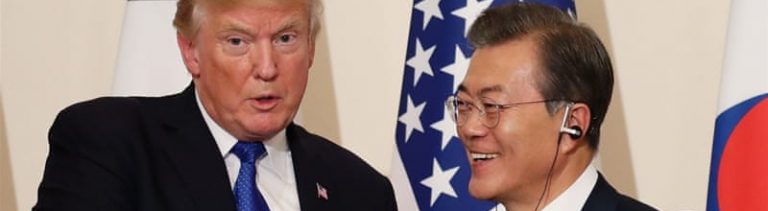
By Staff for Zoom in Korea. U.S. President Donald Trump and South Korean President Moon Jae-in met in Seoul on November 7 and held a joint press conference following their summit. Trump’s statement was noticeably toned down in contrast to his past remarks on North Korea. It did not contain threats of “fire and fury” or military action against North Korea. Trump and Moon agreed to resolve the “North Korean nuclear issue” in a “peaceful manner” and establish “permanent peace” on the Korean peninsula. There were multiple protests against Trump. Thousands of anti-Trump protesters gathered in Seoul’s Gwanghwamun Plaza. South Korean riot police erected a wall of police buses — a tactic begun and widely used by the conservative Lee Myung-bak and Park Geun-hye administrations — to barricade the protesters. The “No Trump Joint Action Task Force” — made up of over 220 civil society organizations — denounced the bus barricades: “Moon Jae-in, the self-proclaimed ‘president of the candlelight revolution,’ ordered police bus barricades to quarantine the people who have gathered to protest Trump, who habitually spouts war threats and bullies other countries through forced weapons sales and trade pressure.”
assetto corsa mods

Urgent End Of Year Fundraising Campaign

Online donations are back! Keep independent media alive. 

Due to the attacks on our fiscal sponsor, we were unable to raise funds online for nearly two years.  As the bills pile up, your help is needed now to cover the monthly costs of operating Popular Resistance.

Urgent End Of Year Fundraising Campaign

Online donations are back! 

Keep independent media alive. 

Due to the attacks on our fiscal sponsor, we were unable to raise funds online for nearly two years.  As the bills pile up, your help is needed now to cover the monthly costs of operating Popular Resistance.

Sign Up To Our Daily Digest

Independent media outlets are being suppressed and dropped by corporations like Google, Facebook and Twitter. Sign up for our daily email digest before it’s too late so you don’t miss the latest movement news.