Skip to content

US military

No Wonder US Forces In Morale Crisis

By Finian Cunningham for Information Clearing House - August 24, 2017 "Information Clearing House" -The spate of deadly US Navy collisions is a symptom of a wider morale crisis among American military forces. Part of the reason is that American troops are simply exhausted from being abused by political masters in Washington. “Over-stretch” is one way of putting it. American forces continue to be assigned in overseas wars and operations around the globe with no end in sight. And for no credible purpose either. This is not just a Navy problem. It affects all other branches of the US military: Army, Air Force, the Marines and National Guard. When President Donald Trump announced his brazen U-turn sending more American troops back to Afghanistan, the move had the backing of the Pentagon’s top brass. No doubt stock prices for US arms manufacturers spiked. But what about ordinary American soldiers? One can imagine renewed Afghan missions are not welcome, given that the US has been fighting its longest war – 16 years – in that country known as the "Graveyard of Empires." Any army is only as good as the morale among soldiers. Morale depends on having a respected leadership and a credible just cause. In America’s case, there are neither of these attributes, therefore it is no surprise that morale diminishes, as does fighting effectiveness. Look at the appalling record of US military defeats or failures. The fatal collision of a US Navy guided-missile destroyer this week with an oil tanker near Singapore – in which 10 missing American crew are feared dead

The Hard Numbers On The War In Afghanistan Trump Left Out Of His Speech

By Mike Ludwig for Truthout - Last night, President Trump was expected to announce that he would be sending several thousand more troops to Afghanistan, where the United States has been at war for 16 years and violence and corruption have become a way of life. Instead, he outlined a vague strategy meant to appease both a public weary of endless war and the military generals who are now among his top advisors. In his address to the nation from Fort Myer, Trump did not say how many more troops he would send to Afghanistan, or how much more money he is willing to spend on the war. He only said that restrictions on wartime spending would be lifted, and that military commanders would have the freedom to launch attacks without waiting for approval from Washington. Trump also refused to give a timetable for withdrawing American forces, saying only that the enemy would not be privy to when and where the US would attack. He said the "nation-building" effort in Afghanistan is over, and the US would no longer seek to forge democracies in foreign lands "in our own image." Trump did mention that the Taliban could have a place in a functioning Afghan democracy, a sign that the White House might now be willing to negotiate with anti-government forces after years of bloody warfare, but it's not clear what such negotiations would look like.

Trump’s Afghan War Speech: More Of The Same, With More Killing

By W.J. Astore for Bracing Views - Actually, the consequences of an American withdrawal are both unpredictable and (most probably) acceptable. Sure, terrorist organizations may gain impetus from an American withdrawal. It’s also possible that a notoriously corrupt Afghan government might finally negotiate with the Taliban and other organizations, and that regional power brokers like Pakistan and Iran, who have their own interests in regional stability, might broker a settlement that Americans could live with. Trump further argued that a rapid U.S. withdrawal from Iraq in 2011 led to “hard-won gains slip[ping] back into the hands of terrorist enemies. Our soldiers watched as cities they had fought for, and bled to liberate, and won, were occupied by a terrorist group called ISIS.” The truth is far more complex. The prolonged U.S. occupation of Iraq helped to create ISIS in the first place, and failed American efforts to create and train reliable Iraqi security forces contributed to easy ISIS victories after U.S. forces left in 2011.

Covering Up The Massacre Of Mosul

By Nicolas J S Davies for Consortium News - Iraqi Kurdish military intelligence reports have estimated that the nine-month-long U.S.-Iraqi siege and bombardment of Mosul to oust Islamic State forces killed 40,000 civilians. This is the most realistic estimate so far of the civilian death toll in Mosul. The bombardment of Mosul included tens of thousands of bombs and missiles dropped by U.S. and “coalition” warplanes, thousands of 220-pound HiMARS rockets fired by U.S. Marines from their “Rocket City” base at Quayara, and tens or hundreds of thousands of 155-mm and 122-mm howitzer shells fired by U.S., French and Iraqi artillery.But even this is likely to be an underestimate of the true number of civilians killed. No serious, objective study has been conducted to count the dead in Mosul, and studies in other war zones have invariably found numbers of dead that exceeded previous estimates by as much as 20 to one, as a United Nations-backed Truth Commission did in Guatemala after the end of its civil war. In Iraq, epidemiological studies in 2004 and 2006 revealed a post-invasion death toll that was about 12 times higher than previous estimates.

Korean Americans Denounce US War Threats In Coordinated Protests

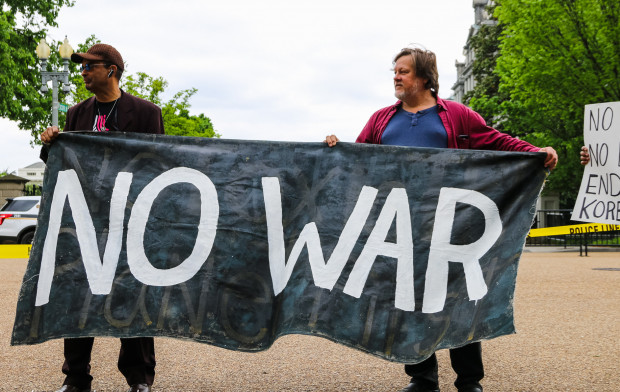
By Staff of Zoom In Korea - On August 14–ahead of the 72nd anniversary of Korea’s liberation from Japanese colonial rule–Korean Americans across the United States rallied to demand the U.S. government stop war provocations against North Korea and start talks towards peace. Korean Americans and other anti-war peace activists in New York, Washington DC, and Los Angeles held coordinated protest actions in their respective regions. Following the impeachment of former South Korean President Park Geun-hye and the election of liberal Moon Jae-in, Korean people around the world had high hopes for the resumption of North-South engagement. Many had expected North, South, and overseas Koreans to come together for a joint conference in Pyongyang or Seoul on August 15 in commemoration of Korea’s liberation. Just as Korea’s liberation was cut short by the arrival of U.S. occupying troops in 1945, however, the prospect of peace on the peninsula is once again thwarted, this time by Trump’s threats of “fire and fury like the world has never seen.”

The 16 Year War In Afghanistan – Headlines Tell The Story

By Ralph Nader for The Nader Page - Since 2001 the US has been at War in Afghanistan – the longest war in US history. Headlines concisely tell the story of this cruel boomeranging quagmire of human violence and misery. Below are some newspaper headlines from 2010 to the present to show that a militarized foreign policy without Congress exercising its Constitutional duties and steadfast public engagement will drift on, costing our soldiers’ lives and limbs, nearly three-quarters of a trillion taxpayer dollars, hundreds of thousands of Afghani lives and millions of refugees, with no end in sight. Here we go – year by year: 2010. Setbacks in Afghanistan Aggravate Fissures Over Obama Administration’s Review Strategy, Magnifying Differences. US Money Financing Afghan Warlords for Convoy Protection, Report Says. Afghan Base Tests US Exit Plans. In Bank Scandal, Kabul Struggles to Recover Missing Money. Afghanistan Halts Taliban Peace Initiative. US Slows Troop Pullout in Afghanistan

How War Pollutes The Potomac River

By David Swanson and Pat Elder for World Beyond War - The Pentagon’s impact on the river on whose bank it sits is not simply the diffuse impact of global warming and rising oceans contributed to by the U.S. military’s massive oil consumption. The U.S. military also directly poisons the Potomac River in more ways than almost anyone would imagine. Let’s take a cruise down the Potomac from its source in the mountains of West Virginia to its mouth at the Chesapeake Bay. The journey down this mighty waterway details six EPA Superfund sites created by the Pentagon’s reckless disregard for the fragile ecosystem of the Potomac River watershed. The U.S. Navy’s Allegany Ballistics Laboratory in Rocket Center, West Virginia, 130 miles north of Washington, is a critical source of contamination in the Potomac River. The on-site disposal of explosive metals and solvent wastes contaminates soil and groundwater with hazardous chemicals. The groundwater and soil along the river are laced with explosives, dioxins, volatile organic compounds, acids, laboratory and industrial wastes, bottom sludge from solvent recovery, metal plating pretreatment sludge, paints, and thinners. The site also has a beryllium landfill. An active burning area is still used for waste disposal, sprinkling chemical dust over the river. It’s not good.

Half A Million People Infected As Yemen Cholera Epidemic Continues To Spread

By Staff of Oxfam - "Yemen's catastrophic cholera crisis is rewriting the miserable history of this disease. Our common humanity tells us that this massive crisis demands a massive response. "This is no accidental disaster - it is a manmade disaster driven by national and international politics. All those fighting and backing this war need to stop fueling the madness and instead come to the peace table for the sake of civilian families in Yemen. Too many people have died, too many have lost everything they owned, too many have seen their futures put on hold. "In backing this war with billions of dollars of arms sales and military support the U.S. and the U.K. are complicit in the suffering of millions of people in Yemen."

US Foreign Military Bases Aren’t For “Defense”

By Thomas L. Knapp for Counter Punch - “U.S. foreign military bases are the principal instruments of imperial global domination and environmental damage through wars of aggression and occupation.” That’s the unifying claim of the Coalition Against US Foreign Military Bases (noforeignbases.org), and it’s true as far as it goes. But as a signer of the Coalition’s endorsement form, I think it’s worth taking the argument a bit further. The maintenance of nearly 1,000 US military bases on foreign soil isn’t just a nightmare for peaceniks. It’s also also an objective threat to US national security. A reasonable definition of “national defense,” it seems to me, is the maintenance of sufficient weaponry and trained military personnel to protect a country from, and effectively retaliate against, foreign attacks. The existence of US bases abroad runs counter to the defensive element of that mission and only very poorly supports the retaliatory part. Defensively, scattering US military might piecemeal around the world — especially in countries where the populace resents that military presence — multiplies the number of vulnerable American targets. Each base must have its own separate security apparatus for immediate defense, and must maintain (or at least hope for) an ability to reinforce and resupply from elsewhere in the event of sustained attack.

US Expanding Militarization & Corporate Looting In Central America

By Jeff Abbott for Towards Freedom - In mid-June, the Presidents of the Northern Triangle (Guatemala, Honduras, and El Salvador) met with US Vice President Mike Pence, Secretary of State Rex Tillerson, and Homeland Security Secretary John Kelly at the United States Southern Command base in Miami, Florida for the Conference on Prosperity and Security in Central America. The Presidents were joined by Mexican President Enrique Peña Nieto, and Colombian President Juan Manuel Santos. Their meeting looked at ways to transform the Alliance for Prosperity, a 2014 policy package that has since shaped relations between the US and Central America. The results of their meeting included plans to increase militarization of Central America while further opening the region to foreign investment. Their project involves dropping US aid to the region by roughly $300 million dollars, while combatting drug trafficking. The general approach reflects the model of Plan Colombia, originally applied by the Bill Clinton administration in the 1990s and continued into today to the tune of billions of dollars.

Building A Mass Movement To Stop Mass Killing

By Medea Benjamin for AlterNet - The $600 billion annual cost of the US military budget eats up 54% of all federal discretionary funds. It’s no wonder we don’t have money to address the crisis of global warming, build effective public transportation systems, institute a Medicare-for-All health system, or provide the free college education that all our youth deserve. You would think it would be easy to form a united front with activists from different movements who want to redirect our tax dollars. Students fighting for free education should understand that stopping just one weapons system, the expensive and unnecessary Lockheed Martin F-35 fighter jets, would fund the education of all college students for the next two decades. Nurses fighting for universal health care should understand that if we cut the bloated military budget, we’d have plenty of money for a national health- care system like the Europeans have. Environmentalists paddling their kayaks to block oil-digging ships should understand that if we dramatically cut our military spending, we’d have hun- dreds of billions of dollars to propel us into the era of green, sustainable energy. Unions should recognize that the military is one of the worst creators of jobs in relation to money spent. It was easier to connect with other movements when the peace movement was strong while trying to stop George W. Bush’s Iraq war.

Missile Defense Will Protect You From North Korea, Say USA Today’s Missile Defense-Funded Sources

By Jim Naureckas for FAIR - “US Missile Defense Plans to Zap North Korean Threats” was the headline of a USA Today story (7/17/17)—or “US Racing to Quash N. Korean Nuke Threat,” in the print edition. Strikingly, the piece contains no sources at all substantiating the “N. Korean nuke threat”: “North Korea’s rapid march to develop a nuclear-armed ballistic missile capable of striking the United States” is simply asserted in the lead, and later on the claim that “North Korea may be only a year or so away” from having missiles that “can hit anywhere in the world with a nuclear warhead” is backed up only by “according to US estimates.” On the “US missile defense plans,” USA Today does have sources—mostly sources with a direct financial connection to the US missile defense program. There’s Todd Harrison, director of the Aerospace Security Project at the Center for Security and International Studies (CSIS), who tells USA Today‘s Oren Dorell that “Missile defense buys you time and opens windows.” There’s also “retired Lt. Gen. Henry ‘Trey’ Obering III, a former head of the Missile Defense Agency who is now executive vice president at Booz Allen Hamilton”; later it’s clarified that Obering “heads the directed energy team at Booz Allen Hamilton”—in other words, his business is to sell to the Pentagon the kind of “smaller, more powerful and lighter” laser-based weapons that he tells USA Today are necessary to protect the United States from the North Korean threat.

U.S. Citizens Take Action Against U.S. Nuclear Bombs In Europe

By Ralph Hutchison for The Nuclear Resister - A delegation of eleven U.S. citizens joined with activists from China, Russia, Germany, Mexico, The Netherlands, Belgium and Britain at a peace encampment at the German airbase in Büchel, Germany, where U.S. B61 bombs are deployed. On Sunday, July 16, following the celebration of a Christian liturgy, Dutch and U.S. citizens removed the fence blocking the main entrance to the airbase and proceeded on site, the Dutch delegation carrying bread for a “Bread Not Bombs” action and the U.S. delegation carrying the text of the Nuclear Ban Treaty passed on July 7 at the United Nations in New York City. More than thirty activists entered the site without incident, passing through the security gate that was accidentally left unlocked and unstaffed. The Dutch delegation placed loaves of bread on the wings of jet fighters; the U.S. delegation lowered the U.S. flag from the flagpole, requested a meeting with the base commander, and read the text of the U.N. Treaty to soldiers at the base. After forty-five minutes, guards ran to seal the gates and police were summoned. Eventually, all activists were expelled from the facility without being charged. On Monday, July 17, activists woke to find themselves prisoners in the peace camp as those attempting to approach the base with banners were rebuffed by police. More than a dozen police vans ringed the roundabout at the gate.

US Expands Military Footprint In Syria To EIGHT Bases

By Vanessa Beeley for 21st Century Wire - With very little fanfare from the western media, the US is quietly creating a hostile military footprint inside Syria. By establishing a chain of airbases, military outposts and missile bases inside Syria, the US is illegally, stealth-occupying a sovereign nation. The number of US military installations in Syria has increased to eight bases according to recent reports, and possibly nine according to one other military analyst. We should also not forget the malevolent presence of Israel in the criminally annexed southern Syrian territory of the Golan Heights. This could just as easily be included in the list of US military outposts inside Syria. Two regional intelligence sources disclosed mid-June that the US military moved a new truck-mounted, long-range rocket launcher from Jordan to a US base in al-Tanf in Southeastern Homs, near the Iraqi and Jordanian borders, stepping up its presence in the area. The sources said the (High Mobility Artillery Rocket Systems – HIMARS) had moved into the desert garrison, which saw a buildup in recent weeks as tensions escalate after the US-led coalition struck positions of the Syrian forces to prevent them advancing toward the al-Tanf base.

What Does War Generate?

By Kathy Kelly for Counter Punch - At an April, 2017 Symposium on Peace in Nashville, TN, Martha Hennessy spoke about central tenets of Maryhouse, a home of hospitality in New York City, where Martha often lives and works. Every day, the community there tries to abide by the counsels of Dorothy Day, Martha’s grandmother, who co-founded houses of hospitality and a vibrant movement in the 1930s. During her talk, she held up a postcard-sized copy of one of the movement’s defining images, Rita Corbin’s celebrated woodcut listing “The Works of Mercy” and “The Works of War.” She read to us. “The Works of Mercy: Feed the hungry; Give drink to the thirsty; Clothe the naked; Visit the imprisoned; Care for the sick; Bury the dead.” And then she read: “The Works of War: Destroy crops and land; Seize food supplies; Destroy homes; Scatter families; Contaminate water; Imprison dissenters; Inflict wounds, burns; Kill the living.” The following week, General James Mattis was asked to estimate the death toll from the U.S. first use in Nangarhar province, Afghanistan, of the MOAB, or Massive Ordinance Air Burst bomb, the largest non-nuclear weapon in U.S. arsenals.
assetto corsa mods

Urgent End Of Year Fundraising Campaign

Online donations are back! Keep independent media alive. 

Due to the attacks on our fiscal sponsor, we were unable to raise funds online for nearly two years.  As the bills pile up, your help is needed now to cover the monthly costs of operating Popular Resistance.

Urgent End Of Year Fundraising Campaign

Online donations are back! 

Keep independent media alive. 

Due to the attacks on our fiscal sponsor, we were unable to raise funds online for nearly two years.  As the bills pile up, your help is needed now to cover the monthly costs of operating Popular Resistance.

Sign Up To Our Daily Digest

Independent media outlets are being suppressed and dropped by corporations like Google, Facebook and Twitter. Sign up for our daily email digest before it’s too late so you don’t miss the latest movement news.