Skip to content

Chris Hedges

Chomsky, Prashad, Hedges And Other Leading Intellectuals: Denuclearize The Middle East

American political decision makers, as well as Israeli political leaders, need to rethink their political, military, economic, and cultural policies in the region. The Middle East is in turmoil now, possibly again on the verge of a major war that could draw in the United States and Russia. President Donald Trump has pulled the United States out of the six-nation nuclear agreement with Iran, known as the Joint Comprehensive Plan of Action or JCPOA. Although a few of his advisers counseled against leaving the agreement, he has brought into his cabinet advisers who are known to be hawkish toward the Middle East and prefer regime change in that area to regime reform. The most notable of these advisers is John Bolton, appointed as director of the National Security Agency.

Chris Hedges: Putting The War In Syria In Full Context

By Kasia Anderson for Truth Dig - It’s been more than a week since the Trump administration abruptly switched out of “America first” mode and into intervention mode by dropping 59 Tomahawk missiles on a Syrian airfield. As Chris Hedges and Alternet journalists Max Blumenthal and Ben Norton argue in this episode of “On Contact With Chris Hedges,” the American public has been lacking something very important before—and after—that strike. Simply put, that would be context. More specifically, it comes down to crucial questions that are not being addressed publicly by members of the U.S. government or the mainstream media. Take these questions, for example: What’s the relationship between the regime change in Libya, encouraged and enabled by the Obama administration in 2011, and the ongoing refugee crisis? Or between that crisis and Brexit? Who are the White Helmets? How are all these questions related to the current conflict in Syria, and the role of the U.S. in that conflict? What role do Iran and Saudi Arabia, in addition to Russia, play in Washington’s stance toward Syrian President Bashar Assad?

Hedges & Wolin (2/8): Can Capitalism And Democracy Coexist?

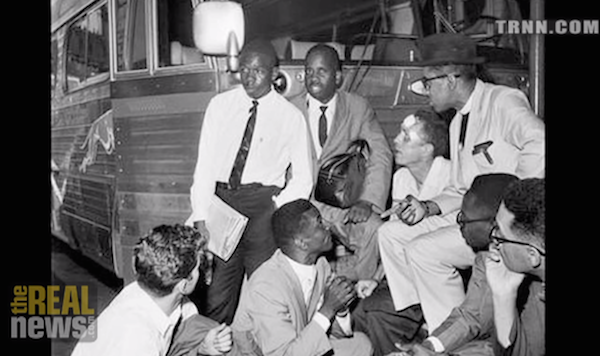
The Republicans, of course, have never had much of an appetite for popular participation. The Democrats have had a checkered history of it. Sometimes very sympathetic, and other times indifferent. But during the '60s, and really even during the '50s as well, movement toward democracy began to take shape with the realization of the kind of voter restrictions, the most elephant elementary kind of restrictions on democracy, prevalent especially, of course, in the South, and especially involving the disfranchisement of African-American voters, so that that kind of development--and, of course, the attempt on the part of Freedom Riders and others to go into the South and try to help African-Americans organize politically and to defend their rights--created a kind of political context, I think, probably which had never existed before. . .

Chris Hedges Gets Ordained

Thirty years ago I stood in a church in Albany, N.Y., with my father, a Presbyterian minister. I had graduated from Harvard Divinity School and had purchased a one-way ticket to El Salvador, where the military government, backed by the United States, was slaughtering between 700 and 1,000 people a month. I had decided, as George Orwell and James Baldwin did earlier, to use my writing as a weapon. I would stand with the oppressed. I would give them a voice. I would describe their suffering and their hopes. And I would name the injustices being done to them. It was a decision that would send me to war for two decades, to experience the worst of human evil, to taste too much of my own fear and to confront the reality of violence and random death.

The Last Gasp Of Climate Change Liberals

The climate change march in New York on Sept. 21, expected to draw as many as 200,000 people, is one of the last gasps of conventional liberalism’s response to the climate crisis. It will take place two days before the actual gathering of world leaders in New York called by U.N. Secretary-General Ban Ki-moon to discuss the November 2015 U.N. Climate Conference in Paris. The marchers will dutifully follow the route laid down by the New York City police. They will leave Columbus Circle, on West 59th Street and Eighth Avenue, at 11:30 a.m. on a Sunday and conclude on 11th Avenue between West 34th and 38th streets. No one will reach the United Nations, which is located on the other side of Manhattan, on the East River beyond First Avenue—at least legally. There will be no speeches. There is no list of demands. It will be a climate-themed street fair. The march, because its demands are amorphous, can be joined by anyone. This is intentional. But as activist Anne Petermann has pointed out, this also means some of the groups backing the march are little more than corporate fronts. The Climate Group, for example, which endorses the march, includes among its members and sponsors BP, China Mobile, Dow Chemical Co., Duke Energy, HSBC, Goldman Sachs, JPMorgan Chase and Greenstone. The Environmental Defense Fund, which says it “work[s] with companies rather than against them” and which is calling on its members to join the march, has funding from the oil and gas industry and supports fracking as a form of alternative energy. These faux environmental organizations are designed to neutralize resistance. And their presence exposes the march’s failure to adopt a meaningful agenda or pose a genuine threat to power.

Chris Hedges: Why Israel Lies

All governments lie, as I.F. Stone pointed out, including Israel and Hamas. But Israel engages in the kinds of jaw-dropping lies that characterize despotic and totalitarian regimes. It does not deform the truth; it inverts it. It routinely paints a picture for the outside world that is diametrically opposed to reality. And all of us reporters who have covered the occupied territories have run into Israel’s Alice-in-Wonderland narratives, which we dutifully insert into our stories—required under the rules of American journalism—although we know they are untrue. I saw small boys baited and killed by Israeli soldiers in the Gaza refugee camp of Khan Younis. The soldiers swore at the boys in Arabic over the loudspeakers of their armored jeep. The boys, about 10 years old, then threw stones at an Israeli vehicle and the soldiers opened fire, killing some, wounding others. I was present more than once as Israeli troops drew out and shot Palestinian children in this way. Such incidents, in the Israeli lexicon, become children caught in crossfire. I was in Gaza when F-16 attack jets dropped 1,000-pound iron fragmentation bombs on overcrowded hovels in Gaza City. I saw the corpses of the victims, including children. This became a surgical strike on a bomb-making factory. I have watched Israel demolish homes and entire apartment blocks to create wide buffer zones between the Palestinians and the Israeli troops that ring Gaza. I have interviewed the destitute and homeless families, some camped out in crude shelters erected in the rubble.

Chris Hedges Interviews Noam Chomsky (2/3)

The idea still should be that of the Knights of Labor: those who work in the mills should own them. And there's plenty of manufacturing going on in the country, and probably there will be more, for unpleasant reasons. One thing that's happening right now which is quite interesting is that energy prices are going down in the United States because of the massive exploitation of fossil fuels, which is going to destroy our grandchildren, but under the, you know, capitalist morality, the calculus is that profits tomorrow outweigh the existence of your grandchildren. It's institutionally-based, so, yes, we're getting lower energy prices. And if you look at the business press, they're, you know, very enthusiastic about the fact that we can undercut manufacturing in Europe because we'll have lower energy prices, and therefore manufacturing will come back here, and we can even undermine European efforts at developing sustainable energy because we'll have this advantage. Britain is saying the same thing. I was just in England recently. As I left the airport, I read The Daily Telegraph, you know, I mean, newspaper. Big headline: England is going to begin fracking all of the country, even fracking under people's homes without their permission. And that'll allow us to destroy the environment even more quickly and will bring manufacturing back here.

Chris Hedges Interviews Noam Chomsky

Well, I think we can draw many very good lessons from the early period of the Industrial Revolution. It was, of course, earlier in England, but let's take here in the United States. The Industrial Revolution took off right around here, eastern Massachusetts, mid 19th century. This was a period when independent farmers were being driven into the industrial system--men and women, incidentally, women from the farms, so-called factory girls--and they bitterly resented it. It was a period of a very free press, the most in the history of the country. There was a wide variety of journals, ethnic, labor, or others. And when you read them, they're pretty fascinating. The people driven into the industrial system regarded it as an attack on their personal dignity, on their rights as human beings. They were free human beings who were being forced into what they called wage slavery, which they regarded as not very different from chattel slavery. In fact, this was such a popular view that it was actually a slogan of the Republican Party, that the only difference between working for a wage and being a slave is that working for a wage is supposedly temporary--pretty soon you'll be free. Other than that, they're not different.
assetto corsa mods

Urgent End Of Year Fundraising Campaign

Online donations are back! Keep independent media alive. 

Due to the attacks on our fiscal sponsor, we were unable to raise funds online for nearly two years.  As the bills pile up, your help is needed now to cover the monthly costs of operating Popular Resistance.

Urgent End Of Year Fundraising Campaign

Online donations are back! 

Keep independent media alive. 

Due to the attacks on our fiscal sponsor, we were unable to raise funds online for nearly two years.  As the bills pile up, your help is needed now to cover the monthly costs of operating Popular Resistance.

Sign Up To Our Daily Digest

Independent media outlets are being suppressed and dropped by corporations like Google, Facebook and Twitter. Sign up for our daily email digest before it’s too late so you don’t miss the latest movement news.