Skip to content

Food and Agriculture

Oregon Voters Say No To GMO Crops

On Wednesday, May 20, voters in two counties in Oregon passed ballot initiatives to ban the growing of genetically engineered crops. Jackson County’s Measure 15-119 passed overwhelmingly, by 66 percent to 34 percent. Proponents of the ban raised only $375,000 compared with a record nearly $1 million raised by the opposition, which included agribusiness giants Monsanto, Syngenta and DuPont Pioneer. Voters in Josephine County passed Measure 17-58 by a vote of 58 percent to 42 percent. However, the ban will be tested in court because the state passed a controversial law in October 2013, stripping counties of the right to pass GMO bans. The Jackson County measure is exempt from the state law because it had already qualified for the ballot prior to the passage of S.B. 863. Ronnie Cummins, national director of the Organic Consumers Association (OCA), and the Organic Consumers Fund which mobilized its members and donated $50,000 to the Oregon campaigns, issued this statement today: “The passing of these two GMO bans in Jackson and Josephine Counties should send a clear signal to politicians that citizens not only reject unregulated and hazardous GMOs, but are willing to defy the indentured politicians who pass laws, like Oregon’s S.B. 863, that take away county rights to ban GMOs and obliterate a 100-year tradition of home rule and balance of powers between counties and the state.

The Battle For Healthy Food Escalates

Defying repeated threats of a lawsuit from Monsanto and the Grocery Manufacturers Association (GMA), on May 8, Peter Shumlin, Governor of Vermont, signed a historic bill requiring food manufacturers to label genetically engineered (GE) foods, and to drop the practice of labeling GE foods as “natural” or “all natural.” On May 9, true to its word, the GMA confirmed that it will sue Vermont in federal court to overturn H. 112. Vermont is prepared to fight back. The state has already established a “food fight” legal defense fund. Legal analysts say Vermont will likely win. Vermont isn’t the only state up against the multi-billion dollar lobbying group. The GMA, whose 300-plus members include Monsanto and Dow, Coca-Cola and General Mills, is pushing a bill in Congress that would preempt all states from passing GMO labeling laws. It’s time for consumers in every state to band together to defeat the GMA’s full-on assault, not only on Vermont, not only on consumers’ right to know what’s in our food, but on states’ rights and on our basic freedoms to protect our health and our communities.

Fast-Food Workers Kick Off Global Labor Action

The world’s largest protest of fast-food workers kicked off Thursday with workers demonstrating in 150 cities in the United States and more than 30 other countries. The protesters are demanding better pay in a global rallying cry against rising income inequality, continuing on the heels of an 18-month-long labor campaign for higher fast-food wages in America. In the U.S., organizers said thousands who wanted their pay increased to $15 per hour participated in the labor action and were joined by other McDonald’s, Burger King, Wendy’s and KFC workers in countries such as Brazil, New Zealand and Morocco, taking a stand for the first time, according to a statement from activist group Fast Food Forward, which is helping coordinate the protests. Kendall Fells, leader of Fast Food Forward, told Al Jazeera that the dozens of New York City workers who walked off their jobs in November 2012 have now launched a global movement to raise the wages of fast-food workers and continue the conversation on income inequality. “It’s a sign of the times, and people are struggling,” he said. "If we want to get the economy back on track, we need to get more money in the pockets of people. People around the country thought we were crazy to ask for $15, but now Seattle has [proposed] this."

Vision For A New Urban Economy Based On Democracy

Tonight is the first night of the Building Our New Economy Together, Economic Democracy Conference in Baltimore. If you are unable to make it to the conference tonight, keep it tuned to this page for a live stream of our town hall at The Real News Network! You will also be able to catch the opening and closing plenary sessions on Saturday right here. For more on the event’s schedule, visit here. The evening will bring together top national experts on reframing our political situation with the folks in Baltimore who are already working on these issues. This session will be held from 7 to 9 PM, with doors opening at 6:30 PM and a reception following. Speakers will include (order TBD): Margaret Flowers of Popular Resistance and Its Our Economy Diane Bell McKoy, Associated Black Charities Gar Alperovitz, University of Maryland, College Park Jacqui Dunne, Author, Rethinking Money: How New Currencies Turn Scarcity into Prosperity Michael Coleman, United Workers

Oglala Lakotas Oppose Expansion Of Uranium Mining Near Reservation

In 2008, Debra White Plume, an Oglala Lakota environmental justice activist, received a piece of mail with no return address. Inside was a 1989 letter to the Nuclear Regulatory Commission from John Peterson, an exploration geologist who had worked on what is now the Crow Butte uranium mine in northwestern Nebraska. In the letter, Peterson describes how uranium mining in the area would almost certainly contaminate the regional water supply if it went forward. “I believe certain aspects of the geology of the Crow Butte uranium deposits have been deliberately overlooked or suppressed so that mining could proceed and profits be gained regardless of the effect upon local ground water quality,” he wrote. Peterson’s warnings were disregarded, mining at the site began two years later, in 1991, and it continues to this day. Now, the mine is on the verge of expanding. Cameco Corporation, a Canadian mining company, is seeking permits to create two new mine sites north and west of its current location. If approved by federal regulators, Cameco’s operations would swallow up an additional 8,300 acres of the prairie hills.

Louisiana Residents Gear Up For Fracking Fight Just Outside New Orleans

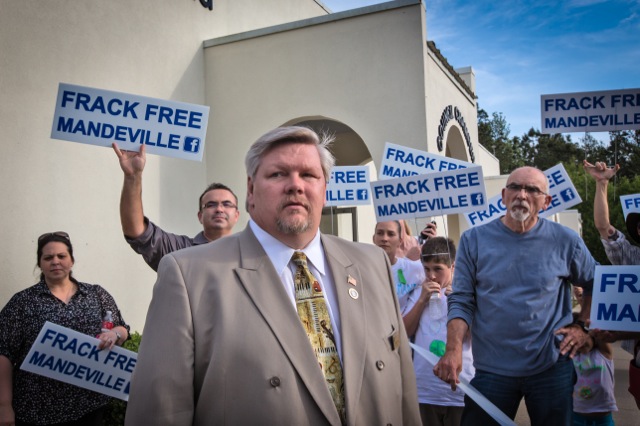
In mid-April, word started spreading like wildfire among Louisiana residents: Helis Oil & Gas LLC wants to drill a well in search of oil and gas on a 960-acre tract of land about 30 miles from New Orleans, in the Mandeville area. Helis plans to use hydraulic fracturing, or fracking, to extract oil and gas from the Tuscaloosa Marine Shale (PDF), which holds an estimated 7 billion barrels of oil beneath the Southern Hills aquifer, which extends from St.Tammany to beyond Baton Rouge and well into Mississippi. On April 16, residents packed a meeting, expressing fear and outrage about the proposed drilling. Right away, they learned two things: firstly, that they’re up against Louisiana's strong laws protecting the oil and gas industry. And secondly, that there’s no time to waste. On May 13, the Department of Natural Resources’ office of conservation, which regulates oil and gas drilling in Louisiana, will hold a hearing to consider issuing a unit permit — the first step in the permitting process.

Food Not Bombs Pilsen Turns Police Station Into Garden

In a globalized city at the heart of advanced capitalism, where bond traders exchange billions of dollars in our financial markets, people are still allowed to die of starvation, malnutrition and lack of permanent shelter. In the wealthiest country of the world, the most extreme forms of poverty persist unabated, while buildings that could be urban farms, social centers, living spaces, radical libraries, free schools or free medical clinics are kept off limits through the unending threat of the prison cell and the barrel of the gun. Today Food Not Bombs Pilsen has taken a small step in our neighborhood to combat the ruthless inequality of capitalist society. Instead of allowing the abandoned police precinct to remain privatized and wasted, we have decided to make a garden to grow food and build community power through autonomous food security. In the garden, we will grow fresh vegetables that we will hand out for free at our weekly food distribution.

Monsanto And Dupont Set To Sue Vermont Over GMO Labeling

Vermont's GMO labeling law will likely still face legal challenges from major food companies like Monsanto Co. and DuPont Co – the leading producers of GMO crops. They are widely expected to sue the state over the law. To defend the legislation, Vermont allocated a $1.5 million legal defense fund in the measure, to be paid for with settlements won by the state. However, even this amount might not be enough to cover the state’s legal bills. Monsanto, DuPont, Kraft Foods Co. and others previously led the charge against the similar labeling legislation in California and Washington state, grossly outspending supporters of the measure that was eventually defeated in both states, with anti-labeling groups spending $22 million of the $28 million total spent on that campaign in Washington. “There is no doubt that there are those who will work to derail this common-sense legislation,” Shumlin said. “But I believe this bill is the right thing to do and will gain momentum elsewhere after our action here in Vermont.”

Alternative Economic Models: Food Co-ops And Fair Trade

But, there is an alternative. If the goal of a movement is economic transformation, US and THEM can actually become WE – considerably more complex and nuanced an approach, but at the end of the day, a much more inspiring and worthwhile goal. And imagine the difference, when people feel ownership in a business model: farmers, workers, members all have a different relationship to their work when they own the decisions… and the results of those decisions. Not only are co-operatives a more empowering model in and of themselves, but in a co-operative economy, the entire system can be transformative. Supply chains are carefully and thoughtfully built so that while each party has their role to fill, a true partnership is formed – people are not reduced to mere “producer” or “consumer”, but instead, all parties along the supply chain become actors, more fully developed and invested in the entire supply chain, the product and the partnerships: quality, integrity, respect and transparency occur throughout the chain.

Michigan Trying To Derail Urban Farming Movement

Michiganders who raise chickens, goats and ​honey ​bees on their residential property have had their right to keep livestock stripped away by the state’s Agriculture and Rural Development Commission, which says they are not protected by the same laws as commercial farms. Urban parts of Michigan, particularly Detroit, have been enjoying a renaissance of small-scale farming in recent years. Much of it has been in the form of community farms, residents providing food for themselves, and small entrepreneurs who sell fresh eggs, dairy, honey, and produce to their neighbors, sometimes off the books. Commission Chair Diane Hanson said that the state’s previous agricultural management rules “were not suitable for livestock in urban and suburban areas.” Now, properties not zoned for agricultural use with 13 or more residences within an eighth of a mile or another residence within 250 feet may be required to cease keeping livestock if asked by local authorities.

Social Unrest Starts With Soaring Food Prices

From 2008 to 2014, insurrectionist activity has sequentially erupted across the globe, from Tunisia and Egypt to Syria and Yemen; from Greece, Spain, Turkey and Brazil to Thailand, Bosnia, Venezuela and the Ukraine. In every instance, there was a tipping point: in Tunisia, it was Mohamed Bouazizi’s self-immolation; in New York City, it was the Wall Street bailout; in Istanbul, it was a few threatened trees in Gezi Park; in Brazil, it was a 20-cent increase in transit fare. Today, the rest of our world seems poised to erupt, with every nation near and far harboring its own Achilles heel, its own tender nerve of geopolitical vulnerability at risk of getting pricked. Thanks to corporate media, which conveniently co-opts the restless amnesia of the news cycle to distract attention from ongoing, systemic issues, this global revolutionary fervor has been presented to us as a bunch of sound and fury that rises and falls and amounts to nothing. But beneath what we’ve come to perceive as isolated and distinct events is a shared but neglected root cause of environmental crisis. What most people don’t realize is that outbreaks of social unrest are preceded, usually, by a single pattern — an unholy trinity of drought, low crop yield and soaring food prices.

Fast-Food Worker Strike About To Go Global

The fast-food worker movement for higher pay is about to go global. Workers from dozens of countries on six continents are joining the push for higher pay and worker rights, it was announced Wednesday at a press conference outside a McDonald's restaurant in Midtown Manhattan by Fast Food Forward, which represents U.S. fast-food workers. The group announced nationwide strike plans for May 15 -- a date which mirrors the $15 per hour pay they are demanding. On that same date, workers from dozens of countries on six continents will hold protests at McDonald's, Burger King and KFC outlets. It is not known how many workers will strike, but thousands of the nation's estimated 4 million fast-food workers are expected to take part in the one-day strike. "We've gone global," said Ashley Cathey, a McDonald's worker from Memphis, Tenn., who makes $7.75 an hour after six years on the job. "Our fight has inspired workers around the world to come together." For the fast-food industry, this seems to be the issue that just won't go away. It's expected to be front-and-center later this month when McDonald's hosts it annual shareholders meeting on May 22, in Oak Brook, Ill.

Video: Protect SacredWater from Tar Sands

This weekend the Moccasins on the Ground Direct Action Training tour on the Lakota homelands traveled to the remote Red Shirt community. Dozens of diverse people from across Turtle Island turned out to deepen their spiritual connection to SacredWater and learn skills in nonviolent direct action, tactical media, and medical training. Owe Aku (Bring Back the Way) gathered Red Nations and non-Natives alike as protectors of SacredWater and caregivers of MotherEarth. Original Peoples on the frontlines continue to lead the struggle and unite nations in defense of our most sacred life sustaining element. Check out this video produced by participants in the tactical media training to demonstrate the diversity of voices calling for the protection of SacredWater from toxic tar sands. The training included a direct action by the Kul Wicasa Oyate (Lower Brule Lakota Tribe). Last Thursday, tribal members and their allies filled the halls of their Tribal Council to protect their sacred water from the threat of Keystone XL.

Fast-Food CEOs Making 1,200 Times Workers’ Wages Are Clueless

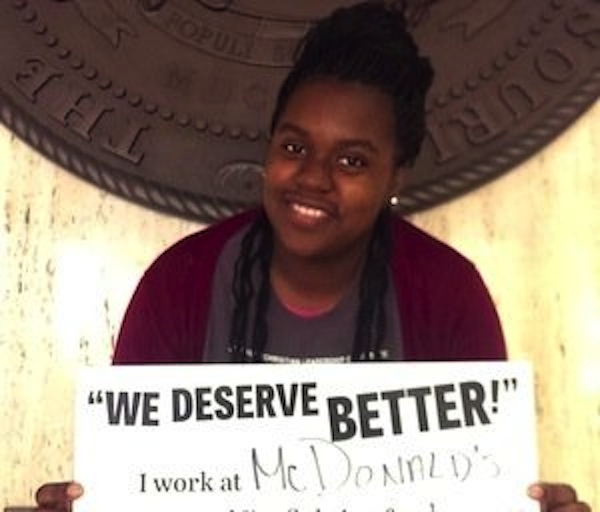
A grand canyon of inequality exists between fast food CEOs and the workers who make their corporate and personal fortunes. In the past decade, fast-food CEOs’ wages have increased more than 400 percent, while workers wages increased 0.3 percent, according to a new report by Demos. The result is that the CEO-to-worker pay ratio is now 1,200-to-one, with the average fast food CEO salary at $23.8 million in 2013 and the average worker salary at $19,000. This ratio is more than quadruple what’s typically found in the nation’s economy, which continues on its path of increasing economic disparity. Another new report by the National Employment Law Project found that there are now 1.85 million more low-wage jobs than before the Great Recession, but 2 million fewer jobs in mid- and high-wage industries, confirming the slide down the economic ladder. While we can comprehend the big picture behind these figures, it is another thing to see what this inequality looks like for people stuck in low-wage jobs. Below are the experiences of three McDonalds workers who are trying to survive, while fighting for higher wages and a union.

The 12 Fruits And Vegetables Most Likely To Be Contaminated

The Environmental Working Group is out with its annual “ Dirty Dozen” list: a ranking of the conventionally grown fruits and vegetables that, based on an analysis of 32,000 samples tested by the USDA and the FDA, are most likely to be contaminated with pesticides. Controversy abounds, however, over whether or not higher pesticide levels translate to a safety risk: the USDA, in its own annual pesticide report, found, as in years previous, that “U.S. food does not pose a safety concern based upon pesticide residues.” While “it’s true that most samples meet legal limits every year,” the EWG countered, “legal doesn’t always mean safe.” There do remain doubts about the safety of pesticide residues, most notably in apples. In the United States, conventionally grown apples are commonly treated with DPA – a chemical that the European Union, citing safety concerns, banned. More recently, the EU also strictly limited the amount of DPA allowed on imported apples — and since U.S. apples average four times the European limit, that means American apples are effectively banned from Europe.
assetto corsa mods

Urgent End Of Year Fundraising Campaign

Online donations are back! Keep independent media alive. 

Due to the attacks on our fiscal sponsor, we were unable to raise funds online for nearly two years.  As the bills pile up, your help is needed now to cover the monthly costs of operating Popular Resistance.

Urgent End Of Year Fundraising Campaign

Online donations are back! 

Keep independent media alive. 

Due to the attacks on our fiscal sponsor, we were unable to raise funds online for nearly two years.  As the bills pile up, your help is needed now to cover the monthly costs of operating Popular Resistance.

Sign Up To Our Daily Digest

Independent media outlets are being suppressed and dropped by corporations like Google, Facebook and Twitter. Sign up for our daily email digest before it’s too late so you don’t miss the latest movement news.