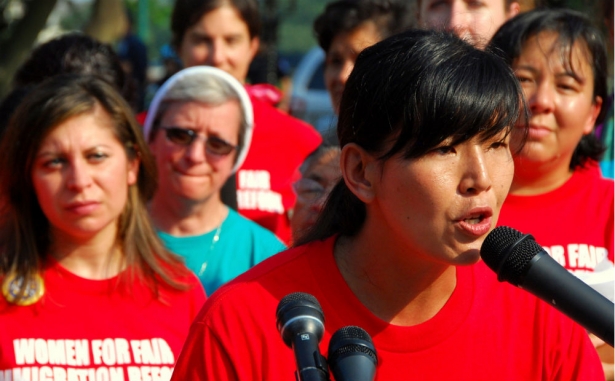
Even as the traditional labor movement falters, hitting a ninety-seven-year low in membership rates, female labor leaders like Jayaraman are on the rise and becoming highly visible. Women workers, who were all but shut out from unions in the 1930s, when the movement first gained real power, have been pushing into the top ranks. Mary Kay Henry is president of SEIU, one of the largest unions in the country. Randi Weingarten heads the American Federation of Teachers. At the AFL-CIO, Elizabeth Shuler is the secretary-treasurer and Arlene Holt-Baker recently retired as executive vice president.
Lower-profile leaders are also making headway—and meeting with success. Karen Lewis, president of the Chicago Teachers Union, made headlines around the country when her members went on strike in 2012 and won important concessions. At the helm of the New York Taxi Workers Alliance, Bhairavi Desai secured a fare hike that benefits taxi drivers. And outside the traditional labor movement, in the so-called “alt-labor” sector, female leaders dominate: Jayaraman at ROC United, Ai-jen Poo at the National Domestic Workers Alliance and Caring Across Generations, Nadia Marin Molina with day laborers at the National Day Laborer Organizing Network, Sarita Gupta at Jobs With Justice, and Madeline Janis bringing workers together with other groups in Los Angeles through LAANE.
These women are bringing new ideas and strategies to labor organizing, many of which are borrowed from the women’s movement—like making the connection between what workers face on the job and what they’re dealing with at home. They don’t only target corporate bosses but bring together a variety of stakeholders within communities to fight for change in the workplace and beyond.