Skip to content

Labor Unions

Resurrection Unionism — 5 Ways Labor Can Rise Again

Despite its flaws, organized labor is the most powerful democratic force in American history. Fewer labor unions means more income inequality, and everyday people and hardworking families are sitting ducks to the corporate agenda without the effective counter-weight of a strong labor movement. That’s why it is imperative that organized labor heed the lessons of Wisconsin, soberly analyze the outcome, and draw the right conclusions from the fight in order to inform the movement’s next steps. The most important lesson to be learned from Wisconsin is that labor’s traditional electoral program is no longer effective, if it ever was. Labor and other allied groups spent tens of millions of dollars in the 2012 recall election and again in 2014 in an attempt to oust Walker, but their spending was still dwarfed by big money corporate interest groups. Even worse was the missed opportunity cost: Labor wasted four years telling everyday Wisconsinites to elect moderate, pro-business Democrats instead of stoking the flames of a historic uprising and working to pull off a general strike.

In Defense Of A New Kind Of Labor Movement

Geoghegan’s argument, based on his 2014 book Only One Thing Can Save Us: Why America Needs a New Kind of Labor Movement, is that a revived—but different—labor movement is the only way to stabilize the economy, solve the problems of hierarchy in the workplace and inequality in the larger society, and save the middle-class. In particular, he developed a compelling case against the idea, shared by mainstream economists and politicians alike, that all we need is more education. Without a stronger union movement, higher levels of education simply won’t solve those pressing economic and social problems.

Adjuncts Join The Fight For 15

Most observers agree that adjunct instructors deserve better pay, but what about $15,000 per course? The Service Employees International Union shocked even some adjunct activists last week when it announced that figure as a centerpiece of its new faculty advocacy campaign. But while union leaders admit the number is bold, those involved in the campaign say adjuncts might as well aim big, since they have little to lose. They also say they hope the $15,000 figure will force a national conversation about just how colleges spend their money, if not on middle-class salaries for instructors. “Clearly this is an aspirational goal, but it’s a realistic goal, as well,” said Tiffany Kraft, an adjunct instructor of English at four different institutions in the Portland, Ore., area, where she earns $2,700 to $3,400 per course -- about average, nationwide.

Striking Grad Students: What Its Like Living On $15,000/Year

As the strikes at both York and the University of Toronto move into their second month, anyone following the news knows that one of the main issues for U of T students is their guaranteed funding package of $15,000 per year. That's technically the minimum amount of funding, although few students (at least in the arts and humanities) get more than that. Living on $15,000 for an entire year in Toronto means living several thousand dollars below the low-income cutoff, which is another frequently mentioned piece of information. But what does that mean? It may sound nearly impossible to live on such a tight budget, but clearly some people manage to do it out of necessity.

How New Postal Union Leadership Could Save The Post Office

Let’s begin with the bad news. The U.S. Post Office, the oldest, most respected and ubiquitous of all public institutions is fast disappearing. In recent years management has shuttered half the nation's mail processing plants and put 10 percent of all local post offices up for sale. A third of all post offices, most of them in rural areas, have had their hours slashed. Hundreds of full time, highly experienced postmasters knowledgeable about the people and the communities they serve have been dumped unceremoniously, often replaced by part timers. Ever larger portions of traditional post office operations--- trucking, mail processing and mail handling-- have been privatized. Close to 200,000 middle class jobs have disappeared.

Teachers Poised To Strike, First Time In 26 Years

Los Angeles may be close to its first teachers strike in 26 years after its school district and the local teachers’ union declared that they would be unable to make progress on contract negotiations. Consequently, later this month California’s state labor board for public employees will be mediating between the two sides in the first of several sessions scheduled thus far. United Teachers Los Angeles (UTLA), a union representing over 35,000 teachers in the area, is working under terms of a contract that expired in 2011 but still remains in effect. Negotiations for a new contract began last July upon the swearing-in of President Alex Caputo-Pearl.

Unions To Fight Trade Pact By Freezing Political Donations

Dozens of major labor unions plan to freeze campaign contributions to members of Congress to pressure them to oppose fast-track trade legislation sought by President Barack Obama , according to labor officials. The move is part of the unions’ campaign against the Trans-Pacific Partnership, or TPP, which the Obama administration is negotiating with 11 nations around the Pacific Ocean. The unions worry the trade agreement could send more jobs to low-wage countries, including Vietnam and Malaysia. Unions have opposed the TPP through demonstrations, letters to lawmakers and political ads, but withholding political contributions is a more forceful way of flexing their muscle. In the 2014 midterm elections, unions—the lifeblood of the Democratic Party—contributed about $65 million from their political-action committee, or PACs, to candidates, nearly all Democrats.

International Labor Group Opposes US Interference In Venezuela

Sharan Burrow, ITUC General Secretary, said, “The US faces real threats to national security on many fronts and from within many countries, but there’s no evidence that Venezuela is one of them. Allegations of human rights abuses and corruption made by the US against seven Venezuelan officials should be dealt with according to the rule of law, and not trial by media. We urge both the US and Venezuela to accept the jurisdiction of the Inter-American Court on Human Rights which was established for just this kind of situation. They should also respect the role of the Inter-American Commission on Human Rights.” UNASUR, the regional government grouping, has been trying to re-start dialogue between the Venezuelan government and opposition, with allegations of opposition efforts to mount a coup and counter-criticism of the government’s crackdown on the opposition dominating Venezuelan politics in recent months.

IMF: Weaker Unions = Higher CEO Pay

As labor unions have declined in most countries around the world, CEO paychecks have ballooned. And that’s not just a coincidence, according to new research from the International Monetary Fund. In the latest issue of the IMF’s Finance & Development journal, researchers Florence Jaumotte and Carolina Osorio Buitron give a preview of their forthcoming study on the links between unionization rates and inequality. Jaumotte and Osorio Buitron also dare to point out that “top earners’ compensation may be larger than what is justified by their contribution to the economy’s output.”Their article — entitled, I kid you not, “Power from the People” — notes that “weaker unions can reduce workers’ influence on corporate decisions that benefit top earners, such as the size and structure of top executive compensation.”

Refinery Strike Is Not Just About Safety – It’s About Pollution

"Our focus is on health and safety; it's not wages at all," said USW spokeswoman Lynne Hancock. Thousands of accidents are reported at refineries across the country every year, but typically only make headlines when workers die or when plumes of pollution spew across neighboring communities. Such disasters have been occurring on a yearly basis. The USW, which bargains on behalf of 30,000 workers at 65 refineries and hundreds of petrochemical facilities, blames working conditions and employment policies at refineries for the industry's alarming safety record. The union wants to put an end to unsafe staffing levels, long shifts that lead to fatigue, and the industry's habit of replacing union workers with inexperienced contractors, among other injurious practices. When the industry balked at initial proposals in mid-February, the USW accused employers of being more interested in profits than safety.

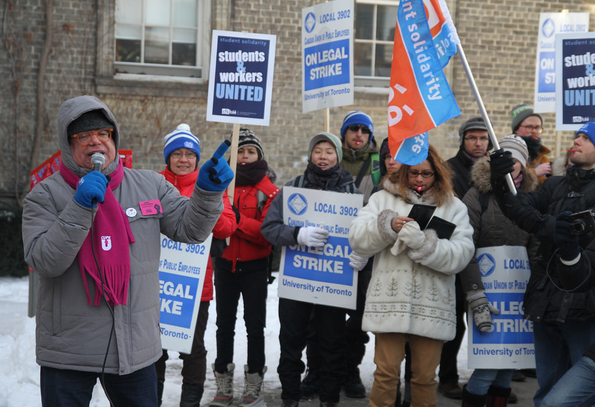
Striking TA’s & Staff Frozen Out Of A Living Wage At UToronto

We've been out of a contract now for close to nine months. In November of this last year, our membership voted in the largest turnout for an academic local union in Canadian history and voted overwhelmingly to endorse [strike (?)] action, which then led to the final hearing, in which negotiations should have taken place. And a limited number of dates was set by the university administration to negotiate a final agreement, which virtually all took place in the final week, the 11th hour, in which literally beyond the 11th hour the university administration put forward a deal that was endorsed by our negotiating team and then put forward to our membership at a meeting the next day. And at that meeting, where more than 1,000 people turned out for that meeting, again, more than 90 percent voted to reject that deal and to therefore be immediately on strike.

Adjuncts Deem Nat’l Day Of Action A Success

It started as a simple question on social media: What would happen if adjuncts across the country walked out on the same day, at the same time? That question got answered Wednesday -- sort of -- on the first-ever National Adjunct Walkout Day. There were some big walkouts at a few institutions but, for a variety of reasons, adjuncts at many more colleges and universities staged alternative protests, such as teach-ins, rallies and talks. Still, the movement led to unprecedented levels of conversation on many campuses, in the media and elsewhere about the working conditions of the majority of college faculty (those off the tenure track). And as a result, adjunct activists declared the day a success -- while wondering what comes next.

Wisconsin Lawmakers Pass Right-To-Work As Thousands Protest

Spelling more trouble for organized labor in the U.S., Republican legislators in the Wisconsin state Senate approved a right-to-work bill here on Wednesday, sending the measure to a GOP-controlled Assembly where it's also expected to pass. Republican leaders chose to fast-track the bill in what's known as an extraordinary legislative session, allowing for less debate than usual. Debate over the bill drew an estimated 2,000 protesters to the state Capitol on both Tuesday and Wednesday, reminiscent of the passionate labor demonstrations surrounding Act 10 in 2011, though vastly smaller in scope. As with that earlier legislation, which stripped most collective bargaining rights from public-sector employees, vocal opposition from the state's unions wasn't enough to stop the right-to-work bill in its tracks.

About 2,000 Protest Against Right-To-Work At Wisconsin Capitol

About 2,000 construction workers, electricians, carpenters and other union members rallied at the Wisconsin state Capitol on Tuesday, pushing back against a fast-tracked right-to-work bill backed by Republicans and Gov. Scott Walker. The gathering was larger than most at the Capitol, but paled in numbers and intensity to the protests seen four years ago when Walker pushed through his measure that effectively ended collective bargaining for most public workers. Rallies then lasted for weeks and grew as large as 100,000 people. “Let’s be loud today and let them hear us,” Phil Neuenfeldt, president of the Wisconsin AFL-CIO, said at the rally where people sang, chanted and booed references to Republicans pushing the issue. Right-to-work laws, in place in 24 states, prohibit private-sector companies from reaching labor agreements in which workers have to pay fees to the unions as a condition of employment.

Manure Dumped On ExxonMobil Refinery In Protest

Protesters clad in hazmat suits protested over the weekend at the ExxonMobil refinery gates in Torrance in response to what they called the company’s “lackluster response” to community complaints in the aftermath of a plant explosion last week. A Faceback post by the United Steel Workers union identified the protesters as “a squadron of USW Local 675 commandos” backed by Occupy Wall Street members. They dumped a pile of manure at the refinery to protest ExxonMobil’s delayed response to inquiries about whether the ash-like debris released from the refinery posed any health risks. The steelworkers claim the debris could be harmful to human health.
assetto corsa mods

Urgent End Of Year Fundraising Campaign

Online donations are back! Keep independent media alive. 

Due to the attacks on our fiscal sponsor, we were unable to raise funds online for nearly two years.  As the bills pile up, your help is needed now to cover the monthly costs of operating Popular Resistance.

Urgent End Of Year Fundraising Campaign

Online donations are back! 

Keep independent media alive. 

Due to the attacks on our fiscal sponsor, we were unable to raise funds online for nearly two years.  As the bills pile up, your help is needed now to cover the monthly costs of operating Popular Resistance.

Sign Up To Our Daily Digest

Independent media outlets are being suppressed and dropped by corporations like Google, Facebook and Twitter. Sign up for our daily email digest before it’s too late so you don’t miss the latest movement news.