Skip to content

Ukraine

Ukraine’s Death By Proxy

There are many ways for a state to project power and weaken adversaries, but proxy wars are one of the most cynical. Proxy wars devour the countries they purport to defend. They entice nations or insurgents to fight for geopolitical goals that are ultimately not in their interest. The war in Ukraine has little to do with Ukrainian freedom and a lot to do with degrading the Russian military and weakening Vladimir Putin’s grip on power. And when Ukraine looks headed for defeat, or the war reaches a stalemate, Ukraine will be sacrificed like many other states, in what one of the founding members of the CIA, Miles Copeland Jr., referred to as the “Game of Nations” and “the amorality of power politics.”

Leftist Parties Intensify Campaign To Maintain Swiss Neutrality

Leftist parties in Switzerland, including the Communist Party and the Swiss Party of Labor (PST-POP), have intensified their campaign demanding that the official Swiss policy of neutrality in international conflicts be maintained. Both parties have prioritized this demand in their manifestos for the upcoming April cantonal elections and the federal elections in October. Earlier this month, the Communist Party organized ground-level campaigns in the neighborhoods of Bellinzona, Locarno, Mendrisio, and Lugano, in the Ticino canton, and collected signatures for its neutrality initiative.

Protest At The White House, March 18, Against US Proxy War In Ukraine

On March 18 protesters will gather at the White House to call for an end to Joe Biden’s cruel proxy war. “Cruel” is the operative word, because the war cynically uses Ukrainians as cannon fodder to weaken Russia and bring about regime change. We should all be there – or at one of the 5 sister demonstrations in other cities listed here. The March 18 Rally is organized by a variety of progressive organizations, including ANSWER Coalition, Black Alliance for Peace, Code Pink , The People’s Forum, Popular Resistance and UNAC (United National Antiwar Coalition).

Why Is The US So Unhappy That China Offered A Peace Proposal?

On February 24, China published its "Position on the Political Settlement of the Ukraine Crisis." The US reacted very negatively very quickly. They reacted more negatively even than Ukraine. What is it about the Chinese proposal that so unnerves the US? It is not even a fully developed settlement proposal ripe for negotiation. There was no hurry to take it off the table. It is merely a declaration of China’s position and a pledge that China is willing to assume "a constructive role in this regard." In a first response so comical it could only be intended for public consumption, the US discredited China as a broker because they are not neutral in the war in Ukraine and then scolded them for considering sending weapons to Russia.

With Us Or Against Us’ Fails In Munich And Bengaluru

“You can’t be neutral” in NATO’s proxy war with Russia, foreign ministers of the U.S., Germany and Ukraine told leaders of Global South countries at the Munich Security Conference on February 18. “Neutrality is not an option,” said Germany’s Foreign Minister Annalena Baerbock, “because then you are standing on the side of the aggressor.” In January Baerbock told the Council of Europe “We are fighting a war against Russia.” U.S. Secretary of State Blinken echoed his German counterpart, stressing “You really can’t be neutral.” Why not? What motivates this Mafia style pressure? “Nearly 90 percent of the World Isn’t Following Us on Ukraine,” blared a Newsweek opinion piece last September 15.

As Bakhmut Falls, US May Turn From Ukraine

On its face, The New York Times article yesterday, “Intelligence Suggests Pro-Ukrainian Group Sabotaged Pipelines, U.S. Officials Say,” appears intended to exonerate both the U.S. and Ukrainian governments from any involvement in the destruction last September of the Nord Stream gas pipelines between Russia and Germany.   The thrust of the Times article is that Ukrainians unaffiliated with the Kiev government were the ones who did it, according to the newspapers often cited, unnamed “U.S. officials.”  But a closer examination of the piece reveals layers of nuance that do not dismiss that the Ukrainian government may have had something to do with the sabotage after all. 

Officials Point Finger At Pro-Ukraine Group For Nord Stream Attack

In a report Tuesday morning, the New York Times claims new intelligence from anonymous U.S. officials puts Nord Stream pipeline sabotage blame on a pro-Ukrainian group. The information released from the intelligence report offers little detail but asserts the group involved in last year’s terrorist attack in the Baltic Sea “were opponents of President Vladimir V. Putin, but does not specify the members of the group, or who directed or paid for the operation.” The Times also alleges that, “U.S. officials said that they had no evidence President Volodymyr Zelensky of Ukraine or his top lieutenants were involved in the operation, or that the perpetrators were acting at the direction of any Ukrainian government officials.”

The Role Of Big Investors In East Palestine And Ukraine

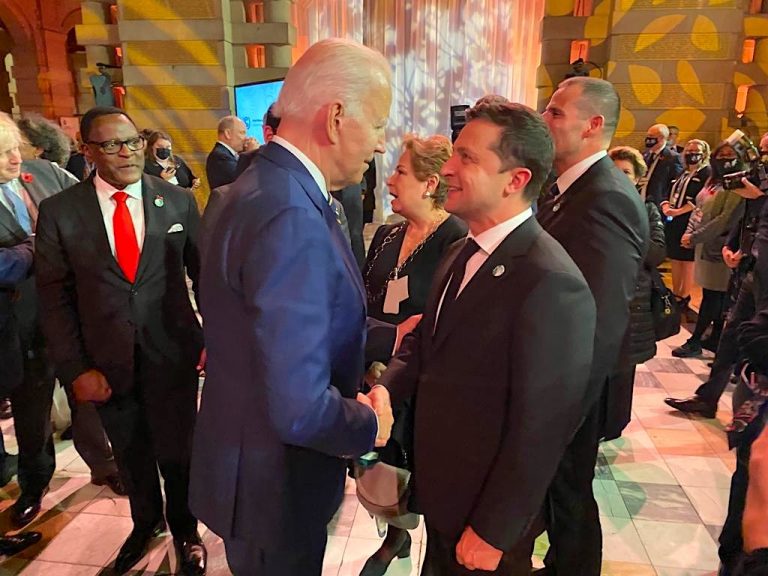
U.S. President Joe Biden made a surprise visit to Kiev Feb. 20 and met with Ukrainian President Volodymyr Zelensky. The trip was purposefully made to focus attention on the one-year anniversary of the U.S.- and NATO-led proxy war against Russia, and Biden promised large amounts of military aid to Zelensky’s regime in Kiev. Meanwhile, in the U.S., the Norfolk Southern derailment in East Palestine, Ohio, had become the lead news story. Because the Biden administration had done little to focus on Ohio, the Ukraine trip caused unexpected political problems at home.

Why Biden Snubbed China’s Ukraine Peace Plan

There’s something irrational about President Biden’s knee-jerk dismissal of China’s 12-point peace proposal titled “China’s Position on the Political Settlement of the Ukraine Crisis.” “Not rational” is how Biden described the plan that calls for de-escalation toward a ceasefire, respect for national sovereignty, establishment of humanitarian corridors and resumption of peace talks. “Dialogue and negotiation are the only viable solution to the Ukraine crisis,” reads the plan. “All efforts conducive to the peaceful settlement of the crisis must be encouraged and supported.” Biden turned thumbs down.

G20 Foreign Ministers’ Meeting Ends Without A Joint Communique

The G20 foreign ministers’ meeting in New Delhi on Thursday, March 2, failed to release a joint statement due to the disagreements over the war in Ukraine, after representatives of both Russia and China objected to the draft. As per Indian foreign minister S Jaishankar, both Russia and China had strong objections to the two paragraphs of the draft statement borrowed from last year’s Bali conference, which demanded the unconditional withdrawal of all Russian troops from Ukrainian territory. Jaishankar instead released a ‘Chair’s Summary and Outcome Document’ as an alternative to the joint statement.

Ukraine War One Year In

It has been roughly a year since Russia invaded Ukraine on February 24, 2022. A month before that invasion, in January 2022, this writer published an article ’10 Reasons Why the US May Want Russia to Invade Ukraine.’ In that prior article it was argued the US had much to gain economically and geopolitically by provoking Russia to invade. That January 2022 article went on to describe in detail at least 10 reasons why and how the US would benefit economically and politically from a Russian invasion and a subsequent protracted War in Ukraine. The article then traced US policy toward Ukraine from the US financed coup d’etat of winter 2013-2014, through the US-EU tactical and temporary ‘Minsk’ truce of 2015-2016 during which the US and its NATO allies ‘bought time’ (as later revealed publicly by German Chancellor, Angela Merkel, and French president, Holland).

Global Days Of Action On Military Spending 2023 From April 13 To May 9

This year of war in Ukraine has meant a huge boost for militarism and military budgets across the world, especially in countries of the Global North. But at GCOMS we believe the response should be quite the opposite: we should drastically reduce military spending and invest in common & human security instead… The 12th edition of the Global Days of Action on Military Spending will take place from April 13 to May 9, 2023. Join us protesting military budgets and warmongering, and take action for peace and justice! April 24 will be the main day of action once again. Using new military spending data released that day by SIPRI, we’ll hold press conferences and launch a Social Media Storm.

Scott Ritter: Reimagining Arms Control After Ukraine

The U.S. withdrawal from the foundational Anti-Ballistic Missile (ABM) treaty in 2002 undid the functional and theoretical premise of mutually assured destruction (MAD) that provided logical equilibrium to the fundamentals of nuclear deterrence theory. Similarly, the Trump administration’s precipitous termination of the Intermediate Nuclear Forces (INF) treaty in 2019 attacked both elements of the “trust but verify” maxim that governed issues of compliance verification that made arms control viable in the first place. The last remaining arms control agreement that places limits on the strategic nuclear arsenals of both the U.S. and Russia is the New Strategic Arms Reduction Treaty (START).

The War In Ukraine Is Part Of The Labor Pains Of A World That Will Emerge

As many heads of state and prime ministers ponder the war in Ukraine, I call attention to one head of state, Venezuelan President Nicolás Maduro. In a January 1, 2023 interview with Franco-Spanish journalist and author Ignacio Ramonet, President Maduro said, “The war in Ukraine is part of the labor pains of a world that will emerge.” Here is his full commentary on the international situation. “The world is undoubtedly in a very difficult situation, we are experiencing the pains of giving birth to a different world. We have always advocated the construction of a pluripolar, multicentric world, with different poles of development, power, centers that accompany all regions of the world.

European Antiwar Protests Strengthen As NATO’s Ukraine Proxy War Escalates

Athens, Greece –– This February 21, several thousand Greeks filled Athens’ streets to denounce NATO and the United States in the wake of Antony Blinken’s Greece visit, where the US Secretary of State applauded the Mediterranean country for being amongst the first European countries to support Ukraine, thus leading to way for “the support of democracy.” It was just one action among many protest actions across the continent as the NATO proxy conflict in Ukraine approached  its first anniversary. European citizens are growing agitated as their leaders appear set on extending the war at least another year: they’ve approved several rounds of sanctions on Russia, provided billions of euros in assistance to Ukraine, and have agreed to train thousands of Ukrainian soldiers.
assetto corsa mods

Urgent End Of Year Fundraising Campaign

Online donations are back! Keep independent media alive. 

Due to the attacks on our fiscal sponsor, we were unable to raise funds online for nearly two years.  As the bills pile up, your help is needed now to cover the monthly costs of operating Popular Resistance.

Urgent End Of Year Fundraising Campaign

Online donations are back! 

Keep independent media alive. 

Due to the attacks on our fiscal sponsor, we were unable to raise funds online for nearly two years.  As the bills pile up, your help is needed now to cover the monthly costs of operating Popular Resistance.

Sign Up To Our Daily Digest

Independent media outlets are being suppressed and dropped by corporations like Google, Facebook and Twitter. Sign up for our daily email digest before it’s too late so you don’t miss the latest movement news.