Skip to content

US Regime Change

Maduro’s Beijing Visit Spooks a US Plotting Venezuela’s Isolation

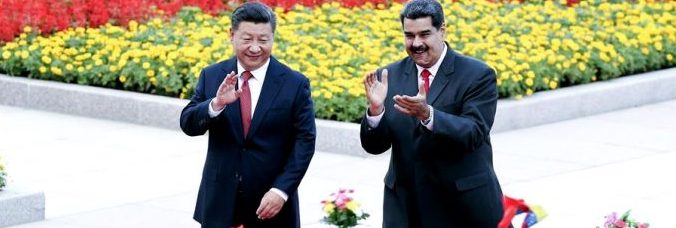
Venezuelan President Nicolas Maduro received a rare yet exceedingly warm welcome Thursday as he landed in Beijing, where the oft-maligned leader and target of U.S.-spearheaded regime-change efforts will discuss new ways in which his government and the People’s Republic of China can deepen their relations and strengthen their long-running ties. The state visit, which came at the invitation of Chinese President Xi Jinping, gives the elected leader of the Bolivarian Republic of Venezuela an important opportunity to break from the imposed isolation his government has suffered.

Trump Officials Secretly Discussed Possible Coup With Venezuelan Officers

Trump officials held a series of covert meetings with Venezuelan military officers over the last year to discuss plans to overthrow President Nicolás Maduro, according to a report by The New York Times published Saturday. Participants in the talks, including anonymous U.S. officials and a former Venezuelan military commander who is on the U.S. sanctions list of corrupt officials in Venezuela. “We have many options for Venezuela, including a possible military option, if necessary,” Trump said last year.

Crashing Currency Chaos Spreads Across The Global South

There is a serious currency crisis affecting key emerging markets. Three of these – Brazil, Argentina and Turkey – are G20 members, and Iran, absent external pressure, would have everything to qualify as a member. Two – Iran and Turkey – are under US sanctions while the other two, at least for the moment, are firmly within Washington’s orbit. Now, compare it with currencies that are gaining against the US dollar: the Ukrainian hryvnia, the Georgian lari and the Colombian peso. Not exactly G20 heavyweights – and all of them also inside Washington’s influence.

A Critical Analysis On The Reporting Of Chemical Weapons In Syria

The western project of regime change in Syria is not over yet. It has just been put on hold. More than two thousand US Special Forces remain in the country illegally. Thousands of jihadist are holed up in Idlib. As the Syrian army tries to recapture this important city, we may yet again hear about chemical weapons. The western leaders may once again bomb Syria, even escalating it drastically. The earlier bombings had virtually no impact on either the course of the war or Syria’s military capabilities, perhaps by design. It may not be the same again. That may bring U.S. and Russia, two nuclear superpowers with hundreds of megaton bombs, perilously close to a confrontation that could have unimaginable consequences.

The Mind Of The Mass Media: Email Exchange With Washington Post Foreign Policy Reporter

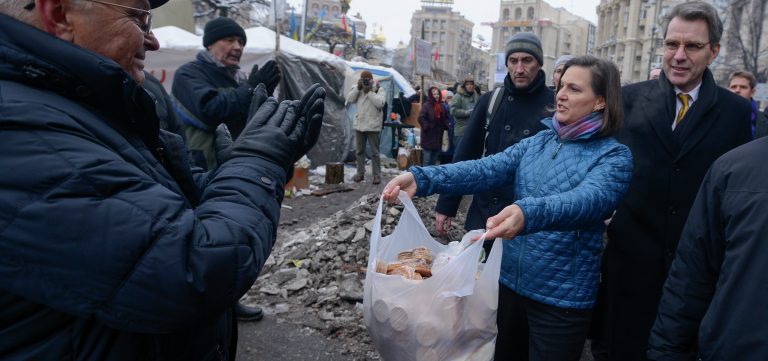
Popular Resistance has covered the Ukraine coup in depth as it was happening. You can find the articles under the tag, Ukraine. There is no question this was a US coup, indeed Victoria Nuland of the State Department acknowledged the US spent billions of dollars to achieve it. The US was the aggressor in Ukraine, yet the media, like the Washington Post (see below) calls Russia the aggressor. In reality, Russia was defending Russian speakers in Eastern Ukraine and Crimea from threats by Kiev against Russian speakers and from Nazi's the US has allied with in Ukraine.

Syria – Pentagon Plants High ISIS Numbers To Justify Occupation

The U.S. aim in Syria is still 'regime change'. The Pentagon has made it clear that it wants to stay in the country even after the Islamic State vanished. A little propaganda trick is now used to create a justification for its continuing occupation. The U.S. is justifying its occupation of north-east Syria by claiming to fight ISIS under the legal cover of two UN Security Council resolutions. Now, as ISIS in Syria has shrunk to a few dozens of fighters, that justification is wearing thin. It is immensely important for the Pentagon to present a high number, as ISIS is its only legal justification to stay in Syria.

Will More U.S. Intervention Solve Nicaragua’s Conflict?

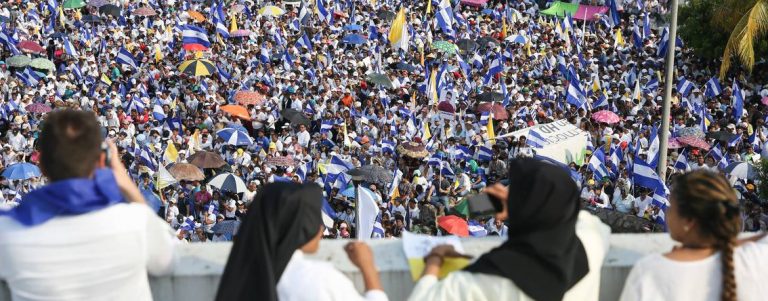
In the midst of ongoing turmoil and violence in Nicaragua in recent weeks there have been veiled and not-so-veiled calls for the United States to intervene in Nicaragua, and a series of actions that seem to portend or pave the way for such an intervention. Articles in such media outlets as the Havana Times have made the argument that there are times when the situation in a country becomes so chaotic and violent that the international community should intervene, and asks whether upholding the sovereignty of a government is more important than ending the killing of its citizens. But United States intervention in Latin America comes with a sorry and often deadly track record and enough baggage to warrant skepticism if one is looking for a solution to a country’s internal conflicts.

Nicaragua: Dynamics of an Interrupted Revolution

The unfolding events in Nicaragua over the past three months pose two critical questions for socialists and antiwar activists. Where do we stand on the critical issue of U.S. imperialist intervention and where do we stand with regard to the dynamics of the still-unfolding confrontations? That U.S. imperialism is intervening in Nicaragua today against the capitalist FSLN (Sandinista National Liberation Front) government of Daniel Ortega cannot be denied. President Trump has openly threatened to send U.S. troops. In this anti-imperialist context, however, each component of any successful U.S.-based united front, democratic, mass-action movement must be free to express its own views on the internal dynamics operating in each nation where any form of U.S. intervention is underway. While we considered Daniel Ortega and the FSLN’s central leaders “revolutionists of action,” that is, honest revolutionaries who desired important changes in Nicaraguan society, we recognized that they were fundamentally adverse to breaking with Nicaragua’s capitalist class...

Nicaraguan Labor Group Urges Peace Highlights Right-Wing Violence & US Regime Change

In Nicaragua, for the past three months, there have been widespread protests, which were originally initiated by university students and other sectors. These protests were both against and in support of proposed reforms to the Social Security system, which had included raising the age of retirement and an increase in both employer and employee contributions. In response to the protests, the government quickly withdrew the proposed reforms, however in spite of this there has been a continuation of widespread violent acts, led by political groups and organizations opposed to the government and now calling for regime change.

U.S. Launches Campaign To Erode Support For Iran’s Leaders

The Trump administration has launched an offensive of speeches and online communications meant to foment unrest and help pressure Iran to end its nuclear program and its support of militant groups, U.S. officials familiar with the matter said. More than half a dozen current and former officials said the campaign, supported by Secretary of State Mike Pompeo and national security adviser John Bolton, is meant to work in concert with U.S. President Donald Trump’s push to economically throttle Iran by re-imposing tough sanctions. A senior Iranian official dismissed the campaign, saying the United States had sought in vain to undermine the government since the 1979 Islamic Revolution. He spoke on condition of anonymity. “Their efforts will fail again,” the official said.

Venezuela — After The Elections: What Is To Be Done?

The recent election results make it clear that although Nicolás Maduro won by a wide margin on May 20, there exists a significant majority made up of those who voted for the opposition and those who did not vote in these elections. The snapshot of the correlation of forces that the elections present us cannot be ignored. Interpreting this data in the most objective manner possible is fundamental. There is no doubt that there are conflicting interests between different sections of the Venezuelan capitalist class. The opposition is not a homogenous bloc. It contains within it enormous internal contradictions. There is a section of the opposition that, rather than worrying about resolving the problems of the country, is focused on overthrowing the government through any means at its disposal, in particular, economic strangulation.

Violent Coup Fails In Nicaragua, US Continues Regime Change Efforts

The violent coup in Nicaragua has failed. This does not mean the United States and oligarchs are giving up, but this phase of their effort to remove the government did not succeed.  The coup exposed the alliances who are working with the United States to put in place a neoliberal government that is part of the US empire and serves the interests of the wealthy. People celebrated the failure of the coup but realize work needs to be done to protect the gains of the Sandinista revolution. A lesson for activists is that peace and justice advocates must be grounded in anti-imperialism and nonintervention by the United States.

What’s Happening In Nicaragua?

On April 18 things suddenly changed dramatically. Triggered by a minor adjustment to the social security program, which was designed to avoid austerity measures promoted by big business and the International Monetary Fund (IMF), violence broke out across Nicaragua. Incongruously, the opposition was led by students from private universities, who had little material interest in old age pensions, and by right wing elements that favored draconian cuts in social welfare programs. Despite the government rescinding the adjustment and its attempts to meet with the opposition and negotiate a settlement, the violence has escalated with a death toll of over 200.

The Regime Change Toolbox Of The United States

Regime change here, regime change there. Officials argue for or against it and the press and media routinely report on it. There are good guys (the U.S. and its current allies) and bad ones. Although the list shifts—today North Korea is trustworthy, Canada is not—one thing is unchanged: Regime change is a basic part of the American toolbox. Not surprisingly, mainstream voices don’t mention that regime change pushed by one country against another is illegal. These laws are, of course, ignored. Since the end of the 19th century, when the U.S. embarked on empire, it has, one way or another, overthrown almost all the governments it didn’t like.

The United States Has Quit the Human Rights Business

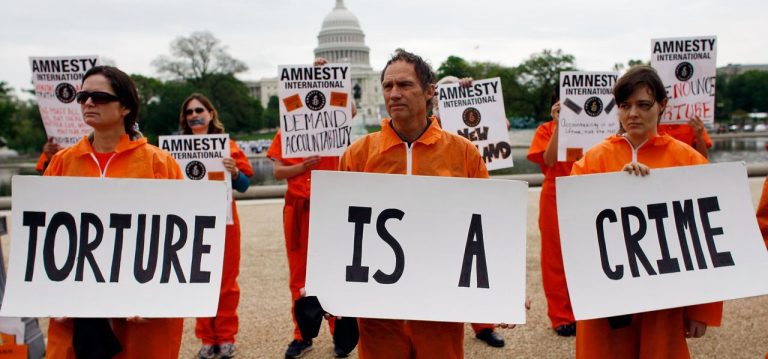
The United States has decided to formally depart from the United Nations Human Rights Council. This action by the Trump administration has been met, in liberal American and European circles, with righteous indignation. Various rights groups—Human Rights First, Save the Children, CARE—said, in a statement, that the U.S. withdrawal would “make it more difficult to advance human rights priorities and aid victims of abuse around the world.” The European Union said that Washington’s withdrawal “risks undermining the role of the U.S. as a champion and supporter of democracy on the world stage.” These U.S.-based aid groups and the European Union assume that the United States is indeed committed to human rights and to the rule of international law. They see the U.S. as an instrument of peace. These assumptions are false. The United States government is neither committed to international law nor to peace.
assetto corsa mods

Urgent End Of Year Fundraising Campaign

Online donations are back! Keep independent media alive. 

Due to the attacks on our fiscal sponsor, we were unable to raise funds online for nearly two years.  As the bills pile up, your help is needed now to cover the monthly costs of operating Popular Resistance.

Urgent End Of Year Fundraising Campaign

Online donations are back! 

Keep independent media alive. 

Due to the attacks on our fiscal sponsor, we were unable to raise funds online for nearly two years.  As the bills pile up, your help is needed now to cover the monthly costs of operating Popular Resistance.

Sign Up To Our Daily Digest

Independent media outlets are being suppressed and dropped by corporations like Google, Facebook and Twitter. Sign up for our daily email digest before it’s too late so you don’t miss the latest movement news.