Skip to content

Coal

People-Power Prevents Construction Of Coal Plant

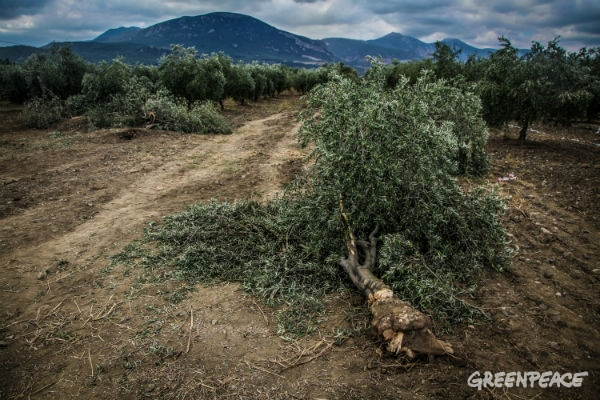
The community of the western Turkish village of Yirca has experienced a roller coaster of sadness and elation in recent days, winning an important court battle against a coal project but losing 6,000 valuable olive trees. Just hours after bulldozers from Turkish construction firm Kolin Group flattened the trees to make way for a coal-fired power plant, a Turkish court unanimously declared the project illegal. The resulting publicity from the people-powered lawsuit also saw the Turkish government publicly distance itself from the controversial project. It was the culmination of an intense three-week period that started on October 21 when Yirca villagers and Greenpeace Mediterranean activists were brutally attacked for trying to protect the trees and prevent construction of Kolin’s proposed 510-megawatt coal-fired power plant.


Ten Things To Know About The US-China Climate Agreement

my take on what the just-announced plan from President Obama and Premier Xi is, and isn't: 1) It is historic. John Kerry was right to use the phrase in his New York Times oped announcing the deal: for the first time a developing nation has agreed to eventually limit its emissions. This is a necessity for advancing international climate negotiations. 2) It isn't binding in any way. In effect President Obama is writing an IOU to be cashed by future presidents and Congresses (and Xi is doing the same for future Politburos). If they take the actions to meet the targets, then it's meaningful, but for now it's a paper promise. And since physics is uninterested in spin, all the hard work lies ahead. 3) It is proof -- if any more was needed -- that renewable energy is ready to go. The Chinese say they'll be using clean sources to get 20% of their energy by 2030 -- which is not just possible, it should be easy. Which they know because they've revolutionized the production of solar energy, driving down the cost of panels by 90% or more in the last decade. 4) It is not remotely enough to keep us out of climate trouble. We've increased the temperature less than a degree and that's been enough to melt enormous quantities of ice, not to mention set the weather on berserk. So this plan to let the increase more than double is folly

‘Not Drowning, Fighting’: Pacific Climate Warriors Blockade Coal Port

Declaring themselves "Pacific Climate Warriors," representatives from a dozen Pacific Island nations—sitting atop traditional outrigger canoes, kayaks, and other small boats—staged a full-day blockade of the Newcastle Coal Port in Australia on Friday as they sent a message to the government of Prime Minister Tony Abbott and the world that they will not sit idly by as the activities of the fossil fuel industry and its backers continue to threaten the existence of their low-lying homes. "The coal which leaves this port has a direct impact on our culture and our islands. It is clear to us that this is the kind of action which we must take in order to survive. Climate change is an issue which affects everyone and coal companies may expect further actions like this in future." —Pacific Climate

Islanders Occupy The Sabine Channel For A Coal Free Salish Sea

Lasqueti Island – In response to the announcement of the approval of permits for the shipment of US thermal coal through Greater Vancouver, the Fraser River, and up the Salish Sea to Texada Island, citizens in the region protested by Occupying the Sabine Channel on Saturday, October 4, 2014. More than 150 people, primarily from Lasqueti Island’s 426 population, came out in boats and on the shoreline to object to the Salish Sea being the staging ground for the export of dirty Thermal coal from Wyoming and Montana to Asia. Several boats were also there from Texada and Thetis islands. Disallowed by US ports to date, this polluting and dirty coal will come by train across the border to the Fraser/Surrey docks (up to 2 trains per day, each train up to 1km long.)

Australia: Activists Disrupt Coal At Several Sites At Once

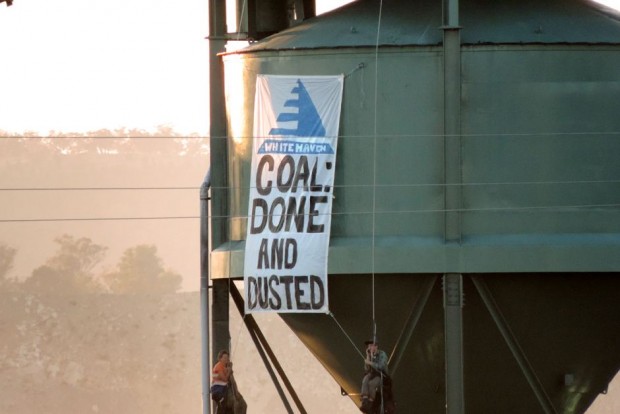
An anti-coal protest group said about 150 protesters had targeted four mines and a coal loader operated by Whitehaven Coal, which is planning a controversial mine at Maules Creek, near Narrabri in the state's north-west. Opponents, including environmentalists and farmers, have said the project and associated forest-clearing pose significant environmental threats including to biodiversity and water required for agricultural use. Four protesters chained themselves to access points to the Maules Creek project and two scaled the coal loader at the Werris Creek mine and unfurled a banner. At the Tarrawonga mine at Boggabri a protestor climbed a tripod structure to block access to the site while, three others chained themselves together across the road. Two protesters chained themselves to a gate at the Rocglen mine near Gunnedah and another pair chained themselves to a gate at the Gunnedah coal handling plant.

Solutionary Rail: Electric Rail For Freight & People

Solutionary Rail envisions a national effort to electrify U.S. rail lines beginning with a successful demonstration on the BNSF Northern Transcon from Seattle to Chicago. The backbone of a sustainable system for national freight transport will be a system of electrified rail corridors. The approximate target for rail electrification in the U.S. is reflected in the Department of Defense's designation of 32,421 miles of major rail corridors as the Strategic Rail Corridor Network. Other rail lines generally do not have enough traffic to economically support electrification. Assuming a single electrification team can complete 50 miles of corridor electrification annually, and that four teams are working, 2,400 miles can be completed in five years. That would electrify the entire length of the Northern Transcon, including multiple routes in some regions. Solutionary Rail envisions electrified locomotives employing renewable energy from wind turbines and solar panels, sources that are now becoming economically competitive with fossil-generated electricity. The National Renewable Energy Laboratory estimates potential electricity generation from wind in just the Dakotas and Texas is three times greater than electricity currently consumed annually in the United States.

Week Of Actions For Climate Justice In Appalachia

While much of the national climate movement has focused on gearing up towards the People’s Climate March in New York City later this month, frontline communities in Appalachia have been working hard at the local and regional level to address climate justice issues at the source. “Our people have been producing energy for this nation for over 100 years. We are proud of our heritage. But we can’t stay stuck in time,” said Teri Blanton, a long time organizer with Kentuckians For The Commonwealth and The Alliance for Appalachia. “In Appalachia we’ve already seen what climate change can do — denuded and destroyed landscapes, poisoned water and a corrupt political system — it’s all together and it’s all connected. We have seen first hand that what they do to the land, they do to the people.” One of the key issues Appalachian leaders are organizing communities around is water pollution; lack of access to safe water has been an issue for decades in the region, a grim irony considering the area is a temperate rainforest.

WVA Implores Health Secretary To Stop Mountaintop Removal

Here’s a reality check: Since President Obama took office in 2009, not a single top level official from the White House, U.S. Environmental Protection Agency, Council on Environmental Quality, Department of the Interior or Department of Justice has ever made a fact-finding tour of mountaintop removal mining communities in central Appalachia, home to one of the worst health and humanitarian disasters in the nation. Even worse, a federal judge ruled last month that the U.S. Army Corps of Engineers may disregard studies on the health impacts of mountaintop removal mining in its permitting process. That could finally change with the newly appointed Department of Health and Human Service Secretary Sylvia Burwell, who was born and raised in Hinton, West Virginia. “We implore you to come home for a visit, come to our mountaintop removal communities in the Coal River Valley,” nationally-honored West Virginia advocate Bo Webb wrote in a letter to Burwell this week. “Come to Twilight and Lindytown and see what mountaintop removal is doing to us.”

Protect Sacred Water: Final Action At Localize This!

To roll back these perilous misdeeds we need a vibrant movement that stirs our hearts, stokes our spirits, compels us to take meaningful action to protect what we love and reminds us of our responsibility to fight for the world our children deserve. An immensely important aspect of the work is to honor, highlight, and support the leadership exemplified by those who have been careful stewards to this beautiful land for centuries before the exploitation and extraction of it ensued. Backbone strategically designed our 6th annual Localize This! action camp to practice and model the good approach to alliance building that Backbone Campaign and our collaborators have been engaged in. At this year's Localize This! we went to school on how to be good allies with Natives.

The Time For Burning Coal Has Passed

“People have gathered here to tell their politicians that the way in which we used energy and our environment in the 19th and 20th centuries is now over,” says Radek Gawlik, one of Poland’s most experienced environmental activists. “The time for burning coal has passed and the sooner we understand this, the better it is for us.” Gawlik was one of over 7,500 people who joined an 8-kilometre-long human chain at the weekend linking the German village of Kerkwitz with the Polish village of Grabice to oppose plans to expand lignite mining on both sides of the German-Polish border. “It's high time to plan the coal phase-out now and show the people in the region a future beyond the inevitable end of dirty fossil fuels" – Anike Peters, Greenpeace Germany They were inhabitants of local villages whose houses would be destroyed if the plans go ahead, activists from Poland and Germany, and even visitors from other countries who wanted to lend a hand to the anti-coal cause. The human chain – which was organised by Greenpeace and other European environmental NGOs – passed through the Niesse river which marks the border between the two countries, and included people of all ages, from young children to local elders who brought along folding chairs. At least 6,000 people in the German part of Lusatia region and another 3,000 across the border in south-western Poland stand to be relocated if the expansion plans in the two areas go ahead.

UBS Backs Away From Mountaintop Removal

UBS, the world's third top funder of mountaintop removal in 2011, has taken steps demonstrating its commitment to significantly reduce financing of the mining practice. Last month, the bank confirmed to environmental campaigners that it will continue backing away from mountaintop removal financing.Moreover, UBS has declined to participate in the most recent transactions with its former clients Alpha Natural Resources and Arch Coal, which were among the top producers of mountaintop removal coal in 2013. "UBS' statement is a step in the right direction on mountaintop removal, but it’s the bank's actions that show they’re following through," said Ricki Draper of Hands off Appalachia. "We have seen that grassroots organizing can make a difference in stopping the financing of this deadly form of mining that poisons coalfield communities and contributes to the destruction of Appalachia’s culture and heritage."

Obama Administration Exporting Climate Change By Exporting Coal

Greenpeace USA has released a major new report on an under-discussed part of President Barack Obama's Climate Action Plan and his U.S. Environmental Protection Agency (EPA) carbon rule: it serves as a major endorsement of continued coal production and export to overseas markets. “Leasing Coal, Fueling Climate Change: How the federal coal leasing program undermines President Obama’s Climate Plan” tackles the dark underbelly of a rule that only polices coal downstream at the power plant level and largely ignores the upstream and global impacts of coal production at-large. The Greenpeace report was released on the same day as a major story published by the Associated Press covering the same topic and comes a week after the release of another major report on coal exports by the Sightline Institute that sings a similar tune. The hits keep coming: Rolling Stone's Tim Dickinson framed what is taking place similarly in a recent piece, as did Luiza Ch. Savage of Maclean's Magazine and Bloomberg BNA. But back to Greenpeace. As their report points out, the main culprit for rampant coal production is the U.S. Bureau of Land Management (BLM), which leases out huge swaths of land to the coal industry. Greenpeace says this is occurring in defiance of Obama's Climate Action Plan and have called for a moratorium on leasing public land for coal extraction.

Coal Giant Ordered To Cease Mining Operations In Tennessee

The federal Office of Surface Mining Reclamation and Enforcement (OSMRE) has issued 39 cessation orders against three Jim Justice owned companies in Tennessee. The subsidiaries in question - National Coal, Premium Coal and S&H Mining - have also been issued "Notice of Violations” from OSMRE under the Surface Mining Control and Reclamation Act (SMCRA) for failing to report water monitoring data and for road maintenance violations and a failure to meet mine reclamation requirements. The total financial cost of the violations is not known at this time. OSMRE recently held public hearings on cessation orders against Premium Coal mining operations in Anderson County, Tenn. The hearings were held to address the company's failure to meet reclamation requirements when they did not plant trees and other vegetation on disturbed areas at two mine sites within the timeframe required by their mining permits. Since the hearings, a letter of decision for both permits has been issued by OSMRE denying Premium Coal's request to drop the cessation orders. "You’d think a coal billionaire could hire firms that can plant a tree the right way around. Sadly, Premium Coal's reasoning for not meeting permit requirements was simply that they ran out of time and hired a bad crew that planted trees upside down with the roots sticking up," said Sierra Club Organizer Bonnie Swinford. “Justice and his firms have a legal responsibility to ensure adequate reclamation of strip-mined land in our state—and upside-down trees don’t cut it. Justice owned companies should hire local tree-planting companies and use the best possible reclamation practices.”

Lawsuits Seek To Stop Work At Coal Mines

Coal industry representatives say lawsuits against mines in three Western states could have consequences across the U.S. as environmentalists seek changes in how mining is approved on federally owned reserves. In civil cases unfolding in Montana, Colorado and New Mexico, the group WildEarth Guardians asserts coal companies benefited from lax oversight by federal regulators. The group says the U.S. Department of Interior approved mining plans without enough public involvement, and gave little heed to the pollution caused by digging, shipping and burning coal. The group asked the courts to stop mining until the plans are re-done. The cases involve the Spring Creek mine in Montana, the San Juan coal mine in New Mexico and the Colowyo and Trapper mines in Colorado. Combined, they employed about 1,200 workers and produced 27 million tons of coal last year, according to federal records. Attorneys for the federal government denied the environmentalists’ claims and have asked the courts to dismiss the cases. More detailed briefs from the government are due in coming weeks. A fourth case involving several mines in Wyoming was voluntarily dismissed.

Court Stops Plans For Colorado Coal Mine

The federal coal leasing program has many flaws, such as cheating taxpayers out of billions of dollars, increasing mining that damages nearby land and water resources, and subsidizing the coal mining industry’s efforts to boost exports. But the biggest problem is that the Bureau of Land Management (BLM) pays almost no attention whatsoever to the very obvious fact that when burned, coal will release carbon pollution and contribute to climate change. However, thanks to an important recent court ruling, the Bureau of Land Management may now have a tougher time denying its role in unlocking huge amounts of carbon pollution. A federal court last week blocked Arch Coal’s plans to expand a coal mine in Colorado, on the grounds that BLM failed to consider the impacts of climate change when it approved the mine expansion. “This decision means that these agencies can’t bury their heads in the sand when confronting the very real impacts of climate change,” said Ted Zukoski, an attorney with Earthjustice, which brought the case along with WildEarth Guardians, High Country Conservation Advocates, and the Sierra Club.
assetto corsa mods

Urgent End Of Year Fundraising Campaign

Online donations are back! Keep independent media alive. 

Due to the attacks on our fiscal sponsor, we were unable to raise funds online for nearly two years.  As the bills pile up, your help is needed now to cover the monthly costs of operating Popular Resistance.

Urgent End Of Year Fundraising Campaign

Online donations are back! 

Keep independent media alive. 

Due to the attacks on our fiscal sponsor, we were unable to raise funds online for nearly two years.  As the bills pile up, your help is needed now to cover the monthly costs of operating Popular Resistance.

Sign Up To Our Daily Digest

Independent media outlets are being suppressed and dropped by corporations like Google, Facebook and Twitter. Sign up for our daily email digest before it’s too late so you don’t miss the latest movement news.