Skip to content

Divestment

Why the Fossil Fuel Divestment Movement May Ultimately Win

That’s because the goal of the divestment campaign is not, and has never been, to do financial harm to fossil fuel companies by causing investors to sell their shares. “Divestment isn’t primarily an economic strategy, but a moral and political one,” says 350.org on its Go Fossil Free website The divestment campaign aims, first, to build a bigger and stronger climate movement, and, second, to put the fossil fuel industry on the defensive by attacking its reputation and challenging the long-term viability of its business in a climate-constrained world. “Calling for divestment is about targeting the fossil fuel industry, taking away its social license to operate, like tobacco, like apartheid,” says Ellen Dorsey, the executive director of the Wallace Global Fund.

Alumni Occupy Oxford Uni To Protest Fossil-Fuel Indecision

Alumni of the University of Oxford are occupying the university in protest over its failure to divest from fossil-fuels. The University, under pressure to act on its major investments in fossil-fuels, announced today it was postponing a decision on what to do with its investments until May. Oxford University has the UK’s second largest endowment fund, valued at £855 million in 2012, with a further £2.9 billion of investments controlled by its colleges. Occupying alumni included the University’s own former Finance Director, John Clements. The BBC quoted him saying: “we are bitterly disappointed about the university’s failure to come to a decision. Oxford should be leading the move away from investment in all world-destroying fossil fuel companies to more sustainable forms of energy.”

Harvard Students Heat Up Campaign For Divestment

Hundreds of Harvard students, alumni and faculty participated in a week-long sit-in within the gaze of John Harvard’s statue to call on their university to divest from the fossil fuel industry. They maintained a blockade of Massachusetts Hall as a peaceful means of opening dialogue with President Faust. Many of the students set up camp to guard all three entrances to the building overnight. The student-run fossil fuel divestment campaign known as Divest Harvard has been ongoing for three years and is one of hundreds of divestment campaigns around the country that have been launched by colleges and universities, churches and even cities. Just last week, Syracuse University committed to divestment in the company of many other institutions have including the First Parish in Cambridge that is directly across the street from Massachusetts Hall.

Protests Lead To President’s Support Of Prison Divestment

37 Wesleyan students sat in on President Michael Roth’s office yesterday and today demanding divestment from fossil fuels, the Israeli occupation and the prison industrial complex. This morning, they left with Roth’s endorsement of prison divestment and commitment to further dialogue on divestment from fossil fuels and the Israeli occupation. President Roth agreed to investigate the current status of the university’s investments in private prisons, to publicly state his endorsement of prison divestment, and proceed to support divestment of any holdings Wesleyan may have. Students arrived in the president’s office at noon on Thursday, marking the anniversary of President Roth’s participation in a sit-in for divestment from South African Apartheid as a Wesleyan student in 1978.

Tulane Students To Occupy President’s Office For Divestment

Tulane students and alumni are planning to stage a sit-in at the office of university president Michael Fitts this week to demand the school divest its $1 billion endowment from fossil fuels. The sit-in is scheduled to take place from 8:45 a.m. to 5 p.m. Tuesday through Thursday at Gibson Hall, 2823 St. Charles Ave. Divest Tulane, a two-year-old, student-led campaign, is organizing the event. Its goal, according to Emma Collin, a Tulane senior and member of Divest Tulane, is to pressure the school to take the money from its endowment that is invested in fossil fuels and put it instead in "sustainable community solutions." "We're not trying to hurt the fossil fuel industry," Collin said. "We're trying to draw attention to the fact that climate change is a huge and urgent problem that threatens Louisiana and New Orleans profoundly."

Harvard Heat Week Kicks Off Week Long Sit-In For Divestment

Hundreds of students, alumni, faculty and community members joined forces in Harvard Yard on Sunday night to launch "Harvard Heat Week," a weeklong sit-in for fossil fuel divestment. As of 11:00 p.m., dozens of students and supporters were still blockading the doors of Massachusetts Hall, where Harvard President Drew Faust will show up for work on Monday. The action began earlier in the evening at the First Parish Church of Cambridge, across the street from the university. Hundreds of people filed into the historic building, under a banner hung on the steeple that read, "We divested from fossil fuels! Your turn, Harvard." "We're on a roll," said 350.org founder Bill McKibben, who took the stage to thunderous applause after an opening song from Reverend Fred Small, who'd opened his house of worship for the event.

With Sit-Ins Around Country, Students Escalate ‘Divestment Spring’

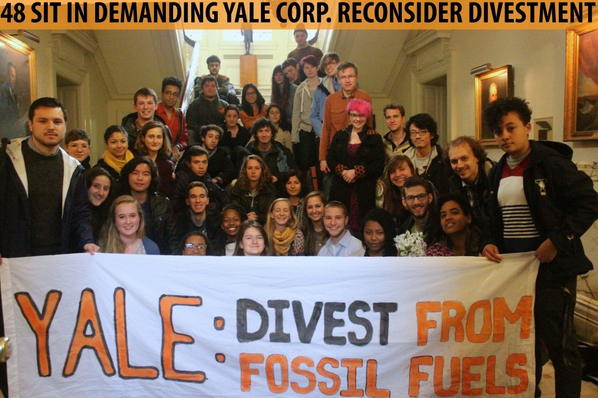
With campus sit-ins taking place in several states, and more direct actions planned for the days and weeks ahead, a new generation of climate activists is taking the reins in an escalating fight for fossil fuel divestment that's sweeping the nation this spring. As a group of environmental leaders wrote in an open letter published Thursday atCommon Dreams, "By taking strategic action this spring, students are posing a . . . crucial question to the public and their institutions' leadership: whose side are you on?" Close to 50 student members of Fossil Free Yale entered the university's Woodbridge Hall on Thursday morning, vowing to stay until the administration publicly commits toreconsidering the case for divestment. Yale, which at $24 billion has the third-largest university endowment in the world, said in August that it wouldn't sell its holdings of oil, gas, and coal stocks.

Yale Police Arrests 19 Students Calling For Fossil Fuel Divestment

19 Yale students were arrested by Yale Police following a day-long sit-in that called for the university to reopen the conversation on fossil fuel divestment. Yale joins Harvard as one of two schools where a fossil fuel divestment action has led to arrest. 48 students peacefully entered Woodbridge Hall, Yale’s main administrative building, at 9 am this morning. Within minutes of their arrival, Yale President Peter Salovey addressed the students, informing them of the administrative channels that exist for students interested in pursuing divestment. Afterward, students provided flowers to the administrative staff and a thank you letter to Salovey. Since then, students have peacefully and quietly sat in the building.

Syracuse University Divests From Carbon Fuels

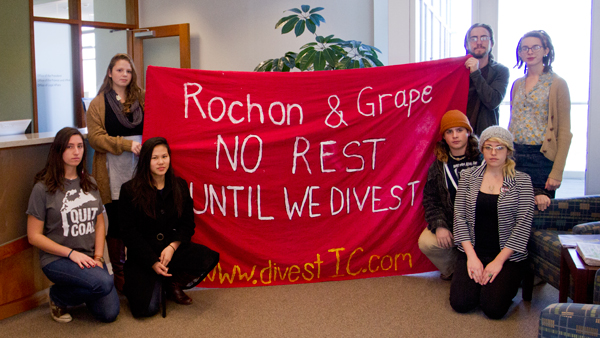
On the last day of March, Syracuse University announced it will be divesting — or withdrawing its endowment fund investments — from coal and other fossil fuel companies. The Orange Nation is joining a growing list of colleges and universities who are taking this step, in addition to municipalities, religious institutions, foundations and more. The movement to divest has primarily been led by college students and broadcasted by environmental activist organization 350.org. With hundreds of active student organizations across the country, sit-ins, marches and banner drops are becoming more and more common. The City of Ithaca is on the list of municipalities who have divested, and the Park Foundation — an invaluable financial source for the Park School of Communications and Ithaca College as a whole — is among the list of divested foundations. The college, however, is nowhere to be found on 350’s “Divestment Commitments” list. The college’s student organization aimed at pressuring administration to take this step, Divest IC, has faltered and become inactive. Without it, President Tom Rochon and the Board of Trustees are off the hook.

BREAKING: Students Sitting-In For Divestment At UMW

The UMW Board of Visitors has dismissed the demands of thousands of students, faculty, and people worldwide by refusing to establish a subcommittee to investigate the financial realities of a fossil free endowment. Students are taking action to show that this denial is unacceptable. In February, DivestUMW delivered a detail presentation on divestment to the Board and demanded the formation of a subcommittee, which would provide information and transparency to advance divestment research. A month after the presentation, Holly Cuellar, Rector of the Board, denied the students’ demand without deliberation or a vote. Stand with these students to show Rector Cuellar that this dismissal is unacceptable. We’re counting on your help to build a strong collective voice.

Students Occupy Swarthmore College For Fossil Fuel Divestment

Student activists have occupied a historic hall at Swarthmore College, the alma mater of the United Nations climate chief, demanding the university cut its ties to fossil fuels. The sit-in at the liberal arts college in Pennsylvania launches a new wave of protests by campus divestment campaigners across the US that will culminate in an old-style teach-in at Harvard on 13 April. Some 37 students and six alumni entered the finance and investment office of the university at about 9am on Thursday. “We are in,” said Stephen O’Hanlon, a political science student. He said the students planned to stay until university administrators agree to return to negotiations on a divestment plan. “At this point we have no plans to leave,” he said. Swarthmore, founded by Quakers, helped launch the campus divestment movement, now active at hundreds of universities across North America, Europe and Australia.

Oxford Alumni Occupation For Carbon Divestment

Oxford alumni have occupied a university administration building to demonstrate their anger over today’s announcement that the university has deferred until May its decision on whether to divest from fossil fuels. The student campaign would like to issue a statement of solidarity with the alumni who have gone into occupation over the issue of fossil fuel divestment. We share their concern that the University is moving too slowly on this vitally important issue. Today’s events indicate the wide ranging support for divestment from University members past and present. We hope that today’s occupation will inspire others to express their support for meaningful climate action from Oxford University.

The U.S. Divestment Movement Takes Nonviolent Direct Action

When we think of student movements in history, they’re often characterized by these big moments that catapult campaigns to victory. From the 6-day student strike and occupation of Columbia University against the Vietnam War in April of 1968, to the shantytowns and sit-ins of the South African divestment movement in the late 1980s, the significance of nonviolent direct action lies in its ability to demonstrate student power and halt business as usual with a vision for a better future. Nonviolent direct action demonstrates activists’ commitment and willingness to make personal sacrifices, and shines a light on how far the opposition is willing to go to quell peaceful student protesters. By taking over their administrative building, Harvard students sent the message that if their officials wouldn’t take action for a living wage, they would. Flash point moments alone, however, are not capable of changing the status quo.

Fossil Fuel Divestment: A Brief History

“We are quite convinced that if he were alive today, as an astute businessman looking out to the future, he would be moving out of fossil fuels and investing in clean, renewable energy,” said Stephen Heintz of John D Rockefeller, as he announced that the heirs to one of America’s most famous dynasties, which was built on oil, were pulling their philanthropic funds out of fossil fuels. For sheer symbolism if not financial value – only $60m (£37m) of the Rockefeller Brothers Fund was invested in fossil fuels – it was perhaps the high point of what has become known as the fossil fuel divestment movement. With its roots in US campuses, the campaign to get institutions to pull their financial investments as a way of tackling climate change has seen a total of $50bn divested so far, according to the US Fossil Free campaign.

Next For Fossil Fuel Divestment Campaign: Escalate

Whether they are trustees who ask Harvard students to "thank BP," or presidents who believe that turning off light bulbs can help solve climate change, administrators have revealed themselves to be out of touch with reality. Presumably in the fantasy world of college boardrooms, the fossil fuel industry neither poisons hometowns nor receives $88 billion in corporate welfare a year. Yet back on planet Earth, students know that university endowments gamble away our futures with investments that undermine everything higher education stands for. At this crucial juncture in history, to value critical thinking and academic credibility is to value climate justice. That is why this spring, we will ask our administrators, "Whose side are you on?"
assetto corsa mods

Urgent End Of Year Fundraising Campaign

Online donations are back! Keep independent media alive. 

Due to the attacks on our fiscal sponsor, we were unable to raise funds online for nearly two years.  As the bills pile up, your help is needed now to cover the monthly costs of operating Popular Resistance.

Urgent End Of Year Fundraising Campaign

Online donations are back! 

Keep independent media alive. 

Due to the attacks on our fiscal sponsor, we were unable to raise funds online for nearly two years.  As the bills pile up, your help is needed now to cover the monthly costs of operating Popular Resistance.

Sign Up To Our Daily Digest

Independent media outlets are being suppressed and dropped by corporations like Google, Facebook and Twitter. Sign up for our daily email digest before it’s too late so you don’t miss the latest movement news.