Skip to content

health

When Workers At Barnes & Noble Got Sick, We Organized And Won

I have been working the night shift at a Barnes & Noble warehouse in Monroe, New Jersey for the past 16 years. For decades I have witnessed abuses at my workplace, but the COVID-19 crisis spurred me into collective action for the first time.   Every evening, I come into work on a shop floor with hundreds of other immigrant workers, all packaging deliveries in close quarters. As news of the pandemic spread, I began to worry about the conditions in my warehouse. My managers were not providing us with any protective equipment, and we were expected to maintain the same rate of productivity, working dangerously close to one another.  I told my boss that I was concerned for my safety, and that of my co-workers. I told him that I was worried if things carried on in the same way we would all get sick, and that I wanted to use my personal days to stay home.

US Trails World In Coronavirus Response And Almost Everything Else

Data from around the world on how nations are handling Coronavirus makes clear that, as in most things (this claim is documented below), the United States is exceptionally awful. Among wealthy countries, only Sweden, which has chosen to intentionally allow the disease to spread, has done worse. A handful of countries in Latin America and the Middle East are doing worse than the United States, though some are doing better. As in many world rankings, as documented below, the United States looks fair to middling as a third-world country, but off-the-charts terrible as a wealthy country — much less as a country that endlessly (albeit falsely; see below) calls itself the wealthiest country on earth ever. The United States’ handling of Coronavirus is not a fluke. It’s not an exception. It’s not a case of a country that’s generally competent and well-run screwing up.

Here’s What ‘Nonlethal’ Weapons Can Do To The Body

Civil unrest in the wake of George Floyd's death has spread around the world, and in some places, protesters are being met with tear gas, rubber bullets, stun guns, and other tactics intended to control crowds without taking lives. Known as nonlethal or less-lethal weapons, many of these tactics were originally pitched as a way to make warfare more humane by incapacitating a person or encouraging them to flee. Law enforcement agencies later adopted these weapons from the military as an alternative to using firearms. Yet people who study nonlethal weapons wonder if reclassification is in order, as research continues to reveal their damaging ramifications on the body. When misused, these weapons break bones, burn the skin, and cause internal injuries that can be fatal. Here’s a look at when and why serious injuries occur with nonlethal weapons, and what people can do to protect themselves.

The Right To Refuse Unsafe Work Is More Important Than Ever

The COVID-19 pandemic is taking a heavy toll on workers. Reports of job hazards grow increasingly dire as several governors and President Trump push past CDC guidelines to "reopen" the economy while forecasts predict soaring infections and deaths.  Some states at the direction of the Labor Department threaten termination of unemployment benefits for workers fearing return to dangerous jobs. A disturbing June 5 New York Times' report reveals how far those machinations have gone. The result: workers fired without pay or benefits or trapped in a deadly vice between poverty and disease.   In short, the news is terrifying – and rightly so. But it often misses essential information about rights workers have to save their own lives. First and foremost is the right to refuse unsafe work free of employer retaliation.  

Why Covid-19 Racial Disparities Make The Case For Medicare For All

The racial disparities of COVID-19 have received much attention. Blacks are dying at a higher rate that is typically more than double the rate of whites. But we need to move beyond naming the problem of fighting for solutions. Medicare for All would go a long way to beginning to address racial disparities in health care in general and for COVID-19 in particular. The obvious and immediate need of black and other working-class populations caught in the teeth of the pandemic is the right to health care treatment without the burden of cost. Even before the pandemic, lower-income, Latino, and younger workers were more likely to be uninsured. Undocumented workers had the highest rates of uninsurance. The pronounced differences in COVID-19 mortality are not driven by a lack of health care per se but a reflection of how the virus compounds health problems created by inequality.

Ten Action Ideas For Building A Police-Free Future

What makes a community healthy and safe? This document doesn’t have all the answers, but it acknowledges that for many of us, police are not part of the solution. Patterns of racism, sexism, homophobia, transphobia, and bullying are too common. When someone is having a mental health crisis, or when neighbors are concerned about a fellow neighbor, or when we feel unsafe– are the police our only option? Of course, different communities have different needs. Vibrant, dynamic, and police-free communities aren’t going to be created by outside groups– they’re going to bloom from the soil that already exists in those spaces. What we can share here, though, is what that process has looked like elsewhere.

Chemical Weapon Use Is Dangerous In A Pandemic

When Amira Chowdhury joined a protest in Philadelphia against police violence on Monday, she wore a mask to protect herself and others against the coronavirus. But when officers launched tear gas into the crowd, Chowdhury pulled off her mask as she gasped for air. “I couldn’t breathe,” she said. “I felt like I was choking to death.” Chowdhury was on a part of the Vine Street Expressway that ran underground. Everyone panicked as gas drifted into the dark, semi-enclosed space, she said. People stomped over her as they scrambled away. Bruised, she scaled a fence to escape. But the tear gas found her later that evening, inside her own house; as police unleashed it on protesters in her predominantly black neighborhood in West Philadelphia, it seeped in.

Two Bimbo Bakery Workers Dead, Others Fired After Raising COVID-19 Concerns

Two workers who were employed at Bimbo Bakeries USA’s Cicero factory have passed away due to COVID-19, according to records from the Cook County Medical Examiner’s Office.  Their deaths come after the company fired two other employees who were quoted in a Cicero Independiente article published on April 7 raising concerns about the lack of workplace safety during the COVID-19 crisis.  Prior to the two deaths, Bimbo Bakery USA workers, many of whom are organizing with a group called Black Workers Matter, accused the company’s Cicero factory of lacking proper sanitation, failing to enforce social distancing, and being slow to communicate when employees tested positive for COVID-19.  Workers are also protesting what they say was an act of retaliation from Bimbo Bakeries USA.

Nicaragua Battles COVID-19 And A Disinformation Campaign

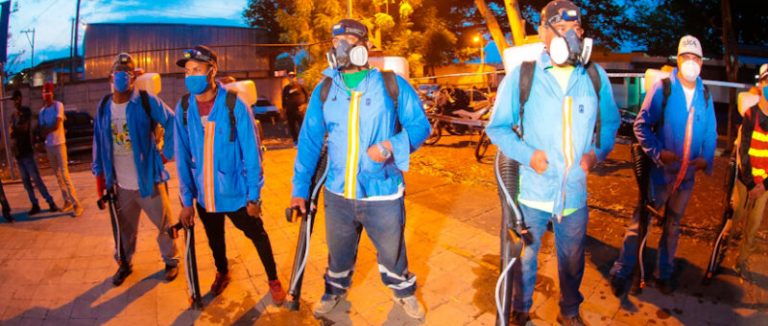
Every country in the world is trying to balance its fight against the virus with the need to have a functioning economy, and there is plenty of debate about what the balance should be. The world’s poorer countries face the toughest challenge, because a high proportion of their populations engage in a daily struggle to earn enough to eat, whether in small businesses or the informal economy. In Nicaragua, around 80% of people make their living in this way. But there are two more problems uniquely affecting Nicaragua in tackling the pandemic. One is that its economy and social life had already been attacked only two years ago when a right-wing coup attempt closed much of the country down for nearly three months. The second problem is that the opposition, thwarted in their coup attempt, has seized the COVID-19 epidemic as a new weapon with which to attack the government. They have deliberately sown fear and suspicion among the Nicaraguan population, so that many people are not only scared of the virus but even of using the public health services

Baton Rouge Inmates Sue For Release Due To COVID-19, Potential ‘Death Sentence’

The inmates are seeking class-action status in an attempt to protect other current and future inmates. Their lawsuit also seeks to have a federal judge order East Baton Rouge to improve jail conditions and inmate treatment, including providing sufficient cleaning supplies and requiring staff to wear personal protective equipment. At least 70 inmates have tested positive and 48 of them have recovered, according to the sheriff's office. Several civil rights attorneys and organizations teamed up on the lawsuit, including the Advancement Project and the Center for Constitutional Rights. David Utter, an attorney on the case who also represents multiple families of people who have died in Parish Prison before coronavirus said, "The notion that we would expose anyone to the jail's conditions and health care system during this pandemic makes no sense."

How Local Leaders Can Ensure Immigrant Justice During COVID-19

Our immigration system is on the threshold of a new crisis precipitated by the COVID-19 pandemic. People in detention face high risks of infection from the close quarters of facilities, shelters, and courtrooms, and they lack adequate sanitation, health care, and protective measures. The frequent transfer of people throughout the immigration detention system also contributes to the rapid spread of the virus. Moreover, unlike in criminal court, immigrants facing deportation do not have the right to a lawyer even if they cannot afford one, leaving most without access to legal representation. As local leaders seek to protect immigrant communities, safeguarding access to legal services for everyone is of critical importance.

Hundreds Of Apple Workers On Strike In Washington

Last week the COVID-related strike in Washington state’s Yakima Valley quadrupled in size, as workers walked out at three more apple packinghouses. More than a hundred stopped work on May 7 at Allan Brothers Fruit, a large apple growing, packing and shipping company in Naches, in Central Washington. On May 12 they were joined by 200 more workers, who walked off the job at the Jack Frost Fruit Co. in Yakima, and at the Matson Fruit Co. in Selah. The next day another 100 workers walked out at the Monson Fruit packing shed, also in Selah. At the center of the stoppages are two main demands for those who decide to continue working during the pandemic: safer working conditions and an extra $2 an hour in hazard pay.

Connecting The Dots Between Environmental Injustice And The Coronavirus

While cities and towns across the United States are wrestling with the devastating impacts of the coronavirus pandemic, none have been hit harder than low-income and minority communities. Places like Detroit, Chicago, and St. James Parish in Louisiana, plagued by decades of economic inequality and pollution in impoverished neighborhoods, have experienced some of the country’s highest mortality rates from the virus. Recent studies have shown a link between high levels of pollution and an increased risk of death from Covid-19. Sacoby Wilson, an environmental health scientist at the University of Maryland, believes the coronavirus has cast a spotlight on largely unnoticed segments of society, from low-income people in polluted neighborhoods to residents of nursing homes and prisons, to workers in the nation’s meatpacking plants

Pandemic Used To Cover For Loosening Crop Poison Regulation

The Trump EPA wants to reapprove use of a dangerous herbicide. Trump appointees are hiding behind the COVID-19 pandemic to excuse a herbicide manufacturer from monitoring levels of the poison in Midwest lakes and streams. The EPA plans to raise the concentration of atrazine allowed in streams and lakes to 15 parts per billion. That is more than four times higher than what the EPA had recommended under the Obama administration. In April, Elissa Reaves, acting director of the herbicide re-evaluation division, suspended monitoring for the rest of the year. “The public will now have no idea whether dangerous levels of atrazine are reaching rivers and streams throughout the Midwest,” said Nathan Donley, a senior scientist with the Center for Biological Diversity. “That’s absurd and reckless.”

Who Is ‘Essential’ To Our Covid-19 World

“When he first came home, it was tough.” So Aleha, the wife of an airman in Colorado, told me. She was describing her family’s life since her husband, who lives with chronic depression, completed a partial hospitalization program and, in March, along with other members of his unit, entered a pandemic lockdown. He was now spending full days at home with her and their four children, which offered needed family time and rest from the daily rigors of training. Yet the military’s pandemic lockdown had its challenges as well. Aside from weekly online sessions with his therapist (the third the military had assigned him in so many weeks), Aleha was left to provide her husband with needed emotional support, while homeschooling their older children and caring for their toddler.
assetto corsa mods

Urgent End Of Year Fundraising Campaign

Online donations are back! Keep independent media alive. 

Due to the attacks on our fiscal sponsor, we were unable to raise funds online for nearly two years.  As the bills pile up, your help is needed now to cover the monthly costs of operating Popular Resistance.

Urgent End Of Year Fundraising Campaign

Online donations are back! 

Keep independent media alive. 

Due to the attacks on our fiscal sponsor, we were unable to raise funds online for nearly two years.  As the bills pile up, your help is needed now to cover the monthly costs of operating Popular Resistance.

Sign Up To Our Daily Digest

Independent media outlets are being suppressed and dropped by corporations like Google, Facebook and Twitter. Sign up for our daily email digest before it’s too late so you don’t miss the latest movement news.