Skip to content

Korea

We Need A Mass Movement To Prevent Nuclear Conflict

By Simone Chun for Truthout - On August 2, US Sen. Lindsey Graham paraphrased President Donald Trump's stance on the prospect of conflict in the Korean Peninsula as follows: "If thousands die, they're going to die over there." Less than a week later, on August 8, President Trump responded to North Korea's latest missile test by threatening to unleash "fire and fury" against Pyongyang, raising alarms throughout the international community. These statements were only the latest excerpts of the ongoing hostile dialog between North Korea and the United States since both parties signed an armistice 64 years ago. A peace treaty was never reached. Will Trump's heightened rhetoric lead the Korean Peninsula to the brink of war anytime soon? Most likely not. As many analysts point out, deterrence still holds in the Korean Peninsula and Northeast Asia, despite bellicose rhetoric on both sides. The United States knows that North Korea now has the capability and willingness to strike back if attacked. North Korea knows firsthand the overwhelming power of the United States, well proven in the devastation visited on the populace during the Korean War, when more than 30 percent of Koreans were either killed or injured.

Newsletter: When Empires Fall

By Margaret Flowers and Kevin Zeese. The Pentagon recently released a report, "At Our Own Peril: DoD Risk Assessment in a Post-Primacy World," which details its concerns about losing access to resources and "resistance to authority" both at home and around the world as governments lose legitimacy. Faced with these changes, the United States could embrace them, become a cooperative member of the world, transition to a lower-waste lower-energy sustainable existence and draw back the military to use those resources to meet domestic needs. Sadly, that is not what the Pentagon has in mind. There is a saying, when all you have is a hammer, everything looks like a nail. The US is the biggest empire in the world; therefore, the Pentagon's solutions are "more surveillance, more propaganda ('strategic manipulation of perceptions') and more military expansionism." The United States' reign as an Empire is coming to an end. It is up to those of us living in the US to take action to prevent more aggression and demand that the US dismantle its empire in a way that causes the least harm at home and abroad.

North And South Korea Want A Peace Treaty: US Must Join

By Christine Ahn for Truthout - Two years ago, I crossed the world's most fortified border from North to South Korea with 30 women peacemakers from 15 countries, calling for a peace treaty to end the six-decade Korean War. On July 13, I was denied entry into South Korea from the United States as retribution for my peace activism, including the 2015 women's peace march. As I checked in for my Asiana Airlines flight to Shanghai at San Francisco International Airport, the ticket agent at the counter informed me that I would not be boarding the plane headed first to Seoul Incheon International. The supervisor handed me back my passport and informed me that she had just gotten off the phone with a South Korean government official who had told her I was "denied entry" into the country. "This must be a mistake," I said. "Is South Korea really going to ban me because I organized a women's peace walk across the demilitarized zone?" I asked, appealing to her conscience. If there was indeed a travel ban, I thought, it must have been put in place by the disgraced President Park. But she wouldn't make eye contact with me. She walked away and said there was nothing to be done. I would need to apply for a visa and book a new flight to Shanghai.

South Korea’s Anti-THAAD Fight Continues

By Zoom in Korea. South Korea - July 12 marked one year since the beginning of the Seongju residents’ struggle to stop the deployment of the U.S. Terminal High Altitude Area Defense (THAAD) missile defense system. So far, the AN/TPY-2 radar — the main component of the THAAD battery that will allow the U.S. to track missile activity in North Korea and China — and two of the six interceptor launchers have made their way into the deployment site. The residents of Seongju and South Korean peace activists are still protesting daily, at times putting their bodies on the line, to block the remaining parts of the THAAD battery from entering the deployment site and call for a reversal of the deployment. Despite the election of a new liberal administration in May, the South Korean government’s response to the protests of Seongju residents has largely remained unchanged.

Protesters Bellow ‘U.S. Out Of Korea’ Outside White House

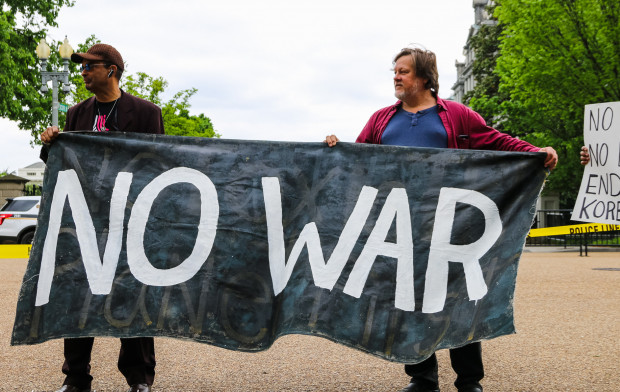
By Jared Feldschreiber for The Huffington Post - Approximately 20 demonstrators rallied at Lafayette Park Friday afternoon to protest U.S. involvement in Korea, just as President Moon Jae-In met with his counterpart, Donald Trump in the Oval Office. The protesters uniformly agreed that it is continued U.S. presence and bellicose language coming out of Washington, which has destroyed prospects for peace in Korea. “[President Moon] was elected [in May] with a mandate to change course. He said he would during the election campaign,” Sarah Sloan, with the anti-war Answer Coalition, told me. “We’re saying: ‘live up to it.’ I think he has different pressures on him. We oppose the deployment of THAAD - Terminal High Altitude Area Defense – [which has been deployed in South Korea].” THAAD is an advanced system designed to intercept short, medium, and intermediate-range ballistic missiles during their terminal flight phase. It is believed to be capable of intercepting North Korea’s intermediate-range ballistic missiles, as it is equipped with long-range radar. In July 2016, military officials in South Korea and the U.S. agreed to deploy it to counter threats.

Time For Peace Negotiations In Korea, Not Escalation

By staff for Center for Peace and Disarmament at People's Solidarity for Participatory Democracy. The state of affairs on the Korean Peninsula is more volatile than ever, now that President Park has been impeached and new government is to be constituted through an early presidential election in South Korea. The Trump administration, in the meantime, is fueling the escalating tension even further with messages that it will not rule out a preemptive strike on North Korea, and that it will redeploy strategic nuclear warheads to South Korea if necessary. The situation is further destabilized by the Trump administration’s decision to send an aircraft carrier to waters near the Korean Peninsula. The latest military stance and strategy of Washington, however, completely overlooks the desire of Koreans for peace. The Kim Jong-un government in Pyongyang meanwhile has warned of another upcoming nuclear test it intends to conduct, poised as it is to show off its growing nuclear capabilities. An existing crisis is already escalating in Northeast Asia over the Terminal High Altitude Area Defense (THAAD) system that the South Korean and U.S. governments have decided to deploy in South Korea. All these acts of military bravado, taking hostage the lives and peace of Koreans, must cease now. It is time for policymakers to be responsible and return to dialogue and negotiations and stop fueling the growing tensions.

Reunification On The Korean Peninsula: Toward A Peaceful Confederation

By Moon J. Pak for Zoom In Korea - In any serious effort to peacefully unite the two Koreas in the future, there will be big hurdles of history and geopolitics to overcome. Due mainly to its unique geopolitical location, surrounded by large, aggressive and ambitious neighbors, China, Japan, Russia, Mongolia, Manchuria and more recently the neighbor across the Pacific, the U.S., the 4,000-year-old history of Korea is tumultuous, to say the least. The country was invaded, occupied, colonized by all of these neighbors. Although Korea fought back, it has never retaliated and invaded any neighboring countries. Despite thousands of years of troublesome and cruel foreign invasions, Korea has maintained its national, ethnic and cultural identity. In the evolution of modern Korea, this ancient pattern of competing for dominance over Korea repeated itself. China, Russia and Japan struggled over the peninsula, which resulted in the colonialization of the country by Japan in 1910. Japan considered Korea to be its geopolitical stepping-stone to the continent. Japan’s ambition for domination over Asia was permanently thwarted in 1945 with the end of the World War II.

Nobel Peace Laureate Mairead Maguire Appeals To President Trump For Peace Leadership

By The Peace People for TRANSCEND Media Service - 1 May 2017 – Mairead Maguire, who visited the women’s peace movements of North and South Korea last year with 30 international women from around the world, made the following appeal to President Trump and the U.S. administration: “The people of North and South Korea want peace and they want a peace treaty. They do not want their country to be bombed or their government to bomb others. Having visited both North and South Korea last year and walked with thousands and thousands of Korean women, North and South, I am convinced that peace is possible and what is needed is the political will of all parties to the conflict to dialogue and for negotiations to move from a Korean armistice to a Korean Peace Treaty. “I therefore would like to appeal to President Trump and his administration not to carry out a military strike on North Korea, but to use the means of dialogue and diplomacy to reach a peace treaty for North Korea. Such peace leadership by President Trump will give hope to the people of Korea and all of humanity.

US & South Korea Force THAAD Through Protesters

By Staff for Zoom in Korea. The residents of Seongju and Gimcheon were caught off guard when the United States Forces Korea and the South Korean Defense Ministry forced key parts of the Terminal High Altitude Area Defense (THAAD) missile system into the former Lotte Skyhill Golf Course in the early morning hours of April 26. Many of the THAAD parts, including the AN/TPY-2 radar, are believed to have been transported into the deployment site. Below is a minute by minute breakdown of the conflict. The environmental impact assessment has yet to be completed, they also noted, yet the key THAAD components have already been transported into the deployment site. A total of 12 protesters sustained injuries and were escorted to the hospital in ambulances. The Defense Ministry reportedly told the South Korean media that it plans to transport the remainder of the THAAD components into the deployment site by the end of this year.

People’s Briefing For #KoreanPeace: Urge De-escalation

By Staff of Zoom In Korea - Following Trump’s Senate briefing on North Korea this week, Korean American activists and allies in the Bay Area held their own “people’s briefing” outside Senator Dianne Feinstein’s office on April 27. They called for de-escalation of military tensions between the United States and North Korea and urged Feinstein to take a peaceful and pro-engagement stance on the issue. In a highly unusual move, Trump called senators to a White House briefing on North Korea on April 26. The administration called for tighter sanctions, increased funding for missile systems in Hawaii and Australia, and reiterated that all options, including military action, are on the table. “Feinstein claims that North Korea poses an existential threat and is the number one threat in the world,” said Bay Area activist IO Sunwoo, “I ask Senator Feinstein and the weapons manufacturing lobby that contributes to her office and all the lawmakers in Washington DC how they can dare comment on existential crises when they are in the business of mass destruction.”

Dear President Trump: We Urge You To Do The Following To Avert War In Korea

By Staff of Women Cross DMZ - We are women leaders from 40 countries, including the Republic of Korea (ROK) and Democratic People’s Republic of Korea (DPRK), and many from nations that fought in the Korean War. We are from academia, business, civil society and the military, and represent a diversity of ethnicities, nationalities, religions, and political views. We are united by our belief that diplomacy is the only way to resolve the nuclear crisis and threat of war now facing the Korean peninsula. On July 27, 1953, leaders from the United States, Democratic People’s Republic of Korea, and China signed the Armistice Agreement to halt the Korean War. They promised to re-convene within three months to replace the ceasefire with a binding peace agreement. This never occurred and an entrenched state of war has ever since defined inter-Korean and U.S.-D.P.R.K. relations. This war must end. Korea is the only nation to remain divided as a result of WWII. For three generations, millions of families have been separated by the world’s most militarized border. We urge you to do the following to avert war in Korea and bring about a long-desired peace on the peninsula...

While Senators Briefed On North Korea Protesters Hold Their Ground

By Anne Meador of DC Media Group. In recent weeks, North Korean ballistic missile tests have led Trump to threaten and insult the country and its leader and send three aircraft carrier groups within striking distance. Following the announcement of the Senators’ briefing at the White House, North Korea explicitly threatened nuclear war. China and the U.N. have admonished both North Korea and the United States and made pleas for restraint. When the senator arrived at the Eisenhower Executive Office Building they were met with protesters calling for No War With Korea.

Protests Outside Of Trump-Senate Meeting On North Korea

By Staff for Popular Resistance. People opposed to war with North Korea were at the White House as senators arrived to meet with the Trump administration. All 100 senators have been invited for a briefing from the State Department and Pentagon on North Korea. As the two buses carrying senators were about to arrive the Secret Service attempted to remove 25 protesters (more protesters were prevented from getting to the area, Richard Ochs was tackled by police when he tried to join the protest others were held behind barriers from joining. Those that were protesting refused to move despite threats of forced removal and arrest. This is the beginning of an ongoing anti-war campaign. The Trump administration and bi-partisans in Congress are threatening war in North Korea and other nations. Take action here: https://popularresistance.org/urgent-stop-the-united-states-from-attacking-north-korea/

The Long History Of US Abuses To Korea

By Anthony Gronowicz for A People's History of US Foreign Policy. The first battle, May 4, 1949—the biggest--initiated a series of clashes that culminated in the publicly declared start of the Korean War on June 25, 1950. This May 4th combat occurred when Rhee’s forces crossed the 38th parallel, only to have two of his infantry companies defect to the communist side. Numerous August skirmishes led the U.S. Korean Military Advisory Group Commander, General W.L. Roberts, to conclude, “Each was in our opinion brought on by the presence of a small south Korean salient north of the parallel …the South Koreans wish to invade the North. … almost every incident has been provoked by the South Korean security forces.” By June 25, 1950, hundreds of troops had been killed as thousands of soldiers fought countless small engagements. Convincing evidence has yet to be shown that the North was preparing to invade the South.

Who Really Started The Korean War?

By Justin Raimondo for Anti War - The sixtieth anniversary of the "end" of the Korean war saw President Obama attempt to rescue that classic example of interventionist failure from history’s dustbin. Addressing veterans of that conflict, he declared: “That war was no tie. Korea was a victory. When 50 million South Koreans live in freedom, a vibrant democracy…a stark contrast to the repression and poverty of the North, that is a victory and that is your legacy.” This is a fairytale: it wasn’t a victory, or even a tie: the US public was disenchanted with the war long before the armistice, and Truman was under considerable pressure at home to conclude an increasingly unpopular conflict. As for this guff about "democracy": whatever the US was fighting for, from 1950, when the war broke out, to 1953, when it ground to a halt, democracy hardly described the American cause. We were fighting on behalf of Syngman Rhee, the US-educated-and-sponsored dictator of South Korea, whose vibrancy was demonstrated by the large-scale slaughter of his leftist political opponents. For 22 years, Rhee’s word was law, and many thousands of his political opponents were murdered: tens of thousands were jailed or driven into exile.
assetto corsa mods

Urgent End Of Year Fundraising Campaign

Online donations are back! Keep independent media alive. 

Due to the attacks on our fiscal sponsor, we were unable to raise funds online for nearly two years.  As the bills pile up, your help is needed now to cover the monthly costs of operating Popular Resistance.

Urgent End Of Year Fundraising Campaign

Online donations are back! 

Keep independent media alive. 

Due to the attacks on our fiscal sponsor, we were unable to raise funds online for nearly two years.  As the bills pile up, your help is needed now to cover the monthly costs of operating Popular Resistance.

Sign Up To Our Daily Digest

Independent media outlets are being suppressed and dropped by corporations like Google, Facebook and Twitter. Sign up for our daily email digest before it’s too late so you don’t miss the latest movement news.