Skip to content

Sanctions

UN Court Issues Interim Order To US To Lift Some Iran Sanctions

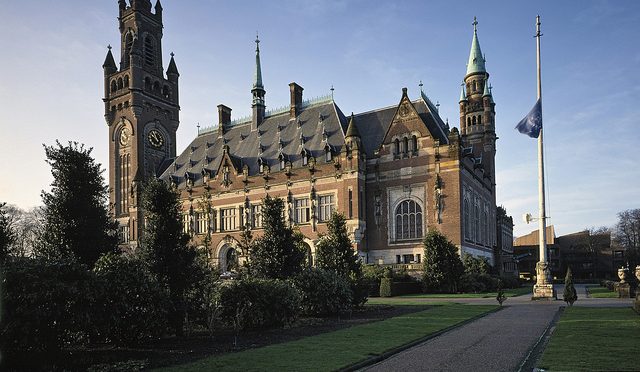
The United Nations' top court has issued an interim order to the United States to lift sanctions linked to humanitarian goods and civil aviation imposed against Iran - a move welcomed by Tehran. "On humanitarian grounds, the US must remove by means of its choosing any impediment to the free exportation to Iran of goods involving humanitarian concerns," the International Court of Justice (ICJ) said in its ruling on Wednesday. The ICJ's rulings are binding, but it has no power to enforce them. "The decision proved once again that the Islamic Republic is right and the US sanctions against people and citizens of our country are illegal and cruel," Iran's foreign ministry said in a statement. 
Iran Sanctions – U.S. Responds To Court Order By Canceling Treaty That Gave The Court Jurisdiction

Earlier today the International Court of Justice (ICJ) issued a provisional judgment (pdf, 29 pages) against some of the U.S. sanction against Iran. The ruling is a preliminary injunction over urgent humanitarian issues that will later be followed by a final judgment. The U.S. responded by canceling the treaty the gave the court jurisdiction over the case. The ICJ is the main judicial organ of the United Nations and settles legal disputes between member states. The rulings of the court, based in The Hague, are binding. But there is no global police force that can make the U.S. government follow the court's ruling. Nevertheless the judgment sets a precedent that other courts will use when more specific cases against the U.S. sanctions against Iran come up.

The UN Just Ordered Trump To Ease Sanctions On Iran

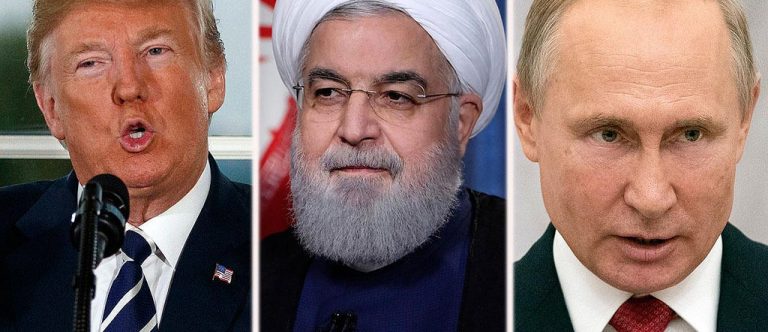
“The U.S. of course will disregard the ruling,” says Trita Parsi, “but Iran’s aim likely was to establish that it is the U.S., and not Iran, that is the rogue nation now.” The United Nations’ highest court on Wednesday ordered the Trump administration to ease sanctions on Iran that are impacting humanitarian aid and aviation safety, ruling that U.S. assurances the economic limitations would not endanger both “were not adequate.” “Iran’s strategy of taking the U.S. to the international court has paid off,” responded Trita Parsi, founder and president of the National Iranian American Council (NIAC). “The U.S. of course will disregard the ruling, but Iran’s aim likely was to establish that it is the U.S., and not Iran, that is the rogue nation now.”

US Doubles Down On Unilateralism, Hegemony & Empire

Amid mounting concerns about possible war with Iran after the Trump administration ditched a decades-old bilateral treaty in response to an International Court of Justice (ICJ) ruling on Wednesday that U.S. sanctions violate it, National Security Adviser John Bolton announced a review of all international agreements that could lead to more binding decisions by the principal judicial organ of the United Nations. "John Bolton and the Trump administration are turning us away from international accountability and cooperation and towards war and unilateral aggression." —Win Without War Bolton also revealed that President Donald Trump "has decided that the United States will withdraw from the optional protocol on dispute resolution to the Vienna Convention on Diplomatic Relations," which gives the ICJ authority to hear diplomatic disputes.

Washington’s Sanctions Machine

Perhaps it is Donald Trump’s business background that leads him to believe that if you inflict enough economic pain on someone they will ultimately surrender and agree to do whatever you want. Though that approach might well work in New York real estate, it is not a certain path to success in international relations since countries are not as vulnerable to pressure as are individual investors or developers. Washington’s latest foray into the world of sanctions, directed against China, is astonishing even when considering the low bar that has been set by previous presidents going back to Bill Clinton. Beijing has already been pushing back over US sanctions imposed last week on its government-run Equipment Development Department of the Chinese Central Military Commission...

Nicaragua: Ortega Says Planned US Sanctions Will Bring Poverty

"They think that with it the Nicaraguan people are going to get down on their knees, and they do not realize that this is a town that does not sell or surrender," Ortega said. Nicaragua’s President Daniel Ortega criticized Saturday the draft sanctions that the United States Congress is discussing against his government saying such actions would bring poverty and economic troubles to his country. "I say to the U.S. congresspeople and senators who are voting in favor of this interventionist law that what they are coming to is simply to harm the country's economy," the president said in a massive rally he led along with Vice President Rosario Murillo. Addressing thousands of people who marched in the capital Managua in favor of peace, despite the heavy rain, Ortega criticized the Nicaragua Investment Conditionality Act...

US Sanctions Reach A Turning Point. De-Dollarization And Collusion Against The U.S.

Up till now, the EU – representing around the same percentage of the world economy as the USA – was sitting put, as the USA grew its sanctions regime to ever more bizarre proportions. Together, the USA and the EU constituted nearly half of the world’s economy, and US sanctions previously “only” used to target the other half of the world’s economies. Hitherto, the EU had no compelling reasons to strain its relations with the USA because US sanctions do not affect them. But now, “secondary sanctions” regarding Iran also hit hard at strategic EU companies and financial institutions and negatively affect EU global strategic interests in energy from the Persian Gulf, US sanctions in effect attack the liberty, security and sovereignty of its biggest group of friends, the EU.

Venezuela’s Monetary Revolution Vis-a-Vis Economic Sanctions

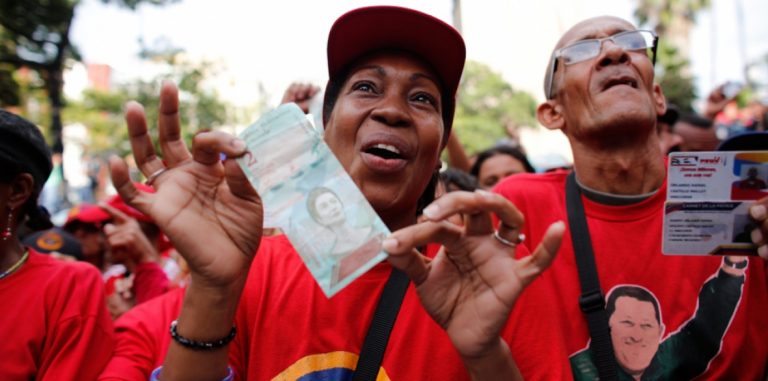
Venezuela has undergone many challenges in the last 20 years since Hugo Chavez was elected president and continued after his death in 2013. The main reason is that Venezuela has taken seriously the internationally recognized right to be sovereign and establish its own social model. Violence has never been part of the model. However, violence has been the reaction of those who do not want to change the status quo despite the people's majority democratic electoral choice. The new social model chosen by Venezuela has been widely called the Bolivarian Revolution. It is a revolution that is still under construction. In fact, having defused the rampant right-wing violence, and with Nicolas Maduro as the re-elected president as of May 20, Venezuela continues building an unequivocal socialist anti-imperialist society by strengthening its Bolivarian Revolution.

Treaties And Irrelevance: Understanding Iran’s Suit Against U.S. For Reimposing Nuclear Sanctions

As the United States gradually reimposes sanctions following its withdrawal from the Iran nuclear deal (formally  the Joint Comprehensive Plan of Action, or JCPOA), the other parties to the agreement are beginning to advance their own legal measures in response. The European Union is set to activate its “Blocking Regulation” to protect EU companies doing business with Iran from U.S. sanctions. Iran just initiated proceedings against the United States in the International Court of Justice (ICJ) to enjoin the reinstatement of U.S. nuclear sanctions. The case tees up an interesting question: whether, under international law, a treaty can be abrogated because too much has changed in the relationship between the parties. In other words, can a treaty become inapplicable because it is simply irrelevant?

Russia-Led Regional Payment Network Could Blunt US Sanctions On Iran

Russia is reportedly making preparations to establish a regional integrated payment network. Iran understandably wishes to join such an endeavor. But what will such a network look like, what will its implications be for Iran and the region, and how will it be received by other countries, especially the United States? The news of the apparent Russian initiative was first publicized by Aboutaleb Najafi, the CEO of Informatics Services Corporation, an executive arm of the Central Bank of Iran (CBI) that was established in 1993 to create and operate Iran's comprehensive banking automation system and payment networks. Najafi did not disclose many details, while media coverage in Russia has been scant.

Sanctions Backfire: US Is Being Left Behind

The United States has a long history of dominating international economic institutions and has been able to use that power in the past to control other governments and enrich its industries. At present, the United States is waging an economic World War targeting much of the world economy, including allies who refuse to comply with US mandates. This is a time for the US to try new tactics, but the power elites and Pentagon don't seem to know any other way. It is up to us, the people, to organize and mobilize for a modern foreign policy and economy that takes the new global dynamics into account.

Blockading Venezuela: The Linchpin Of The US Strategy Of Aggression

REVEALING examples are emerging of the cumulative impact that US sanctions against Venezuela are having on the Venezuelan people in the field of health, one of the key priorities of the Bolivarian revolution. In July 2017, the US bank Citibank refused to handle Venezuela’s payment for the import of 300,000 insulin doses to meet the needs of 450,000 registered patients. Three months later, the US blockade prevented Venezuela from depositing funds with the UBS Swiss bank, delaying a purchase of vaccines for months and disrupting the country’s vaccination schedules. In November 2017, transnational pharmaceutical companies Baster, Abbot and Pfizer refused to issue export certificates for cancer drugs, making it impossible for Venezuela to buy them.

Sanctions, Sanctions, Sanctions – The Final Demise Of Dollar Hegemony?

All looks arbitrary and destructive. All is of course totally illegal by any international law or, forget law, which is not respected anyway by the empire and its vassals, but not even by human moral standards. Sanctions are destructive. They are interfering in other countries sovereignty. They are made to punish countries, nations, that refuse to bend to a world dictatorship. Looks like everybody accepts this new economic warfare as the new normal. Nobody objects. And the United Nations, the body created to maintain Peace, to protect our globe from other wars, to uphold human rights – this very body is silent – out of fear? Out of fear that it might be ‘sanctioned’ into oblivion by the dying empire? – Why cannot the vast majority of countries – often it is a ratio of 191 to 2 (Israel and the US) – reign-in the criminals?

Economic War On Iran Is War On Eurasia Integration

Hysteria reigned supreme after the first round of US sanctions were reinstated against Iran over the past week. War scenarios abound, and yet the key aspect of the economic war unleashed by the Trump administration has been overlooked: Iran is a major piece in a much larger chessboard. The US sanctions offensive, launched after Washington’s unilateral pullout from the Iran nuclear deal, should be interpreted as an advance gambit in the New Great Game at whose center lies China’s New Silk Road – arguably the most important infrastructure project of the 21st century — and overall Eurasia integration. The Trump administration’s maneuvers are a testament to how China’s New Silk Road, or Belt and Road Initiative (BRI), threaten the US establishment.

New Sanctions On Russia And Iran Are Unlikely To Work. Here’s Why

Sanctions are much in demand these days as a tool of American foreign policy. Members of Congress want tough new sanctions against Russia for its interference in American elections. Sanctions will remain in place against North Korea, the White House says, until Pyongyang shows progress toward denuclearization. After tearing up the Iran nuclear accord, the Trump administration restored sanctions against Tehran in an effort to get a better deal on restricting its weapons and a change in its behavior. And even NATO ally Turkey faces sanctions for imprisoning several U.S. citizens and employees of its diplomatic mission. Policymakers claim that sanctions are an effective means of achieving policy goals, but is that true? Are new measures against Moscow and Tehran likely to be successful?
assetto corsa mods

Urgent End Of Year Fundraising Campaign

Online donations are back! Keep independent media alive. 

Due to the attacks on our fiscal sponsor, we were unable to raise funds online for nearly two years.  As the bills pile up, your help is needed now to cover the monthly costs of operating Popular Resistance.

Urgent End Of Year Fundraising Campaign

Online donations are back! 

Keep independent media alive. 

Due to the attacks on our fiscal sponsor, we were unable to raise funds online for nearly two years.  As the bills pile up, your help is needed now to cover the monthly costs of operating Popular Resistance.

Sign Up To Our Daily Digest

Independent media outlets are being suppressed and dropped by corporations like Google, Facebook and Twitter. Sign up for our daily email digest before it’s too late so you don’t miss the latest movement news.