Skip to content

TPP

Peace Movement Should Focus On China

Whether the US Agenda is War on an Arms Race, the US Peace Movement Should be Concerned. While the Middle East teeters on the brink of another prolonged conflict that would engender some form of US involvement, the Obama’s administration’s shift away from the region and toward East Asia is easier said than done. Though the “Pivot to Asia” policy of the Obama administration may not be stealing all the headlines, US military presence around the South China Sea and the Straits of Malacca is quietly building up, giving rise to increased American muscle in Southeast Asia. Obama announced the pivot policy during a visit to Australia in 2011, declaring a fully equipped 2,500-strong Marine task force operating from Darwin by 2016. The pivot to Asia is anything but an empty catchphrase, as the US Air Force is beginning to bolster its presence in bases in Singapore, Thailand, and the Philippines, with plans to move 60 percent of US warships to the region by 2020. It’s no secret that these developments are the Pentagon’s response to China’s ever-increasing military and economic clout, and Uncle Sam is boldly sending the message that he’s coming to town. Washington’s objective is to build a Cold War-style security ring around China by deepening military partnerships with American allies in Southeast Asia, while broadening its capacity to police vital trade and energy chokepoints.

Trading Nature For Profit

People of the Pacific Rim, their communities and the ecosystems, on which all life depends, are at the mercy of big energy and agriculture corporations, which are among the thousands of global corporations advising the Trans-Pacific Partnership (TPP) process. The Investor-to-State Rules of the TPP will allow foreign corporations to by-pass a country’s domestic court system and go directly to a secret international tribunal to challenge our environmental laws as a “regulatory taking” that lowers “expected future profits.” Each country has hundreds or thousands of foreign corporations doing business in its territory that can challenge their domestic environmental laws.

NAFTA At 20: Legacy Of Lost Jobs, Lower Wages

There is nothing in the current treaties being negotiated by President Obama that indicate any different result. Essentially, these laws will continue the trend of privatization of public goods to create profit for the wealthiest people in the US and other countries, will weaken workers and heighten the race to the bottom. Research on the impact of the TPP finds exactly this: the wealthiest will get richer while 90% of Americans get poorer and the economy will grow only by 1/10th or 1% annually. The race to the bottom in wages means an expanding wealth divide throughout the world. The US already has the largest wealth divide of any developed nation, and larger than many developing nations. If TPP becomes law we will look back 20 years after it has been enacted and see much the same. It is so obviously predictable that one wonders what political leadership is thinking? They must know they are empowering the wealthy, dis-empowering workers and weakening the economy. If they really cared about their people the lesson from 20 years of NAFTA is rigging the economy for big business is bad for the economy, the people and the planet and a new direction is needed. Rather than repeating the mistakes of NAFTA, they would be correcting them.

Next Big Day Of Action To Stop The Trans-Pacific Partnership

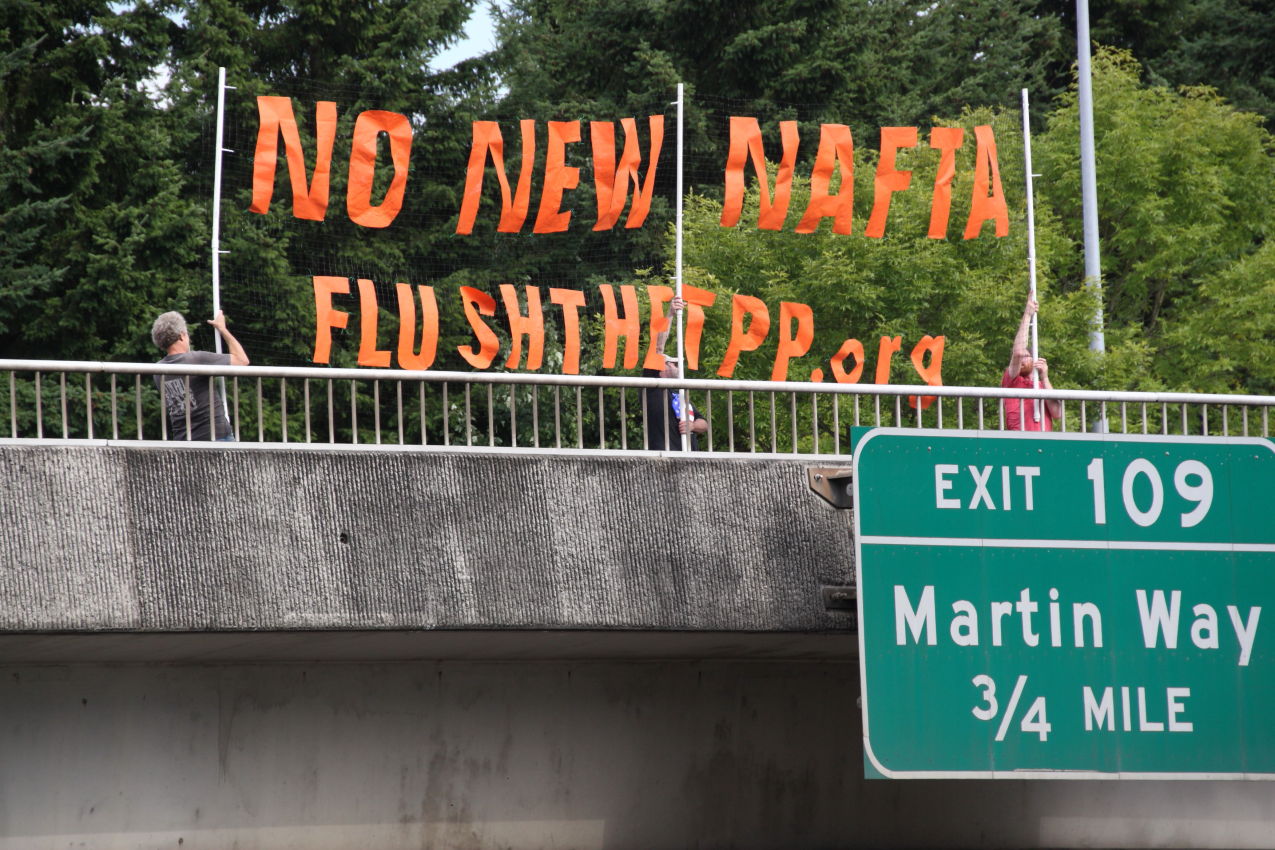
January 2014 marks the twenty-year anniversary of the North American Free Trade Agreement (NAFTA), a pact that has had devastating consequences for working families, small farmers, indigenous peoples, small business and the environment in all three countries and beyond. The pending Trans-Pacific Partnership (TPP) has been described as "NAFTA on Steroids." Four years into the TPP negotiations, this new corporate power grab threatens to: Destroy livelihoods and accelerate the global race to the bottom in wages and working conditions Further commodify agriculture, trample food sovereignty, hurt small farmers and contribute to forced migration Enable new corporate attacks on democratically-enacted environmental and consumer protections Undermine global economic stability by prohibiting effective regulation of financial markets Reduce access to life-saving generic medications, increase the costs of prescriptions, and restrict freedom on the Internet

Open Letter To Government Employees From Whistleblowers

Since the summer of 2013, the public has witnessed a shift in debate over these matters. The reason is that one courageous person: Edward Snowden. He not only blew the whistle on the litany of government abuses but made sure to supply an avalanche of supporting documents to a few trustworthy journalists. The echoes of his actions are still heard around the world – and there are still many revelations to come. For every Daniel Ellsberg, Drake, Binney, Katharine Gun, Manning or Snowden, there are thousands of civil servants who go by their daily job of spying on everybody and feeding cooked or even made-up information to the public and parliament, destroying everything we as a society pretend to care about. Some of them may feel favourable towards what they're doing, but many of them are able to hear their inner Jiminy Cricket over the voices of their leaders and crooked politicians – and of the people whose intimate communication they're tapping. Hidden away in offices of various government departments, intelligence agencies, police forces and armed forces are dozens and dozens of people who are very much upset by what our societies are turning into: at the very least, turnkey tyrannies.

US Fails to Close TPP Deal as Wikileaks Exposes Discord

The United States is blaming Wikileaks for sowing discord, but in fact what the most recent leaks showed was there is discord because of the US negotiating positions. Their extreme pro-corporate agenda is not something other countries support, in addition the US is being inflexible in its pro-corporate demands and trying to force them through with bullying. The failure of the TPP is not Wikileaks it is the US Trade Representative and the Obama Administration insisting on a rigged trade agreement for the transnational corporations. Of course, they will publicly blame the leaks, but anyone who reads the leaks will see the problem is the United States being in bed with transnational corporate power rather than what is best for the people of the world. Before this last round of negotiations we described the negotiations as "in crisis" because the negotiating positions and approach of US negotiators were causing deep divisions. When the intellectual property chapter was leaked it was evident that the US was isolated in its negotiating position. If they want to blame the correct culprit for the failure of the TPP, they need to look in the mirror not point at Wikileaks.

TPP Conflicts Exposed: Many Areas Of Dispute, Negotiations In Crisis

Today, 9 December 2013, WikiLeaks has released two more secret TPP documents that show the state of negotiations as the twelve TPP countries began supposedly final negotiations at a trade ministers’ meeting in Singapore this week. One document describes deep divisions between the United States and other nations, and "great pressure" being exerted by the US negotiators to move other nations to their position. The other document lists, country-by-country, the many areas of disagreement remaining. It covers intellectual property and thirteen other chapters of the draft agreement. This suggests that the TPP negotiations can only be concluded if the Asia-Pacific countries back down on key national interest issues, otherwise the treaty will fail altogether. Here are some excerpts from the Salt Lake City documents

Trade Agreements Reveal How Life Will Be Organized In 2050

In simple terms, trade agreements are about trade — exports and imports. However, these trade agreements also serve as political, social, cultural and moral documents, which set political and social standards for countries and communities. These trade agreements regulate countries in the same way that our Constitution regulates Congress, our courts, the president, and our state governments. However, the substance — the values — in our Constitution are very different from values expressed in trade agreements. Our Constitution grants extensive political rights and social protections to people and communities. Our Constitution never mentions corporations — not once.

Popular Resistance Newsletter – Making This “Our Moment”

The solidarity at the fast food worker protests on December 5 echoed the solidarity seen on December 3 when people throughout the United States and around the globe protested toxic trade agreements especially the World Trade Organization (WTO) and Trans-Pacific Partnership (TPP). We are moving toward becoming a movement of movements that cannot be ignored because more people are coming to the realization that our individual struggles are all connected to a larger struggle and that we have more strength when we act together rather than alone. As unity becomes a reality, we will succeed in creating the kind of solidarity that will make this era “OUR MOMENT.”

One More Week To Tell Congress “No” To Fast Track TPP

TPP negotiators are meeting in Singapore from December 7 to 9 to attempt to complete the text of the TPP agreement. As the year ends, pressure is growing to both finish the TPP and to pass Fast Track Trade Promotion Authority in Congress. If the President is given Fast Track, then he can sign the TPP and Congress will have a limited time to read the agreement before they are required to vote up or down on it. Fast Track has been used historically to pass trade agreements that would not survive under Congressional scrutiny. Congress only has one more week in session this year, the week of December 9. So far our pressure to stop the TPP has been working. Close to 200 members of Congress have expressed opposition to Fast Track. We must keep the pressure on (because you know that the corporate lobbyists are) to send Congress home with a clear message that they must not give up their responsibility under the Constitution to oversee commerce and they must go through the process of understanding the full implications of the TPP before they vote on it. That means that they must oppose Fast Track.

Global People’s Tribunal on WTO & Free Trade Agreements

The Indictment A. We the Justices of the Global People’s Tribunal on WTO, Free Trade Agreements, Investments & Transnational Corporations, have heard the substantive testimonies of the affected communities and sectors, including women and children, peasants, fishers, workers, migrants and indigenous peoples in Indonesia, other Asian countries (India, Korea, Thailand, Cambodia), and other regions - Latin America, Canada. B. These testimonies have given evidence on: The systematic violation of human rights; The massive destruction of livelihoods and the environment; The privatization and commodification of the commons and of nature; The violation of international law. . . . I. We underline people’s inalienable right to justice. We acknowledge the importance of social movements and civil society organisations engagement in the campaigns to end corporate impunity, the WTO and the trade & investment regime. J. We recognize that the struggle of resistance goes hand in hand with the construction of alternatives of an economy for the people and the planet, with initiatives such as the indigenous knowledge systems, seed banks, food sovereignty, and a new paradigm for trade and investment, as well as a new juridical system that will deliver justice.

Unions: Deep & Broad Concern To Job-Killing Trans-Pacific Partnership

This weekend, trade negotiators from the 12 countries negotiating the massive Trans-Pacific Partnership (TPP) trade agreement are meeting in Singapore for the latest round of negotiations. Joining them, as normal, will be representatives from the corporate world who have been granted more access at seeing and shaping the bill than elected members of Congress. But this time members of the media are also being wooed as it is widely expected that negotiators will announce the framework of a final deal. No matter what the trade negotiators in Singapore say or how they spin it, this trade deal is far from settled. In fact, concern against the deal at home is both broad and deep. While they will want to call it a done deal, there is significant concern about the TPP at home and abroad. Congress has the chance to stand up for American business owners, workers and families by taking a full look at the secretive text and not grant fast-track trade authority.

Congress Warns Obama: Don’t Rush Into A TPP Deal

Democrats’ Congressional Campaign Chair, Senior Party Members Warn Obama: Don’t Rush into a TPP Deal in Singapore They Vow to Block Any Pact Without Enforceable Labor and Environmental Standards, Currency Disciplines or that Includes Patent or Copyright Extensions Senior Democratic members of Congress said Thursday the still-secret Trans-Pacific Partnership (TPP) trade pact is dead on arrival in Congress if it doesn’t meet their demands to protect American workers and punish currency manipulation as well as provide enforceable labor and environmental standards, in addition to meeting other conditions.

Global Day of Action Targets ‘Toxic’ Trade Agreements

Activists in Baltimore and more than 30 cities across the world take action to highlight the failures of so called free trade agreements. On Tuesday December 3, activists from Baltimore and more than 30 cities across the U.S. and Mexico participated in a Global Day of Action against so-called “toxic trade agreements”. Called for by civil society in Indonesia as the World Trade Organization begins meetings in Bali, the events also precede negotiations for the Trans-Pacific Partnership (TPP) set to begin in Singapore on Dec. 7th. Meanwhile, thousands of Japanese farmers protested US Vice President Joseph Biden’s Tuesday visit to Tokyo, while hundreds marched in Bali’s Renon Square.

How TPP Will Gut Environmental Protection

"You might be interested to know the TPP looks terrible for environmental protection too, due to a proposed mechanism called 'investor-state arbitration'. Basically this'd allow investors to sue countries for passing legislation detrimental to the financial interests of those investors. Yep, think environmental protections, workers' rights laws and any other kind of public protection that might reduce a profit margin. The international climate change group 350.org is starting a new campaign against the TPP on these grounds; there's a petition and links to further information at the link. The more fronts we expose and fight this thing on the better: the TPP will reduce the power of civil society in all kinds of ways and we shouldn't let it happen.
assetto corsa mods

Urgent End Of Year Fundraising Campaign

Online donations are back! Keep independent media alive. 

Due to the attacks on our fiscal sponsor, we were unable to raise funds online for nearly two years.  As the bills pile up, your help is needed now to cover the monthly costs of operating Popular Resistance.

Urgent End Of Year Fundraising Campaign

Online donations are back! 

Keep independent media alive. 

Due to the attacks on our fiscal sponsor, we were unable to raise funds online for nearly two years.  As the bills pile up, your help is needed now to cover the monthly costs of operating Popular Resistance.

Sign Up To Our Daily Digest

Independent media outlets are being suppressed and dropped by corporations like Google, Facebook and Twitter. Sign up for our daily email digest before it’s too late so you don’t miss the latest movement news.