Skip to content

Capitalism

Corporate Capitalism Is Foundation Of Police Brutality & Prison State

By Chris Hedges in Truthdig - More training, body cameras, community policing, the hiring of more minorities as police officers, a better probation service and more equitable fines will not blunt the indiscriminate use of lethal force or reduce the mass incarceration that destroys the lives of the poor. Our capitalist system callously discards surplus labor, especially poor people of color, employing lethal force and the largest prison system in the world to keep them under control. This is by design. And until this predatory system of capitalism is destroyed, the poor, especially people of color, will continue to be gunned down by police in the streets, as they have for decades, and disproportionately locked in prison cages.


Holder Returns To Law Firm That Lobbies For Big Banks

By Lee Hang in The Intercept - After failing to criminally prosecute any of the financial firms responsible for the market collapse in 2008, former Attorney General Eric Holder is returning to Covington & Burling, a corporate law firm known for serving Wall Street clients. The move completes one of the more troubling trips through the revolving door for a cabinet secretary. Holder worked at Covington from 2001 right up to being sworn in as attorney general in Feburary 2009. And Covington literally kept an office empty for him, awaiting his return. The Covington & Burling client list has included four of the largest banks, including Bank of America, Citigroup, JPMorgan Chase and Wells Fargo. Lobbying records show that Wells Fargo is still a client of Covington.

The Battle For Berkeley Springs

By Morgan County USA - If it were up to the likes of Morgan County Commissioner Bob Ford, we’d have a Wal-Mart at the north end of the county, a second Dollar General store in a rural residential neighborhood across from Union Chapel United Methodist Church and Cacapon State Park at the south end of the county and fast food joints in between. And the Morgan County Planning Commission would let them do it. Communities around the country are fighting back against this kind of big city corporate takeover of their rural communities. Just last month, for example, the planning commission in Lake County, Californiaunanimously voted down the application by Dollar General to establish a store in Kelseyville. One reason cited by the planning commission — the effect the Dollar General store would have on “the character of the town.”

12 Corporations Benefit From Prison Industrial Complex

By Rick Riley in Atlanta Black Star - According to the Left Business Observer, “the federal prison industry produces 100 percent of all military helmets, war supplies and other equipment. The workers supply 98 percent of the entire market for equipment assembly services; 93 percent of paints and paintbrushes; 92 percent of stove assembly; 46 percent of body armor; 36 percent of home appliances; 30 percent of headphones/microphones/speakers; and 21 percent of office furniture. Airplane parts, medical supplies and much more: prisoners are even raising seeing-eye dogs for blind people.” With all of that productivity, the inmates make about 90 cents to $4 a day. Here are some of the biggest corporations to use such practices, but there are hundreds more. . .

London: The City That Ate Itself

By Rowan Moore in The Guardian. London is without question the most popular city for investors,” says Gavin Sung of the international property agents Savills. “There is a trust factor. It has a strong government, a great legal system, the currency is relatively safe. It has a really nice lifestyle, there is the West End, diversity of food, it’s multicultural.” We are in his office in a block in the centre of Singapore and he is explaining why people from that city-state are keen to buy residential property in London. He’s right – London has all these qualities. It has parks, museums and nice houses. Its arts of hedonism are reaching unprecedented levels: its restaurants get better or at least more ambitious and its bars offer cocktails previously unknown to man.

$15 An Hour NOW – Not 5 To 7 Years From Now

By C. Robert Gibson in Occupy - So, to be clear, $15 an hour now is neither an unreasonable nor irrational demand. By contrast, the default argument against increasing the minimum wage is the alleged harm it will do to businesses. This can be negated by simply restructuring existing corporate entitlement programs already in place. According to a 2014 report by Good Jobs First, just 965 corporations have received over 75 percent of all state business subsidies. Fortune 500 companies – by definition the most successful and profitable in the world – received $63 billion in taxpayer handouts. Good Jobs First found that out of 441,000 entitlement programs (277,000 state and local; 164,000 federal), those 965 corporations received a total of 25,000 entitlements worth $110 billion through various subsidiary corporations.

The Long Term Western Imperialism Behind The Greek Crisis

By William R. Polk in Consortium News - Focusing exclusively on the monetary aspects of the Greek crisis the media misses much of what disturbs the Greeks and also what might make a solution possible. For over half a century, Greeks have lived in perilous times. In the 1930s, they lived under a brutal dictatorship that modeled itself on Nazi Germany, employing Gestapo-like secret police and sending critics off to an island concentration camp. Then a curious thing happened: Benito Mussolini invaded the country. Challenged to protect their self-respect and their country, Greeks put aside their hatred of the Metaxis dictatorship and rallied to fight the foreign invaders. The Greeks did such a good job of defending their country that Adolf Hitler had to put off his invasion of Russia to rescue the Italians.

Leaked: What’s In Obama’s TPP Trade Deal

By Michael Grunwald in Politico - A recent draft of the Trans-Pacific Partnership free-trade deal would give U.S. pharmaceutical firms unprecedented protections against competition from cheaper generic drugs, possibly transcending the patent protections in U.S. law. The draft text includes provisions that could make it extremely tough for generics to challenge brand-name pharmaceuticals abroad. Those provisions could also help block copycats from selling cheaper versions of the expensive cutting-edge drugs known as “biologics” inside the U.S., restricting treatment for American patients while jacking up Medicare and Medicaid costs for American taxpayers. “There’s very little distance between what Pharma wants and what the U.S. is demanding,” said Rohit Malpini, director of policy for Doctors Without Borders.

The Lonely American

By Chris Hedges in Truthdig - Totalitarian societies, including our own, inundate the public with a steady stream of propaganda accompanied by mindless entertainment. They seek to destroy independent organizations. In Nazi Germany the state provided millions of cheap, state-subsidized radios and then dominated the airwaves with its propaganda. Radio receivers were mounted in public locations in Stalin’s Soviet Union; and citizens, especially illiterate peasants, were required to gather to listen to the state-controlled news and the dictator’s speeches. These totalitarian states also banned civic organizations that were not under the iron control of the party. The corporate state is no different, although unlike past totalitarian systems it permits dissent in the form of print and does not ban fading civic and community groups. It has won the battle against literacy.

Socialism Means Abolishing Distinction Of Bosses & Employees

By Richard D. Wolff in Truthout - Actual large-scale socialism would thus predominantly entail worker cooperative enterprises such as these. Like the capitalist enterprises that once emerged from European feudalism, these new cooperative enterprises would seek to solve problems such as how to organize their interdependencies with one another and with the public, how to relate to private and public property, and how to manage transitions from smaller- to larger-scale enterprises. Different forms of societal socialisms will emerge: some with markets, private property and large corporations, and others with centralized and/or decentralized planning systems, socialized property, constraints on enterprise size etc. Debates, experiments and choices among them will likely characterize the multiple forms that socialism will take.

Resistance Is Needed To End Corporate Toxic Zones

By Mark Karlin in Truthout- This incentivizes the contractor subcontracting to sweatshops, pushing workers to the point of exhaustion, paying them low wages and spending no money on pollution controls. The western companies can then say they have no responsibility for these conditions because they don't care what happens inside those factories so long as the goods come in at the right price. This absolves them of legal responsibility even though they set the terms of contract with their suppliers. The system produces high profits on the backs of the workers as well as nearby residents who have to deal with the pollution of these factories.

Global Cost Of War Was $14 Trillion Last Year

By Telesur - If “global violence were to decrease by 10 percent uniformly, an additional US$1.43 trillion would effectively be added to the world economy.” A new report released Friday said that the global cost of war was soaring as it was US$14 trillion in 2014. The report by the Institute for Economics and Peace (IEP) also claimed that conflicts in Syria, Iraq and Afghanistan were responsible for most of the deaths in the world. According to the report, Syria remained the least peaceful place on Earth, followed by Iraq and Afghanistan, with the United States contributing violence in all three nations. “Last year alone it is estimated that 20,000 people were killed in terrorist attacks up from an average of 2,000 a year only 10 years ago,” the report said.

“Shit’s Gonna Hit The Fan”: Talking To A Billionaire

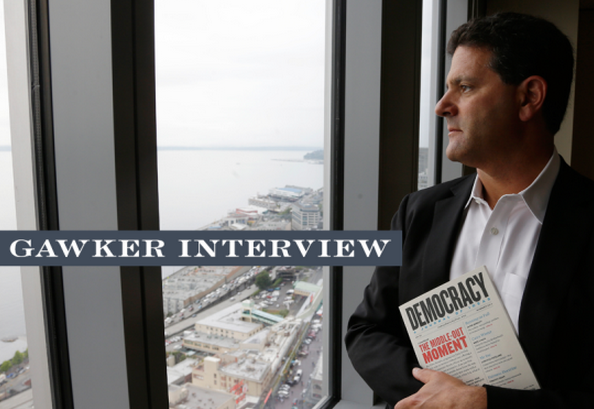
By Hamilton Nolan in Gawker - Nick Hanauer, a venture capitalist who was one of the first investors in Amazon, has the distinction of being one of America’s few progressive billionaires. We spoke to him about the class war—which he is busily fighting. Hanauer drew attention last year for writing an op-ed in Politico warning his “fellow zillionaires” that “the pitchforks are coming” if something is not done to address America’s growing economic inequality. Since then, he has been producing a steady stream of blog postsand essays calling for higher pay for low-wage workers and other measures designed to boost the fortunes of the declining lower and middle classes. Yesterday, the Seattle-based investor was in New York testifying in favor of a $15 per hour minimum wage for fast food workers. He stopped by our office afterwards to talk.

Why The War Against BDS?… The Real Reason

By James North in Desert Peace - Well, here’s why. The Financial Times has published a big, and somewhat balanced, article on the rapid rise of BDS that includes two stunning financial numbers showing how powerful the nonviolent movement for justice in Israel/Palestine is becoming. The most important information is deep inside the FT article: However, there are signs that Israel’s disquiet over BDS is genuine. This week an Israeli financial newspaper covered a leaked government report estimating that BDS could cost Israel’s economy $1.4bn a year. The estimate included lower exports from the settlements in keeping with the EU’s plans to begin labelling goods made there — not part of the BDS movement, although many Israelis lump the two things together. The Rand Corporation, the US think-tank, says the costs could be more than three times higher: $47bn over 10 years.

Fast Track To The Corporate Wish List

By David Dayen in Propsect - Pharmaceutical companies, software makers, and Hollywood conglomerates get expanded intellectual property enforcement, protecting their patents and their profits. Some of this, such as restrictions on generic drugs, is at the expense of competition and consumers. Firms get improved access to poor countries with nonexistent labor protections, like Vietnam or Brunei, to manufacture their goods. TPP provides assurances that regulations, from food safety to financial services, will be “harmonized” across borders. In practice, that means a regulatory ceiling. In one of the most contested provisions, corporations can use the investor-state dispute settlement (ISDS) process, and appeal to extra-judicial tribunals that bypass courts and usual forms of due process to seek monetary damages equaling “expected future profits.”
assetto corsa mods

Urgent End Of Year Fundraising Campaign

Online donations are back! Keep independent media alive. 

Due to the attacks on our fiscal sponsor, we were unable to raise funds online for nearly two years.  As the bills pile up, your help is needed now to cover the monthly costs of operating Popular Resistance.

Urgent End Of Year Fundraising Campaign

Online donations are back! 

Keep independent media alive. 

Due to the attacks on our fiscal sponsor, we were unable to raise funds online for nearly two years.  As the bills pile up, your help is needed now to cover the monthly costs of operating Popular Resistance.

Sign Up To Our Daily Digest

Independent media outlets are being suppressed and dropped by corporations like Google, Facebook and Twitter. Sign up for our daily email digest before it’s too late so you don’t miss the latest movement news.