Skip to content

Inequality

No One In The United States Should Be Poor, Period

The federal minimum wage hasn’t gone up in nearly 10 years. Yet with a stroke of his pen, Jeff Bezos of Amazon raised the wages of hundreds of thousands of the company’s lowest paid workers. In an age of extreme income inequality, this is leap in the right direction. It’s also a stark reminder of how far we as a nation are from caring for our most vulnerable people. Consider the story of Vanessa Solivan, an East Trenton mother of three struggling in and out of homelessness. Vanessa is “working homeless,” an increasingly common phenomenon as the gap between wages and cost of living grows wider. In the richest country in the world, millions of families shouldn’t have to struggle every day to get by while wealth concentrates into fewer and fewer hands at the top.

World Bank – IMF Guilty Of Promoting Land Grabs, Increasing Inequality

07 OCTOBER, BALI: At a meeting of La Via Campesina facilitated by Serikat Petani Indonesia (SPI) in Bali, peasant organizations from Asia, Africa, Americas, and Europe have unanimously held World Bank and IMF responsible for facilitating large-scale land grab, deforestation and ocean grabbing around the world, which has led to inequality, poverty, and global hunger. Peasants pointed to several decades of neo-liberal push from the World Bank and IMF for privatization and de-regulation in developing countries, as among the major factors that have led to increased cost of living for peasant communities. Over the last 30-40 years, the World Bank and the International Monetary Fund (IMF) and more recently the WTO has forced countries to decrease investment in food production and to reduce support for peasant and small farmers.

The United States Can ‘Share The Wealth’ Now, Here’s How

In the United States, back during the Great Depression, three simple words animated a grassroots upsurge that would help make the nation the world’s first mass middle-class society: Share the wealth! And the nation did. By the end of the 1960s, the top 1 percent’s share of America’s national income had dropped by more than half. The bottom 90 percent share, meanwhile, had jumped from half the nation’s total income to over two-thirds. Redistribution — via the tax code — drove this dramatic egalitarian shift, as high incomes faced high tax rates throughout the middle decades of the 20th century. But these high tax rates, levies that topped 90 percent on income over $200,000, would have no staying power. The relentless assaults of America’s wealthiest would over time grind them down.

America 2018: Even More Gilded Than America 1918

It took 100 years, but America has returned to its unequal past. With a vengeance. The year many consider the height of the Gilded Age, when John D. Rockefeller’s wealth was at its peak, was exactly a century ago, in 1918. By that time, Rockefeller had amassed about $1.2 billion — the equivalent of $340 billion today. America’s economy and aggregate wealth were much smaller in those days, which made Rockefeller a truly towering figure. Just over a decade after Rockefeller’s fortune peaked, the Great Depression put an end to America’s first Gilded Age. America eventually recovered from the ruins of the Great Depression and made huge strides toward economic equality. Between 1945 and the early 1970s, circumstances for all Americans, rich and poor alike, improved.

The Capitalist Manifesto: Let Poor People Die

The original Capitalist Manifesto was a 1958 book by economist Louis O. Kelso and philosopher Mortimer J. Adler. In their view of a properly conducted democratic capitalist society, a sort of modern-day Homestead Act was envisioned, in which all Americans would participate in the “capitalist revolution” of growing stock portfolios. This would be possible because of great technologies (energy in the 1950s, AI now) that would allow all of us, in Aristotelian and Jeffersonian property-owning ways, to become ‘free’ to pursue the arts & sciences and to enjoy more leisure time. Today, this form of democratic capitalism could be realized through the Employee Stock Ownership Plan promoted by the “Just Third Way” movement.

Billionaires Are The Lethal Monkey On The Back Of The American Public

This week on “Scheer Intelligence,” Anand Giridharadas, whose latest book is “Winners Take All: The Elite Charade of Changing the World,” discusses “how rich people and philanthropists and others are engaged in this well-meaning attempt to make the world better … but upholding through their actions an indecent system.” He describes this as a system in which the market and its needs come before the needs of the people, a system that allows the rich and powerful to be seen as philanthropic rather than the malignant force they represent. They would be, as Tolstoy opined, the guy on the American back, choking our society and destroying our economy. They do so in the name of the distorted libertarian ideology that they use to subvert the American experiment in democracy, by denying the legitimacy of government intervention into the economy on the side of fairness and justice...

Rich People Broke America And Never Paid The Price

The obvious, minimum observance, I would think, would be a mass march down Wall Street and around the Lower Manhattan’s Financial District. I know, from my traipsing around with Occupy Wall Street, how cathartic such rituals of return can be. Even if much of high finance has decamped to Midtown Manhattan or somewhere else along the high-frequency trading wires, that old downtown of America's largest city has more symbolic heft. The march might be raucous and wild, like most marches were in the Occupy days. But the generation that came into adulthood during the crisis has grown older. Maybe they would be more inclined to something quiet, like holding up their student loan bills with the silent resignation that survival has taught them.

How Struggling Dayton, Ohio, Reveals The Chasm Among American Cities

“Left Behind America,” a ProPublica/Frontline collaboration, premieres on PBS on Sept. 11 and can also be streamed. The news this past year has been full of the tribulations facing the cities at the vanguard of the great urban rebirth. There are fights over Uber limits in New York, cash-free purchasing in Washington, D.C., and extreme housing costs in San Francisco. Dayton, Ohio, has been grappling with a different set of concerns. For example, there was a spate of disturbing, unexplained deaths in a formerly middle-class neighborhood just northwest of downtown. Over the span of seven months, five women’s bodies were found scattered around the area, at least three of them the victims of homicides, the others likely dead by overdose. Three had gone undiscovered for so long that they’d been partly eaten by animals.

Billionaires Plan Escape From Apocalypse

What’s with capitalism/capitalists? As soon as things turn sour, they turn south with tails between their legs and hightail it out of Dodge. However, they feast on and love steady, easy, orderly avenues (markets) to riches, but as soon as things heat up a bit, they turn tail and run. History proves it time and again, for example, FDR rescued capitalism, literally rescued it, from certain demise by instituting social welfare programs for all of the citizens as capitalists fled and/or jumped off buildings. Then during the 2008 financial meltdown capitalists were found curled up in the corners of rooms as all hell broke lose.

Capitalism Is Beyond Saving, And America Is Living Proof

Policies that fail in the same way over and over are not failing. Someone is lying about their intent. The drug war didn’t fail to stem the flow of banned narcotics and to stop epidemic abuse and addiction; it succeeded at building a vast carceral and surveillance apparatus targeted at people of color as a successor to Jim Crow. The war in Iraq didn’t fail to bring democracy to the Middle East; it smashed an intransigent sometimes-ally in the region, and deliberately weakened and destabilized a group of countries whose control of, and access to, immense oil reserves was of strategic American interest. The “end of welfare as we know it” didn’t fail to instill in the nation’s poor a middle-class sense of responsibility; it entrenched a draconian regime of means-testing and a Kafkaesque bureaucracy for access to even meager social benefits for a rapidly shrinking middle class.

What Just Happened? $30 Trillion To The Richest White Americans Since 2008

The conclusion that $30 trillion went to white households is based on various reliable sources. The Washington Post references Federal Reserve data that estimates combined Black/Hispanic households as about 7% of all millionaire households (about 2% of 40 million Hispanic and Black households), and thus accruing about $2.5 trillion of that total $33 trillion decade-long gain. Statista, on the other hand, estimates that Black/Hispanic households make up 15% of all millionaires, which would represent a $5 trillion gain since the recession. Asian-Americans, with just 7 million households, are millionaires at about the same rate as white Americans. By the best estimates, the ten-year gains by White/Asian households is close to $30 trillion.

Becoming Serfs

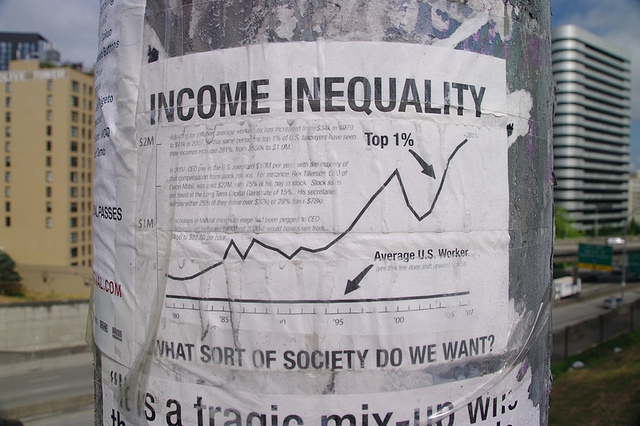
You know the statistics. Income inequality in the United States has not been this pronounced in over a century. The top 10 percent has 50 percent of the country’s income, and the upper 1 percent has 20 percent of the country’s income. A quarter of American workers struggle on wages of less than $10 an hour, putting them below the poverty line, while the income of the average CEO of a major corporation is more than 300 times the pay of his or her average worker, a massive increase given that in the 1950s the average CEO made 20 times what his or her worker made. This income inequality is global. The richest 1 percent of the world’s population controls 40 percent of the world’s wealth. And it is getting worse. What will the consequences of this inequality be economically and politically?

The Homelessness Problem We Don’t Talk About

The punishment for a crime doesn’t necessarily end when the person has been released from prison. Formerly incarcerated people face multiple barriers to securing housing (including public housing) and employment, which can lead to homelessness. And just by virtue of being homeless—by having to sleep on a bench or take shelter under a bridge—these people may then be targeted by the police. Thus starts an unrelenting cycle, through which people are tossed back and forth between jail and the street. A new report by the Prison Policy Initiative (PPI) presents some troubling numbers on this phenomenon. Using a Bureau of Justice Statistics survey, for which the last available year of data comes from 2008, it found that among formerly incarcerated people, the rate of homelessness that year was 10 times that of the general public.

The Enemy Between Us: How Inequality Erodes Our Mental Health

When people are asked what matters most for their happiness and wellbeing, they tend to talk about the importance of their relationships with family, friends and colleagues. It is their intimate world, their personal networks that mean the most to them, rather than material goods, income or wealth.  Most people probably don’t think that broader, structural issues to do with politics and the economy have anything to do with their emotional health and wellbeing, but they do. We’ve known for a long time that inequality causes a wide range of health and social problems, including everything from reduced life expectancy and higher infant mortality to poor educational attainment, lower social mobility and increased levels of violence. Differences in these areas between more and less equal societies are large, and everyone is affected by them.

You’ve Heard Of The Gender Pay Gap, But There’s More

The gender wage gap continues to harm women, their families, and the economy, despite women being in the workforce for decades. But not all women are marginalized by this disparity in the same way. In 1996, the National Committee on Pay Equity decided to bring awareness to the wage gap by creating National Equal Pay Day. The day signifies how long it takes for a woman to make the same amount of money a man makes for the year prior. Each year Equal Pay Day for All is held in April — meaning it will take an average woman about 16 months to make what a typical man makes in a year. But when we look at the wage gap for women of color, this day of “catching up” falls way later in the year — all the way into August.
assetto corsa mods

Urgent End Of Year Fundraising Campaign

Online donations are back! Keep independent media alive. 

Due to the attacks on our fiscal sponsor, we were unable to raise funds online for nearly two years.  As the bills pile up, your help is needed now to cover the monthly costs of operating Popular Resistance.

Urgent End Of Year Fundraising Campaign

Online donations are back! 

Keep independent media alive. 

Due to the attacks on our fiscal sponsor, we were unable to raise funds online for nearly two years.  As the bills pile up, your help is needed now to cover the monthly costs of operating Popular Resistance.

Sign Up To Our Daily Digest

Independent media outlets are being suppressed and dropped by corporations like Google, Facebook and Twitter. Sign up for our daily email digest before it’s too late so you don’t miss the latest movement news.