Skip to content

Journalism

Egyptian Injustice: Journalists Sentenced To 7 Years

An Egyptian court convicted three Al-Jazeera journalists and sentenced them to seven years in prison each on terrorism-related charges in a verdict Monday that stunned their families and was quickly denounced as a blow to freedom of expression. International pressure mounted on Egypt's president to pardon the three. The verdicts against Australian Peter Greste, Canadian-Egyptian Mohamed Fahmy and Egyptian Baher Mohammed came after a 5-month trial that Amnesty International described as a "sham," calling Monday's rulings "a dark day for media freedom in Egypt." The three, who have been detained since December, contend they are being prosecuted simply for doing their jobs as journalists, covering Islamist protests against the ouster last year of President Mohammed Morsi. Three other foreign journalists, two Britons and a Dutch citizen, were sentenced to 10 years in absentia. Media groups have called the trial political, part of a fight between the government and the Qatar-based Al-Jazeera network , which authorities accuse of bias toward the Muslim Brotherhood and Morsi. The network denies any bias.

Two Journalists Released, 14 Still Behind Bars

The Committee to Protect Journalists welcomes the release from prison this week of two Egyptian journalists and calls on authorities to release at least 14 journalists still behind bars, including three Al-Jazeera journalists whose trial continues on Monday. Abdullah al-Shami, reporter for Al-Jazeera who was jailed without charge, was released on Tuesday in connection with his deteriorating health, and Karim Shalaby, reporter for Al-Masder, was freed on Monday after a court acquitted him of charges that included protesting illegally. "Egypt's newly elected president, Abdel-Fattah el-Sisi, has an opportunity to reverse the drastic decline in the country's press freedom record by doing all he can to ensure that journalists are set free from jail," said Sherif Mansour, CPJ's Middle East and North Africa program coordinator. "Releasing all imprisoned journalists and allowing them to report freely and safely would be a resounding signal that Egypt is changing course."

Peter Van Buren, RIP, The Bill of Rights

Here’s what passes for good news when it comes to a free press these days: two weeks ago, the Supreme Court refused without comment to hear a case involving New York Times reporter James Risen. It concerned his unwillingness to testify before a grand jury under subpoena and reveal a confidential source of information in his book State of War on the secret U.S. campaign against the Iranian nuclear program. The case will now go back to the United States Court of Appeals for the Fourth Circuit, which has already ordered him to testify. He says he will instead go to jail, if necessary. That’s the bad news, right? Really bad news! The Supremes, the highest court in the land, refused to protect a reporter protecting a source at a moment when the Obama administration is in the midst of a wide-ranging crackdown on leakers and whistleblowers of all sorts (and those in the media considered to be aiding and abetting them). Actually, in a world in which Congress has not yet managed to pass a federal shield law that would protect reporters, it turns out that that’s actually the good news -- or so at least various media commentators say. Follow the logic here (and it is logic of a sort). Right now the Richmond, Virginia-based Appeals court decision applies only to courts in states under its jurisdiction. Had the Supremes agreed to take on the case, given their conservative and generally government-friendly bent on matters of executive power and what passes for national security, they would likely have ruled against Risen and that ruling would have applied nationally.

Reporting Saudi Arabia’s Hidden Uprising

Even inside Saudi Arabia, the protests in the coastal region of Qatif hardly ever make the news. It's nearly impossible for journalists to operate here. But I travelled in under the radar. I know the area well, as I was born and raised nearby. I visited the Eastern Province several times in the past two years without the knowledge of the Saudi authorities. I wanted to find out why activists from the country's Shia minority were risking their lives to demonstrate against the monarchy. How had frequent protests rumbled on without being silenced? The Eastern Province is home to most of Saudi Arabia's Shia Muslims. They make up less than 15% of the population, and many claim they suffer sectarian discrimination. The demonstrations in Saudi Arabia began in early 2011, when protesters demanded the release of nine men held for years without trial. They were emboldened by the Arab uprisings sweeping through the region. But in this conservative monarchy, dissent is rarely tolerated.

Brazil: Journalist Arrested, Beaten, In Police Custody

UPDATE: After a day of being under arrest by the police of Belo Horizonte, and after her case became known to international audiences, the social media journalist was released, together with two other activists. See more here. Translated press release from Midia NINJA Karinny de Magalhães correspondent from Midia NINJA was arrested while working as a journalist covering the protests against the World Cup in the city of Belo Horizonte. While live streaming the protest “Copa sem povo, tô na rua de novo” Karinny suffered a long series of outrages by the Military Police. In the live stream we saw a frame where she claimed she had been assaulted. The transmission was disconnected and Karinny stopped filming. After being held for over an hour inside a police car, she was taken in secret to a police barracks where she was beaten by five policemen into unconsciousness. She was then taken to the 6th Regional Police Civilian Police – North West, where she was held overnight, and testified that tests were performed corpus delicti. Karinny is accused of being part of the group that flipped a Civil Police vehicle during the protests. Another video shows the entire event and proves the accusations against her are false. Two other protesters were also arrested.

Supreme Court Rejects NYT Reporter’s Appeal

Reporters Without Borders is deeply worried by the United States Supreme Court’s rejection of an appeal by New York Times reporter James Risen on June 2, 2014. Last July, an appeals court in Richmond, Virginia, demanded that James Risen testify at the criminal trial of Jeffrey Sterling, a former CIA agent who is being prosecuted for leaking classified information to Risen in violation of the Espionage Act. Monday’s Supreme Court decision not to intervene in the case could result in prison for Risen if he does not testify. A jail sentence for protecting his sources would have a chilling effect on journalists and whistleblowers. Investigative journalism would not be possible without leaks, especially in the United States where nearly all information related to national security is classified. Risen, who has repeatedly said that he would protect his sources’ identity at all costs, told Reporters Without Borders today that he “will continue to fight.”

I Confronted Donald Trump In Dubai

This May, I researched labor issues in the United Arab Emirates with a local journalist. To avoid being deported, he goes by the pseudonym Tom Blake. We interviewed construction workers building museums on Abu Dhabi's Saadiyat Island. In the richest city in the world, the workers we spoke to were little more than indentured servants. For between $150 and $300 a month, they worked 13 hours a day, six days a week. Their bosses kept their passports. They landed in the UAE owing more than a year's salary to recruiters back home. They could be deported for striking. In Pakistan, Bangladesh, India, and Nepal, they had families dependent on their wages. However brutal it was, the Gulf dream was their one shot out of poverty. They could not fuck this up. The UAE is not uniquely guilty. Migrants throughout the world, in the US as well as the UAE, do the worst work and suffer the worst state violence. While my research focused on Abu Dhabi, poor conditions are typical throughout the Gulf. Thousands of workers could die building the World Cup stadia in Qatar. Figurative blood stains the gleaming steel of Earth's tallest building, Dubai's Burj Khalifa.

NY Times Reporter Still Faces Threat Of Jail

A former Fox News journalist disclosed on Thursday that he had been subpoenaed in 2011 for notes and testimony identifying his confidential sources in a leak investigation, adding a new public chapter to the Obama administration’s crackdown on unauthorized disclosures. Later, in a surprise move, the House of Representatives voted 225 to 183 to approve an amendment to an appropriations bill barring the Justice Department from compelling reporters to testify about confidential sources. Advocates for journalists have tried for years to enact a federal “media shield” bill allowing judges to quash such subpoenas. The legislation, sponsored by Representative Alan Grayson, Democrat of Florida, has a long way to go before it would become law; in 2009, the House approved a media shield bill, but it died in the Senate. But the latest measure, approved just after midnight on Friday, resonated with the disclosure by the former Fox News reporter and producer, Mike Levine, who now works for ABC News.

The Limits Of MSNBC

Michael Arria's new book Medium Blue: The Politics of MSNBC is a nice summary of how a liberal corporate or liberal partisan television network falls short -- something of an update from Jeff Cohen's Cable News Confidential and the bad old days when MSNBC dumped Cohen and Phil Donahue for being anti-war. It turns out the good new days of MSNBC-gone-liberal are seriously flawed as well. The flaws do a disservice to a large section of the population, many majority perspectives, and large numbers of people whose opinions would improve if their information did. Yes, of course, it's nice to have a 24/7 channel that everybody receives making fun of Republicans. But the Comedy Channel (Comedy Central) does that too. The comedy fake news shows also make fun of Democrats and anyone else they can identify; they build cynicism and disgust without offering any better course of action than a mass Rally-for-Nothing to give people too smart to attend other rallies a chance to rally ironically. But what does MSNBC offer? Beyond its mocking of Republicans, it gives a significant pass to Democrats, resulting in dishonest presentations of facts and a proposed course of action that's doomed to fail.

The Corporate-Right Wing Attack On Public Broadcasting

The war on public broadcasters by corporate media is currently enjoying a resurgence. Britain’s Daily Mail editor Paul Dacre has long loathed the BBC, accusing it of supporting “cultural marxism”. In a 2007 lecture, he said the organisation attempted to undermine “the values of conservatism, with a small ‘c’, which, I would argue, just happen to be the values held by millions of Britons.” To Dacre, the BBC is a “closed thought system operating a kind of Orwellian Newspeak … perverting political discourse and disenfranchising countless millions”. In reality, it would be hard to find any media group in Britain more polarising than the Daily Mail, constantly railing against refugees, Muslims, single women and anybody who threatens its view of the world. We can look forward to the same outlook when it formally launches in Australia this year. Dacre’s comments on the BBC were little different to Rupert Murdoch’s Australian editorial last weekend on the ABC, that alleged managing director Mark Scott had “failed to address bias issues at the national broadcaster, lift standards or impose accountability.” Furthermore (and Dacre would have been proud of this line), “the ABC has an endless list of progressive journalists and hosts sharing their perspectives and an absence of hosts or programmers who are mainstream or, heaven forbid, conservative”.

#SaveOurGuys Tops Russian Twitter

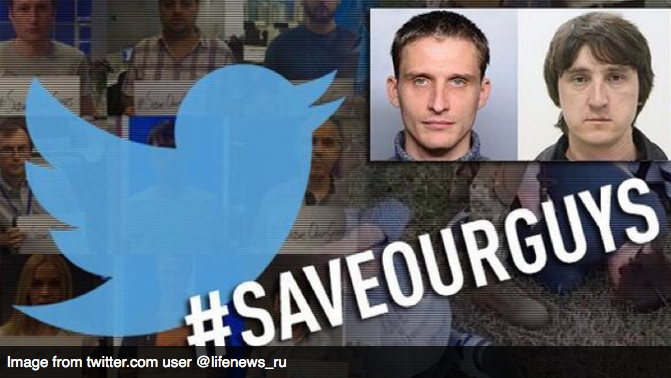
#SaveOurGuys has become the top trending hashtag in the Russian Twittersphere, currently the forefront of an online campaign, launched for the release of LifeNews reporters detained by the Ukrainian National Guard. Russian social media has been deluged with photos of users holding signs reading Save Our Guys. LifeNews journalists were the first to post them in support of their colleagues on Monday. Мы делаем все возможное, чтобы вернуть ребят домой. Марат и Олег, держитесь! #SaveOurGuyspic.twitter.com/nfDePHNgEA — LIFENEWS (@lifenews_ru) May 19, 2014 In just hours, thousands either re-tweeted existing messages or posted their own images. By Tuesday, the hashtag #SaveOurGuys was trending on Russian Twitter. @rykov #SaveOurGuyspic.twitter.com/lib4KjoEpW — Leonid (@leobols) May 19, 2014

Five Principles For Independent Media In 2014

Today's media landscape is constantly shifting. As the industry follows wider economic trends, steady writing jobs remain few and far between. Many talented reporters and critics move around from outlet to outlet in a largely freelance economy. The way audiences find news and analysis has also changed - more and more often, readers will follow those writers around, using social media feeds to find stories, rather than going directly to one web site (let alone one television network, radio station or print publication). The line between "audience" and "media-makers" has eroded, too, amplifying voices and movements traditionally excluded from dominant journalistic platforms. Tweets and Facebook posts often travel farther and wider and faster than even the most "high-profile" newspaper articles. As corporate media companies have scrambled to adapt, sometimes in the process offering platforms to people who disrupt the hegemony of the mainstream, new outlets have emerged which can't be categorized as mainstream yet but don't fit clearly into the mold of independent media either. Some of them openly tack still further to the right than corporate news (Free Beacon, for example, or the Breitbart News Network), while others have drawn criticism for the extent to which they seem dominated by the same, already overrepresented voices. Meanwhile, at the same time as social media has become increasingly recognized - though certainly not by everyone - as Media with a capital M (media to be taken seriously), it has enabled the emergence of new critiques of all sections of media - or perhaps more accurately, it has amplified critiques that were not new but now for the first time are too loud to be ignored.

Tunisia: Popular Revolutionary Activist And Photographer Arrested

Yesterday, Tuesday 13 May, the ‘El Hambra’ theatre in Tunis was the site of a gathering of some 300 activists, young people and human rights’ campaigners. They were there to protest against the arrest on Monday night of the blogger and activist, Azyz Amami, and of his friend, the photographer Sabri Ben Mlouka. They were arrested at the port of La Goulette, in the north of Tunis. The police forced the pair to get out of a car and to kneel down with their hands on their heads. They were then subjected to a humiliating body search, something prohibited by the law, as explained by their lawyers during the protest rally yesterday. The police claimed that Azyz and Sabri had 700 grams of cannabis on their possesion. But the charge of possession or use of cannabis is a notorious tactic dating back from the Ben Ali dictatorship days, and commonly used by the police as a cover for political arrests. Azyz’s father, who visited his son in the Gorjani detention centre, in Tunis, was able to confirm that his son had bruises on the face and body, indicating that he was beaten by the police. A few days ago, Azyz Amami was a guest on a TV talk-show discussing a campaign called, “I too burned a police station”. This campaign defends youth arrested under spurious and often fabricated charges, such as drug use, or vandalism of police stations during the revolutionary movement that brought down Ben Ali.

Jailed Journalist Given Press Freedom Prize As Trial Resumes

One of the four al-Jazeera journalists jailed in Egypt, Mohamed Fahmy, has been given a press freedom award, before the seventh session of his trial on Saturday. The Canadian Committee for World Press Freedom said it had awarded the prize to Fahmy, a Canadian-Egyptian and the Cairo bureau chief for al-Jazeera English, in recognition of the battle he has fought for free speech since being detained with two colleagues in late December. Fahmy, an ex-CNN journalist; Peter Greste, an Australian former BBC reporter; and a local producer, Baher Mohamed, are accused of smearing Egypt's reputation, doctoring footage and aiding terrorists. A fourth colleague – Abdullah Elshamy, a reporter for al-Jazeera's Arabic channel – has been jailed without charge in a separate case since last August. Fahmy recently celebrated his birthday in prison and has applied for permission to marry his fiancee inside jail. In a handwritten letter smuggled from prison, Fahmy thanked the judges for the award and donated the prize money, worth C$2,000 (£1,100), to the family of an Egyptian journalist, Mayada Ashraf, who was shot dead in unexplained circumstances at a protest last month.

Reporters Without Borders Profiles “100 Information Heroes”

For the first time ever, Reporters Without Borders is publishing a list of profiles of “100 information heroes” for World Press Freedom Day (3 May). Through their courageous work or activism, these “100 heroes” help to promote the freedom enshrined in article 19 of the Universal Declaration of Human Rights, the freedom to “to seek, receive and impart information and ideas through any media and regardless of frontiers.” They put their ideals in the service of the common good. They serve as examples. “World Press Freedom Day, which Reporters Without Borders helped to create, should be an occasion for paying tribute to the courage of the journalists and bloggers who constantly sacrifice their safety and sometimes their lives to their vocation,” said Reporters Without Borders secretary-general Christophe Deloire.
assetto corsa mods

Urgent End Of Year Fundraising Campaign

Online donations are back! Keep independent media alive. 

Due to the attacks on our fiscal sponsor, we were unable to raise funds online for nearly two years.  As the bills pile up, your help is needed now to cover the monthly costs of operating Popular Resistance.

Urgent End Of Year Fundraising Campaign

Online donations are back! 

Keep independent media alive. 

Due to the attacks on our fiscal sponsor, we were unable to raise funds online for nearly two years.  As the bills pile up, your help is needed now to cover the monthly costs of operating Popular Resistance.

Sign Up To Our Daily Digest

Independent media outlets are being suppressed and dropped by corporations like Google, Facebook and Twitter. Sign up for our daily email digest before it’s too late so you don’t miss the latest movement news.