Skip to content

Law

The Extent Of Electronic Communications Surveillance

“I think you’re misunderstanding the perceived problem here, Mr. President. No one is saying you broke any laws. We’re just saying it’s a little bit weird that you didn’t have to.”—John Oliver on The Daily Show1 The government is collecting information on millions of citizens. Phone, Internet, and email habits, credit card and bank records—virtually all information that is communicated electronically is subject to the watchful eye of the state. The government is even building a nifty, 1.5 million square foot facility in Utah to house all of this data.2 With the recent exposure of the NSA’s PRISM program by whistleblower Edward Snowden, many people—especially activists—are wondering: How much privacy do we actually have? Well, as far as electronic privacy, the short answer is: None. None at all. There are a few ways to protect yourself, but ultimately, nothing in electronic communications is absolutely protected. In the United States, surveillance of electronic communications is governed primarily by the Electronic Communications Privacy Act of 1986 (ECPA), which is an extension of the 1968 Federal Wiretap act (also called “Title III”) and the Foreign Intelligence Surveillance Act (FISA). Other legislation, such as the USA PATRIOT Act and the Communications Assistance for Law Enforcement Act (CALEA), supplement both the ECPA and FISA.

Lawsuits Seek To Stop Work At Coal Mines

Coal industry representatives say lawsuits against mines in three Western states could have consequences across the U.S. as environmentalists seek changes in how mining is approved on federally owned reserves. In civil cases unfolding in Montana, Colorado and New Mexico, the group WildEarth Guardians asserts coal companies benefited from lax oversight by federal regulators. The group says the U.S. Department of Interior approved mining plans without enough public involvement, and gave little heed to the pollution caused by digging, shipping and burning coal. The group asked the courts to stop mining until the plans are re-done. The cases involve the Spring Creek mine in Montana, the San Juan coal mine in New Mexico and the Colowyo and Trapper mines in Colorado. Combined, they employed about 1,200 workers and produced 27 million tons of coal last year, according to federal records. Attorneys for the federal government denied the environmentalists’ claims and have asked the courts to dismiss the cases. More detailed briefs from the government are due in coming weeks. A fourth case involving several mines in Wyoming was voluntarily dismissed.

‘Watershed Moment’ For Fracking Foes?

Opponents of fracking are feeling emboldened by a ruling in New York’s highest court that found towns can outlaw the controversial drilling practice. Environmentalists are cheering the decision against hydraulic fracturing as a major step toward more local control over the natural gas production. Industry groups, on the other hand, fear the ruling could results in a patchwork of local rules that slow development of the booming energy source. “I think it’s a really watershed moment for the movement,” said Deborah Goldberg, an attorney with Earthjustice who argued the New York case for one of the towns involved. “People all over the country have been watching what’s been going on in New York, and what this says to them is that if you work with your neighbors and you educate yourself and you organize and you work with local government, you can stand up to industry and win.”

US Female Justices Issue Fierce Dissent On Contraception Ruling

The US supreme court late Thursday ruled in favor of a Christian college that believes the contraception mandate of US healthcare law burdens the school, inciting forceful dissent from the three female justices in the nation’s highest court. In an unsigned, provisional order, the court granted a Christian college a temporary exemption from having to provide full contraception coverage to its employees and students as is mandated by the Affordable Care Act (ACA). This decision comes days after the court’s 5-4 decision in Burwell v Hobby Lobby, which provided small, for-profit corporations with a similar exemption. The court’s three females justices – Sonia Sotomayor, Ruth Bader Ginsburg and Elena Kagan – said Thursday’s ruling introduced unnecessary layers of bureaucracy, altered the interpretation of the Hobby Lobby ruling and “undermines confidence in this institution.” “Those who are bound by our decisions usually believe they can take us at our word,” Sotomayor wrote. “Not so today.” Last year, the Obama administration finalized its rules that grant churches an exemption to the mandate under the ACA. These provisions also allows religious nonprofits to request exemption by filing a form to its insurance issuer or third-party administrator.

Anonymous Threatens Congress Over Bill

A threat by the hacktivist group Anonymous over a new cybersecurity bill scheduled for committee markup next month is being taken seriously by the Washington D.C. capitol police. The Cybersecurity Information Sharing Act of 2014 (CISA), authored by Senators Dianne Feinstein (D-Calif.) and Saxby Chambliss (R-Ga.), is being labelled by many constitutional groups, including the American Civil Liberties Union (ACLU), as the third installment of a much-despised piece of Internet legislation widely known as CISPA. CISPA, or the Cyber Intelligence Sharing and Protection Act, was a hugely unpopular bill that has twice been dropped by the U.S. Senate. As a law, it would have permitted the U.S. government to share sensitive information with companies about the online habits of U.S. citizens, specifically, when deemed necessary to protect against rather ambiguously defined “cyber threats.” Opponents of CISPA, such as the Electronic Frontier Foundation (EFF) and Fight for the Future, successfully derailed CISPA by painting it as a danger to American civil liberties. The bill, critics said, would have allowed the federal government too broad authority when it came to tracking users’ online activities.

Report On Torture Survivor’s Week

Dear Friends, Last week, members of Witness Against Torture gathered in Washington, D.C. for the International Day in Support of Survivors of Torture. Our group of about fifteen attended a panel organized by National Religious Campaign Against Torture (NRCAT) on Thursday on U.S. sanctioned torture, engaged in nonviolent direct action at Senator Ayotte and McCain’s offices, and participated in an all-day vigil with Torture Abolition and Survivors Support Coalition(TASSC). On Sunday, we retreated to the Peace Oasis to put in motion a framework for January 11, 2015. During our opening session on Thursday, we found our energy drawn to the Cotton amendment that passed in the House of Representatives and similar efforts to keep Guantanamo open by Kelly Ayotte in the Senate. These bills would make transfers from Guantanamo virtually impossible and continue to senselessly criminalize the men detained without charge at the prison. Furthermore, we decried McCain’s tweet about shipping the newest Benghazi Attack suspect to Guantanamo. Jeremy V. wrote a letter to each senator expressing our concerns.

Supreme Court Backs Koch-Funded Anti-Union Case

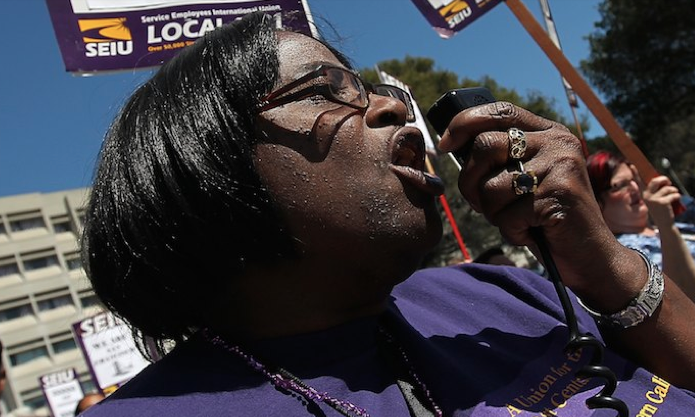
In a 5-to-4 decision today, the U.S. Supreme Court ruled that Illinois home care workers who benefit from higher wages and better working conditions that their union negotiated for—but who choose not to join—do not have to pay their fair share of the cost of the union’s bargaining for and representation of all workers. Text STRENGTH to 235246 to fight back against these attacks on working families. The suit was filed in 2010 by the National Right to Work Legal Defense Foundation, an extreme anti-worker group whose funders include billionaires like the Charles Koch Charitable Foundation and the Walton Family [of Walmart] Foundation. But the suit was dismissed first by a federal district court and then again on appeal by the 7th U.S. Circuit Court of Appeals. The Supreme Court agreed to hear it in October. Said AFL-CIO President Richard Trumka: The extreme views of today’s Supreme Court aimed at home care workers aren’t just bad for unions—they’re bad for all workers and the middle class. But the attacks on the freedom of workers to come together are nothing new. They are part of an onslaught from anti-worker organizations hostile to raising wages or improving benefits for millions of people. These attacks are a direct cause of an economy in which middle-class families can’t get a break because their wages have stagnated and their incomes have declined.

Major Victory For Opponents Of Fracking In New York

In a decision with far-reaching implications for the future of natural gas drilling in New York State, its highest court ruled on Monday that towns can use zoning ordinances to ban hydraulic fracturing, the controversial extraction method known as fracking. Since the issue arose about six years ago, there has been a statewide moratorium on fracking, and the State Health Department is currently studying its potential health effects. But in recent years some towns, worried that the state would eventually allow the practice, have taken matters into their own hands by banning fracking within their borders. Among them, two towns — Dryden, in Tompkins County, and Middlefield, in Otsego County — amended their zoning laws in 2011 to prohibit fracking, on the basis that it would threaten the health, environment and character of the communities. Subsequently, an energy company that had acquired oil and gas leases in Dryden before the 2011 zoning amendment, and a dairy farm in Middlefield that had leased land to a gas drilling company, filed legal complaints, arguing that state oil and gas law pre-empted the town ordinances. On Monday, in a 5-to-2 decision, the State Court of Appeals affirmed a lower-court ruling rejecting that argument, and found that the towns did indeed have the authority to ban fracking through land use regulations.

Supreme Court Creates Impossible Standard For Unions To Meet

The Supreme Court on Monday issued a wide-ranging opinion that will heavily impact the future of labor in America. The majority opinion in Harris v. Quinn held that home healthcare workers in Illinois and every other state that has a similar program are only “partial” or “quasi” public employees—as opposed to “full-fledged public employees”—and thus don't have to pay fees for labor representation. While the majority, led by Justice Samuel Alito, did not go so far as to fully gut the ability of public sector unions to finance their existence, the decision in the case was by no means a moderate one. Harris v. Quinn has set the stage for the eventual overruling of Abood; it has confused and perverted the concept of free-riders; and it has created an impossible standard for unions to meet. Monday's 5-4 ruling goes against decades of Supreme Court precedent allowing fair-share provisions, starting with the seminal case of Abood v. Detroit Board of Education in 1977. (Fair share provisions require workers who choose not to join the union to pay a portion of the dues that is spent in representing them, thereby not allowing them to become free-riders.) The majority’s treatment of the balance created by Abood is problematic on several grounds.

Abu Ghraib Torture Victims May Sue U.S. Corporation, Court Rules

Today, the Fourth Circuit Court of Appeals ruled that victims of torture and abuse in Abu Ghraib prison could pursue legal claims for their abuse against private military contractors. The appeals court ruling overturned a lower court decision that had barred the survivors from suing U.S. corporations involved in the torture in U.S. courts. U.S. military investigators had determined in 2004 that private U.S.-based contractor CACI Premier Technology, Inc. (CACI) had participated in torture and other “sadistic, blatant, and wanton criminal abuses” of detainees at Abu Ghraib, yet a district judge ruled that the 2013 Supreme Court decision in Kiobel v. Shell/Royal Dutch Petroleum foreclosed claims arising out of Iraq. Today’s decision, by contrast, recognized that CACI could be held liable in U.S. courts under the Alien Tort Statute (ATS) for its role in the torture. The case, Al Shimari v. CACI International Inc., was filed by the Center for Constitutional Rights (CCR) on behalf of four Iraqi men who were tortured at Abu Ghraib. Said CCR Legal Director Baher Azmy, “Today’s court ruling affirms that U.S. corporations are not entitled to impunity for torture and war crimes and that holding U.S. entities accountable for human rights violations strengthens this country’s relationship to the international community and basic human rights principles.”

Victory For Dr. Sami Al-Arian: Feds Drop All Charges!

All criminal charges against Palestinian American community leader and professor, Dr. Sami Al-Arian, were dropped on Friday, June 27th. The United States Palestinian Community Network (USPCN) congratulates Dr. Al-Arian, his family, and his legal defense team for this huge victory. Dr. Al-Arian was facing criminal contempt charges for refusing to testify in front of a grand jury unrelated to a case in which he accepted a plea bargain from the U.S. government. The government’s move to dismiss the charges is a response to trial Judge Leonie Brinkema having not yet ruled on a defense motion that was filed over five years ago. As Dr. Al-Arian and his family were living in limbo awaiting Brinkema’s decision, another U.S. District Court Judge, Anthony Trenga, signed the order to accept the government’s motion, which ends close to two decades of repression against the doctor. The witch hunt began in 1994, when federal agents began surveilling, wiretapping, and investigating him. In 2003, federal prosecutors in Tampa filed an indictment which alleged that he was affiliated with the Palestinian Islamic Jihad, one of the many Palestinian resistance groups that the U.S. State Department calls a terrorist organization.

Corporations Gag Whistleblowers To Hide Wrongdoing

In November 2012, the U.S. Department of Energy asked contract employees at the Hanford plutonium processing plant in Washington state to take an unusual oath. The DOE wanted them to sign nondisclosure agreements that prevented them from reporting wrongdoing at the nation’s most contaminated nuclear facility without getting approval from an agency supervisor. The agreements also barred them from using any information for financial gain, a possible violation of federal whistleblower laws, which allow employees to collect reward money for reporting wrongdoing. Donna Busche reluctantly signed the agreement. “It was a gag order,” said Busche, 51, who served as the manager of environmental and nuclear safety at the Hanford waste treatment facility for a federal contractor until she was fired in February after raising safety concerns. “The message was pretty clear: ‘Don’t say anything to anyone, or else.’ ”

Baltimore Police Department Struggles With Truth & Justice

Baltimore Police Chief Batts has taken up the task of swaying public opinion of the city’s law enforcement. This past Wednesday on June 25th, Chief Batts along with his top brass participated in a City Hall public hearing on law enforcement practices. This comes after several years of community activism against police brutality, including brutality against Anthony Anderson and Tyrone West. Joining the fight recently has been 36 year old Abdul Salaam. Both the West and Salaam families filed reports with internal affairs which that say they were ignored. Both the Anderson & West incidents had been clouded by conflicting reports by the police and witnesses. The Baltimore Police Department claimed Anthony Anderson died of a drug overdose, while the facts revealed by the medical examiner indicated that it had been a homicide by blunt force. Abdul Salaam had been severely beaten by police upon a routine seatbelt stop last July of 2013. It has been recently reported that both the Salaam and West families have taken their grievances to a civil court because the Baltimore PD have found no wrong doing of officers in either case.

Judge Upholds Order Demanding Release Of CIA Torture Accounts

A military judge has rejected the US government's attempts to keep accounts of the CIA's torture of a detainee secret, setting up a fateful choice for the Obama administration in staunching the fallout from its predecessor's brutal interrogations. In a currently-sealed 24 June ruling at Guantánamo Bay – described to the Guardian – Judge James Pohl upheld his April order demanding the government produce details of the detentions and interrogations of Abd al-Rahim al-Nashiri during his years in CIA custody. The Miami Herald also reported on the ruling, citing three sources who had seen it. Among those details are the locations of the "black site" secret prisons in which Nashiri was held until his September 2006 transfer to Guantánamo; the names and communications of CIA personnel there; training and other procedures for guards and interrogators; and discussions of the application of so-called "enhanced interrogation techniques". The government has charged Nashiri in connection to the deaths of 17 sailors in the 2000 bombing of the USS Cole. After his 2002 capture, Nashiri's interrogators revved a power drill near his head, threatened him with a gun and waterboarded him, producing a sensation akin to drowning.

Federal Appeals Court Rejects Torture Survivor’s Case

As declared by the United Nations in 1997, June 26 is International Day in Support of Victims of Torture. Unfortunately, the U.S. Court of Appeals may have set an alarming precedent for torture survivors around the country with its decision against victim Darrell Cannon late last month. On May 27, the court shocked Cannon and his supporters by opting to deny him full compensation for the brutal treatment he incurred at the hands of the Chicago Police Department starting in 1983. Led by the notorious Commander Jon Burge, who was fired from his position in 1993 and convicted of perjury in 2010, the Chicago Police victimized at least 120 African-American suspects over the course of two decades, including Cannon, who was tortured before being imprisoned unjustly for 24 years. Despite a number of other survivors receiving millions of dollars from the city of Chicago, Cannon was left with almost nothing—suggesting that the U.S. legal system is all too willing to abandon survivors behind a smokescreen of denial and victim-blaming. Cannon’s lawyers argued his case in front of the three-judge federal appeals court in January of 2013.
assetto corsa mods

Urgent End Of Year Fundraising Campaign

Online donations are back! Keep independent media alive. 

Due to the attacks on our fiscal sponsor, we were unable to raise funds online for nearly two years.  As the bills pile up, your help is needed now to cover the monthly costs of operating Popular Resistance.

Urgent End Of Year Fundraising Campaign

Online donations are back! 

Keep independent media alive. 

Due to the attacks on our fiscal sponsor, we were unable to raise funds online for nearly two years.  As the bills pile up, your help is needed now to cover the monthly costs of operating Popular Resistance.

Sign Up To Our Daily Digest

Independent media outlets are being suppressed and dropped by corporations like Google, Facebook and Twitter. Sign up for our daily email digest before it’s too late so you don’t miss the latest movement news.