Skip to content

US coup

An Epic Act Of Resistance And Trial Of Our Times

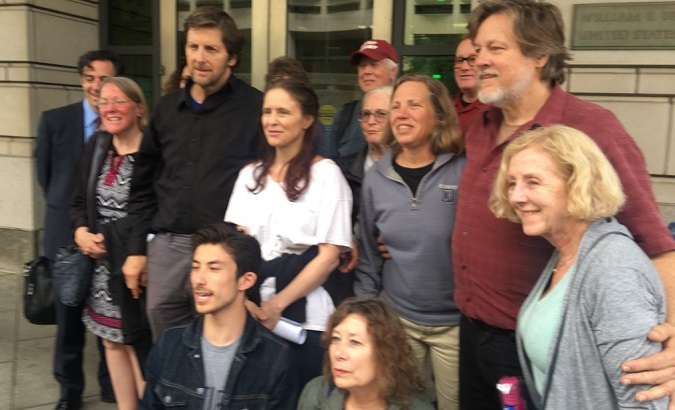
The U.S. government’s accusation against of the four members of the Embassy Protectors Collective is merely a pretext used for their arrest and prosecution, since they haven’t broken any laws.  On Feb. 11, four American peace activists, known as the Embassy Protectors Collective, will be tried before the U.S. empire for “interfering with certain protective functions” of its Federal government for their occupation of the Venezuelan embassy in Washington, D.C. to prevent it from being handed over to coup leaders sponsored by the Trump administration. Their occupation ended on May 16, 2019, when federal agents broke into the sealed embassy, against international law, and arrested them in a swat style raid. The government’s accusation against them is merely a pretext used for their arrest and prosecution since they haven’t broken any laws.

MAS Party Under Threat as Bolivia Moves Towards New Elections (Without Evo)

As anthropologist Nicole Fabricant has argued, to defeat Bolivia’s ascendant right-wing forces—which will continue to be nourished and fortified by the Añez regime during the run-up to the election—will require a broad united front of left-Indigenous groups across the historic pro- and anti-Morales divide. For the MAS, choosing a presidential slate that is more independent of Morales could help to appeal to popular opposition sectors. For the anti-Morales left, which has been disturbingly silent regarding the Añez regime’s abuses, taking a stand against political persecution, racist discourse, and the erosion of democracy occurring under the de facto government could go a long way towards reconciliation.  

Bolivia’s MAS Leader: “Our Advantage Is Not To Be Afraid Of Death In Defense Of The Country”

The arrival of Evo Morales to Argentina was accompanied by a massive arrival of leaders of his party, the Movement to Socialism (MAS), to meet with him and outline the policy to face the coup in Bolivia. Among those who traveled to Buenos Aires for these days was Rodolfo Machaca from the Political Directorate of the MAS, former Deputy Minister of Interculturality and leader of the Single Trade Union Confederation of Peasant Workers of Bolivia (CSUTCB). In dialogue with NOTAS, he denounced the dictatorship of Jeanine Añez which continues to violate human rights, persecuting the population and delivering the country’s natural resources to multinationals. However, he was optimistic about next year’s elections.

TIME Magazine Won’t Say It, But Maduro Is The Man Of The Year

On January 4, 2019, the governments of the now decadent Grupo de Lima announced that from January 10 – the date on which, after winning elections whose numbers were better in terms of majority and participation than those legitimized by several of the leaders who questioned him, Nicolás Maduro would be proclaimed President of Venezuela – they would no longer recognize the Bolivarian government as the representative of the Venezuelan people. From that moment on, the actions, sanctions and statements against Maduro’s government followed one after the other without pause. Visible was an open presence of the United States government, in the person of its President, its Vice President, its Secretary of State and the National Security Advisor.

Embassy Protectors Are Being Denied Their Right To A Fair Trial

Judge Beryl A. Howell, the chief judge of the US District Court, denied the discovery motions requested by the four embassy protectors who were arrested on May 16 after staying in the Venezuelan Embassy in Washington, DC for 37 days to prevent it from being handed over to coup-leaders in violation of the Vienna Convention. This denial will severely restrict the scope of the trial, currently scheduled for February 11, 2020, of Adrienne Pine, David Paul, Margaret Flowers, and Kevin Zeese. They face federal charges punishable by up to a year in prison, a $100,000 fine each and restitution to the government for police time and damages. Judge Howell's ruling will result in a farcical trial where the jury will not be allowed to consider the contentious legality of the Trump administration’s recognition of the leadership of the coup in Venezuela, and thus the legal basis of the charges the defenders are facing.

Chile: People Come To This Square For Bread, Not Weapons

On November 14, Chile's indigenous nations called for a day of peaceful solidarity, remembrance, and ritual in Santiago's central square, which still bears its colonial name, Plaza de Armas (Weapons Square). It was the one-year anniversary of when police in the south of Chile killed a Mapuche man, Camilo Catrillanca. On all four sides of the square (about the size of two soccer fields) we counted and photographed no fewer than 40 heavily armed police in military-style riot gear and about five tear gas tanks and two water cannons. This was not for one of the bigger gatherings 10 blocks away in what the pro-democracy protesters now call Dignity Plaza. This massive show of force unlike anything I've seen in the US - supposedly to "keep the peace" - was for about 2000 people who gathered in front of the nation's Catholic Cathedral in order to pray to the four directions, light candles, sing songs, fly flags and dance.

United States Takes Drastic Measures As It Loses Control Of Latin America

This week, Latin American countries allied with the United States are meeting in Colombia to invoke a post-World War II treaty, the Inter-American Treaty of Reciprocal Assistance, TIAR in Spanish, which would permit military intervention in Venezuela. This comes as the US-appointed coup-leader Juan Guaido faces the end of his term as president of the Venezuelan National Assembly and all efforts to install him as the president of Venezuela have failed. We speak with William Camacaro, a Venezuelan activist living in the United States, about the impact of TIAR and what people in the United States can do to stop US interference in Venezuela. We also discuss what is happening in the region as the United States loses control. Plus, we provide current news and analysis.

Bolivia: Junta Hunts Down Last Remaining Dissidents

La Paz, Bolivia – A brutal military junta that seized power from Bolivia’s democratically elected President Evo Morales is violently repressing a working-class indigenous-led uprising, and the country is rapidly falling under its control. Soldiers in military fatigues prowl the streets, enforcing a series of choke points around the seat of power. Anyone perceived as standing against the status quo is now subject to being arrested on charges of sedition or terrorism. Dissident journalists and Morales sympathizers have been forced into hiding, leaving the house only when necessary.  “It’s a fascist dictatorship, there’s no hiding it,” says Federico Koba, a left-wing journalist who asked that I not use his real name for fear of arrest. “There are paramilitary agents going around the city taking pictures and pinpointing who’s who. Who is a leader, who is recording the protests, who is recording the repression.”

Now The Interim Of US Self-Deception Over Bolivia

Years from now, maybe a generation from now, it will be permissible to describe Evo Morales’s resignation-at-gunpoint two weeks ago as what it was: a coup the U.S. cultivated just as it has dozens of others since it emerged as a superpower in 1945. The acknowledgement will not matter then. The events in question will be comfortably distant in time. Those responsible for deposing the Bolivian president will be either retired or deceased. Americans will not have fooled any Bolivians, for this autumn will be etched in their memories, but Americans will have once again fooled themselves. This is how it often goes when Washington crushes the democratic aspirations of others by toppling legitimately elected leaders and replacing them with figures — usually corrupt, often dictatorial, by definition undemocratic — to its liking.

Elections Between Witch Hunts, The Coup Plan In Bolivia

A colleague who had to leave Bolivia writes to me. She is being chased along with her partner who, they told her, they are looking for him to “liquidate him”. Since before Evo Morales was forced to resign, a list of names began to circulate; its application accelerated from that moment. It was Arturo Murillo, de facto government minister, who was responsible for putting it in black and white: he talked about “hunting” three leaders, after chasing parliamentarians accused of “sedition” and “subversion.” Communication minister Roxana Lizárraga pointed to “journalists and pseudo-journalists”, and on Thursday the Telesur TV channel was taken off of Bolivian television stations.

Maduro Denounces Bribery Attempts On Army Officers

Venezuelan President Nicolas Maduro denounced this Sunday that the country's right-wing has received more than US$400 million with the objective of buying politicians, policemen and members of the Bolivarian National Armed Force, to put them at the service of foreign nations' interests. During an interview for the 'Jose Vicente Hoy' show, Maduro affirmed that despite bribes, the Venezuelan Armed Forces have remained loyal to the Constitution, the Venezuelan people, and the Bolivarian Revolution. However, the head of state informed there are people imprisoned for giving in or being caught taking such illegal money. "We have dismembered, with the participation of our own armed force officers, more than 47 attempts to recruit officers to put them at the service of Colombia's strategy and the gringos," Maduro said...

Another Failed US-Backed Coup Attempt In Venezuela

Fresh off a successful military coup deposing leftist President Evo Morales in Bolivia last week, the United States attempted to overthrow the government of Nicolás Maduro in Venezuela this weekend. The events, however, went barely noticed outside the South American nation, as the attempt proved to be a complete fiasco.  U.S.-backed self-declared President Juan Guaidó, who had tried multiple times earlier in the year to depose Maduro to no avail, had long publicly targeted November 16 as the date of his latest insurrection, calling on all Venezuelans to rise up and fight in the streets against the “dictatorship.” That way, he explained on social media, they could build up national and international pressure on Maduro

“They’re Killing Us Like Dogs” – A Massacre In Bolivia And A Plea For Help

I am writing from Bolivia just days after witnessing the November 19 military massacre at the Senkata gas plant in the indigenous city of El Alto, and the tear-gassing of a peaceful funeral procession on November 21 to commemorate the dead. These are examples, unfortunately, of the modus operandi of the de facto government that seized control in a coup that forced Evo Morales out of power. The coup has spawned massive protests, with blockades set up around the country as part of a national strike calling for the resignation of this new government. One well-organized blockade is in El Alto, where residents set up barriers surrounding the Senkata gas plant, stopping tankers from leaving the plant and cutting off La Paz’s main source of gasoline. Determined to break the blockade, the government sent in helicopters, tanks and heavily armed soldiers in the evening of November 18.

31 US Organizations Denounce The Brutal Repression In Bolivia

We, the undersigned US organizations condemn the civic-military coup in Bolivia and the brutal repression unleashed by the police and military authorized by the self-proclaimed anti-Indigenous “President” of Bolivia, Senator Jeanine Áñez. The regime has burned the Wiphala, flag of the Indigenous nations of Bolivia; decreed an exemption to prosecution for the police and military for the use of lethal force against demonstrators; and has criminalized democratically elected officials and rank and file members of organizations associated with the deposed government. These decrees led to the massacre in Cochabamba on November 15 in which police and the armed forces opened fire on demonstrators killing five people and wounding more than 100, as well as the massacre of Senkata on November 19 in which at least 8 people were killed and at least 30 wounded.

Youth Shut Down Luis Almagro’s Talk In Paraguay

Paraguay - Social and political organizations of Paraguay expressed their rejection of the Secretary General of the Organization of American States (OAS), Luis Almagro, and at the same time expressed their solidarity with the people of Bolivia and the legitimate president of that country, Evo Morales. This Tuesday, Almagro, a Uruguayan national, planned to offer a talk on “Democracy and Development” at a private university in Asunción, however, social, political and student organizations threw the head of the inter-American organization from the academic venue, according to the collaborator from teleSUR in Paraguay, Osvaldo Zayas. In the expressions of repudiation there were shouts like "murderer!", "Almagro, your hands have blood!", "Coup!" And "Almagro fascist, you are the terrorist".
assetto corsa mods

Urgent End Of Year Fundraising Campaign

Online donations are back! Keep independent media alive. 

Due to the attacks on our fiscal sponsor, we were unable to raise funds online for nearly two years.  As the bills pile up, your help is needed now to cover the monthly costs of operating Popular Resistance.

Urgent End Of Year Fundraising Campaign

Online donations are back! 

Keep independent media alive. 

Due to the attacks on our fiscal sponsor, we were unable to raise funds online for nearly two years.  As the bills pile up, your help is needed now to cover the monthly costs of operating Popular Resistance.

Sign Up To Our Daily Digest

Independent media outlets are being suppressed and dropped by corporations like Google, Facebook and Twitter. Sign up for our daily email digest before it’s too late so you don’t miss the latest movement news.