Skip to content

Activism

Canada’s Intelligence Services Intensive Spying On Environmentalists

Canadian spies are trying to narrow the scope of an inquiry into whether they overstepped the law while eyeing environmental activists. A lawyer for the Canadian Security Intelligence Service says the terms spelled out in a civil liberties group’s complaint are “overly broad” and must be “better defined.” At issue is how far the Security Intelligence Review Committee, the watchdog over CSIS, can delve into the British Columbia Civil Liberties Association’s complaint about alleged spying on groups concerned about Canadian energy policy. CSIS is trying to hide the reasons it monitored environmental groups, said Paul Champ, lawyer for the civil liberties association.

Online Protest In Support Of Net Neutrality Planned For Sept. 10

Web activists are planning an online protest for next week to press federal regulators for stronger rules to protect net neutrality, or the idea that all web content should be treated equally. The activists are asking websites and social networks to join the protest on Sept. 10 by embedding special code on their sites depicting a “loading” icon, which they say symbolizes how Internet traffic could be slowed down if regulators don't create stronger net neutrality rules. The code would also give visitors a way to submit comments supporting net neutrality to the Federal Communications Commission and to elected officials. The groups organizing the protest include Demand Progress, a political action group focused on shaping debate on Internet policy, Free Press, a consumer group, and Fight for the Future, a nonprofit that assisted with the organization of online protests in 2012 that helped derail the controversial anti-piracy bills called SOPA and PIPA. The organizers said “many” tech companies and social networks are planning to participate in the protest, which they’re calling an “Internet slow down," but declined to name them until later this week. “Cable companies want to slow down (and break!) your favorite sites, for profit,” the groups said on their website, battleforthenet.com. “To fight back, let's cover the web with 'loading' icons, to remind everyone what an Internet without net neutrality would look like, and drive record numbers of emails and calls to lawmakers.”

Animal Rights Need To Be Protected And Deserve Advocates

My friend and founder of The Daily Banter, Ben Cohen, wrote a post today titled, Here Are 7 Causes More Important Than Animal Rights. I absolutely agree that all of the issues he listed are important, but as an animal rights supporter I believe there’s more than enough room for an entire menu of important issues, including the moral and humane treatment of animals and the protection of endangered species. Besides, it’s not as if the U.S. government is somehow busily prioritizing animal rights at the expense of thwarting Ebola or the ISIS threat. Unfortunately, there’s exactly nothing on the political docket with regards to protecting animals. So, it’s unclear why animal rights activism needed to be taken down a notch. Let me know when a congressional candidate or incumbent mentions animal rights during the midterm and I’ll post an update here. But it isn’t going to happen. Horrifying abuses to humans, animals and the environment by the American meat-packing industry — a major contributor to Ben’s number-one most important issue, global warming — will surely continue.

Petition Of 90,000 Signatures To Be Delivered To Detroit Mayor

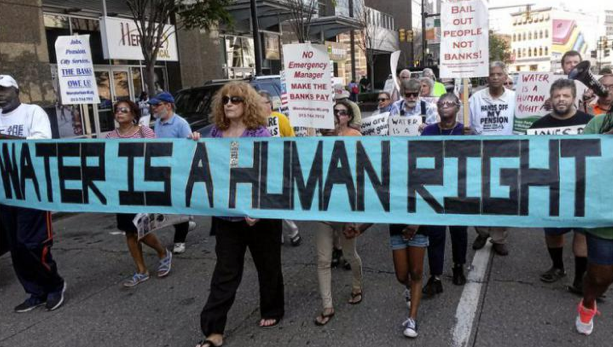
A press conference will be held on Thursday, August 28, 2014 at 11:00am in front of the Spirit of Detroit located outside of the CAYMC, where we plan to deliver over 90,000 signatures to Mayor Duggan, and Governor Snyder via Emergency Manager Orr. In an attempt to preserve the moratorium on water shut-offs, a group of Detroit residents and civil rights attorneys filed court documents over the weekend asking a judge to immediately block the Detroit Water and Sewerage Department (DWSD) from terminating water service to any occupied residence, and to require the restoration of service to occupied residences without water. The ACLU of Michigan and NAACP Legal Defense fund are serving as expert consultants in the ongoing litigation. Instead, the moratorium ended on Monday, August 25, 2014 and a hearing linking the shutoffs to the policies of the Emergency Manager and the rulings of the bankruptcy judge will be held at the bankruptcy court on September 2, 2014 at 8:30am. “Without a continued moratorium on water shutoffs, thousands more Detroiters, mostly low income children, seniors, and disabled, will immediately be at risk for shutoff,” says Alice Jennings of Edwards & Jennings, P.C., counsel in the lawsuit, “A comprehensive water affordability plan, a viable bill dispute process, specific polices for landlord- tenant bills and a sustainable mechanism for evaluating the number of families in shutoff status or at risk for shutoff, is necessary prior to lifting the DWSD water shutoff moratorium.”


Government’s Arsenal To Destroy Revolutionaries

Defining "political prisoner" is a risky endeavor, historian Dan Berger notes in the introduction to his recently released book on the topic, The Struggle Within: Prisons, Political Prisoners, and Mass Movements in the United States. Too often, it's assumed that political prisoners are people who "haven't done anything" - who are imprisoned simply because of their beliefs. However, as Berger articulates throughout this engrossing, fact-packed primer, most political prisoners did do something: They participated actively in movements to resist state power, often acting outside the bounds of the law. And so, rather than limiting conversations about political prisoners to determinations of "innocence" and "guilt," it's much more useful to discuss how and why the state attempted to suppress those movements. Through recounting the incarceration of activists fighting for black liberation, Native American sovereignty, Puerto Rican independence, economic justice, the abolition of nuclear weapons and more, Berger illustrates how imprisonment serves as a political tool deployed to maintain the status quo. The activists Berger introduces us to aren't usually protesting legislation or railing against particular politicians housed within current power structures. They're working to disrupt the deep groundings of those structures - including the legitimacy of the law itself. In other words, they're shaking the foundation of the very laws that are later used to confine them.

Part III: Tools To Track And Kill Activists

The U.S. Department of Defense's multimillion dollar university research program, the Minerva Research Initiative, is developing new data mining and analysis tools for the U.S. military intelligence community to capture and analyze social media posts. The new tools provide unprecedented techniques to identify individuals engaged in political radicalism around the world, while mapping their behavioral patterns and social or organizational connections and affiliations. The range of research projects undertaken by Arizona State University (ASU), a National Security Agency (NSA)-designated university, includes the development of algorithms which leading intelligence experts agree could directly input into the notorious "kill lists" – enhancing the intelligence community’s ability to identify groups suspected of terrorist activity for potential targeting via the CIA’s extrajudicial "signature" drone strikes. Through the Social Media Looking Glass One Pentagon-sponsored ASU project whose findings were published by the Social Network Analysis and Mining journal in 2012 involved downloading and cataloging 37,000 articles from 2005 to 2011 from the websites of 23 Indonesian religious organizations to “profile their ideology and activity patterns along a hypothesized radical/counter-radical scale.”

Four Days: Israeli Ship Blocked From Unloading In Oakland

San Francisco Bay Area activists have not allowed a vessel from Israel’s largest shipping company to unload in the Oakland Port for four consecutive mornings. On Tuesday, 19 August, at 6:45am, activists declared yet another victory against the Zim Line, which has been trying to make its way into Oakland since Saturday, 16 August. Lara Kiswani, the executive director of the local Arab Resource and Organizing Center, told The Electronic Intifada that they are now waiting to hear if the Zim Line will leave the Port of Oakland today with the cargo it brought. “If not,” Kiswani wrote in an email, “we will continue to mobilize until it does.” Organizers had initially planned a one-day action for 16 August, delaying the weekly, Saturday-scheduled offloading of the Zim ship by just one full work day. Saturday’s success was seamless: the Zim Pireaus avoided the Oakland Port completely, preferring to remain at sea south of Oakland rather than meet the thousands of protesters who had descended onto the docks. But, fueled off the initial triumph, activists returned to Berth 57 at the Oakland Port the next evening, on Sunday, 17 August. At 5pm Sunday, activists released an urgent call for supporters to convene at the port. Within thirty minutes of the call, hundreds of people returned to the docks. Workers with the International Longshore and Warehouse Union (ILWU) - Local 10 honored the picket line, and refused to unload the ship.

Seattle: Escalating Activism Leads To Escalating Surveillance

Activists in Seattle are currently extremely active, doing daily protests for Ferguson, Palestine, against Monsanto for environmental issues, among many other causes. Image credit: jglsongs It is under-reported how active these people are, and how much work they have put into making people conscious. Seattle, and more specifically Capitol Hill activists, are in such large numbers and work so peacefully and effectively, that the Seattle Police Department and the Department of Homeland Security are targeting them and doing heavier and heavier surveillance by the day. On a daily basis, helicopters fly over the protests that take place in Seattle, hovering menacingly over completely peaceful people. Innocent people get maced for no reason who aren’t even involved in protesting, and violence is instigated by the police. For example, earlier this week the anarchist Co-Op coffee shop ‘Black Coffee’ was put under blatant surveillance and were met with intimidation by an officer. A female officer parked directly in front of the place and pointed her dashcam camera at the activist coffee shop, videotaping the entire scene for about an hour and a half. This coffee shop is under investigation in several ways , and the police are doing everything they can to shut it down. It will probably have to move to another location in Seattle in the next few months.

Part II: DoD Data Mining To Track, Kill Activists

The Pentagon’s multimillion dollar Minerva research program to fund social science research for military applications includes a flagship project established in 2009 at Arizona State University (ASU) to examine “radical” and “counter-radical” Muslim movements in Southeast Asia, West Africa and Western Europe. The project’s "expert wisdom gathering tool," used by academics involved in the project to assess and rank the threat-level from organizations and civil society groups, set its sights on the UK, Germany, France, Europe generally, Nigeria, Niger, Senegal, Indonesia, Malaysia, Singapore and the Philippines. Although purportedly designed to assess Islamic movements, among the 36 UK organizations targeted for ranking on the tool’s "radicalization" scale are several non-Muslim activist groups critical of US, British and Israeli foreign policy. A deeper analysis of the criteria used by the project to label organizations discloses serious deficiencies that tend to cast suspicion of propensity for violence on any group calling for radical social, political or religious change. Conflating violent and nonviolent "radicalism" Explaining the rationale behind the Minerva initiative, program director Dr. Erin Fitzgerald said, “Decreasing terrorism and political violence requires an understanding of the underlying forces that shape motivations and mobilize action. The vast majority of political movements – even only those with seemingly ‘radical’ political philosophies – do not turn violent or destabilize regional security; we want to understand what makes those leading to armed conflict different.”

City Cut Funds For Mental Health Patients, Spied On Them Instead

Two years after Mayor Rahm Emanuel closed the mental health clinics, he's finally allowing his City Council allies to hold a hearing on them sometime this month. If it actually happens, I'm hoping someone asks about the curious tale of Mo and Gloves, because their story reveals a lot about the Emanuel administration's attitude toward mental health care in poor areas. The tale started in the fall of 2011, when the mayor decided to close six of the city's 12 clinics, most of them in low-income, high-crime neighborhoods. As I've written before, Emanuel never gave a reason for the closings. He never conducted a study or convened a task force or, most importantly, met with the patients—even though a number of them, backed by other activists, demanded that the mayor hear firsthand the consequences of closing clinics in low-income communities where residents are under stress from gunfire and unemployment. In fact, the mayor repeatedly went out of his way to avoid any face-to-face encounters.

Pentagon Funds New Data-Mining Tools To Track And Kill Activists

The U.S. Department of Defense (DoD) is funding a multimillion dollar university research program to develop new data mining and analysis tools for the U.S. military intelligence community to track political radicalism among British Muslims and other activist groups around the world. Leading intelligence experts including former National Security Agency (NSA) official Thomas Drake – the whistleblower who inspired Edward Snowden – confirm that the tools are designed to enhance the intelligence community’s capabilities to identify potential terrorism suspects that could face a range of sanctions, from surveillance to no-fly injunctions to, at worst, being targeted for extrajudicial assassination via the CIA’s "kill lists." But, they say, inherent flaws in the program are instead likely to facilitate the criminalization of political dissent and the targeting of innocent civilians – and that such trends are increasingly likely to affect not just "hostile theatres" abroad, but even domestic populations in the U.S., Britain and Europe.

Indonesian Women Take Environmental Protection Into Their Own Hands

Aleta Baun, an Indonesian environmental activist known in her community as Mama Aleta, has a penchant for wearing a colourful scarf on her head, but not for cosmetic reasons. The colours of the cloth, she says, represent the hues of the forests that are the lifeblood of her Mollo people living in West Timor, part of Indonesia’s East Nusa Tenggara province. “The forest is the life of my people, the trees are like the pores in our skin, the water is like the blood that flows through us…the forest is the mother of my tribe,” Aleta told IPS. “If I were a man, I would have been arrested and thrown in jail by now. Because we women stand together, police are reluctant to act like that.” -- Suryamani Bhagat, founder of the Torang tribal rights and cultural centre The winner of the 2013 Goldman Environmental Prize, she represents an expanding international movement against environmental destruction helmed by humble, often poor, rural and tribal women. For many years, Aleta has been at the forefront of her tribe’s efforts to stop mining companies destroying the forests of the Mutis Mountains that hug the western part of the island of Timor.

Occupiers Flock To Sacramento For Meeting

They gathered Thursday under a stand of redwoods near the steps of the state Capitol, a modest mix of young people and the graying veterans of the progressive and protest movements. They came to Sacramento, in the words of one, to reclaim the public square. Three years after Occupy Wall Street and the larger Occupy movement sprang into the national consciousness with rallies across the country and calls for economic justice, foot soldiers of the grass-roots movement are arriving in Sacramento for the third annual Occupy National Gathering. Previous gatherings were in Kalamazoo, Mich., and Philadelphia. “All of our grievances are connected,” said Nikohl Vandel of Palm Springs, who is advocating to close the Diablo Canyon nuclear power plant in San Luis Obispo County. Activists from across the country and as far away as Europe and Australia are meeting in the capital city over the next three days – a rally is planned Saturday at Sacramento’s Southside Park – to mobilize, strategize, share ideas and take the temperature of a movement that has seemingly faded from the limelight of its heady early days.

Syria: Activists Call For Release Of Human Rights Defender Mazen Darwish

Mazen Darwish, a prominent Syrian activist, human rights defender and the director of the Syrian Centre for Media and Freedom of Expression (SCM), was arrested with a number of his colleagues on 16 February 2012 by Assad forces that broke into his office in Damascus. For two years and half, Darwish, Hussien Ghreer and Hani al-Zayati have been kept Damascus central prison standing trial in terrorism court according to article (8), added newly to the Syrian law; while the regime is ignoring all International, legal and humanitarian calls to release them. The statement stresses the fact that the presidential pardon issued by Assad after the elections was another trick of the regime since dozens of people including Darwish and his co-workers were not released, though according to decree No. (22), they should be set free immediately with other activist detainees. The statement raises the issue of detaining and torturing civil activists and sending them to terrorism court while pardoning military people on one hand. On the other hand, the regime claims on media its readiness to negotiate with the opposition.

Activists Fighting To Protect Environment — And Their Lives

908. That’s the number of environmental and land-reform activists assassinated worldwide between 2003 and 2013, according to a study by the NGO Global Witness. The number might shock you, but perhaps even more shocking is that nearly half of those murders — 448 — took place in one country: Brazil. What is it that makes Brazil the most dangerous place in the world to be an activist? You’ll find clues in the story of Guarabana Bay. The bay, just minutes from downtown Rio’s world famous beaches, is a study in pollution and filth. Dark sludge cakes the shoreline. Garbage floats everywhere. It’s so bad that some sailors set to compete here in the 2016 Summer Olympics are warning colleagues not to let this water touch their skin. The sailors' worries do not surprise local fisherman Sandy Anderson de Souza. He said he was out in his boat in 2001 when Brazil’s state-run oil giant Petrobas accidentally dumped 1.3 million tons of oil into the waterway. “There was so much oil it looked like there was no water at all,” he said during a recent tour of the coastline. “A year later we noticed that many species of fish were disappearing and we started to catalogue this. There are 46 species of fish and shrimp that are no longer here.”
assetto corsa mods

Urgent End Of Year Fundraising Campaign

Online donations are back! Keep independent media alive. 

Due to the attacks on our fiscal sponsor, we were unable to raise funds online for nearly two years.  As the bills pile up, your help is needed now to cover the monthly costs of operating Popular Resistance.

Urgent End Of Year Fundraising Campaign

Online donations are back! 

Keep independent media alive. 

Due to the attacks on our fiscal sponsor, we were unable to raise funds online for nearly two years.  As the bills pile up, your help is needed now to cover the monthly costs of operating Popular Resistance.

Sign Up To Our Daily Digest

Independent media outlets are being suppressed and dropped by corporations like Google, Facebook and Twitter. Sign up for our daily email digest before it’s too late so you don’t miss the latest movement news.