Skip to content

Food and Agriculture

Farmers Clash W/ Police In Milk & Meat Prices Protest

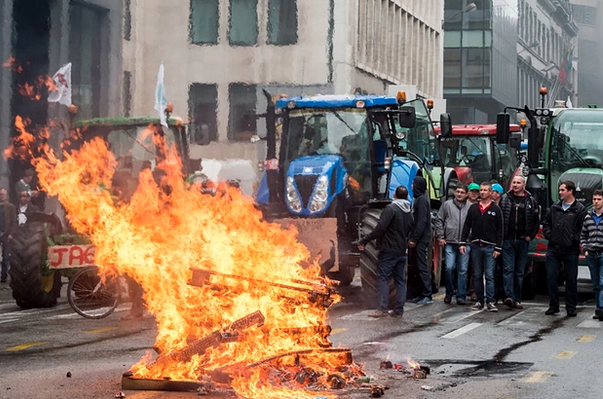
By Graham Ruddick in The Guardian - European agriculture ministers have agreed a €500m (£366m) aid package at an emergency meeting in Brussels as police outside clashed with farmers protesting against falling dairy and meat prices. The announcement from the commission came after a day of protests, which police said involved 4,800 farmers – with 70 from Britain – and 1,450 tractors. Tractors blockaded streets while some protesters pelted the police with eggs and sprayed milk and hay at them. At least one police officer was injured and water cannon were used. Jyrki Katainen, vice-president of the European commission, said the aid was a “robust and decisive response” to the crisis in the industry.

City Farmer’s Journey Of Hope In NYC

By David Radovanovic on Youtube. New York City, NY - City Farmers is a journey of hope down New York City's meanest streets where inner-city residents have transformed the rubble and rats of abandoned land burgeoning vegetable and flower gardens. "City Farmers is about as inspiring as they come, a cornucopia of hope, fulfillment and diversity." -- LA Weekly, Paul Malchom In this collective narrative, the gardeners share stories about life on both sides of the garden fence; from the struggle to remove drug dealers and gangs, to the success of the gardens providing food for the community, as well as empowering and educating neighborhood children.

Latvia And Greece Kick Monsanto Out, Opt To Ban GM Crops!

By Amanda Froelich in True Activist - First Scotland opted to ban GM crops from its country, citing fear of GMO crops contaminating its food supply, then Germany followed suit. Now, both Latvia and Greece have booted Monsanto from their countries and banned the only GM crop presently allowed to be grown in EU countries, Monsanto’s MON810 GM Maize. If it wasn’t clear before, it seems quite evident that the tide is turning. Big biotech companies are losing influence by the day, and the addition of two more European countries in favor of banning GMOs is evidence of that. Under the EU law signed in March, individual countries can seek geographical exclusion from any approval request for GM cultivation across the EU. Every request to ‘opt out’ of GM cultivation has to be approved by not only the European Commission but also the company making the application, Monsanto.

Colombia’s Agriculture Ministry Occupied Amid Agrarian Protests

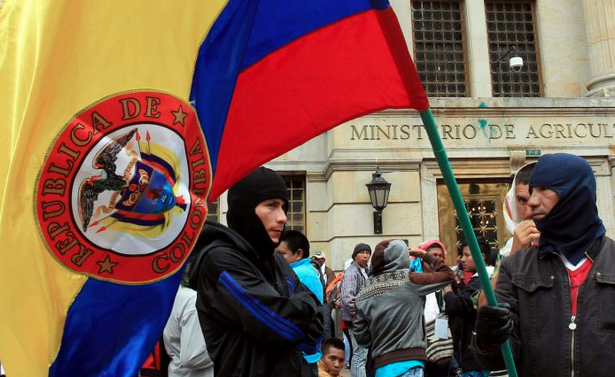
By Grace Brown in Colombia Reports - Some 100 masked protesters occupied the Colombia’s ministry of agriculture in the capital Bogota on Tuesday in an escalation of a demonstration by farmers that began on Monday. The protesters blocked the entrance and exit to the ministerial building on Tuesday morning, demanding that the ministry “complies with agreed commitments and that President [Juan Manuel] Santos guarantees the right to protest”, a spokesperson for the group told Caracol radio. The authorities said that they have since regained control of the building and evacuated the protesters. The occupation occurred in the middle of a peaceful protest, which saw 5,000 farmers from rural areas arrive in Bogota on Sunday, demanding answers from Santos, who has failed to keep promises he made in negotiations to end a major agrarian strike in 2013.

Why Food Belongs In Our Discussions Of Race

By Kirsten Wartman in Civil Eats - In the wake of the unrest in Ferguson, Missouri, after the death of Michael Brown, the Baltimore uprising after the death of Freddie Gray, and the emergence of the Black Lives Matter movement, much has been written about the nature of poverty and violence in American cities. But one aspect that is chronically underreported is the lack of access to healthy foods in many of those same communities. Indeed, the reliance on a highly processed food supply is causing disease, suffering, and eventual death, especially to those in the poorest of neighborhoods. A report released this June by the Johns Hopkins Center for a Livable Future found that one in four Baltimore residents lives in an under-resourced area or “food desert” (a term that some food activists reject). This is not unusual or unique to Baltimore, but is the standard in urban centers throughout the country.

Food Fight 2015: Taking Down The Degenerators

By Ronnie Cummins in Organic Consumers - After decades of self-destructive business-as-usual—empire-building, waging wars for fossil fuels, selling out government to the highest bidder, lacing the environment and the global food supply with GMOs, pesticides, antibiotics, growth hormones, toxic sweeteners, artery-clogging fats, and synthetic chemicals, attacking the organic and natural health movement, brainwashing the body politic, destroying soils, forests, wetlands, and biodiversity, and discharging greenhouse gas pollution into the atmosphere and the oceans like there’s no tomorrow—we’ve reached a new low, physically and morally. Distracted by know-nothing media conglomerates and betrayed by cowardly politicians and avaricious corporations, homo sapiens are facing, and unfortunately in many cases still denying, the most serious existential threat in our 200,000 year evolution—catastrophic climate change.

Black US Farmers, Honduran Afro-Indigenous Share Food Prize

By Heather in Community Alliance for Global Justice - In this moment when it is vital to assert that Black lives matter, the U.S. Food Sovereignty Alliance honors Black and Afro-Indigenous farmers, fishermen, and stewards of ancestral lands and water. We especially commemorate them as a vital part of our food and agriculture system – growers and workers who are creating food sovereignty, meaning a world with healthy, ecologically produced food, and democratic control over food systems. In 2015, the U.S. Food Sovereignty Alliance’s two prize winners are: the Federation of Southern Cooperatives in the U.S., and the Black Fraternal Organization of Honduras. The prizes will be presented in Des Moines on October 14, 2015.

Protesters Urge Costco Not To Sell Genetically Modified Salmon

By Natasha Chen in KiroTV - A dozen protestors met with a Costco executive Thursday to deliver a petition, urging the wholesale company not to sell genetically modified fish. The protesters told KIRO 7 they are particularly concerned about fish produced by a company called Aqua Bounty, who crosses the DNA of three different types of fish to create salmon that grows twice as fast. The fish is currently not approved by the U.S. Food and Drug Administration, but several grocers have already pledged not to sell the fish if it ever gets approved. The protesters said those grocers include Target, Trader Joe’s, QFC, and Safeway. In a video shot by protesters when they met with the chief operating officer of merchandising, the executive told them it would be hard to promise never to sell the product: “That would be disingenuous to say ‘never.’ Never is a long time, right?” “They’re not listening to Costco members that are saying that they don’t want genetically modified foods,” said Danielle Friedman, the organizing director of Community Alliance for Global Justice.

Soil Not Oil International Conference

By Soil Not Oil - Inspired by Dr. Vandana Shiva’s book, Soil Not Oil, the 2015 Soil Not Oil International Conference examines the crisis on food security while highlighting the role of oil-based agro-chemicals and fossil fuels in soil depletion and climate change. The conference will focus on practical carbon farming solutions including cover crops, planned grazing, compost application on range land, tree planting and other holistic land use practices. “We are pleased to host this important gathering in the San Francisco Bay Area, the heart of the organic food industry,” said Richmond-based John Roulac, founder and CEO of organic food leader Nutiva. “To secure a livable planet we need to both de-carbonize energy and re-carbonize our soils via regenerative agriculture.“

GMOs, Herbicides, And Public Health

By Philip J. Landrigan, M.D., and Charles Benbrook, Ph.D. - Two recent developments are dramatically changing the GMO landscape. First, there have been sharp increases in the amounts and numbers of chemical herbicides applied to GM crops, and still further increases — the largest in a generation — are scheduled to occur in the next few years. Second, the International Agency for Research on Cancer (IARC) has classified glyphosate, the herbicide most widely used on GM crops, as a “probable human carcinogen”1 and classified a second herbicide, 2,4-dichlorophenoxyacetic acid (2,4-D), as a “possible human carcinogen.”2 The application of genetic engineering to agriculture builds on the ancient practice of selective breeding. But unlike traditional selective breeding, genetic engineering vastly expands the range of traits that can be moved into plants and enables breeders to import DNA from virtually anywhere in the biosphere.

Meet America’s First School District To Serve 100% Organic Meals

By Nadia Prupis in AntiMedia - When schools in California’s Sausalito Marin City District return to session this August, they will be the first in the nation to serve their students 100 percent organic meals, sustainably sourced and free of genetically modified organisms (GMOs). More than 500 students at Bayside MLK Jr. Academy in Marin City and Willow Creek Academy in Sausalito will eat fresh, local food year-round, thanks to a partnership with the Conscious Kitchen, a project of the environmental education nonprofit Turning Green. “Students everywhere are vulnerable to pesticide residues and unsafe environmental toxins,” Turning Green founder Judi Shils said on Tuesday.

Germany’s Agricultural Minister Moves To Ban GM Crops

By Nick Meyer in March Against Monsanto - As United States citizens battle legislation like the DARK Act (HR 1599, now headed to the Senate) designed to take away mandatory GMO labeling, across Europe the debate is not over whether to label but instead whether to ban the controversial crops. Recently one European nation, Scotland, announced its plans to enact a ban, and now another big domino is set to fall on the side of banning GMOs as well: Germany. According to a report from Reuters today, the nation with a population of over 80 million will make use of the European Union’s “opt-out” clause in order to move toward a ban of genetically modified crops, according to documents seen by the news agency.

Stop Corporate Sacrifice Zones From Destroying Everything

By Lee Camp on Redacted Tonight. In his new book, Erik Loomis explains how corporations create "sacrifice zones" in which they often decimate the land and people. They do this in areas with poor minority populations because those are the people least likely to have the power to fight against it. We see this across the US but also around the world. The Trans-Pacific Partnership (TPP) and other rigged corporate trade treaties will make every community into a potential sacrifice zone, unless we stop them. Here's how to protect your community: Step one is to keep the TPP from becoming law. Step two is to scream from the hills about the wrongdoing of major corporations To learn more, comedian Lee Camp breaks down both how this works and how to fight back against it on his show, Redacted Tonight.

Speech Of Walden Bello At “People’s Struggles & Alternatives”

By Walden Bello in Focus Web - It is great to see so many of those who have been part of Focus on the Global South’s twenty-year journey here today, cherished comrades and friends, all of who are also 20 years older…but all still burning with youthful energy like Focus. Focus was born in the same year as the World Trade Organization, with the goal of challenging that force of which the WTO was said to be the cutting edge: corporate-driven globalization. When we were founded, we were said to be on the wrong side of history. We were told that we were like the people who claimed that the earth was flat, that globalization would sweep all before it and deposit us in the dung heap of history. We were undeterred because we were convinced we were on the right side of history, on the side of the vast majority of people who were hurt and devastated by globalization.

World Food Supply At Growing Risk From Severe Weather

By Erik Stokstad in Science Mag - In 2007, drought struck the bread baskets of Europe, Russia, Canada, and Australia. Global grain stocks were already scant, so wheat prices began to rise rapidly. When countries put up trade barriers to keep their own harvests from being exported, prices doubled, according to an index of the Food and Agriculture Organization of the United Nations. Just 3 years later, another spike in food prices contributed to the Arab Spring uprisings. Such weather-related crop disasters will become more likely with climate change, warns a detailed report released today by the Global Food Security (GFS) program, a network of public research funding agencies in the United Kingdom. “The risks are serious and should be a cause for concern,” writes David King, the U.K. Foreign Secretary’s Special Representative for Climate Change, in a foreword to the report.
assetto corsa mods

Urgent End Of Year Fundraising Campaign

Online donations are back! Keep independent media alive. 

Due to the attacks on our fiscal sponsor, we were unable to raise funds online for nearly two years.  As the bills pile up, your help is needed now to cover the monthly costs of operating Popular Resistance.

Urgent End Of Year Fundraising Campaign

Online donations are back! 

Keep independent media alive. 

Due to the attacks on our fiscal sponsor, we were unable to raise funds online for nearly two years.  As the bills pile up, your help is needed now to cover the monthly costs of operating Popular Resistance.

Sign Up To Our Daily Digest

Independent media outlets are being suppressed and dropped by corporations like Google, Facebook and Twitter. Sign up for our daily email digest before it’s too late so you don’t miss the latest movement news.