Skip to content

Jobs

The AI Race: How The Surge In Data Centers Harms Us

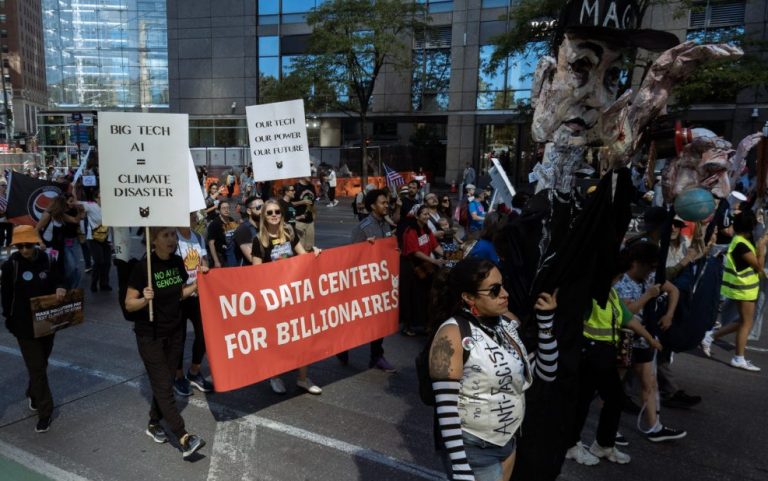
There are more than 5,400 data centers in the United States, which is almost half of the number of data centers worldwide. In the past four years, there has been a surge in data center construction, particularly in poor communities in the South. Clearing the FOG speaks with Jai Dulani of Media Justice, who authored a new report: The People Say No: Resisting Data Centers in the South, and Kali Akuno of Cooperation Jackson, about the harms that these centers are causing in local communities, particularly in their enormous consumption of water and energy, and the risk they pose to the US economy. Akuno also addresses the bigger picture of the deleterious impact of artificial intelligence on our lives.

It’s Time For Community Incubators

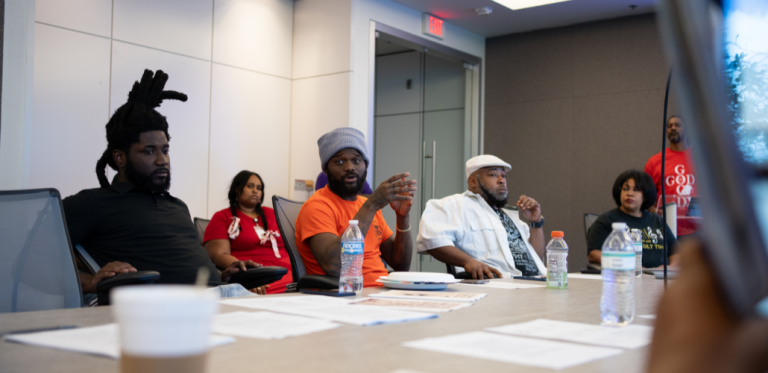
Let’s imagine something new has arrived in the neighborhood—a community incubator. It’s a little like a free health club, if you take health in the broadest sense—i.e., including social and economic health. You could think of the incubator as working like a golden funnel turned on its side. It’s wide-open at one end (which most business incubators are not really) but it channels and directs the flow to particular places—like toward a good job. Or even a new business you co-own. The logical home for a program like this is a community hub. You probably know this kind of place. It’s not a community center with yoga classes and senior swimming groups. An authentic community hub feels grassroots-y and kinda political.

US-Based Companies Announce Record Number Of Impending Layoffs

Companies based in the U.S. announced in July that they plan to eliminate a record number of jobs, more than double the amount announced in the same month last year, according to a new report. The report, from recruitment firm Challenger, Gray & Christmas, tracks U.S.-based employers’ announcements about layoffs, which do not indicate the number of job losses that have occurred or when the positions will be eliminated. The estimates can change based on a variety of factors, including, in the case of government layoffs, litigation, explained Gbenga Ajilore, chief economist at the Center on Budget and Policy Priorities. “These are job cut announcements versus actual people losing a job,” Ajilore told Truthout.

Corporations Want To Prevent Workers From Leaving Their Jobs

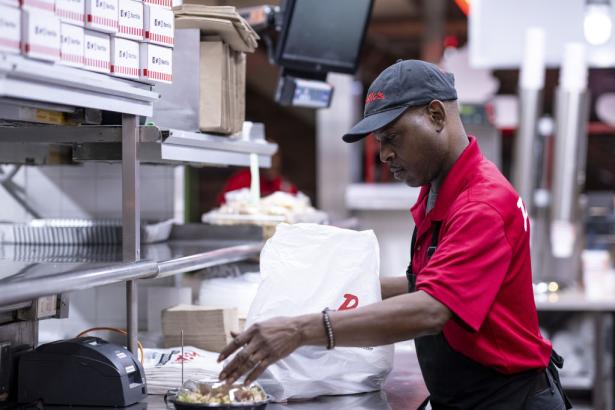
A Texas nurse switched to a better-paying job at a nearby hospital only to wind up with debt collectors at her door demanding she pay her former employer back for a loan she didn’t know she owed. A cargo pilot faced a $20,000 lawsuit over job-training expenses at a commercial airline that had just fired him for refusing to fly a plane under unsafe conditions. After being promised college tuition relief paid for by Chipotle, fast-food workers can get stuck with the tuition bill. These are all examples of how millions of workers across the country are increasingly finding themselves bound by Training Repayment Agreement Provisions (TRAPs), a new form of “stay-or-pay” contract that indebts employees to their bosses.

Deporting Immigrants Kills Native Jobs Too

As Trump and his ICE Sturmabteilung troop stormingly about the country deporting people, there’s an important fact that’s being overlooked: deporting undocumented workers destroys domestic jobs as well. Of course, their nativist campaign is grotesque and revolting in itself, and would be were no native-born bystanders injured by the expulsions. But we should be clear on what damage we’re doing to ourselves as well. As Ben Zipperer shows in work for the Economic Policy Institute, almost as many native-born workers could lose their jobs as deported immigrants.

This Baltimore Food Incubator Is A Local Economic Engine

Walking up the stone steps to MFG Toffee & Bark Company a few days ahead of the shop’s grand opening in Baltimore’s Little Italy, chef Sylva Lin inhales the scent of sugar and espresso coming from the kitchen. She’s dropping by to see the fruit of her efforts incubating local food businesses out of Culinary Architecture, the project she launched a decade ago. After a successful career in catering and professional kitchens, Lin’s entrepreneurial spirit was hungry to create a space that would benefit her neighborhood in Baltimore. She didn’t just want to offer interesting foods. She wanted to connect with neighbors, create good-paying jobs and draw foot traffic to support other businesses on the block.

Amazon Workers Defy Dictates Of Automation

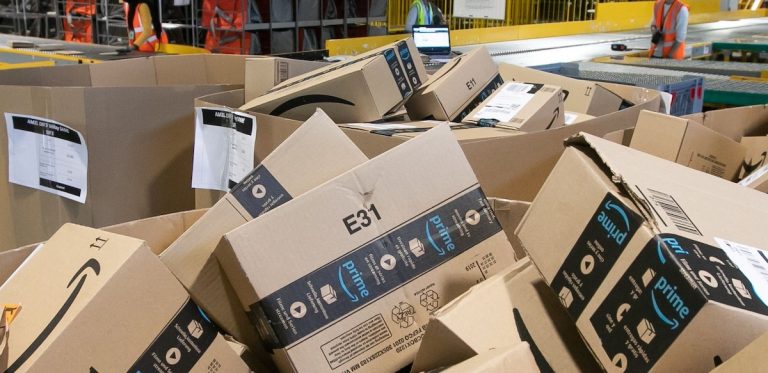
Amazon delivery stations are being outfitted with robots across the country, leading to fewer workers and speedup for the workers that remain. Workers have reacted with defiance at the delivery station where I work. Amazon fulfillment centers, where items are packaged up, have been gradually automating, but until now, delivery stations were mostly operated by human labor. Now, entire systems are being retrofitted or entirely removed “in the name of safety” and “for the good of employees.” But automation means workers will be laid off, shifted into new positions, or forced to transfer. I work at the New York delivery station DBK4, in Maspeth, Queens, and it’s a window into this future.

Student Unions Overwhelmingly Vote For ‘Fossil Free Careers’

Students’ unions at two universities have voted overwhelmingly to boycott fossil fuel recruiters. Non-profit People & Planet coordinated the successful student-led Fossil Free Careers campaigns at University College London (UCL) and the University of Bath. Students there are demanding that their institutions end oil, gas, and mining industry recruitment on their campuses for good. As a result of student campaigning by the Bath People & Planet Society and the UCL Climate Action Society, UCL and Bath Students’ Unions are now mandated to actively campaign for their universities’ careers services to implement an ethical careers policy that excludes oil, gas, and mining companies from recruiting on campus.

Waiting For The Supply Shock

Two milestones converged this week that seem important in the moment but in retrospect will be minor blips historically: yesterday’s reaching of the first hundred days of Donald Trump’s second term, and today’s announcement of first-quarter gross domestic product showing the economy contracted by 0.3 percent on an annualized basis. The former is just a news hook to overlay “what it all means” stories that are as light as air. The second covers the period before the April 2 Liberation Day, though it was influenced by it.

Who’s Fighting Back (And Not) Against Cuts in Veteran’s Administration

Among the Republican voters experiencing buyer’s remorse are more than a few military veterans who chose Trump over Harris by a margin of 65 to 34%, according to some exit polls. Their shock and dismay surfaced in DC this month during the legislative conference of the reliably conservative and hawkish Veterans of Foreign Wars (VFW), which has 1.4 million members. In the run-up to that annual event, VFW national commander Al Lipphardt, urged his members to “march forth” and “engage with lawmakers” to “stop the bleeding” at the Department of Veterans Affairs (VA).

Labor Faces Artificial Intelligence And Outsourcing

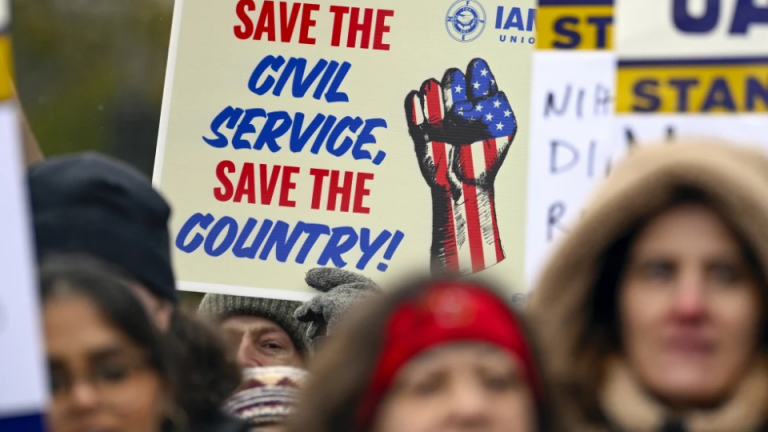
Two recent articles on AI / automation and outsourcing / immigration offer a glimpse of what faces labor unions and the working class as capital, emboldened by the election of Trump and his alliance with Big Tech, sets up to continue its push on automation, subcontracting, outsourcing, and the importing of foreign labor – despite Trump’s tacit claims to support “American jobs”. Organized labor, which, with the exception of the Teamsters, doubled down on its support for Biden and the Democrats in November and clinging to the lost strategy of labor-management cooperation, now appears more on the backfoot than ever to defend against the onslaught.

Union Jobs, At Your Fingertips

Union workers make more than non-union workers, on average by more than 10%. For women, that differences is more than 20%. That’s a crucial pay bump for many working people, not to mention the job security, workplace protections, and earned respect that come with a union contract. These differences can be life changing. Wanting a union job is one thing — but finding a union job is another. Enter the Virtual Union Hiring Hall, a collaborative project between the Presidents’ Organizing Initiative (POI) housed at the Martin Luther King Jr. County Labor Council (MLK Labor) and Partner in Employment (PIE).

Philadelphia’s Reforestation Hub Isn’t Just Diverting Tree Waste

Each year, U.S. cities lose an estimated 36 million trees to development, disease and old age, many of which ultimately end up in landfills. Losing these urban trees – known to help cool their neighborhoods, lower carbon emissions and improve mental health, among other benefits – costs an estimated $96 million annually. In Philadelphia, a partnership is giving the City of Brotherly Love’s fallen trees new life. Philadelphia Parks & Rec joined forces with Cambium Carbon, a Washington, D.C.-based startup that repurposes waste wood, and PowerCorpsPHL, a local nonprofit that creates job opportunities for unemployed and under-employed 18- to 30-year-olds, to launch the Reforestation Hub in late May.

Applause For The FTC’s Ban On Noncompete Agreements

Today, the Federal Trade Commission voted to issue a rule declaring that most noncompete clauses in employment contracts are unfair methods of competition. This is an important step toward fostering fair competition and empowering U.S. workers. Noncompete agreements are employment provisions that ban workers at one company from working for, or starting, a competing business within a certain period of time after leaving a job. These agreements are ubiquitous. EPI research finds that more than one out of every four private-sector workers—including low-wage workers—are required to enter noncompete agreements as a condition of employment.

How US Government Statistics Are Like The Bible

This week on February 2nd, the US Labor Department released its monthly jobs report for January. One of the Department's two surveys showed +353,000 jobs created in January. But a second report shows a drop in total employment in January of -1,070,000 full time and part-time jobs (and an additional -400,000 jobs if one includes unincorporated independent contractors jobs. So, like the Bible, one can find whatever one wants in the government job stats. So why the discrepancies between the two surveys in the monthly jobs report? One reason is that the two surveys have big differences in their methodologies (and underlying assumptions).
assetto corsa mods

Urgent End Of Year Fundraising Campaign

Online donations are back! Keep independent media alive. 

Due to the attacks on our fiscal sponsor, we were unable to raise funds online for nearly two years.  As the bills pile up, your help is needed now to cover the monthly costs of operating Popular Resistance.

Urgent End Of Year Fundraising Campaign

Online donations are back! 

Keep independent media alive. 

Due to the attacks on our fiscal sponsor, we were unable to raise funds online for nearly two years.  As the bills pile up, your help is needed now to cover the monthly costs of operating Popular Resistance.

Sign Up To Our Daily Digest

Independent media outlets are being suppressed and dropped by corporations like Google, Facebook and Twitter. Sign up for our daily email digest before it’s too late so you don’t miss the latest movement news.