Skip to content

Labor Movement

Strike Wave Rocks Britain, As Unions Confront The Cost-of-Living Crisis

In Britain today, anyone asking a worker about the direction the country is headed will be unlikely to receive a printable answer. Stumbling from crisis to crisis, the country is on its third prime minister of the year. Energy bills have skyrocketed by 96 percent since last winter, and rent has shot up by as much as 20 percent, while inflation—which currently stands at 12.3 percent—has been predicted to rise as high as 18 percent by the first few months of 2023. This is happening in a country which was the first in Western Europe to register 200,000 deaths from the coronavirus and has already been subject to brutal austerity measures that have wrecked the social fabric. An analysis by the Trades Unions Congress (TUC, the British equivalent of the AFL-CIO) released earlier this year found that British workers earned £60 ($70) less per month in real wages in 2021 than at the start of the financial crisis in 2008—the longest wage slump since the Napoleonic Era.

Starbucks Workers’ First National Strike

On Thursday morning, thousands of Starbucks workers across the country rose at the crack of dawn — some braving bitter cold — to set up picket lines outside their stores. Over 100 Starbucks locations participated in what workers were calling the “Red Cup Rebellion” — a nationwide walkout planned by Starbucks Workers United (SBWU), the union that represents nearly 7,000 Starbucks workers across the United States. Workers who spoke to In These Times said they hoped the day of action would finally convince Starbucks to negotiate in good faith instead of doubling down on retaliation, intimidation and union busting. The strike was strategically timed. Starbucks’ annual Red Cup Day is a late fall tradition where customers can get certain beverages in reusable, limited-edition holiday cups.

How The Pandemic Changed The Landscape Of US Labor Organizing

The story of essential workers during the pandemic is part of the long unraveling of the New Deal. The destruction of the welfare state, the attack on unions, and the rise of neoliberalism provide the historical backdrop for the pandemic labor unrest. As workers’ fortunes came under renewed attack in the early 1970s, the historic gains of the New Deal were rolled back decades. Inequality became the defining feature of our economy as we arrived at a second Gilded Age. This was more than unfair — during the pandemic it had deadly consequences. A 2020 study found that in over 3,000 U.S. counties, income inequality was associated with more cases and more deaths by the virus.

Lessons On Workplace Activism From Winning Campaigns At Google

On Sept. 14, 2020, Google CEO Sundar Pichai posted a blog outlining the company’s “Third Decade of Climate Action,” with its escalated commitments to addressing the crisis. Among them were an elimination of Google’s entire carbon legacy, a commitment to run all of its campuses and data centers on carbon free electricity, and promises to invest in tools to promote energy efficiency. The announcement came on the heels of an escalating pressure campaign from Google workers for the tech giant to do better on climate change. Like many campaign victories, it was an imperfect one. Many of the Google workers’ demands, like a commitment to cease funding for climate-denying think tanks, remained unaddressed.

Canadian Education Workers Strike Against Anti-Strike Law And Inflation

Ontario, Canada - The Canadian province of Ontario is in the midst of a fierce labor struggle, the likes of which hasn’t been seen in decades. On Thursday, November 3, Ontario Premier Doug Ford signed Bill 28 (the “Keeping Students in Class Act”), which made it illegal for education workers represented by the Canadian Union of Public Employees (CUPE) and Ontario School Board Council of Unions (OSBCU) to go on strike. The next day, 55,000 education workers walked off the job in defiance of the bill, risking a C$4,000 fine. These workers, mainly janitors, early childhood educators, librarians, and other support staff, are demanding a C$3.25 pay raise, overtime pay, an expansion of benefits, and 30 minutes of daily prep time. The mood at the Friday demonstration was combative.

Teamsters President Sean O’Brien Vows To ‘Pulverize’ UPS

Chicago — Spelling out union strategy for an all-important contract with UPS, Sean O’Brien worked his way up to a fiery pitch. ​“We gotta strategize, we gotta organize, and then we gotta pulverize UPS,” he declared. The room erupted into cheers, applause and fists clenched upward. The presentation by the short, muscular, bald-headed, fourth-generation Teamster from Boston, a union member since his teenage years, felt like a shop steward’s typical nitty-gritty warm-up speech.  Listening near the back of the conference, Dan Campbell, 69, a retired Teamster from Wisconsin, felt lifted by what he heard. He liked O’Brien’s ​“hard-nosed” tone and especially liked his call ​“for everyone to get on board and row with all hands.” O’Brien is president of the one-million-plus Teamsters Union.

Bosses Hate This One Trick

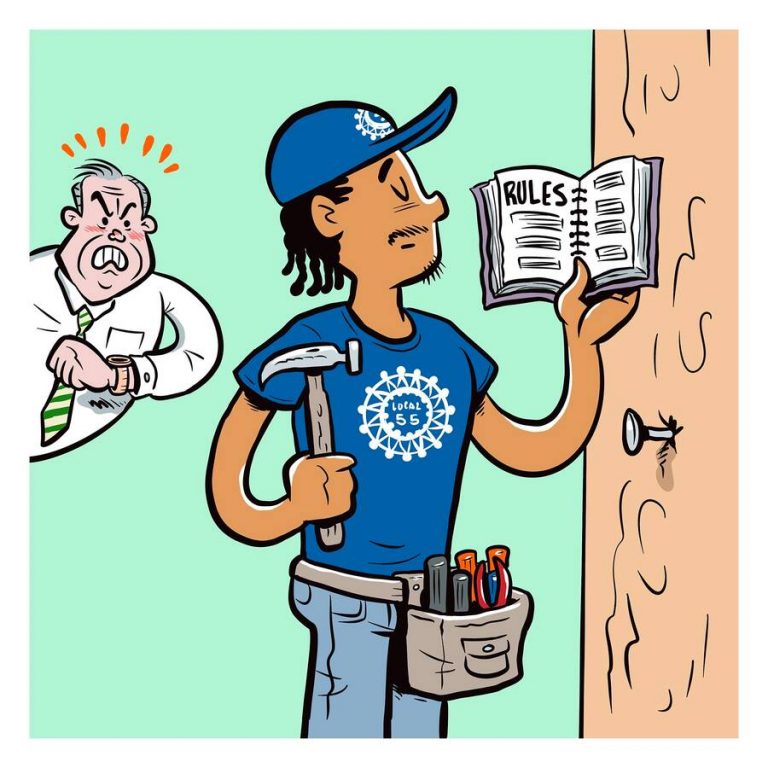
Work-to-rule has been deployed successfully across industries throughout the decades, especially when traditional strikes aren’t an option. In 1938, French railway workers barred from striking instead seized on a law requiring train engineers to consult crew members if there was any doubt about a bridge’s safety. Crew members began scrutinizing every bridge, incurring massive train delays and therefore gaining negotiating power.In the 1980s, when United Auto Workers realized during contract negotiations that manufacturers were trying to provoke workers into striking — to permanently replace them with scabs — the union turned to work-to-rule, throwing production into chaos and winning a 36% wage bump over three years at one plant.

Have We Learned Anything Since Striketober?

This month marks the one-year anniversary of “Striketober.” Last fall, many expressed hopes that the labor movement was experiencing a Phoenix-like resurgence in the form of a strike wave. New data and measures of strike activity reported “dramatic” increases that garnered significant media attention. Gathered by the likes of Payday Report and Cornell’s School of Industrial Relations, these new data and measures were partly meant to question official, government measures of strike activity collected by the Bureau of Labor Statistics, which stopped collecting more comprehensive data in the early 1980s. However, subsequent commentary threw buckets of cold water on this pyre of hope.

Black Mold, Bed Bugs And Anti-Union Tactics

Manhattan, New York - On Tuesday morning, 10 workers at Starbucks’ upscale Reserve Roastery in Manhattan, New York walked off the job, alleging unsanitary work conditions including bed bugs and black mold, as well as union busting by management. “Nobody wants to be in a building where management is lying to us, keeping us in the dark, where we clearly have a big bed bug infestation. Nobody wanted to be there,” says 27-year-old Nicole DeRose, an employee at the store who was on shift when the strike began. Starbucks Media Relations said in an email to In These Times that it became aware of a “potential pest issue” on Monday and called a pest control service that found no evidence of an infestation and “gave…the all-clear to re-open on Tuesday.”

How To Win NLRB Cases Against Union-Busters

As big brands like Amazon, Starbucks, and Chipotle lash back at worker organizing, union-busting is getting long overdue exposure in the press. But while the stories graphically depict the problem, they don’t offer any solutions. Though many of the common tactics of union-busting are illegal, there are only insignificant penalties that fail to discourage its lucrative practice. This is the only area of law where attorneys can advise clients to commit perjury in federal court without fear of disbarment or even censure. A union leader who understands leverage and human nature, though, can unmask their deception. Union-busting on a plant-wide scale usually takes place under three circumstances: organizing drives, first contract negotiations, and attempts to decertify an existing local.

New Leadership, New Direction In Major Midwest Teamsters Local

Members overwhelmingly elected new leadership in the 14,000-member Teamsters Local 135, where Dustin Roach and the 135 Members First Slate won with 68 percent of the vote. The election is a triumph for grassroots action and rank-and-file power, after an intense grassroots member-to-member campaign. Local 135 is one of the biggest locals in the Teamsters, representing members across Indiana, Ohio, and Michigan as well as 2,000 flight attendants nationwide at Republic Airlines. Until recently, no one could have seen this change coming to a local that was tightly controlled by officers and dominated from the top down. But Local 135 members organized for change from the bottom up—and now they’re in the driver’s seat.

It’s Time To Tap Into Labor’s Fortress Of Finance

Despite the recent upsurge in worker militancy, union membership and density have been declining for decades. But a close look at labor’s finances suggests that unions have the economic resources to potentially reverse this decline. Standard explanations for labor’s decline blame our grossly unfair labor laws, the full-scale corporate attack on organizing and collective bargaining, and economic trends including the decline of manufacturing. But labor is not a passive bystander. Unions have the resources to deploy to new organizing and growth. They have chosen to pursue a defensive financial strategy instead. Consider the National Education Association. Since 2010 its membership has declined by nearly 300,000—while its net assets more than doubled.

‘I Don’t Want To Work Two Jobs’: College Of William And Mary Workers

Dining workers across the US were hit hard by the pandemic. Layoffs, staff shortages that have put immense pressure on workers (increasing workloads and creating long lines), requests by some schools for faculty and staff to volunteer to assist in dining halls—all of this has created nearly impossible working conditions. For all their sacrifices and best efforts, however, as working conditions have continued to deteriorate, pay and benefits have stagnated. As a result, some workers in this industry are attempting to unionize to improve these conditions and push universities to treat (and compensate) their workers better. For about five years, Ivory Merritt, a mother of three, has worked for dining services contractor Sodexo at the College of William & Mary in Williamsburg, Virginia, a public research university that, founded in 1693, is the second oldest institution of higher education in the US.

Crisis In The UK Regime: From A Summer To A Winter of Discontent?

Just six weeks after taking office, Liz Truss resigned as head of the Conservative Party, the third UK prime minister to step down in as many years. In recent weeks, a growing number of Tory ministers had been calling on her to resign following the economic turmoil set off by her proposed economic adjustment plan. The final blow to the Truss regime came with the one-two punch of her sacking her finance minister and close ally, Kwasi Kwarteng, and receiving the resignation of Home Minister Suella Braverman. Although she had vowed to stay and fight, quoting the architect of Tony Blair’s neoliberal reign and saying she was not a quitter but a fighter, the chips were hard to consolidate. Following Prime Minister Boris Johnson’s resignation on a slew of ethics violations, Truss was selected as PM by the Tory majority, inheriting a regime that is in deep economic, social, and political crisis.

Students For A Democratic Society Convention: ‘Not Another Step Back!’

Kent, Ohio - On October 15 and 16, members of the New Students for a Democratic Society (SDS) from across the United States gathered for their annual national convention at Kent State, Ohio. Roughly 90 students from SDS chapters and affiliates listened to speakers and gave workshops, summing up their victories and losses over the past year. The convention was united under the slogan of, “Not Another Step Back!” in reference to the year-long fight to keep rights such as the right to an abortion, but also to win even more. They featured national SDS’ commitments to, “Fight for Black lives, defend Roe v. Wade, and stop homophobic and transphobic attacks.” The location was particularly poignant to New SDS, as local students and faculty membered the four students who were killed on campus by the National Guard in 1970 for protesting the Vietnam War.
assetto corsa mods

Urgent End Of Year Fundraising Campaign

Online donations are back! Keep independent media alive. 

Due to the attacks on our fiscal sponsor, we were unable to raise funds online for nearly two years.  As the bills pile up, your help is needed now to cover the monthly costs of operating Popular Resistance.

Urgent End Of Year Fundraising Campaign

Online donations are back! 

Keep independent media alive. 

Due to the attacks on our fiscal sponsor, we were unable to raise funds online for nearly two years.  As the bills pile up, your help is needed now to cover the monthly costs of operating Popular Resistance.

Sign Up To Our Daily Digest

Independent media outlets are being suppressed and dropped by corporations like Google, Facebook and Twitter. Sign up for our daily email digest before it’s too late so you don’t miss the latest movement news.