Skip to content

Labor

Bangladesh Police Fire Tear Gas At Striking Garmet Workers

Bangladesh police have fired tear gas and stormed a garment factory where workers were staging a hunger strike over pay, a union official says. The police, armed with batons, forced 400 workers to flee the factory in the capital Dhaka where they had been holding a 10-day strike to demand back pay and a holiday bonus, the official said. Bangladesh's garment industry, the world's second largest, which supplies top Western retailers such as Wal-Mart and H&M, has a woeful history of poor pay and conditions for its four million workers. "Police fired tear gas and baton charged us, they forced us out of the factory, where we were staging the hunger strike," said Moshrefa Mishu, head of Tuba Group Sramik Sangram Committee, which represents 15 garment unions. An AFP reporter at the scene saw workers running out of the factory crying due to the tear gas, while others were bleeding from head injuries. Angry at the police action, the workers then took to the streets, vandalising cars and buses and prompting officers to fire more rounds of tear gas, the reporter said. The workers have been on a hunger strike on behalf of 1,500 employees who stitch clothes in five factories belonging to the Tuba Group in Dhaka's Badda district.
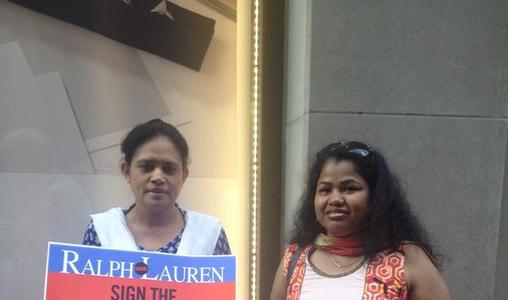
Protest Outside Ralph Lauren Shareholders Meeting

Protesters gathered today in front of the St. Regis Hotel in New York City to call on Ralph Lauren to sign onto theAccord on Fire and Building Safety in Bangladesh to improve workplace safety for garment workers. The protest preceded Ralph Lauren’s annual shareholders meeting where the AFL-CIO Reserve Fund (its investments) had a proposal on the ballot related to human rights reporting. At today’s shareholder meeting, Nazma Akter, president of the Sommilito Garments Sramik Federation, representing 70,000 workers, spoke to the protesters and called on Ralph Lauren join with more than 180 brands that have agreed to participate in the Accord. The Accord is a binding and enforceable agreement that represents a new model in supply chain accountability and risk management. Other programs to audit and monitor for workers' safety follow the same model that has failed the hundreds of workers who have died in preventable garment factory fires and building collapses over the past 20 years.

Push Back Against Privatization Of Postal System

The United States Postal Service (USPS) management just ran into a possible game-changing obstacle to its shameful pursuit of a fully privatized post office: labor solidarity Here’s the background. For a decade the USPS has been aggressively shrinking, consolidating, and outsourcing the nation’s postal system. In July 2011 management upped the ante by announcing the rapid closure of 3600 local post offices, a step toward the eventual closing of as many as 15,000, half of all post offices in the nation. A groundswell of opposition erupted. Citizens in hundreds of towns mobilized to save a treasured institution that plays a key and sometimes defining role in their communities. In December 2011, after Congress appeared ready to impose a six-month moratorium on closures USPS management voluntarily adopted a freeze of the same length. In May 2012, the moratorium ended but management, possibly concerned about reviving a national backlash, embraced an ingenious stealth strategy. Rather than closures, management moved to slash hours at 13,000 post offices. That could be accomplished quickly. Reduction in hours, unlike outright closures, requires little justification. Appeals are limited. Moreover a reduction in hours doesn’t generate the same level of outrage as a closure. The building remains open even though its value to the community is dramatically diminished.

Why Fair Trade Clothing Is Essential

Pact Apparel offers a range of soft basics, from socks to tees in GOTS-certified organic cottons. The company has now also earned Fair Trade certification for many of its products, and is working to get certification for even more of its factories. Few American brands own factories, but rather have contracts with facilities overseas to produce the styles they design. In much of the world, wages for garment workers have stagnated or even gone down, while the cost of living goes up around them. Fair Trade certification has helped Pact better support the makers of their clothes. “It’s an opportunity for us as a brand to pay the right price for the product,” said Jeff Denby, founder of Pact. Fair Trade also guarantees that factory employees have full-time work, rather than seasonal jobs. Currently, all of the products being produced for Pact in India are certified by Fair Trade U.S.A., and the company is working with their sock factory in Turkey to also earn its certification. Denby has a background in mass-production, and previously worked at a firm that designed “everything from forks to furniture” for large retailers. He was appalled by the factory conditions he encountered while working in Asia, and concluded there must be a better way. “We don’t have to kill people to make mass-produced products.”

Mercedes-Benz Violated Alabama Workers’ Organizing Rights, Judge Rules

An administrative judge for the National Labor Relations Board ruled that Mercedes-Benz U.S. International Inc. violated the organizing rights of workers at its Vance, Ala., plant by not allowing the distribution of union literature in common areas during off-work hours. A charge initially filed Sept. 3 alleged the automaker violated the National Labor Relations Act, citing a number of complaints of unfair labor practices. Judge Keltner Locke dismissed all other complaints in the charge, saying Mercedes took “prompt remedial action.” But Locke in the ruling issued last week found Mercedes violated the act when it told employees they could not disseminate union materials in the plant’s atriums and team centers, which he determined were mixed-use areas. The company also was found in violation for “maintaining a solicitation and distribution rule which employees reasonably could understand to prohibit all solicitation in work areas.” The ruling did not impose any penalties but said Mercedes must amend its solicitation and distribution rule to make it explicit that employees off the clock may solicit other employees also not on work time.

McDonalds Responsible For Determining Wages At Franchises

McDonald's is coming under intensifying pressure for labor practices at its U.S. restaurants. The National Labor Relations Board said Tuesday that the world's biggest hamburger chain could be named as a joint employer in several complaints regarding worker rights at franchise-owned restaurants. The decision is pivotal because it could expose McDonald's Corp. to liability for management practices in those locations. It also comes as protests for higher pay have captured national attention, with labor groups calling for pay of $15 an hour and the right to unionize. Organizers had been pushing to get McDonald's named as a joint employer at franchised restaurants, a move intended to give them a centralized and powerful target. In the U.S., the vast majority of McDonald's more than 14,000 restaurants are owned and operated by franchisees. The same is true for many other fast-food chains, including Burger King and Yum Brands, which owns Taco Bell, KFC and Pizza hut. As such, the companies have sought to distance themselves from the pay protests by saying they don't determine wages at its franchised locations. Heather Smedstad, senior vice president of human resources for McDonald's USA, said in a phone interview that the company has never been determined to be a joint employer in the past and that it would fight the decision by the labor board.

Market Basket Revolt A Sign Of Fed-Up Times

Micum McIntire stood shoulder to shoulder with his employees inside the cafe at Market Basket in Biddeford just after noon Monday, his eyes glued to live TV coverage of his company imploding at an outdoor protest in Tewksbury, Massachusetts. “They’re calling for us to shut the stores down,” said McIntire, the Biddeford store director, as thousands of Market Basket workers and their supporters rallied for their recently fired CEO and against the company’s new leadership. “That’s what they’re saying: ‘Shut it down.’ ” Demonstrators display placards outside a Market Basket grocery store as a shopper pushes a grocery cart on Tuesday in Chelsea, Mass. Supporters and employees rallied at Market Basket locations calling for Arthur T. Demoulas to be reinstated as CEO. The Associated Press And where did that leave McIntire? “I have no idea,” he replied. Had he received any guidance from Demoulas Supermarkets Inc., the grocery chain’s Massachusetts-based parent company? “There’s nobody there,” replied McIntire, his face etched with anxiety. “They’ve all been fired.”

Public Employees Union Allies With First Nations

In a continuing effort to build relations and stand with Indigenous peoples, CUPE sent a delegation to the Assembly of First Nations (AFN) 35th Annual General Assembly from July 14 to 17. This year’s assembly in Halifax, Nova Scotia (the traditional territory of the Mi’kmaq), drew more than 300 First Nations leaders, youth and elders. The chiefs in assembly discussed treaty implementation, ways to gain First Nations control of First Nations education, funding for post-secondary education, fracking on First Nation territory, reconciliation and justice for survivors of residential schools, among many other issues. The assembly delegates passed a resolution renewing their commitment in calling for a national public inquiry into missing and murdered Indigenous women and girls. The assembly held a special tribute, standing in a “Circle of Hope” in honour of over 1,100 murdered and missing Indigenous women and girls reported in Canada. CUPE fully supports the call for a national public inquiry.

Unions Gear Up For Climate Mega-March

A major climate change march in New York on September 21 may be a tipping point for labor movement participation in global warming activism. Climate initiatives are still controversial in the labor movement. But dozens of unions in New York, jarred by memories of Superstorm Sandy, have lined up to join the People’s Climate March, planned to coincide with a United Nations summit that will draw world leaders to the city. “Let’s be clear, climate change is the most important issue facing all of us for the rest of our lives,” said John Harrity, president of the Connecticut State Council of Machinists, which endorsed the march. “Climate protection is the single most essential issue for us now,” said J.J. Johnson, a Service Employees (SEIU) 1199 retiree, at a June union planning meeting. The U.N. meeting “provides us an unusual opportunity,” Johnson said. “There is no way that we should fritter this away.” With 400,000 members and 85,000 retirees, 1199 is among the biggest unions to sign up so far. Others are AFSCME’s District Council 37 and the New York State Nurses Association. Members of NYSNA have direct experience with climate catastrophes. They’ve volunteered help in New Orleans after Hurricane Katrina, in the Philippines after Typhoon Haiyan, and close to home in devastated communities on Staten Island and in the Rockaways after Sandy.

Fast-food Workers Ready To Escalate Wage Demands

Fast-food workers say they're prepared to escalate their campaign for higher wages and union representation, starting with a national convention in suburban Chicago where more than 1,000 workers will discuss the future of the effort that has spread to dozens of cities in less than two years. About 1,300 workers are scheduled to attend sessions Friday and Saturday at an expo center in Villa Park, Ill., where they'll be asked to do "whatever it takes" to win $15-an-hour wages and a union, said Kendall Fells, organizing director of the national effort and a representative of the Service Employees International Union. The union has been providing financial and organizational support to the fast-food protests that began in late 2012 in New York City and have included daylong strikes and a protest outside this year's McDonald's shareholder meeting that resulted in more than 130 arrests. "We want to talk about building leadership, power and doing whatever it takes depending on what city they're in and what the moment calls for," said Fells, adding that the ramped-up actions will be "more high-profile" and could include everything from civil disobedience to intensified efforts to organize workers. "I personally think we need to get more workers involved and shut these businesses down until they listen to us," perhaps even by occupying the restaurants, said Cherri Delisline, a 27-year-old single mother from Charleston, S.C., who has worked at McDonald's for 10 years and makes $7.35 an hour.

Workers Speak Out Against Work Schedule Abuse And Retaliation

When American women have no control over their own work schedules, they have no control over their own lives. Mary Coleman of Wisconsin knows this first-hand. She was working the night shift at a Milwaukee Popeye’s restaurant, a time slot notoriously unpopular for its exhausting hours. When she asked her manager for a transfer to the day shift, she was denied, lied to, and then penalized for even asking. Coleman’s manager told her that there were no more shifts available during daylight hours that she could have. But just weeks later, five new employees were hired to Popeye’s, all of whom were given day shifts. Simultaneously, Coleman’s hours were dramatically cut. She now only works two days a week. That is not nearly enough to live on. Coleman expressed her struggles at a Tuesday briefing in the Cannon House Office Building jointly hosted by the Center for Popular Democracy and the National Women’s Law Center. Coleman’s experience is like that of roughly 2.5 million other American women working in low-wage jobs who are at the mercy of their employers for consistent work, and so, for consistent pay.

Staples Misled Public On Postal Service Deal

American Postal Workers - The announcement by Staples yesterday, indicating it is terminating its no-bid deal with the U.S. Postal Service and replacing it with an “approved shipper” program, “is a ruse,” says American Postal Workers Union President Mark Dimondstein. Staples and the USPS are changing the name of the program, without addressing the fundamental concerns of postal workers and postal customers. If it looks like a duck, walks like a duck and quacks like a duck, it’s a duck. Dimondstein says the Staples announcement, along with a July 7 letter from the USPS, “makes it clear. They intend to continue to privatize postal retail operations, replace living-wage Postal Service jobs with low-wage Staples jobs and compromise the safety and security of the mail.” He adds: This attempt at trickery shows that the ‘Don’t Buy Staples’ movement is having an effect. We intend to keep up the pressure until Staples gets out of the mail business. The U.S. Mail Is Not for Sale.

A World Cup For The 1%

When Germany and Argentina square off in the Word Cup Final, the whole world will be watching the culmination of what may be the most exciting FIFA World Cup Tournament ever. What most people are unaware of, however, is the brutal conditions that FIFA creates to pull off the games.

Britain Strikes For A Day

It’s finally happened. The rusty machinery of the British trade union movement has turned—sluggishly—to allow us a magnificent day of rank-and-file protest. Only one day of striking, when there should be so many. Yesterday hundreds of thousands of public sector workers “took a day off” the length and breadth of Britain to protest not only their poverty pay (already low-paid, they have now been denied anything more than a 1 percent increase since 2010), the loss of 400,000 public sector jobs in the same period, and pension losses. Support from the National Union of Teachers meant the closure of schools across the country. Civil Service strikes closed government offices and even national art galleries.

Owner Keeps Paying Employees After Fire

In a world smattered with corporate greed, it is good to hear some uplifting news, and the owner of Culver’s restaurant in Platteville, Wisconsin is providing just that. Bruce Kroll owned Culver’s for over 19 years, but last November the entire building was destroyed in a fire, leaving 40 employees wondering how they would make a living. Kroll did something few would even consider – he continued to pay his employees – out of his own pocket – for six months until he could rebuild. This restaurant re-opened just this past week. The employees weren’t asked to pay back the $144,000 that Kroll was out while paying them for not working. He simply asked them to pay it forward with community volunteer work. You can watch a video of his employees talking about this unusual, but welcomed the act of kindness, here.
assetto corsa mods

Urgent End Of Year Fundraising Campaign

Online donations are back! Keep independent media alive. 

Due to the attacks on our fiscal sponsor, we were unable to raise funds online for nearly two years.  As the bills pile up, your help is needed now to cover the monthly costs of operating Popular Resistance.

Urgent End Of Year Fundraising Campaign

Online donations are back! 

Keep independent media alive. 

Due to the attacks on our fiscal sponsor, we were unable to raise funds online for nearly two years.  As the bills pile up, your help is needed now to cover the monthly costs of operating Popular Resistance.

Sign Up To Our Daily Digest

Independent media outlets are being suppressed and dropped by corporations like Google, Facebook and Twitter. Sign up for our daily email digest before it’s too late so you don’t miss the latest movement news.