Skip to content

Privacy

Facebook Fights Broad Search By Government

Facebook and the Manhattan district attorney’s office are in a bitter fight over the government’s demand for the contents of hundreds of Facebook accounts. In confidential legal documents unsealed on Wednesday, Facebook argues that Manhattan prosecutors last summer violated the constitutional right of its users to be free of unreasonable searches by demanding nearly complete account data on 381 people, ranging from pages they had liked to photos and private messages. When the social networking company fought the data demands, a New York judge ruled that Facebook had no standing to contest the search warrants since it was simply an online repository of data, not a target of the criminal investigation. To protect the secrecy of the investigation, the judge also barred the company from informing the affected users, a decision that prevented the individuals from fighting the data requests themselves. The case, which is now on appeal, pits the Fourth Amendment right to be free from unreasonable searches by the government against the needs of prosecutors to seek evidence from the digital sources where people increasingly store their most sensitive data.

A New Play About Edward Snowden Opens In London

Edward Snowden is holed up in a hotel in Hong Kong. He has left his life in Hawaii, abandoned paradise for a life on the run. Tortured by thoughts of his girlfriend, his mother and father and the ghosts of other whistleblowers from Chelsea Manning in solitary confinement to Thomas Drake, charged with 35 years imprisonment, he waits. But will the CIA and the National Security Agency find him first? This story has not yet finished. The revelations of mass surveillance by the U.S. and British security services keep coming out. Never mind about Angela Merkel, are they listening to your conversations, reading your messages, checking your emails?

Join The Open Wireless Movement

What is the Open Wireless Movement? Imagine a future with ubiquitous open Internet. We envision a world where, in any urban environment: Dozens of open networks are available at your fingertips. Tablets, watches, and other new devices can automatically join these networks to do nifty things. The societal expectation is one of sharing, and, as a result, wireless Internet is more efficient. The false notion that an IP address could be used as a sole identifier is finally a thing of the past, creating a privacy-enhancing norm of shared networks. We're working with a coalition of volunteer engineers to build technologies that will let users open their wireless networks without compromising their security or sacrificing bandwidth. And we're working with advocates to help change the way people and businesses think about Internet service. Join the movement now.

House Votes To Rein In NSA

Something awesome happened last night: The House of Representatives voted to cut funding the NSA has used to conduct warrantless back-door searches of our emails, browsing histories and online chats. The bipartisan vote was 293–123 for Reps. Lofgren and Massie's amendment to the defense appropriations bill. The margin of victory was much bigger than anticipated — which shows that opposition to the NSA's unconstitutional surveillance programs is growing. Last night’s vote represented a big step forward. But the movement to restore our right to privacy faces an uphill battle. Here’s why: Last month the House also voted for a version of the USA Freedom Act that was so watered down we and our friends had to withdraw our support for it. Now it’s the Senate's turn to consider the USA Freedom Act. In the coming weeks, the Free Press Action Fund will push our senators to protect our right to speak in private and restore the original bill, which would stop many of the NSA's worst abuses. Stay tuned!

Facebook’s History Of Tracking You

For years people have noticed a funny thing about Facebook's ubiquitous Like button. It has been sending data to Facebook tracking the sites you visit. Each time details of the tracking were revealed, Facebook promised that it wasn't using the data for any commercial purposes. No longer. Last week, Facebook announced it will start using its Like button and similar tools to track people across the Internet for advertising purposes. Here is the long history of the revelations and Facebook's denials: Facebook's Mark Zuckerberg introduces the "transformative" Like button… April 21, 2010 – Facebook introduces the "Like" button in 2010 at its F8 developer conference. Facebook founder Mark Zuckerberg declares that it will be "the most transformative thing we've ever done for the Web."

Close NSA Backdoors: Support Amendment To DoD Funding

Last year, we were 12 votes shy of defunding the NSA's phone spying program's with a last minute amendment. Now we have a chance for another sneak attack, but we could have less than 24 hours to implement it and push it over the edge. Today or tomorrow, U.S. Congress will vote on an Amendment to the "must-pass" Defense funding bill that -- if it gets enough yes votes -- could close up the backdoors the NSA has been using to spy on all of us (1). This is a significant silver bullet to disrupt the NSA’s blanket spying. But time is running out. Click here to take action right now! This Amendment is different. It’s not a big clunky bill that we can expect to get watered down by the corrupt leadership of both parties, it’s more of a Congressional guerilla tactic.

Plans To Expand Scope Of License-Plate Readers Alarm Privacy Advocates

Denise Green had just dropped off her sister at the 24th Street Mission BART station after picking her up from the hospital. Green, who was driving a 1992 red Lexus, noticed a San Francisco police car with its lights on pull up behind her as she passed through the intersection of Mission Street and Highland Avenue. Green pulled over to let the patrol car pass. She was stunned when officers yelled, “Put your hands up!” Sgt. Ja Han Kim ordered her to step out of the car, and as Green complied, she turned and saw several officers with their guns trained on her. “Don’t look at us!” one of them said. “Turn around!” the officers shouted, forcing Green to her knees. They handcuffed her and searched her Lexus. Green overheard officers standing near her license plate shouting numbers to each other.

We Cannot Have Political Surveillance And Democracy, Too

From the UK to the United States, law enforcement at all levels is conflating dissent with terrorism, threatening the possibility for open societies and democratic change. In both countries, the war on terror—cast as an endless and border-less battle over ideology and religion—provides dangerous new latitude for governments to criminalize and monitor speech. But political surveillance today remains what it has always been: a way for governments to uphold the status quo in the face of demands for change. Perhaps then it shouldn't come as a surprise to find that politicians who ally with activists are prime targets of state security spying, in both London and Boston. New reports out of England confirm that London’s Metropolitan Police has been keeping track of politicians in a “extremists” database. Vice reports: Through the use of data protection laws, Jenny Jones, a London Green Party peer, and Ian Driver, a local councillor for the party, obtained files on themselves held in the database, which is supposedly used to monitor activists who use criminal means to push their ideas.

Obama Admin Urges Police Silence On Cellphone Surveillance

The Obama administration has been quietly advising local police not to disclose details about surveillance technology they are using to sweep up basic cellphone data from entire neighborhoods, The Associated Press has learned. Citing security reasons, the U.S. has intervened in routine state public records cases and criminal trials regarding use of the technology. This has resulted in police departments withholding materials or heavily censoring documents in rare instances when they disclose any about the purchase and use of such powerful surveillance equipment. Federal involvement in local open records proceedings is unusual. It comes at a time when President Barack Obama has said he welcomes a debate on government surveillance and called for more transparency about spying in the wake of disclosures about classified federal surveillance programs.

Defending Our ‘Right To Know’ With Courage

Yesterday in Berlin, a new international organization was announced whose purpose is to (1) defend whistleblowers when they are facing prosecution; and (2) defend the public’s right to know. In a video to the Courage Foundation opening announcement Edward Snowden described how we need to confront surveillance because in order to participate in a democratic government we need to know “what the government is doing to us and what they are doing in our name.” It the people are not informed about what the government is doing “the government becomes a force unto itself not a public servant but a public master.” Snowden believes that public officials who take illegal or unethical action must be held accountable. Snowden goes on to say that since government is not protecting whistleblower we must say “we will protect them as a global society.” For him the Courage Foundation is “a new rapid response team for global democracy” saying now, when “we see someone facing unjustified retaliation for performing a public service we can rally to their defense.”

Epic Actions To Reset The Net

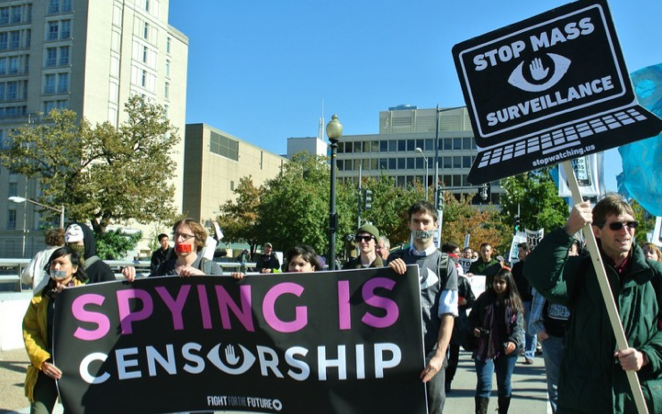
On the first anniversary of the NSA leaks by Edward Snowden, people united on the Internet to "reset the net" by taking steps to directly block mass surveillance. The changes made will effect 3 billion emails each month, 500,000 users each month, 187 million blogs and 14.5 billion web pages. The American public agrees NSA spying has gone to far. USA Today reports "By nearly 3-1, 70%-26%, Americans say they shouldn't have to give up privacy and freedom in order to be safe from terrorism.? The Electronic Frontier Foundation summarizes the polls writing: Polls continue to confirm the trend. In a poll conducted in December 2013 by the Washington Post, 66% of Americans were concerned "about the collection and use of [their] personal information by the National Security Agency." Americans aren't only concerned about the collection. A recent Pew poll found—yet again—that a majority of Americans oppose the government's collection of phone and Internet data as a part of anti-terrorism efforts. Below is an infographic published by Fight for the Future summarizing Reset The Net's impact.

WordPress Resets The Net

If we properly encrypt our sites and devices, we can make mass surveillance much more difficult. We’ll be serving pages only over SSL for all *.wordpress.com subdomains by the end of the year. A year ago today, we joined the world in shock on learning that governments were spying on internet users around the world. Tapping internet service providers’ undersea cables, intentionally and secretly weakening encryption products, surreptitiously collecting everything from call metadata to photos sent over the internet by US citizens — nothing was off limits. Just as troubling as the revelations themselves is the fact that since last summer, little if anything has changed. Despite a lot of rhetoric, our three branches of government in the United States have not made many concrete steps toward truly protecting citizens from unchecked government surveillance. Automattic has been a strong supporter of efforts to reform government surveillance. We’ve supported reform legislation in Congress, and participated in the Day We Fight Back, earlier this year. More importantly, we aim to make our own legal processes for securing the information our users entrust to us as transparent and protective as possible.

Foil The NSA With Reset The Net Privacy Download

On the anniversary of the first news story based on Edward Snowden NSA leaks, Fight for the Future and other Internet privacy advocates are taking matters into their own hands. Legislators have failed to be own up to the illegality of the NSA programs which collect massive amounts of data on all citizens, nor will they protect them from NSA monitoring. The US government is conducting cyber warfare on its own people and whole populations in other countries around the world with little or no oversight. Thus, people must choose to protect themselves from government and corporate prying eyes. In this video, cybersecurity professional Ian Schlakman explains why he chose to leave the IT world to run for office in the district of the NSA.

Snowden: Now We Know We’re Under Surveillance

Edward Snowden: Today, our most intimate private records are being indiscriminately seized in secret, without regard for whether we are actually suspected of wrongdoing. When these capabilities fall into the wrong hands, they can destroy the very freedoms that technology should be nurturing, not extinguishing. Surveillance, without regard to the rule of law or our basic human dignity, creates societies that fear free expression and dissent, the very values that make America strong. In the long, dark shadow cast by the security state, a free society cannot thrive. That’s why one year ago I brought evidence of these irresponsible activities to the public—to spark the very discussion the U.S. government didn’t want the American people to have.

Snowden Sounds Call To Reset The Net

It's been one year since news broke that Edward Snowden had leaked troves of US government documents detailing the National Security Agency's secret spying programs. And, to mark this anniversary Internet advocates have launched a pro-privacy campaign and day of action called Reset the Net. Not only have some top tech titans signed on, like Google, Mozilla, and Reddit, but Snowden himself has also thrown his weight behind the movement. In a statement issued via his attorney on Wednesday, Snowden said that in the face of government foot dragging, Reset the Net is a way citizens can "take back" their privacy. "Today, we can begin the work of effectively shutting down the collection of our online communications, even if the US Congress fails to do the same," Snowden wrote. "This is the beginning of a moment where we the people begin to protect our universal human rights with the laws of nature rather than the laws of nations." Reset the Net aims to circumvent policy makers and put the power directly in the hands of Internet users. The advocacy group behind the movement, Fight for the Future, has been rallying tech companies to join the cause and create encryption tools for users.
assetto corsa mods

Urgent End Of Year Fundraising Campaign

Online donations are back! Keep independent media alive. 

Due to the attacks on our fiscal sponsor, we were unable to raise funds online for nearly two years.  As the bills pile up, your help is needed now to cover the monthly costs of operating Popular Resistance.

Urgent End Of Year Fundraising Campaign

Online donations are back! 

Keep independent media alive. 

Due to the attacks on our fiscal sponsor, we were unable to raise funds online for nearly two years.  As the bills pile up, your help is needed now to cover the monthly costs of operating Popular Resistance.

Sign Up To Our Daily Digest

Independent media outlets are being suppressed and dropped by corporations like Google, Facebook and Twitter. Sign up for our daily email digest before it’s too late so you don’t miss the latest movement news.