Skip to content

Student Activism

Five Economic Reforms Millennials Should Be Fighting For

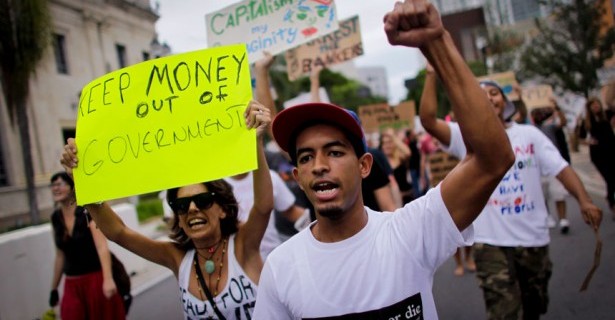
It's a new year, but one thing hasn't changed: The economy still blows. Five years after Wall Street crashed, America's banker-gamblers have only gotten richer, while huge swaths of the country are still drowning in personal debt, tens of millions of Americans remain unemployed – and the new jobs being created are largely low-wage, sub-contracted, part-time grunt work. Millennials have been especially hard-hit by the downturn, which is probably why so many people in this generation (like myself) regard capitalism with a level of suspicion that would have been unthinkable a decade ago. But that egalitarian impulse isn't often accompanied by concrete proposals about how to get out of this catastrophe. Here are a few things we might want to start fighting for, pronto, if we want to grow old in a just, fair society, rather than the economic hellhole our parents have handed us.

The Nonviolent Roots Of Syrian Rebellion: Students United Against Tyranny

When a group of students staged the first demonstration at the Damascus College of Science in April 2011, they could not imagine that would be the beginning of the future Union of Free Syrian Students (UFSS). The Union, which has played a fundamental role in the Syrian uprising, remains one of the most relevant youth groups developing civil resistance in the country. “At that first demonstration, 50 of us had planned to gather to demand freedom, justice and dignity,” one of the organizers said to Syria Untold. “We were amazed when we saw hundreds of students show up.” After that first protest, which was recorded and widely shared online, professionalization and self-protection became a goal for the students. It became clear that there was an urgent need to protect demonstrators by concealing their identities on camera, which led to an increasing effort in hiding people´s faces on pictures and videos. Today, most of the Union’s work focuses on humanitarian and health aid, as well as on reporting and media activities. They evolve in response to the reality on the ground, which has evolved from a peaceful civil uprising to increasing militarization and Islamization, amid international indifference. In spite of everything, the Union, as many other civil activists, continues to resist all those trends, aiming for a future of freedom, justice and dignity.

Victory: Jacksonville Activists Win Name Change From KKK Named School

With more than 50 activists and community members present, the Duval County School Board voted unanimously, Dec. 16, to change the name of Nathan Bedford Forrest High School. The historic vote by the school board comes at the end of a six-month campaign by the Jacksonville Progressive Coalition (JPC) and other forces to drop the local high school's racist namesake. "We have to change the name of this school because this city can no longer honor a slave trader, war criminal and grand wizard of the KKK," said Richard Blake, a Teamster and member of the JPC who spoke at the school board meeting before the vote. "The heritage of Nathan B. Forrest is not our heritage - it is that of the oppressor." Superintendent Nikolai Vitti began the school board meeting by sharing the board's findings in polling the community about the name change. A poll conducted last week by the school board at Forrest High School found that about 64% of the student body favored changing the name. He then made a recommendation to the board to change the school's name, which was approved by every board member. Paula D. Wright, one of the school board members who spoke out in support of the name change, said, "We talk about what's in a name. A name does matter because it can service the foundation of how we think of ourselves and how we move beyond the particular place we're in at the time."

School Tries To Silence Fifth-Grader’s Speech On Religion

Zachary Golob-Drake is the kind of kid any school would be proud to have representing it. And last week, the Tampa, Fla., fifth-grader won a first place blue ribbon in a class contest for his speech about how to make the world “a better place.” He was then set to deliver that speech to his entire fourth and fifth grade, and, if he did well, go on to represent his school at the regional 4-H Tropicana Public Speech contest. Instead, the boy says the school tried to strip him of his prize and block him from sharing his speech with the school. Titled “In the Name of Religion,” Golob-Drake’s brief speech notes that “The world’s major religions all have messages about coexisting,” but “Religious differences have always sparked conflict, even leading to warfare and mass murder.” As examples, he cites the Crusades, the campaigns of Genghis Khan and the attacks on the United States of 9/11. He ends by stating, “Religion provides moral guidance for most of the seven billion people on the earth” and invoking the Golden Rule of “Do not do to others what you do not want them to do to you.”

CUNY Wars: Petraeus, ROTC, Student Center Closing & Police Conflict

The trouble started this semester when the school enlisted Petraeus, the disgraced ex-commander of U.S. operations in Iraq and Afghanistan and former CIA chief, to teach a class, “The Coming North American Decades,” at its Macaulay Honors College. Course materials included literature espousing the virtues of hydraulic fracturing, aka fracking, but no mention of the general's ties to Kohlberg Kravis & Roberts, a private equity firm with millions invested in the controversial oil and gas extraction method. Yet demonstrations against Petraeus's presence mainly focused on his role as an architect of U.S. wars abroad—part of an ongoing challenge to what critics describe as the increasing militarization of the university. The protests quickly turned violent, with police beating students in the streets this September.

Video: Street Politics 101: The Story Behind The ‘Maple Spring’

In the spring of 2012, a massive student strike in opposition to a tuition hike rocked the streets of Montreal for over six months. Protests and militant street actions became part of the daily and nightly reality of this Canadian metropolis. Several times during this tumultuous spring, the numbers in the streets would reach over one hundred thousand. Police routinely clubbed students and their allies, and arrested them by the hundreds. Some were even banned from entering the city. But every time the cops struck, the student movement got bigger and angrier. This is a story about how the arrogance of a government underestimated a dedicated group of students, who through long-term organizing laid the foundation for some of the largest mass demonstrations in Canada’s history. But it’s also a story of how a crew of determined anarchists educated a new generation of students on the importance of owning the streets. In Street Politics 101, subMedia.tv features some of the best footage from what has been referred to as “the maple spring”. The documentary also features interviews with students, teachers and anarchists involved in one of the most militant rebellions in Québec.

Police Violence Won’t Stop Alliance Of Students And Workers

It's kicking off on campus again. Almost three years since nationwide college occupations, marches and strikes against tuition fee rises led to the first wave of crackdowns on student protest, undergraduates are mobilising, and meeting unprecedented retaliation. Last week in Bloomsbury, central London, students organising for fair wages for workers at their institutions said they were beaten bloody. There were mass arrests, and the sort of court injunctions banning all further protest that wouldn't be tolerated in any country that valued freedom of speech. "We are facing a concerted attempt to silence a nascent student movement before it gets off the ground," said Michael Chessum, president of the University of London union. However, despite the clampdown on protest, students, lecturers, service workers and their allies are planning to rally in their thousands tomorrow afternoon.

London’s Biggest University Bans Student Protests

The University of London - a body representing London universities including University College London, the School of Oriental and African Studies (SOAS), Birkbeck and the London School of Economics - has banned protests on its campus for the next six months. Students who hold sit-in protests in an area in Holborn, central London, including the Senate House, the student union building, and the buildings of SOAS and Birkbeck, can be imprisoned. The president of the University of London student union, Michael Chessum, told Channel 4 News it was a "draconian" reaction and "a sign that the university had lost the argument". The court order obtained on the 4 December by the University of London bans "occupational protest" in the area for the next six months. Anyone breaching the order can be charged with contempt of court.

Video: @FreeCooperUnion Protests Tuition With 1,500 Ping Pong Balls

The ping-pong-pocalypse was the latest protest action by Free Cooper Union, a student group protesting the formerly-free university’s plan to begin charging tuition in 2014. The video of the ball drop (raw footage above, edited video below) marks the one-year anniversary of the group’s first major protest, when 11 students started a week-long lockdown of Foundation Hall across the street. The use of ping pong balls has a dual significance, according to student spokesperson Casey Gollan. The students were inspired by a group of Syrian rebels who used similar techniques to frustrate supporters of President Bashar al-Assad, although Gollan is quick to note they do not mean to imply a direct equivalency between the situation in Syria and East Village universities. The other inspiration goes more directly to one of Free Cooper Union’s complaints, specifically about the replacement of Linda Lemiesz, the former dean of student affairs, with Stephen Baker, dean of athletics. According to Gollan, one of Baker’s first actions was to send an e-mail to students informing them the school had purchased six championship ping pong tables and was forming a ping pong club.

Driving While Black,” Now “Waiting While Black”

A police officer arrested three teens last week as they were standing outside a store in downtown Rochester, New York. Their crime: Waiting for a school bus. The three boys — Raliek Redd, 16, Deaquon Carelock, 16, and Wan'Tauhjs Weathers, 17 — are star athletes at Edison Tech high school, and were waiting to be taken to a basketball game when they were spotted by an officer. It seems the store adjacent to their pick-up spot was being monitored by police due to past complaints from the owner of teens loitering outside. The officer asked the teens to disperse, but they explained that they were waiting to be picked up by a bus. The officer again asked the teens to disperse. "We tried to tell them that we were waiting for the bus," Wan'Tauhjs told WHEC. "We weren't catching a city bus, we were catching a yellow bus. He didn't care. He arrested us anyways." While they were being handcuffed, their coach, Jacob Scott, arrived at the scene and attempted to reason with the cop. "He goes on to say, 'If you don't disperse, you're going to get booked as well," Scott recalled. "I said, 'Sir, I'm the adult. I'm their varsity basketball coach. How can you book me? What am I doing wrong? Matter of fact, what are these guys doing wrong?'"

Finding Power in Occupy

'There is a general unrest in my generation. We are the most diverse and the most underrepresented; we are the most educated and the most unemployed. Our values are not reflected in the systems that govern our lives.' I came to Occupy Ohio University as an environmentalist. I played my part, I answered questions about fracking and mountain top removal. I even spoke on greening urban space. I came angry and hungry. Occupy was about rethinking the spaces we inhabit. These spaces are beyond parks and lawns and state capitols. These spaces are in leadership in history books, in racial profiles, in standardized tests, in pre-existing conditions, in credit scores and loan distributions. Occupy was about shifting the conversation to make people understand that we are many and they are few. They have leveraged the resources they had at hand to gain control. It is up to us to do the same. Occupy was not about hope. It was about power.

Graduate Employees Historic Agreement With NYU After Eight-Year Struggle

UAW graduate employees have reached an unprecedented agreement with New York University in which the administration will remain neutral and respect the results of an election for more than 1,200 GAs, TAs, and RAs to vote on Union representation. In an election expected to happen on December 10th and 11th, a majority vote by graduate employees would restore collective bargaining and put the Union in position to have a new contract in place by the end of the academic year. Looking forward to voting “yes” to win back the Union after an eight-year struggle, a group of more than 100 graduate employees from every major department across NYU and the Polytechnic Institute of NYU has endorsed the agreement between NYU and the Graduate Student Organizing Committee/UAW (GSOC/UAW) and Scientists and Engineers Together/UAW (SET/UAW). Key provisions of the agreement, which represents a significant improvement over previous NYU offers

A ‘Historic Moment’ for Campus Solidarity

'Solidarity between campus workers in different sectors is really central to changing the power relations at universities so that their operations actually reflect the interests of the majority of the people who work and study here.' In a labor action rarely seen on university campuses, graduate student employees in the University of California systemannounced on Wednesday that they plan to strike alongside university service workers walking off the job next week due to allegations of illegal retaliation against members of their union. After members of UAW 2865, which represents 16,000 UC graduate teaching and research assistants, voted to authorize a strike last week, the union pledged Wednesday to join the picket lines when service and patient care workers represented by AFSCME 3299 stage a one-day walkout on November 20. Graduate student organizers call the decision to stage a sympathy strike alongside other campus workers a “historic moment” for campus solidarity that comes in the midst of contentious contract negotiations between the university’s largest unions and the UC administration. “Academic workers standing in solidarity with service workers will send a clear message to UC management that its employees will not tolerate intimidation from bosses or the decline in working conditions,” says Marco Antonio Rosales, a union steward and graduate instructor.

Blaming the Victims: Media Bias Against Struggling Millennials

The Globe's worthless offerings on the subject notwithstanding, there can be no doubt that the issue of the economic plight of young people is worth examining. But to do so requires a serious look at the real economic conditions young adults face and the reasons these conditions exist. Graham's article, and many others like it, generally fail to consider the context in which young people are struggling to find decent jobs, including the long-term economic impacts of deregulation and neoliberalism pushed by state managers and wealthy elites for some three decades now, which have kept wages stagnant for people of all ages, including young people; the impact of the 2008 economic crisis (mostly caused by people born well before 1980); the college affordability crisis; and the fact that low-wage service-sector jobs tend to be where job growth is. To understand why millennials are facing such perilous economic conditions, one must first understand why people of all ages are suffering massive economic struggles. For some three decades, under leadership of both political parties, the policies of deregulation, privatization, neoliberalism and the globalization of finance have been disastrous for working-class people.

Create Strike Debt In Your Community, Broaden The Revolt

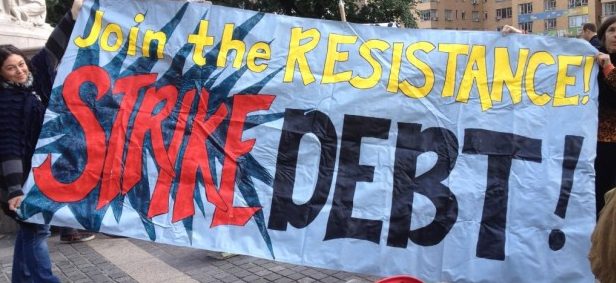
One of the great evolutions of the Occupy Movement is Strike Debt and the "You are not a loan" movement. Strike Debt Urges You To Take Action Fighting debt and our exploitative economic system will require both individual and collective action. Here are some immediate steps you can take to shift the balance of power, apply pressure to creditors, and help the debt movement keep rolling. They urge you to consider: (1) Fight back against debt buyers, (2) Hold a debt assembly, (3) Save houses and whole communities using Eminent Domain, and (4) Work together against student debt. More will be coming. Check this page often. We’ll be updating it regularly with new projects.
assetto corsa mods

Urgent End Of Year Fundraising Campaign

Online donations are back! Keep independent media alive. 

Due to the attacks on our fiscal sponsor, we were unable to raise funds online for nearly two years.  As the bills pile up, your help is needed now to cover the monthly costs of operating Popular Resistance.

Urgent End Of Year Fundraising Campaign

Online donations are back! 

Keep independent media alive. 

Due to the attacks on our fiscal sponsor, we were unable to raise funds online for nearly two years.  As the bills pile up, your help is needed now to cover the monthly costs of operating Popular Resistance.

Sign Up To Our Daily Digest

Independent media outlets are being suppressed and dropped by corporations like Google, Facebook and Twitter. Sign up for our daily email digest before it’s too late so you don’t miss the latest movement news.