Skip to content

Supreme Court

How The Supreme Court Made A Mess Of Our Voting System

In 2011, my organization, the Brennan Center for Justice, calculated that the first wave of these new laws, if implemented, could have made it far harder for five million citizens to vote. At first, the judiciary seemed to recognize that risk. In the run up to the 2012 election, courts around the country routinely blocked or postponed the new voting regulations. On Election Day, few of those disenfranchising laws were in effect. Then last year, the U.S. Supreme Court stepped in. In Shelby County v. Holder, it gutted the landmark 1965 Voting Rights Act by neutering its requirement, under Section 5 of the law, that states with a history of discrimination clear changes to voting regulations with a court or the Justice Department. The court was bitterly divided, five to four. During oral argument in February 2013, Justice Antonin Scalia called the Voting Rights Act little more than a “racial entitlement.”

Decisions Spell Disaster For Working Women

Retail sales and home healthcare work are two of the three fastest-growing jobs in this country. That’s an important consideration when looking at the decisions the Supreme Court handed down today in Harris v. Quinn and Burwell, Secretary of Health and Human Services v. Hobby Lobby Stores: If you are not affected by these rulings yet, you well could be in the future. Both 5 – 4 decisions were written by Justice Samuel Alito, a conservative Catholic from New Jersey appointed by George W. Bush, and both rested on narrowly tailored legal arguments that just happen to cut wide enough to impact groups of workers who are almost exclusively female. Harris creates the special designation of “partial public employees” for publicly-funded home healthcare aides who work both for the client and for the state—who are 90 percent female, most of them poor, immigrants, and of color. Hobby Lobby, meanwhile, in deciding whether an employer with religious beliefs can be required to provide health insurance that covers contraception, singles out women by targeting its arguments towards workers who use birth control—but not any other form of healthcare. As Sheila Bapat, author of Part of the Family? Nannies, Housekeepers, Caregivers and the Battle for Domestic Workers' Rights, tweeted, “These decisions speak squarely to the value of women's labor.”

Supreme Court Creates Impossible Standard For Unions To Meet

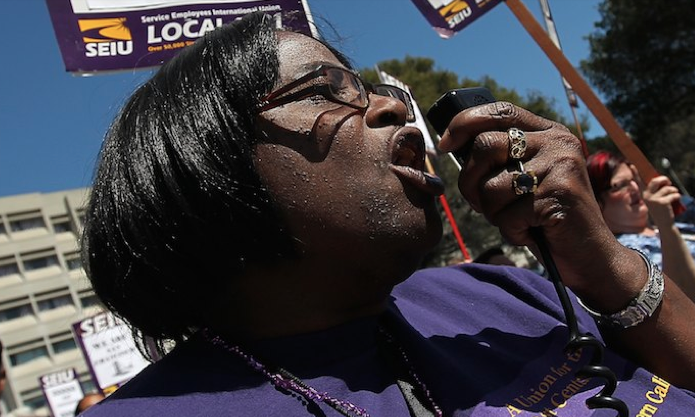
The Supreme Court on Monday issued a wide-ranging opinion that will heavily impact the future of labor in America. The majority opinion in Harris v. Quinn held that home healthcare workers in Illinois and every other state that has a similar program are only “partial” or “quasi” public employees—as opposed to “full-fledged public employees”—and thus don't have to pay fees for labor representation. While the majority, led by Justice Samuel Alito, did not go so far as to fully gut the ability of public sector unions to finance their existence, the decision in the case was by no means a moderate one. Harris v. Quinn has set the stage for the eventual overruling of Abood; it has confused and perverted the concept of free-riders; and it has created an impossible standard for unions to meet. Monday's 5-4 ruling goes against decades of Supreme Court precedent allowing fair-share provisions, starting with the seminal case of Abood v. Detroit Board of Education in 1977. (Fair share provisions require workers who choose not to join the union to pay a portion of the dues that is spent in representing them, thereby not allowing them to become free-riders.) The majority’s treatment of the balance created by Abood is problematic on several grounds.

Argentina President Blasts US Bank ‘Extortion’

Argentina will not submit to Wall Street's "extortion" of their debt, said President Cristina Fernández de Kirchner in a national address Tuesday night. De Kirchner's comments came after it was announced that the U.S. Supreme Court refused to hear an appeal by the South American country despite their argument that obliging predator banks would "encourage creditor free-for-alls" and "intensify and prolong the suffering of the poor in countries undergoing sovereign debt crisis." On Wednesday, following news that the Supreme Court would uphold two lower court rulings which demanded that Argentina pay $1.3 billion in debt holdouts to "vulture" funds before repaying their other restructured debts, Standard & Poor lowered the country’s rating to CCC-. According to the credit rating bureau and reported by Bloomberg News, this is the lowest rating for any nation that’s currently assessed by the company and is nine levels below "investment grade."

Peter Van Buren, RIP, The Bill of Rights

Here’s what passes for good news when it comes to a free press these days: two weeks ago, the Supreme Court refused without comment to hear a case involving New York Times reporter James Risen. It concerned his unwillingness to testify before a grand jury under subpoena and reveal a confidential source of information in his book State of War on the secret U.S. campaign against the Iranian nuclear program. The case will now go back to the United States Court of Appeals for the Fourth Circuit, which has already ordered him to testify. He says he will instead go to jail, if necessary. That’s the bad news, right? Really bad news! The Supremes, the highest court in the land, refused to protect a reporter protecting a source at a moment when the Obama administration is in the midst of a wide-ranging crackdown on leakers and whistleblowers of all sorts (and those in the media considered to be aiding and abetting them). Actually, in a world in which Congress has not yet managed to pass a federal shield law that would protect reporters, it turns out that that’s actually the good news -- or so at least various media commentators say. Follow the logic here (and it is logic of a sort). Right now the Richmond, Virginia-based Appeals court decision applies only to courts in states under its jurisdiction. Had the Supremes agreed to take on the case, given their conservative and generally government-friendly bent on matters of executive power and what passes for national security, they would likely have ruled against Risen and that ruling would have applied nationally.

How Supreme Court Made U.S. Government Illegitimate

Earlier this year, the U.S. Supreme Court ruled, in McCutcheon V. FEC, the court struck down a limit on how much cash an individual could give to all federal candidates during an election cycle. In the 5-4 decision, the majority of justices on the Roberts court ruled that individuals could buy elections. Or, in the words of Chief Justice Roberts,  “government regulation may not target the general gratitude a candidate may feel toward those who support him or his allies, or the political access such support may afford.” In the dissenting opinion, Justice Stephen Bryer, did not hold back in voicing the disgust felt by an overwhelming majority of Americans (if not by a majority of Supreme Court Justices) in writing that the majority’s “legal analysis is faulty: It misconstrues the nature of the competing constitutional interests at stake. It understates the importance of protecting the political integrity of our governmental institutions. It creates a loophole that will allow a single individual to contribute millions of dollars to a political party or to a candidate’s campaign.”

Supreme Court Rejects NYT Reporter’s Appeal

Reporters Without Borders is deeply worried by the United States Supreme Court’s rejection of an appeal by New York Times reporter James Risen on June 2, 2014. Last July, an appeals court in Richmond, Virginia, demanded that James Risen testify at the criminal trial of Jeffrey Sterling, a former CIA agent who is being prosecuted for leaking classified information to Risen in violation of the Espionage Act. Monday’s Supreme Court decision not to intervene in the case could result in prison for Risen if he does not testify. A jail sentence for protecting his sources would have a chilling effect on journalists and whistleblowers. Investigative journalism would not be possible without leaks, especially in the United States where nearly all information related to national security is classified. Risen, who has repeatedly said that he would protect his sources’ identity at all costs, told Reporters Without Borders today that he “will continue to fight.”

Hedges v. Obama: Supreme Court Leaves NDAA Intact

On Monday, the Supreme Court declined to consider Hedges v. Obama, a constitutional claim challenging a law that could enable the indefinite military detention of US citizens—within the US—without trial, charge, or evidence of crime. The decision is remarkable, both for its implications for fundamental rights, and its reflection on judicial independence. A dangerous and controversial law When the National Defense Authorization Act of 2012 was first signed into law on the last day of 2011, few observers noticed. Some version of the bill is passed every year, but the 2012 version inserted dangerous provisions that could expand the military’s domestic detention powers. Several notable observers did take notice, however. Despite her complicity in mass NSA surveillance, Senate Intelligence Committee Chair Dianne Feinstein (D-CA) has spoken out against torture, as well as detention. When Congress debated the 2013 NDAA in 2012, she unsuccessfully tried to limit the detention provisions through amendments.

The Dubious Authority Of The Supreme Court

Gov. Patrick Deval said in a radio interview on April 15, 2014 that “I respect the authority of the Supreme Court to make those decisions” like McCutcheon. I write the Governor to clarify his position, and to express opposition to his statement. To “respect” authority in the abuse of its power is to align oneself with and further enable that same abuse. Experience shows that contesting that authority, especially in the case of the Supreme Court, has the effect of curbing it. Converting a democracy into a plutocracy is a task of constitutional dimensions. If the Governor does sincerely believe that the Roberts Court legitimately has the power to amend the Constitution, I would like to have him point out to me where precisely the Constitution gives that power to an unelected Court to exercise in a 5-4 vote? Article V seems to have a different, much more difficult, process in mind, involving a 2/3 vote of each house of Congress, and then ratification by ¾ of the states. The elected representatives of both Congress and the states, through their legislative acts, have expressed an entirely different view than five judges on the Supreme Court about the constitutional importance of keeping big money out of politics.

How We Can Fight Back Against The Supreme Court

"The issue today is the same as it has been throughout all history, whether man shall be allowed to govern himself or be ruled by a small elite." -- Thomas Jefferson When asked if his payments to politicians had worked, Charles Keating replied, "I want to say in the most forceful way I can: I certainly hope so." When asked outside of Independence Hall if we have a republic or a monarchy, Benjamin Franklin replied, "A republic, if you can keep it." Well, here we are, aren't we? Right at the point where we are about to find out whether we can keep it or not. The Supreme Court has decided that a small amount of people will get to control our entire political system. Which politician or political party can resist hundreds of millions of dollars put in at once? Maybe one person can resist, maybe one party can resist for a small period of time, but eventually they will succumb.

McCutcheon Decision Is Our Rallying Cry

While some still believe the United States is the greatest democracy on Earth, the US is actually a plutocracy, a government ruled by the wealthiest. The recent Supreme Court decision in McCutcheon will subject us to an even stronger plutocracy that no one will be able to deny. The ‘rule of money’ will become more deeply entrenched at a time of economic and environmental crisis. In the US today, a small group of people rule over hundreds of millions of us through a government corrupted by money; and controls the economy through mega-businesses that receive special treatment from that government, prevent entrepreneurial competition and control tens of millions of people through low wages and high debt. The plutocrats fund the only two parties allowed to run for office and the people are manipulated by fear to vote against their interests in a mirage democracy of rigged elections.

McCutcheon Makes Clear, Ending The Rule Of Money Is Key Challenge

Wealthy interests are taking this struggle very seriously. This ruling is the result of a decades-long strategy to repopulate the American judicial system with political partisans willing to act boldly in the interests of corporations and the wealthy. That does not mean that all is lost. There is a national mood of deep dissatisfaction with a status quo based on privilege and inequality. Sometimes all that is needed is a galvanizing moment, after which a mood becomes a movement. With luck, and if we work to make it so, this could be that moment for a movement to restore democracy in the United States. Previous generations rose to the urgency of their moments: to end slavery, to give women the vote, to rebuild after the Great Depression, to establish civil rights and end wars. Today’s ruling points us to the defining struggle of today’s generation – a struggle for democracy itself. This defeat could ultimately lead to victory – if we respond to the urgency of the moment.

Supreme Court Just Struck Down Democracy. What Now?

We celebrate the principle of political equality, of "one person, one vote". But the new rule is "one dollar, one vote", and it is a recipe for plutocracy. This was essentially true before Citizens United, painfully obvious after, and now, in McCutcheon's wake, it is beyond rational argument. For a nation riven by historic economic disparity, with a generation poised to be the first to fall behind its parents, the loss of real democratic power for the vast majority of citizens is an existential crisis. What can we do? To start, we can stand up and say No. Some have said to me that disrupting the court - or any activism targeting it - serves only to harden the elitist majority's stance. Perhaps. But there comes a time when we can no longer just defer to the institutions governing us, when the failure of those institutions demands that we stand up as citizens and take nonviolent action – no matter the cost.

Fighting the Militarized State

If Section 1021(b)(2) is not struck down by the Supreme Court it will effectively overturn nearly 150 years of case law that repeatedly holds that the military has no jurisdiction over civilians. A U.S. citizen charged by the government with “substantially supporting” al-Qaida, the Taliban or those in the nebulous category of “associated forces” will be lawfully subject to extraordinary rendition on U.S. soil. Arrested citizens will languish in military jails, in the language of Section 1021(b)(2), until “the end of hostilities.” This obliteration of the right to due process and a fair hearing in a court of law, along with the mass surveillance that has abolished our right to privacy, will be the legal foundation of our militarized, corporate state.

Supreme Court Refuses to Stop Illegal Government Surveillance

This refusal will give those who claim the programs are "legal" another notch on the rhetoric belt, as if not discussing the legality (or illegality) of the program was the equivalent to being found legal by the highest court in the land. If the courts are unwilling to entertain surveillance-related cases, either by refusal to grant standing or refusal to hear the case at all, the defenders can continue to claim the programs are legal. CCR has what would seem to be a pretty solid legal stake in challenging the legality of these programs, especially considering the recent revelations that the NSA signed off on the collection of privileged attorney-client communications. CCR is representing "hundreds" of Guantanamo Bay detainees, charged as "enemy combatants" and held indefinitely, each of which could be "legally" surveilled as they hold supposedly privileged conversations with their legal representation.
assetto corsa mods

Urgent End Of Year Fundraising Campaign

Online donations are back! Keep independent media alive. 

Due to the attacks on our fiscal sponsor, we were unable to raise funds online for nearly two years.  As the bills pile up, your help is needed now to cover the monthly costs of operating Popular Resistance.

Urgent End Of Year Fundraising Campaign

Online donations are back! 

Keep independent media alive. 

Due to the attacks on our fiscal sponsor, we were unable to raise funds online for nearly two years.  As the bills pile up, your help is needed now to cover the monthly costs of operating Popular Resistance.

Sign Up To Our Daily Digest

Independent media outlets are being suppressed and dropped by corporations like Google, Facebook and Twitter. Sign up for our daily email digest before it’s too late so you don’t miss the latest movement news.