Skip to content

Unions

Baristas Form First Unionized Peet’s Coffee In United States

In a win for workplace democracy, employees at a Peet's Coffee & Tea located in Davis, California formed the chain's first unionized shop in the United States on Friday. Workers at the café voted 14-1 to join Service Employees International Union (SEIU) Local 1021. "We will not be the last," tweeted Peet's Workers United (PWU), which organized the winning unionization campaign. PWU is the counterpart to Starbucks Workers United (SBWU), the outfit behind dozens of successful union drives nationwide. "Solidarity, from coffee shop to coffee shop," SBWU wrote on social media ahead of Friday's vote at Peet's. After PWU won, their Starbucks allies gave them a warm "welcome to the labor movement." SBWU organizer Tyler Keeling from Lakewood, California played an instrumental role in PWU's efforts, as detailed last week in Jacobin. PWU expressed gratitude to Keeling before and after the union vote.
The Union Membership Rate Has Dropped To A Historic Low

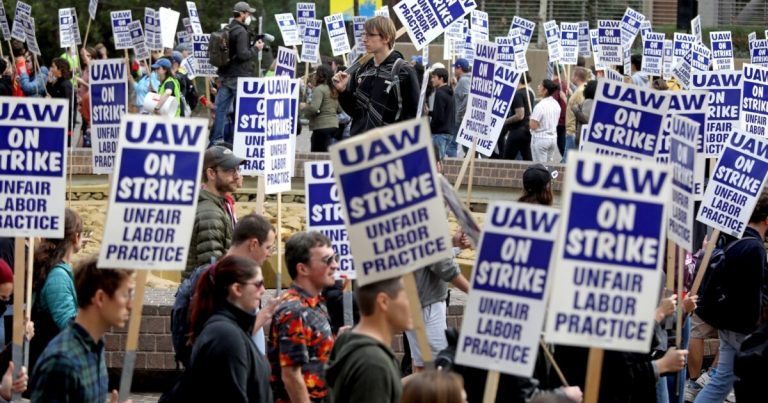
The Bureau of Labor Statistics released its annual union membership report January 19. The report shows a nationwide decline in the percentage of wage and salary workers who are union members, from 10.3% in 2021 to 10.1% in 2022 — the lowest union membership rate on record since comparable data was first collected in 1983, when the union membership rate was 20.1%, according to the Bureau of Labor Statistics (BLS). But the annual report, compiled with the use of the Current Population Survey, leaves out what some labor advocates say is a critical piece of information: evidence suggests an estimated 60 million workers would vote to join a union if they could. “The fact that tens of millions of workers want to join a union and can’t is a glaring testament to how broken U.S. labor law is,” the Economic Policy Institute asserts in response to the BLS report. “It is urgent that Congress pass the Protecting the Right to Organize (PRO) Act and the Public Service Freedom to Negotiate Act. State legislatures must also take available measures to boost unionization and collective bargaining.”

Ballots Out In UAW Presidential Run-Off

The election pits challenger Shawn Fain, an electrician from Kokomo, Indiana, and an international rep, against incumbent president Ray Curry. The 400,000-member union represents workers at the Big Three auto plants, auto parts factories, and other sectors including heavy equipment manufacturing and higher education. Curry picked up 38.2 percent in the first round of voting late last year, to Fain’s 37.6 percent. Three other candidates split the rest. Since no candidate received a majority, the election went to a run-off. Fain’s Members United slate notes that 62 percent of voters picked candidates other than the incumbent. Fain has pledged to build a fighting union that will take on the big auto companies and reverse decades of concessions, while Curry has emphasized his experience in leading the union; he was appointed president by the Executive Board in 2021 after being elected secretary-treasurer in 2018.

South Korea’s Yoon Launches Vicious Attack On Unions, Peace Groups

In scenes reminiscent of South Korea’s authoritarian past, South Korea’s National Intelligence Service – the successor to the once-dreaded KCIA – raided the headquarters of the country’s second-largest and most militant labor federation on Wednesday morning. Korean and foreign press services reported that the NIS and the National Policy Agency stormed the offices of the Korean Confederation of Trade Unions (KCTU) and the KCTU-affiliated Korean Health and Medical Workers’ Union in Seoul. They are being charged with violating the anti-communist National Security Law by receiving orders from North Korea, possibly as spies, according to Kiji Noh, a U.S. journalist and peace activist who closely follows South Korean politics. In a related action just south of the Korean mainland, South Korea’s security forces also raided a “peace shelter” on Jeju Island that is dedicated to remembering the *Sewol*, a passenger ferry that capsized off the coast of southern Korea in April 2014 while en route to Jeju.

Mexico: Battleground For Independent Union’s First Contract Fight

Piedras Negras, Coahuila, Mexico - In the Mexican border city of Piedras Negras, Coahuila, auto parts workers are throwing down yet again against their employer, Michigan-based VU Manufacturing, and its chosen union, the Confederation of Mexican Workers (CTM). Last August, VU workers voted to form an independent union, the Mexican Workers’ League (la Liga), defeating management’s effort to impose an employer-friendly union affiliated with the CTM. After a union wins an election, Mexican labor law grants six months to bargain a contract. In the League’s case, the timetable runs through March 6. Bargaining a new contract usually takes about two months, say Mexican labor activists. At GM Silao, workers negotiated a new contract last May, three months after voting in a new union. But workers say VU Manufacturing has renewed its campaign to bust the independent union.

Nickelodeon Voluntarily Recognizes Production Workers Union

The Animation Guild has succeeded in procuring voluntary recognition for a group of unionizing production workers at Nickelodeon Animation Studios. About a month after the IATSE local filed for a National Labor Relations Board election, Nickelodeon has chosen to bypass that process by agreeing to recognize a bargaining unit of 177 workers — including production coordinators, production managers, asset production coordinators and others. This will amount to “the largest bargaining unit of production workers to organize under The Animation Guild” so far, TAG said in its announcement Tuesday. Nickelodeon confirmed the news as well. The production workers’ next step will be to negotiate a contract with Nickelodeon, for which no date has yet been set. More than 400 Nickelodeon Animation Studios artists are already unionized with TAG, and select production worker staff will soon be added to the guild’s studio-specific negotiations committee.

Rail Workers Are Fighting On After Biden Blocked A National Strike

While the high-stakes labor dispute on U.S. freight railroads has receded from headlines since President Joe Biden and Congress imposed a new contract last month, rail workers are continuing their fight for dignity and better conditions — albeit without the threat of a national strike on the table. “The American people should know that while this round of collective bargaining is over, the underlying issues facing the workforce and rail customers remain,” the AFL-CIO Transportation Trades Department said in a statement. The major underlying issue remains precision scheduled railroading (PSR), the business model adopted in recent years by Class I rail carriers like Union Pacific, BNSF, Norfolk Southern and CSX. Designed to maximize shareholder profits by cutting costs to the bone, PSR has been blamed for a dramatic reduction in the freight rail workforce, increased supply-chain congestion and deteriorating safety — all while investors rake in record profits.

Striking Workers From A Homelessness Charity Beat Their Tight-Fisted Bosses

Workers from the homelessness charity Shelter have won their battle against the bosses. Unite the Union, which organises Shelter workers, said they had won a “vastly improved pay offer” following effective strike action. In addition, a one-off payout was also prised out of the bosses. A statement on the Unite website announced: During the strike action talks were held at the conciliation service Acas and an improved pay offer was made. The revised offer was for an increase in pay of seven per cent, which was more than double the three per cent the workers had previously been offered. And added that: In addition, the workers will each receive a one off payment of £1,250. Following a ballot of members, the new offer was accepted. Unite’s general secretary Sharon Graham commended the workers. She said this was more evidence that trade unionism delivered for workers in concrete terms: This was a significant result, our members were prepared to stand together in unity and by doing so were able to secure a greatly improved pay increase.This is further proof of how Unite’s unflinching focus on jobs, pay and conditions is delivering substantial financial benefits for its members.

New Zealand’s New Sectoral Bargaining Law Holds Lessons For US

In one of the more important advances in collective bargaining around the world, New Zealand recently passed an innovative sectoral bargaining policy, called Fair Pay Agreements. Labor supporters in Britain and Australia want to replicate elements of the policy in their countries, while for American audiences the most important lesson may be how New Zealand’s experiences highlight that sectoral bargaining — in conjunction with worksite bargaining — is necessary to improve working conditions in today’s economy and thus should be part of policy efforts to strengthen unions. Sectoral bargaining, sometimes called broad-based bargaining or industrywide bargaining, is a type of collective bargaining between unions and employers that sets minimum standards on issues such as wages, benefits, safety, and training for all workers in a sector or occupation.

The Supreme Court Could Gut The Right To Strike

The Supreme Court heard oral arguments January 10 in Glacier Northwest Inc. v. International Brotherhood of Teamsters Local Union No. 174, a court case that labor advocates say threatens the right to strike. “The ability to withhold your labor is the one powerful tool throughout the history of unionization that has ensured workers can improve their working conditions,” Teamsters General President Sean M. O’Brien offered in a statement issued the same day. “This right is now on trial at the Supreme Court,” O’Brien said, calling on the court to affirm the rulings of lower courts. Noel J. Francisco, the Jones Day attorney representing Glacier Northwest, did not respond to a request for comment. C.M. Lewis, working for In These Times, interviewed Kate Bronfenbrenner, director of labor education research and a senior lecturer at Cornell University’s School of Industrial and Labor Relations about the potential labor implications of the case.

Virginia Transit Strikers Fight Privatized Race To The Bottom

Loudoun County, Virginia - Around 130 workers who operate, fix, and dispatch buses in Loudoun County, Virginia, went on strike Wednesday morning. They’re up against Keolis, a French multinational and one of the largest private operators of public transit systems in the U.S. The company has challenged the union’s right to strike, its right to a contract, and even its existence. The Loudoun County workers join a movement of bus operators, mechanics, dispatchers, and call center operators striking around greater Washington, D.C. It’s the eighth transit job action in the region in just over three years. Hundreds of strikers have faced down major private contractors—not only Keolis but also Transdev, MV Transportation, and RATP Dev. For Amalgamated Transit Union Local 689, these fights are not just over bad behavior from this or that private operator, they’re about whether buses should be a public service or a source of private profit.

The Higher Education Labor Movement Runs Full Speed Ahead Into 2023

At the end of 2022, workers in higher education had their eyes turned toward the weeks-long strikes at the University of California (UC) and The New School. These strikes were among the largest and longest that higher education in the U.S. has ever seen. In California, the striking unions represented about 48,000 workers. While the total number of striking faculty at The New School in New York was much smaller, they represented 87 percent of all teaching faculty at the university, showing the power of what a near-total shutdown of classes can do. These strikes are part of a much bigger trend in the higher education labor movement, which has grown significantly in the last decade, with 144 new private sector faculty and/or graduate student bargaining units forming just between 2013 and 2019, and many more filing for elections in the public sector and in the years since then.

The French Working Class Organizes To Defeat Macron’s Pension Reforms

On January 10, all the major trade unions in France gave a joint call for protests against the proposals for pension reforms announced by the Emmanuel Macron-led government. The unions, including the General Confederation of Labor (CGT), the French Democratic Confederation of Labor (CFDT), Workers’ Force (FO), the French Confederation of Christian Workers (CFTC), the French Confederation of Management—General Confederation of Executives (CFE-CGC), the National Union of Autonomous Trade Unions (UNSA), Fédération syndicale unitaire (FSU), and Solidaires, have called for a general strike and nationwide protest mobilization on January 19. The left-wing coalition Nouvelle Union Populaire Écologique et Sociale (NUPES) composed of the La France Insoumise (LFI), French Communist Party (PCF), and others also oppose the reforms and have extended support to the protests.

New Anti-Union Law In UK Takes Aim At Strike Wave

The Tory government in the UK under Prime Minister Rishi Sunak is mulling new anti-strike legislation that aims to crack down on the growing worker unrest spreading throughout the country. Faced with a historic cost-of-living crisis, workers across the UK made 2022 the busiest year for strikes and worker actions since the 1980s. The National Union of Rail, Maritime and Transport Workers (RMT) have been at the forefront of Britain’s strike wave, as TRNN previously reported. They have been joined by countless workers across multiple industries, from university lecturers to mail carriers. The new anti-strike law in Parliament would force workers to cross their own picket lines to uphold a standard of “minimum service” while striking, effectively squashing the ability of workers to withhold their labor.

Fort Worth Journalists Win Only Newspaper Union Contract In Texas

On the heels of an unprecedented 24-day labor strike late last year, around 20 journalists at the 117-year-old Fort Worth Star-Telegram have ratified the only union contract at a Texas newspaper. The union victory comes after more than two years of difficult negotiations and forms part of a surge in nationwide newsroom organizing since the mid-2010s as journalists have increasingly fought back against corporate predation in a struggling industry. Workers at two other Texas papers, in Dallas and Austin, are still bargaining for union contracts after roughly two years. Before launching the labor strike on November 28—likely the first open-ended newsroom work stoppage in Texas history—Kaley Johnson, a justice reporter at the Star-Telegram and vice president of the paper’s union, the Fort Worth NewsGuild, said negotiations were largely stuck in the mud.
assetto corsa mods

Urgent End Of Year Fundraising Campaign

Online donations are back! Keep independent media alive. 

Due to the attacks on our fiscal sponsor, we were unable to raise funds online for nearly two years.  As the bills pile up, your help is needed now to cover the monthly costs of operating Popular Resistance.

Urgent End Of Year Fundraising Campaign

Online donations are back! 

Keep independent media alive. 

Due to the attacks on our fiscal sponsor, we were unable to raise funds online for nearly two years.  As the bills pile up, your help is needed now to cover the monthly costs of operating Popular Resistance.

Sign Up To Our Daily Digest

Independent media outlets are being suppressed and dropped by corporations like Google, Facebook and Twitter. Sign up for our daily email digest before it’s too late so you don’t miss the latest movement news.